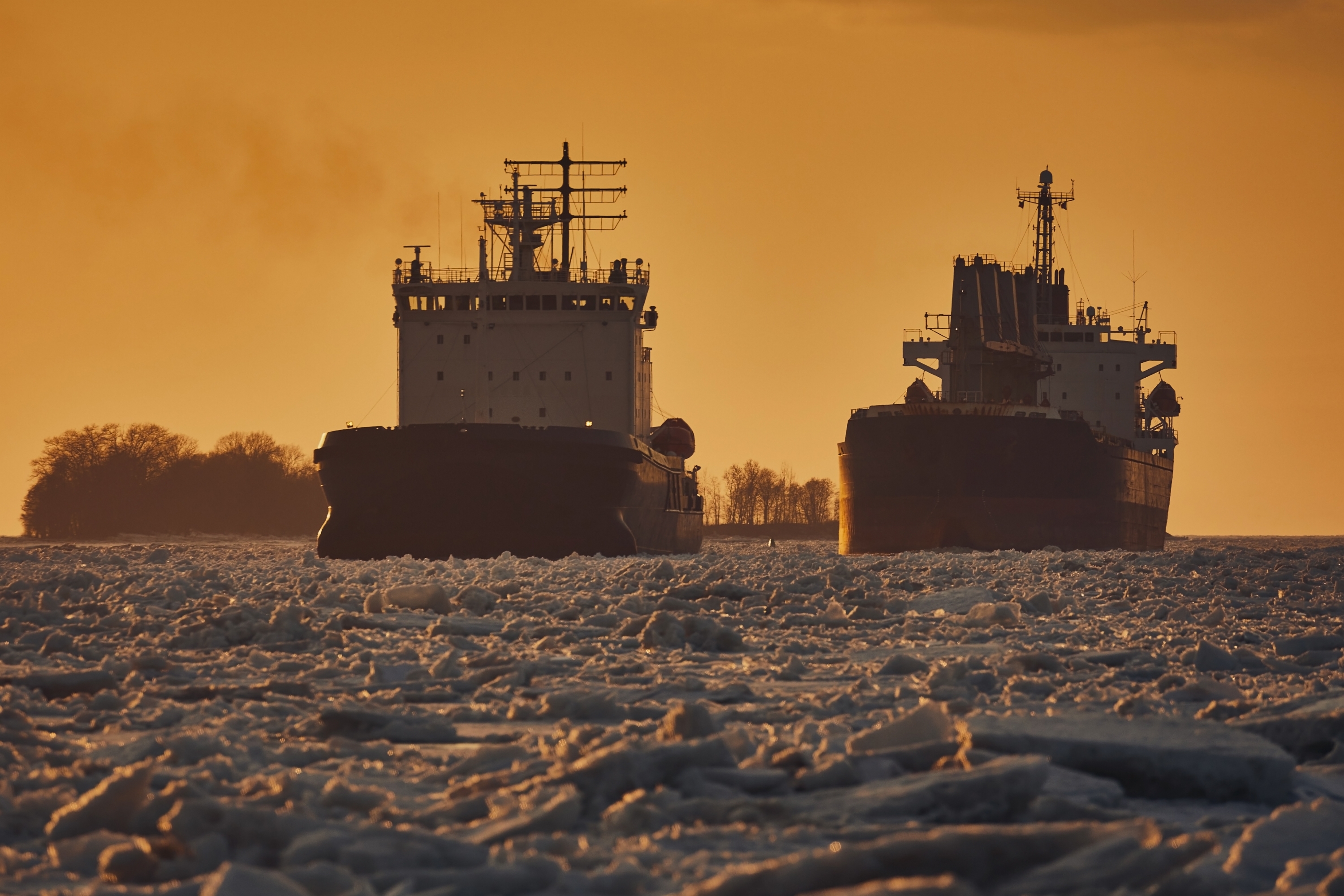
In 2018, Danish ship Venta Maersk completed its maiden voyage from Southeast Asia to Europe through the Arctic. Stocked up with frozen fish from Russia and electronics from South Korea, Venta Maersk was the first container ship to successfully traverse the Northeast Passage.
This bitter cold route through the Arctic, known as the Northern Sea Route, or the NSR, is a long-lived dream of European traders. In the 16th and 17th centuries, explorers hoped to find a shorter way to ancient China to return home with fine silk, porcelain, and other riches. Using the NSR would cut the travel distance by up to 35%. But it wasn’t until 1878 that the first sailor, Finnish-Swedish Adolf Nordenskiöld, actually managed to complete the passage. By then, investors realized that the NSR was too dangerous and unsuitable for commercial shipping.
That was until global warming began its destruction of the ice masses in the Arctic. In 2018, the Copenhagen Business School projected that the NSR may become economically feasible and competitive by 2040, which would mark the beginning of large-scale international shipping. An optimist might say that it will never come this far if governments keep their pledges to reduce emissions, but a study from last year confirmed that the Arctic waterways will become seasonally ice-free “by mid-century under all but the most aggressive of emissions control scenarios” (Lynch, Norchi & Li, 2022). Therefore, whether we like it or not, we should think about how this reality will impact international shipping and geopolitical relations.
Great Powers on Thin Ice
Russia hopes that the NSR can provide a new source of revenue as the oil and gas industry dwindles. It’s investing greatly in harbors, infrastructure, and ice-breakers to support ships traversing the passage. At the same time, Russia is securing its control over the route by building up its military presence in the region. China has also taken an interest in the High North and has rebranded itself as a “near-Arctic state,” considering itself to be a major stakeholder in the region. The West, on the other hand, has a more ambiguous and passive stance towards the NSR, even though it is a historical and natural stakeholder in the Arctic.
The United States has legal disputes with Russia and Canada, each claiming portions of the Northeast and Northwest Passages within their internal waters. The US and the EU wish to guarantee freedom of passage by having these waterways established as “international straits.” But the fact is that any ship traversing the NSR practically depends on Russian infrastructure and Russian icebreakers to complete its journey. Recognizing the NSR as an international strait would do little to remove this dependency on Russia.
Moreover, the ice-breaking capabilities of the US Navy are too limited to project power and enforce freedom of navigation like in the Pacific. Unfortunately, the Arctic was never as high on the agenda. The Trump administration brought the region back into focus, eyeing on the Arctic’s natural resources. Mr. Trump’s awkward attempt at buying Greenland from Denmark, however, only highlighted the United States’ relatively weak position in the High North. The Biden administration, although with more concern for environmental issues, continued with a confrontational Arctic strategy. The United States views the Arctic as a potential security threat, which is why its policy is aimed at military deterrence, maintaining the political status quo, and perhaps even preventing the development of trade routes (Pincus, 2020).
China on the other hand is highly interested in the Russian Arctic and even embraced the NSR as their “Polar Silk Road.” But the Sino-Russian alliance isn’t as sturdy as it seems. Russia is very distrustful of China’s presence in the Arctic. In 2012, the Russians prohibited Chinese research vessels from operating along the Arctic coast. A year later, Russia voted against China’s application for observer’s status on the Arctic Council. Despite the grand rhetoric about Sino-Russian cooperation, few Chinese investments have actually been realized in the Arctic (Pincus, 2020). The partnership between the two countries did get a boost after Russia’s invasion of Ukraine. Russia suffers under Western sanctions and China seizes this opportunity to buy up Russian oil and gas and make advantageous investments.
Beyond Great Power Rivalry
We shouldn’t look at the NSR as merely a chess piece in great power games. It’s not just Russia and China that stand to gain from the opening of the Arctic. In fact, the Northern Sea Route will benefit Western countries just as much, if not more. According to a recent study, Japan ranks as the number one beneficiary, followed by South Korea (Sur & Kim, 2020). China comes in at only the third place. In Europe, The Netherlands, Germany, and the United Kingdom would also benefit from the shorter trade route.
According to Filip Medunic from the European Council on Foreign Relations, maritime choke points will be increasingly weaponized by states. Russian control over the Northeast Passage gives Russia the opportunity to exploit it. Since the war in Ukraine, Russia has not been afraid to use its economic assets as leverage. However, cutting gas supplies isn’t the same as blocking international shipping. How useful would that really be for Russia? Doing so would hurt not only Europe but also China, an ally Russia cannot afford to lose.
The United States would rather not see China obtaining another trade link with Europe, but the EU has no desire for abrupt “decoupling” from China. Instead, the West agreed on a policy of “de-risking” by diversifying global supply chains. The opening of the NSR can perfectly fit this strategy. The blockage of the Suez Canal by containership the Ever Given in 2021 demonstrated that the current shipping route has its own choke points and vulnerabilities. The NSR can provide a secondary, shorter route from Europe to Southeast Asia. This will boost the economies of Northern Europe, Japan, and South Korea before that of China. It would also make the economy of the EU more resilient.
The war in Ukraine has politically and economically refrozen the Arctic. Diplomacy became non-existent, European investors pulled out, and shipping activity dropped. Sadly, this won’t prevent the sea ice from melting and somewhere in the coming decades, commercial shipping in the Arctic will become viable. Considering the high certainty of this scenario, the West should start thinking about its own position in the future. Beyond the geopolitical rivalry of the US, Russia, and China, the Northern Sea Route offers interesting prospects for Europe, Japan, and South Korea.

Bart van der Wal is an exchange student from The Netherlands. He is majoring in history at Utrecht University with a specialization in globalization and world order. Bart followed a minor in American Studies at the University of Amsterdam and is now on a year-long exchange at Binghamton University, where he takes classes in history and political science. He is especially interested in transatlantic relations and international conflicts. In the near future, Bart will be pursuing a master’s degree in International Relations.
References
Lynch, Amanda H., Norchi, Charles H. & Li, Xueke. “The interaction of ice and law in Arctic marine accessibility.” Proceedings of the national academy of sciences 119, no. 26 (2022).
Medunic, Filip. “A glimpse of the future: The Ever Given and the weaponization of choke-points.” European Council on Foreign Relations. April 23, 2021. https://ecfr.eu/article/a-glimpse-of-the-future-the-ever-given-and-the-weaponisation-of-choke-points/.
Pincus, Rebecca. “Three-Way Power Dynamics in the Arctic.” Strategic Studies Quarterly 14 (2020), 40-63.
Sur, Ji Min & Kim, Dong Jin. “Multi criteria evaluation of beneficial effect of commercializing Northern Sea Route on Europe and Asia countries.” The Asian Journal of Shipping and Logistics 36, no. 4 (2020), 193-201.

 Happy Medium
You must be logged in to post a comment.