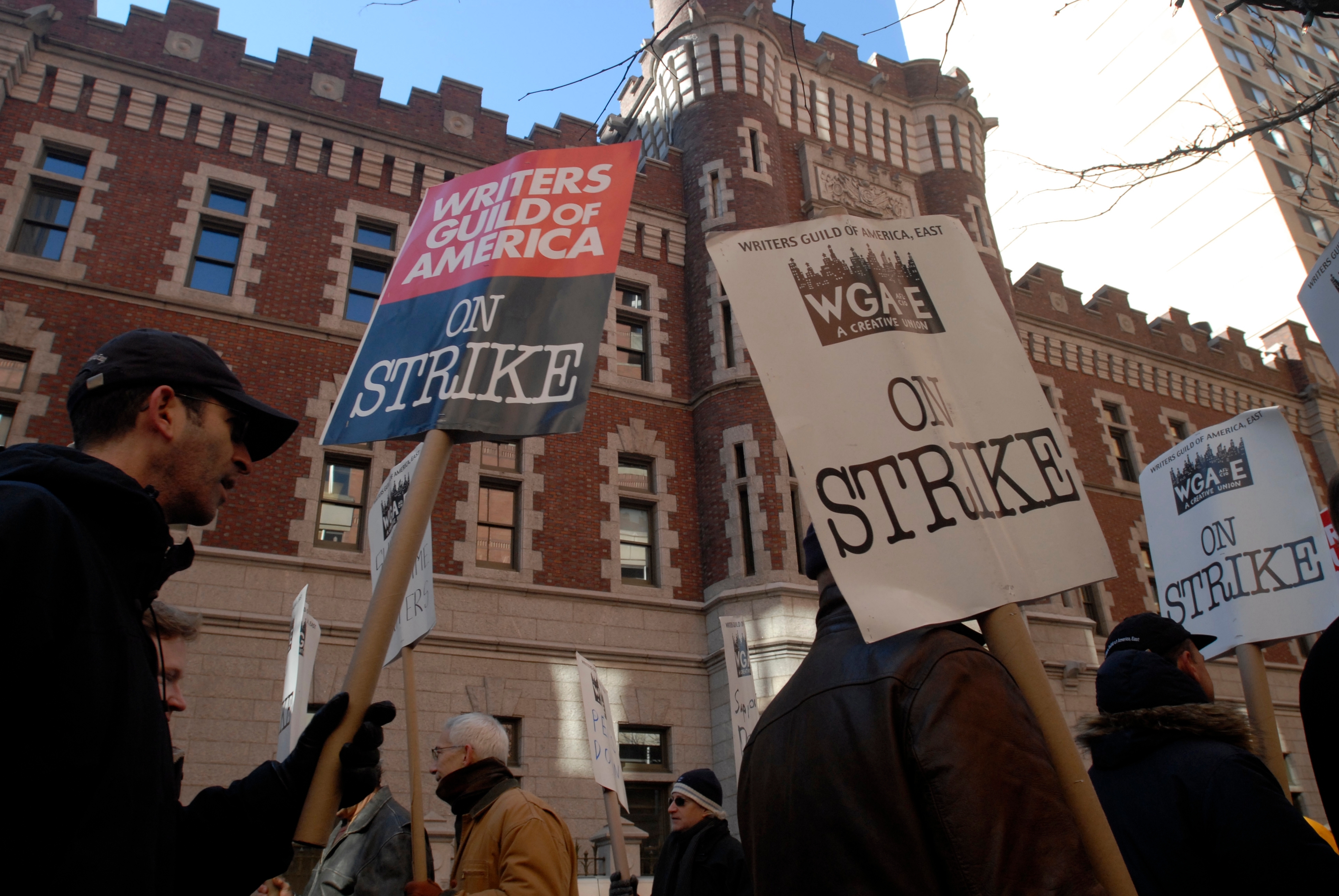
On May 1, 2023, the Writers Guild of America (WGA) announced that it couldn’t reach an agreement with the Alliance of Motion Picture and Television Producers (AMPTP). Thus, beginning at 12:01a.m. PT on May 2, the WGA officially went on strike.
The Original Demands
Four of the most crucial WGA demands, which were emphasized by union members, include: (1) an increase in minimum rates, (2) viewership-compensation for streaming residuals, (3) preserving the writers’ room and duration of employment and (4) addressing concerns regarding artificial intelligence.
Minimum Rates
These demands stem from the fact that a career in television and film writing has grown to be no longer sustainable. Adjusting for inflation, most writers are making less than they were ten years ago. According to the Associated Press, “Accounting for inflation, writer pay has declined 14% in the last five years. The median weekly writer-producer pay is down 23% over the last decade, with inflation factored in.” Many writers have been forced to find second jobs.
Caroline Kwan is a WGA and SAG-AFTRA member who also livestreams daily on Twitch. Throughout the strike, Kwan informed her over 2,000 concurrent viewers about why the strike happened, any updates that occurred, and would even stream going to picket lines in Los Angeles. “Everybody looks at the WGA and is like ‘you guys are just whining about not being super rich,’” Kwan said on a stream from a WGA rally. “But that’s not the case at all. So many people are having to work a second job in something that should be just, your only job.”
Streaming Residuals
Streaming residuals are an issue that significantly contributed to both the WGA and SAG-AFTRA strike. Briefly, residuals are payments writers and actors receive for a television show or movie after it originally premiered. The way people consume content has drastically changed over the past decade. With the rise of platforms like Netflix, Hulu, Max and numerous others, fewer people are watching broadcast and cable television in favor of streaming. In July 2022, streaming outperformed both the traditional forms of television, cable and broadcast (Davis 2022). However, the way writers’ and actors’ residuals are calculated has not caught up with the dominance of streaming.
Residuals are much lower than they used to be. While residuals from cable reruns are based on the amount of times the episode or movie is aired and viewed, streaming residuals are based on the number of subscribers the streaming service has (Anders 2023). No matter how many times a show is viewed on a streaming service, the writers and actors are paid a flat fee. A writer for the fourth season of Stranger Things, which crossed 1.35 billion hours viewed in its first 28 days on Netflix, would receive the same amount of residuals as a writer for a much less successful show (Dellatto 2022).
Fighting Against Mini Rooms
Over the past several years, studios have been aiming to shift how a television show is written. One example of this is the increased use of mini rooms. A traditional writers’ room usually consists of seven or eight writers while a mini room contains only two or three writers. For a show in development, along with the pilot episode, writers in a mini room will also typically have to write a number of additional scripts for the same rate—even before the show is greenlit. Networks or streaming services may also establish a mini room and request scripts for an ongoing show to determine if it should be renewed (Maas et al. 2023). One of the biggest issues with this model is that if the show is not picked up or renewed, the writers would have wasted eight to ten weeks of their time, during which they turned down other jobs. Moreover, even if the series gets ordered, the mini room writers will often not be involved in the production or post-production of the show.
The WGA asserted that the increased separation of writing and production has hindered any possibility of growth for new writers. In addition to the fact that mini room writers are paid less, new writers will not get the experience and mentorship of working throughout the production process. Without that experience, young writers would struggle to eventually advance to showrunners. Furthermore, in the past, writers were always involved throughout production.
Kwan goes on to illustrate the implications for writers with this separation by explaining how the final version of scripts goes through extensive changes before use on set, leaving writers limited in their involvement outside of the writing room. “Sometimes they’re over budget so they have to consolidate. Sometimes actors are like ‘this isn’t working with my character.’ So writing is happening from start to finish throughout the entire production and post production.”
Artificial Intelligence
With the rise of sophisticated artificial intelligence (AI) tools such as ChatGPT, another major concern of the WGA regards AI and regulating its use. Many writers fear that studios and production companies will seek to use AI in order to save money or use AI to completely write a script, then hire a real writer to revise it. Reuters reported in August that before the strike started, Disney “created a task force to study artificial intelligence and how it can be applied across the entertainment conglomerate, even as Hollywood writers and actors battle to limit the industry’s exploitation of the technology,” (Chmielewski and Hu 2023). Just two months prior to this report, Disney sparked controversy when it used AI to generate the opening credits of the Marvel Disney+ show Secret Invasion.
“It’s not so much about what AI is going to do, but what companies are going to use AI to justify,” Sarah Myers West, the Managing Director of AI Now Institute told Time. “They could use AI to create a first draft and then bring in someone else to do a second draft. And that devalues their work by not having them do that whole process.”
Public Opinion
Even outside of the industry, the Union has always had support from across political parties. Polling released by Rob Todaro and Lew Blank from Data for Progress found that a majority of likely voters supported both the WGA and SAG-AFTRA, with 67% of likely voters in support of strikes and only 18% opposed. Even among those polled who held an unfavorable opinion of labor unions, a plurality (48%) supported the strikes.
Additionally, 59% of voters say they have an unfavorable opinion of the major Hollywood studios after learning that they rejected the demands of the WGA and SAG-AFTRA. The studios’ favorability also took a hit when insider studio executives told Deadline in July that they planned to “break the WGA.”
“The endgame is to allow things to drag on until union members start losing their apartments and losing their houses,” (Patten 2023).
International Support
Support for the WGA goes beyond those in the United States. When the strike began, the Writers’ Guild of Great Britain (WGGB) informed its members that they were not to accept work on United States productions for the duration of the strike, and in doing so actors would be considered crossing the picket line and subsequently blacklisted (Goldbart 2023). The Writers Guild of Ireland (WGI) also recommended to its members that they show the same solidarity in not accepting work from an American company.
Additionally, June 14 marked the International Day of Solidarity for the strike, branded as “Screenwriters Everywhere,” which was organized by the Federation of Screenwriters in Europe, International Affiliation of Writers Guilds, and UNI Global Union; combined, these organizations represent roughly 67,000 film and TV writers worldwide (Veltman 2023). Events were held in numerous countries, including Argentina, Belgium, Colombia and more. The general delegate of La Guilde des Scenaristes Marie Roussin spoke at an event in Paris about how the issues the WGA faces in the United States are also felt internationally.
“We’re not yet seeing so many French producers using AI but we need to be prepared for it because it’s coming,” Roussin said. “We don’t want them to start offering screenwriters €1000 [$1083] to rework six episodes written by an AI app. The WGA is fighting so that writers will get credited and paid for their scripts even when AI is involved, and we want to do the same in France,” (Keslassy et al. 2023).
The Historic Deal
On Sept. 24, the WGA announced that a tentative agreement was reached, writing in an email to members that the deal is “exceptional—with meaningful gains and protections for writers in every sector of the membership.” The strike officially ended at 12:01a.m., PT on Sept. 27 after 148 days. In each of the key demands, the WGA made remarkable gains.
Minimum Rates
At the beginning of negotiations, the WGA proposed annual increases over the next three years of 6%-5%-5% for all minimums including residual bases. The AMPTP offered 4%-3%-2% and a one-time increase to most residual bases of 2% or 2.5%. In the tentative agreement, the WGA secured increases of 5%-4%-3.5% for most minimums (WGA 2023).
Residuals
While the AMPTP initially refused to even discuss the notion of performance-based residuals and more transparency regarding program viewership, it eventually relented on the issue. For a movie or series that is viewed by 20 percent or more of a platform’s domestic subscribers in the first 90 days, or during a 90-day window in a new calendar year, writers will receive “a bonus equal to 50% of the fixed domestic and foreign residual.” As for streaming data transparency, the AMPTP agreed “to provide the Guild, subject to a confidentiality agreement, the total number of hours streamed, both domestically and internationally, of self-produced high budget streaming programs (e.g., a Netflix original series),” who can then share aggregated information (WGA 2023).
Fighting Against Mini Rooms
On the issues of both preserving the writers’ room and the duration of employment, the AMPTP rejected the WGA’s original proposals and refused to make counter offers. However, an agreement was eventually reached. With the new deal, a show in development that has more than three writers will require a minimum staff of three writer-producers that are guaranteed at least ten consecutive weeks of work. A post-greenlight writing room will have minimum staff requirements based on the episode order, unless a single writer is employed to write all episodes of a season. Writers in post-greenlight rooms will be guaranteed either at least 20 weeks of work or the duration of the post-greenlight room, whichever is shorter. Additionally, two writer-producers, along with the showrunner, must be hired “for the lesser of 20 weeks or the duration of production,” (WGA 2023).
Artificial Intelligence
The WGA originally demanded the regulation of AI, that AI cannot write or rewrite literary material, be used to generate source material and that AI cannot be trained using contract-covered material. The AMPTP rejected this proposal, instead offering annual meetings to discuss advancements in technology. In the end, the WGA scored big protections against AI. The new agreement establishes that “AI-generated written material is not considered literary material, source material or assigned material.” Moreover, while writers can choose to use AI as a tool with the production company’s consent, the company cannot require the use of AI software such as ChatGPT. Although the new deal does use vague language regarding training AI using contract-covered material, it asserts, “Guild reserves right to assert that exploitation of writers’ material to train AI is prohibited by MBA or other law,” (WGA 2023).
Conclusion
The WGA Strike of 2023 will undoubtedly be remembered for many years to come. Not only did the union achieve improvements for American writers, but the outcome of the deal will be felt across the country.
“I really want to take a moment and relish in the success of the strike and the fact that we won,” Kwan said in a stream after the end of the strike. “This will have an effect on SAG-AFTRA, on IATSE, on other unions who are on strike or thinking about going on strike. This absolutely will have an effect with UAW, these things work as a domino effect. So it’s a big deal. It’s not to be taken lightly but there are other aspects of this industry that are very worrisome and are problems that need to be addressed yesterday.”

Ashley Pickus is a senior from Plainview, New York. She is double-majoring in political science and English rhetoric and minoring in writing studies. Ashley spends most of her free time following the current pop culture trends, watching television shows, or listening to music. If asked, she can explain the meaning of any Taylor Swift song and its significance. After graduation, Ashley hopes to find a job in the media industry.
References
Anders, Caroline. 2023. “Residuals are a key issue for Hollywood strikers. Here’s how they work.” Washington Post, July 15. https://www.washingtonpost.com/lifestyle/2023/07/15/actors-strike-what-are-residuals/.
Associated Press. 2023. “What do striking Hollywood writers want? A look at demands.” AP News, May 3. https://apnews.com/article/wga-writers-strike-demands-d403f5b4666f20e2ce3e379bcaef5f2a.
Chmielewski, Dawn and Krystal Hu. 2023. “Disney creates task force to explore AI and cut costs – sources.” Reuters, August 10. https://www.reuters.com/technology/disney-creates-task-force-explore-ai-cut-costs-sources-2023-08-08/.
Davis, Wynne. 2022. “Streaming outperforms both cable and broadcast TV for the first time ever.” NPR, August 18. https://www.npr.org/2022/08/18/1118203023/streaming-cable-broadcast-tv.
Dellatto, Marisa. 2022. “Netflix’s ‘Wednesday’ Surpasses ‘Stranger Things 4’ As Most-Watched English-Language Series In A Week.” Forbes, November 30. https://www.forbes.com/sites/marisadellatto/2022/11/29/netflixs-wednesday-surpasses-stranger-things-4-as-most-watched-english-series-in-a-week/?sh=21ebaa55dfd9.
Goldbart, Max. 2023. “UK Writers Guild Expresses Solidarity With WGA & Tells Members Not To Work On U.S. Projects For Strike Duration.” Deadline, May 2. https://deadline.com/2023/05/writers-guild-uk-wggb-solidarity-ban-non-members-1235353404/.
Keslassy, Elsa, K.J. Yossman and Manori Ravindran. 2023. “Charlie Brooker, Jesse Armstrong, Russell T Davies Turn Out to Support Global WGA Day of Solidarity.” Variety, June 14. https://variety.com/2023/biz/global/writers-strike-wga-international-solidarity-1235643165/.
Kwan, Caroline. 2023. “IRL WRITERS STRIKE MARCH TO RALLY!” Twitch, June 21. https://www.twitch.tv/videos/1886800600
Kwan, Caroline. 2023. “news! reacts! my brain is dying! hello!” Twitch, September 27. https://www.twitch.tv/videos/1936947183.
Maas, Jennifer, Joe Otterson and Michael Schneider. 2023. “One of the Writers Guild’s Biggest Contract Negotiation Issues Is the ‘Mini Room’ Boom.” Variety, March 29. https://variety.com/2023/tv/news/writers-guild-contract-negotiation-mini-room-1235568173/.
Patten, Dominic. 2023. “Hollywood Studios’ WGA Strike Endgame Is To Let Writers Go Broke Before Resuming Talks In Fall.” Deadline, July 11. https://deadline.com/2023/07/writers-strike-hollywood-studios-deal-fight-wga-actors-1235434335/.
Shah, Simmone. 2023. “The Writers Strike Is Taking a Stand on AI.” Time, May 4. https://time.com/6277158/writers-strike-ai-wga-screenwriting/.
Todaro, Rob and Lew Blank. 2023. “A Majority of Voters Support the WGA and SAG-AFTRA Strikes, Overwhelmingly Agree With Key Demands.” Data for Progress, August 18. https://www.dataforprogress.org/blog/2023/8/17/a-majority-of-voters-support-the-wga-and-sag-aftra-strikes.
Veltman, Chloe. 2023. “International screenwriters organize ‘Day of Solidarity’ supporting Hollywood writers.” NPR, June 14. https://www.npr.org/2023/06/14/1181981582/international-screenwriters-organize-day-of-solidarity-supporting-hollywood-writ.
WGA. 2023. “What We Won.” WGAContract2023, September 27. https://www.wgacontract2023.org/the-campaign/what-we-won.

 Happy Medium
You must be logged in to post a comment.