By Hatim Husainy, Sustainability
A single, undeniable fact looms large in the political sphere—the world is warming. Each passing year pushes the planet closer to a potential climate catastrophe, the threat of which has grown to dominate the past four presidential terms and now demands immediate action. The differing approaches of presidential administrations and their subsequent consequences are quite complex. To better understand broader climate policy, we can look at the changes in U.S policy on a specific issue.
We can analyze fracking policy’s relationship to broader environmental policy to see how different administrations approach the complicated balance of energy independence and carbon emissions reduction. Hydraulic fracturing, or fracking, is a method of extracting oil and natural gas by digging deep wells and injecting liquid into them at high pressure. This process is particularly productive when combined with horizontal drilling and has been used to extract an abundance of natural gas from shale deposits across the United States. The extraction of natural gas and oil are controversial because the burning of fossil fuels is largely responsible for climate change (Nelsen 2024). Fracking is itself controversial for a variety of reasons. One being that the pressurized liquid can leak into the nearby groundwater. Additionally, an investigation by Environmental Health News uncovered a range of negative health externalities: “researchers found that babies born near frequent flaring—the burning off of excess natural gas from fracking wells—are 50 percent more likely to be premature. In Colorado, … people living near fracking sites face an elevated risk of nosebleeds, headaches, breathing trouble, and dizziness. In Pennsylvania, … people living near fracking face increased rates of infant mortality, depression, and hospitalizations for skin and urinary issues”(Marusic 2021).
The US government’s regulatory structures can dramatically increase or decrease our country’s carbon footprint. The way policies have changed over time can demonstrate the effectiveness of different techniques, and show us the path forward.
Former President Barack Obama’s administration was one of the first in which climate change became an important part of a president’s agenda, and is when the government took some of its first significant steps to slow the warming. He was critical in getting the United States to sign the Paris Climate Agreement (Somnader 2016). This international framework placed the responsibility on countries to cut their emissions in half by 2030 and implement a series of new agencies to assist in the transition (United Nations 2016). His Clean Power Plan was projected to move the country more than halfway to its climate goals before Former President Trump repealed it. Notably, the law was set to go into its enforcement phase in 2022, indicating the speed at which the Obama administration intended to address this issue (NRDC 2017). His rules and regulations on new fracking technology were mainly about transparency concerning the extraction liquid, which environmental groups condemned for being too weak, and energy companies for being too strong (Plumer 2015).
In most policy arenas, Trump’s presidency can be understood as a reaction to and a reversal of the Obama administration. His fracking policy was one aggressively in favor of the practice– he dismantled all of the transparency policies put in place by President Obama and by the end of his presidency, the Trump Administration proudly proclaimed that the US was “the world’s leading producer of both oil and natural gas.” Much of his justification for this hinged on the incredible profitability of natural gas—“[Trump’s] Council of Economic Advisers estimated that fracking and other innovations had reduced energy prices and saved Americans $203 billion per year, or $2,500 each year for a family of four” (Trump White House 2020). Notably, Trump-era deregulation within and outside of fracking led to an estimated 1.8 billion cubic tons more in carbon dioxide emissions throughout his administration, despite many states establishing strong climate policies within their jurisdictions (Pitt et al. 2020).
The Biden Administration, in contrast, was one of the first-ever successful presidential campaigns to center climate policy in its campaign, which later became realized through targeted measures. The Inflation Reduction Act constituted a massive investment in achieving climate goals and is considered the most significant investment in fighting climate change by the United States thus far (Lashof 2024). In other ways, the Biden administration failed to counteract substantial drivers of local emissions—much of the promised regulation of drilling either struggled to pass or was shot down in the courts, and one of the most significant oil projects on federal land was approved (Nilsen 2023). The Biden administration has pursued a “neutral” stance on fracking – not approving any new infrastructure or fracking on federal land nor seeking a curtailment or ban (Egan 2021).
Since the Obama administration, there has been a dramatic increase in focus on climate change, and thus a massive improvement in approaching climate emissions and climate remediation. The cost of solar and offshore wind have decreased dramatically, while wind and solar capacities have soared (Crimmens et al. 2024). As the country becomes more exposed to the climate disaster, it becomes more clear that these efforts can’t come quickly enough.
Fracking is a serious problem, and a good example of the monumental difficulties facing climate legislators. The infrastructure related to fracking and the natural gas it extracts is largely permanent and privately built—this permanence means that the natural gas infrastructure can never be re-positioned towards forms of renewable energy, and privatization means that corporations will be very resistant to the removal or phasing out of that infrastructure before its lifespan is up. Dismantling it will be a formidable and probably decades-long task: but an extremely necessary one (Kemfert et al. 2022).

Hatim Husainy is a freshman from Smithtown, NY, studying political science. He is in the early phases of a research project on human rights in the Binghamton area. In addition to the Happy Medium, he participates in Moot Court, Model United Nations, and Citizens Climate Lobby. He plans to pursue law school after his undergraduate degree, and from there, he plans to save the world.
References:
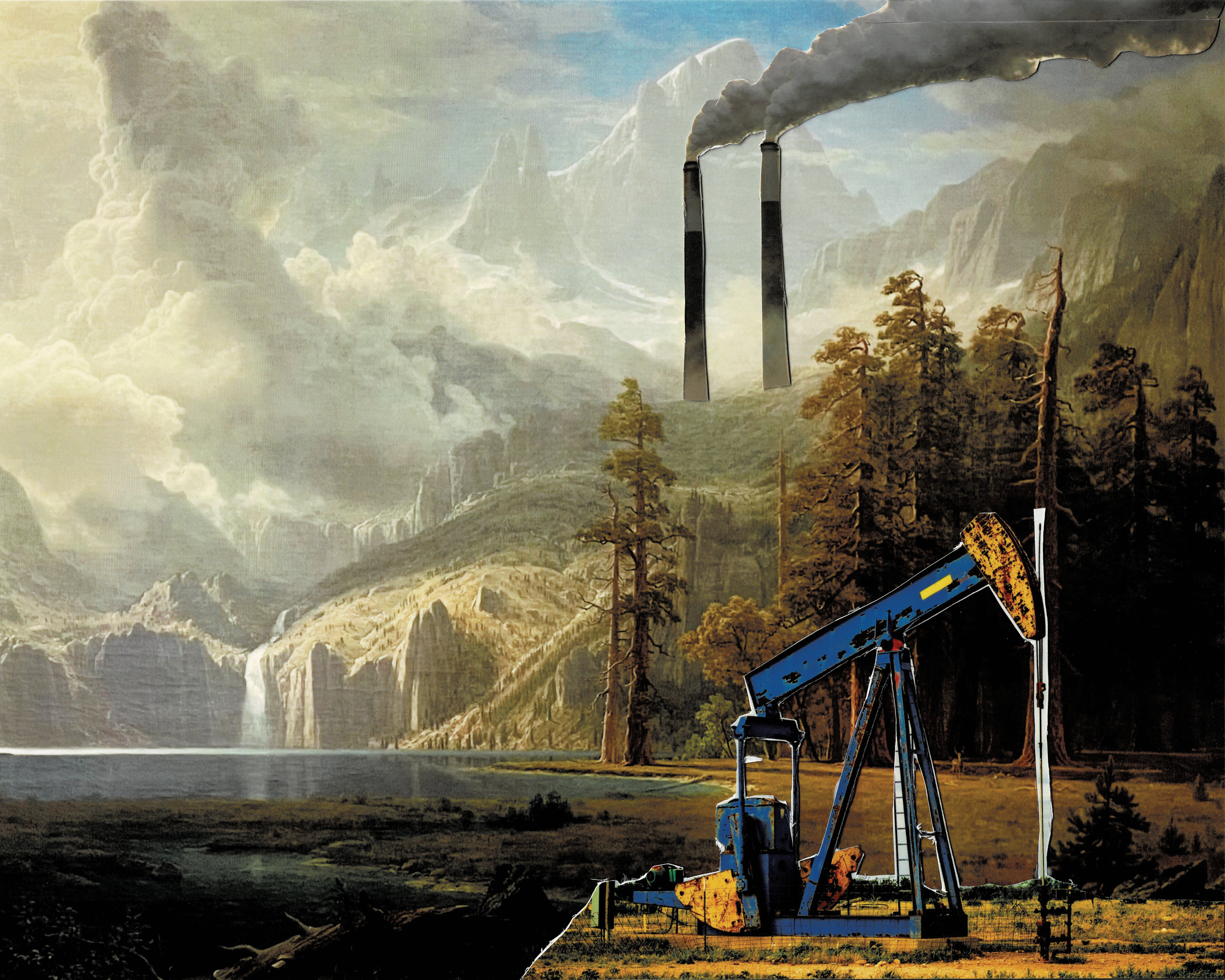
Photo credit: Figure 1. Mount Whitney: Albert Bierstadt circa 1877. Exhibited in The Rockwell Museum, Corning, New York. Alterations by the Happy Medium.
Crimmins, Allison R. 2023. “Fifth National Climate Assessment.” Fifth National Climate Assessment, November 14. https://nca2023.globalchange.gov/.
Egan, Matt. 2021. “No, Joe Biden Didn’t Just Ban Fracking.” CNN, January 27. https://www.cnn.com/2021/01/27/business/fracking-ban-biden-federal-leasing/index.html.
Kemfert, Claudia, Fabian Präger, Isabell Braunger, Franziska M. Hoffart and Hanna Brauers. 2022. “The Expansion of Natural Gas Infrastructure Puts Energy Transitions at Risk.” Nature Energy 7: 582–87, July 4. https://doi.org/10.1038/s41560-022-01060-3.
Lashof, Dan. 2024. “Tracking Progress: Climate Action under the Biden Administration.” World Resources Institute, July 30. https://www.wri.org/insights/biden-administration-tracking-climate-action-progress.
Marusic, Kristina. 2020. “Babies born near natural gas flaring are 50 percent more likely to be premature: Study” Environmental Health News, July 16.
Marusic, Kristina. 2021. “Fractured: Harmful Chemicals and Unknowns Haunt Pennsylvanians Surrounded by Fracking.” Environmental Health News, April 15. https://www.ehn.org/fractured-harmful-chemicals-fracking-2650428324.html.
Nelsen, Matt. 2024. “Natural Gas Is Scamming America.” YouTube, March 27. https://www.youtube.com/watch?v=K2oL4SFwkkw.
Nilsen, Ella. 2023. “The Willow Project Has Been Approved. Here’s What to Know about the Controversial Oil-Drilling Venture.” CNN, March 14. https://www.cnn.com/2023/03/14/politics/willow-project-oil-alaska-explained-climate/index.html.
Pitt, Hannah, Kate Larsen and Maggie Young. 2020. “The Undoing of US Climate Policy: The Emissions Impact of Trump-Era Rollbacks.” Rhodium Group, September 17. https://rhg.com/research/the-rollback-of-us-climate-policy/.
Plumer, Brad. 2015. “Obama’s Controversial New Fracking Rules, Explained.” Vox, March 20. https://www.vox.com/2015/3/20/8265507/federal-fracking-standards.
“The Paris Agreement.” 2015. United Nations Framework Convention on Climate Change. https://unfccc.int/process-and-meetings/the-paris-agreement.
Trump White House. 2020. “President Donald J. Trump Is Supporting Hydraulic Fracturing and Other Technologies to Protect Our Jobs, Economic Opportunity, and National Security.” National Archives and Records Administration, October 31. https://trumpwhitehouse.archives.gov/briefings-statements/president-donald-j-trump-supporting-hydraulic-fracturing-technologies-protect-jobs-economic-opportunity-national-security/.
Somanader, Tanya. 2016. “President Obama: The United States Formally Enters the Paris Agreement.” National Archives and Records Administration, September 3. https://obamawhitehouse.archives.gov/blog/2016/09/03/president-Obama-United-states-formally-enters-Paris-agreement.“What Is the Clean Power Plan?” 2017. NRDC, September 29. https://www.nrdc.org/stories/what-clean-power-plan.

 Happy Medium
You must be logged in to post a comment.