By Travis Rayome, Political History
Diplomacy between nations is guided by complex and implicit variables. How a government chooses to negotiate and interact with foreign governments is determined by how they govern themselves – this is statecraft. Statecraft is governance as a project; it is how nation-states choose to build their national identity, what sort of larger goals they pursue and rules of conduct they hold themselves to, and how they choose to perform universal functions (economics, culture, fiscal policy, law, etc.). Statecraft influences diplomacy because diplomacy is a reaction to statecraft; the diplomatic actions taken by a government are a reflection of and contribution to the ever-evolving project of their state. To demonstrate this relationship, one can point to the history of European diplomacy. In the past three centuries, European states (primarily led by the empires of Western Europe) have completely changed standard diplomatic conduct. As European states evolved into their modern forms, the developments made in statecraft shifted diplomacy away from monopoly-based imperial competition towards the maintenance of a shared hegemony over globe-spanning colonial holdings.
The primary element of statecraft that guided European politics starting in the 16th Century was colonialism. Colonialism spawned from mercantilism, an economic system that prioritized giving the colonizing state as much of an export advantage as possible to maximize the flow of valuable resources, capital, and precious metal-backed currency into the country to bring about prosperity. Thus, capitalization on unclaimed resources and monopolization of supply chains was an economic imperative for countries, leading to aggressive colonial territorial acquisition and protectionism becoming a common goal among European states. A key element of mercantile colonialism was the charter company, which were companies that had a monopoly on trade within a designated territory, such as the British East India Company, which operated on behalf of the British Empire in Asia. These companies were chartered by state governments, granted a region to operate in, and handed over to non-state actors to run the company in the name of that government. This made the state the primary benefactor and driver of economic activity internationally. This aspect of European statecraft, then, fostered an environment of fierce competition between nations who had a direct incentive to control as much of the trade in colonized regions as possible. As a result, wars over territorial disputes were common in the Americas.
As the mercantile system developed and more of the world came under the control of one of a few European empires, though, the trade monopolies held by chartered companies began to wane. First, the advent of the joint-stock company created alternate ways for companies to maximize profits, such as stock price fixing, inflating demand for stocks without increasing output, and driving investment by issuing bank notes and shares without gold and silver backing (Boardman-Weston et al. 46-7). This meant much more rapid but also unsustainable growth in revenue based on returns in the financial market, also known as an investment bubble. Second, unincorporated joint-stock companies began popping up all over Europe and receiving heavy investment from investors and the newly developing middle class. These companies, existing outside legal jurisdiction and thus being almost entirely unregulated, challenged the charter company monopolies and market bubbles they facilitated. The illegality of these companies also encouraged more unstable bubbles, made contractual obligations and accountability meaningless, and increasingly threatened to take control of the economy away from the state (55-7). This meant that the mercantile trade monopoly and domestic prosperity European statecraft had been directed towards was now in danger of wide-scale collapse, as was seen in France’s 1719 economic crisis, when the investment bubble popped and the chartered monopoly collapsed as they were unable to pay back investors, leaving millions of French people destitute (47). This led governments to begin changing the policy and goals surrounding economic activity, which led to a shift in their diplomacy.
The British Parliament passed the Joint Stock Companies Act of 1844 and Limited Liability Act of 1855 to address the rising prominence of unincorporated companies, which made it easier for private companies to be incorporated and made the corporation into an entity legally distinct from its owners (Boardman-Weston 58). These acts indicated a larger shift in how European states began to contend with the emergence of the free market: by changing the role of the state in the economy from corporate monopoly to universal mediator and benefactor of economic activity. This period also saw the increasing financialization of the market, growing number, scale, and complexity of corporations, and massively widened trade networks as more lands were claimed by European empires in the 19th century. These factors gave less of an incentive for European governments to wage territorial wars abroad and crush the competition and caused them to instead focus primarily on encouraging as much economic activity as possible within the empire to increase national wealth. Additionally, it was apparent that conflict was hurting potential economic gains, as British diplomat John Kasson wrote: “[productive labor] can only be arrived at through the permanent establishment of a peaceful regime” (Kasson 163, as cited in Shepperson, 41). Alongside the shift in the nature of the market was the reduction of protectionist policies. These policies restricted international trade by adding barriers to importing goods. Protectionism grew out of favor as trade networks became more solidified and the free-market system was given room to grow. Britain famously repealed its rigid Corn Laws in 1846, which to that point had prevented cheaper foreign corn from being sold in Britain. The repeal of these laws signaled commitment from European empires to move away from mercantilism.
Another large change in European statecraft came from changing attitudes surrounding the method of imperial expansion. European-American colonies were settler colonies, meaning that the home country brought in civilians to live on and cultivate the land, turning the colonized area into an extension of the state both politically and demographically. However, as these colonies grew and developed and the political stability of Europe was shaken by the Napoleonic Wars, the flaws of settler colonialism as a method of imperial expansion made the system unsustainable for Europe’s new economic priorities. The Spanish crown was left with less means to enforce loyalty from its colonies, who had no interest or obligation to continue Spanish rule in its colonies once the monarchy had collapsed by 1809, and so Latin American states revolted and gained independence across the continent in the following decades (Humphreys 227). A similar situation occurred in North America with the American Revolution, where Britain’s 13 colonies along the Atlantic coast of North America grew self-sufficient and distant enough from the home country that they sought independence.
In tandem with the decline in favorability of settler colonies and expansion of the free-market global economy was the emerging imperial front in Africa and Asia. Africa and Asia were vast regions already known to be rich in resources and population. Imperial charter companies had also already laid claim to numerous parts of these regions, such as the British East India Company. Due to the decreasing emphasis on settler-colonial projects in imperial pursuits and the decreased drive for monopoly, European empires did not need to settle in and populate the region to colonize. Instead, a military garrison could just station itself there, establish relations with the local power, occupy the land, and create the right conditions for private companies to set up operations. These private companies could extract resources from the land using the existing population as cheap or free labor to generate profits, build wealth, and strengthen the influence of the empire. Facilitated by the rise of the free-market capitalist economic system in the 19th Century, imperial land acquisitions in Africa and Asia furthered the new economic interests of European empires by prioritizing maximal market activity over direct and complete monopolistic domination.
The diplomatic shift away from mercantile monopolization, expansion of the free market, and changes in imperial practices culminated in the Scramble for Africa, which was a joint European imperial effort to divide the entire African continent amongst themselves. Unlike the rapid and competitive colonization of the Americas, the Scramble for Africa was a coordinated effort that began with the Berlin Conference, which ran from 1884 to 1885. The Conference was held to prevent friction among the empires and establish rules of engagement when claiming Africa. The changing economic needs of the nations and shared white identity are central reasons given for the conference, with the General Act framing imperialism as “furthering the moral and material wellbeing of the native populations” (General Act of the Berlin Conference of West Africa, 1885) and “regulat[ing] the conditions most favorable to the development of trade and civilization in certain regions of Africa” (General Act, 1885). The rules of engagement laid out in the Conference reflected the new focus in European statecraft on making economic activity as smooth as possible: free trade and travel, qualifications for the legitimacy of a territorial claim, and communication between empires on developments in imperial expansion. At this point, the elements of European statecraft– the priority of facilitating economic activity, the justification of white supremacy and humanitarianism to collaborate and expand influence, and the evolving methods of imperialism– made it so that collaboration between European states in managing a shared global hegemony was now a chief focus of diplomacy.
Statecraft in Europe before the 20th century was guided by the changes in economic priorities brought on by imperialist pursuits. From this, diplomacy changed in response to suit the goals of the state. As mercantilism transformed into free-market capitalism, diplomatic incentives trended towards a Europe united in national wealth-building through facilitating as much free-market activity as possible in the regions and peoples they dominated. This is because previous European diplomacy, which spawned from mercantilist economics and was centered around warfare and outcompeting adversarial empires, was harming the priorities of the emerging capitalist system. That system spawned from the statecraft of European empires as well, as the popularity of the financial market and new economic opportunities presented by imperialism pushed the mercantile system away from state-chartered monopolies and towards private ventures whose activities were sanctioned by the state. The environment fostered by European statecraft is what created the grounds for diplomacy.

Travis Rayome is an English and Economics major from Alexandria, Virginia. He hopes to work for humanitarian NGOs around the Washington, DC area, continue writing on politics and economics, and play music. His areas of political interest are propaganda and information dissemination, structural violence and inequality, and power distribution within and between nation states.
References:
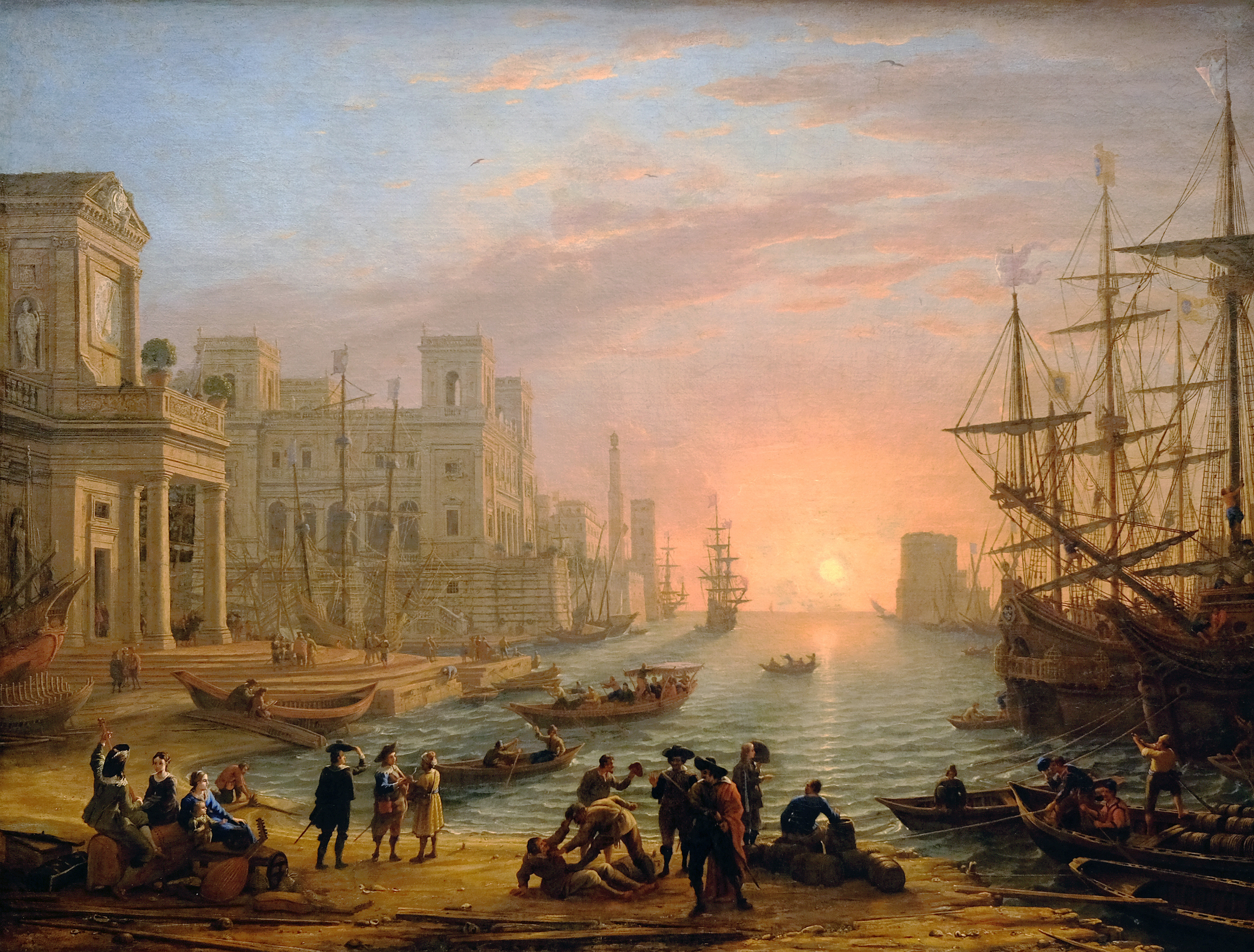
Photo credit: Claude Lorrain, Public domain, via Wikimedia Commons. https://commons.wikimedia.org/wiki/File:F0087_Louvre_Gellee_port_au_soleil_couchant-_INV4715_rwk.jpg
Boardman-Weston, et al. 2012. “The Rise and Fall of the Chartered Corporation: A Historical Analysis: The Development of the Charter up to 1500, the Rise of the Chartered Corporation post-1500, the Decline and Fall of the Charter as a Method of Incorporation in the 19th Century and the Potential for a Resurgence in the 21st Century.” Durham University, November 8. https://etheses.dur.ac.uk/5572/.
Cao, Yahin. 2014. “Comparison Between the African Colonialism and American Colonialism.” Pennsylvania State University, December 11. https://sites.psu.edu/afr110/2014/12/11/comparison-between-the-african-colonialism-and-american-colonialism/.
Coleman, D.C. 1980. “Mercantilism Revisited.” The Historical Journal, November 4. http://www.jstor.org/stable/2638725.
General Act of the Berlin Conference on West Africa, 1885, February 26. https://loveman.sdsu.edu/docs/1885GeneralActBerlinConference.pdf
Humphreys, R.A. 1952. “The Fall of the Spanish American Empire.” History, October. https://www.jstor.org/stable/24403077.
Kasson, John. Protocols and General Act of the West African Conference. 1885. United Kingdom National Accounts (Blue Books), as cited in: Shepperson, George. 1985. “The Centennial of the West African Conference of Berlin, 1884-1885.” Clark Atlanta University. https://www.jstor.org/stable/274944.
LaHaye, Laura. “Mercantilism.” Library of Economics and Liberty. https://www.econlib.org/library/Enc/Mercantilism.html.
Thomas, J.A. 1929. “The Repeal of the Corn Laws, 1846.” Economica, April. https://www.jstor.org/stable/2548518.

 Happy Medium

You must be logged in to post a comment.