Moss Magnusson, Political Theory
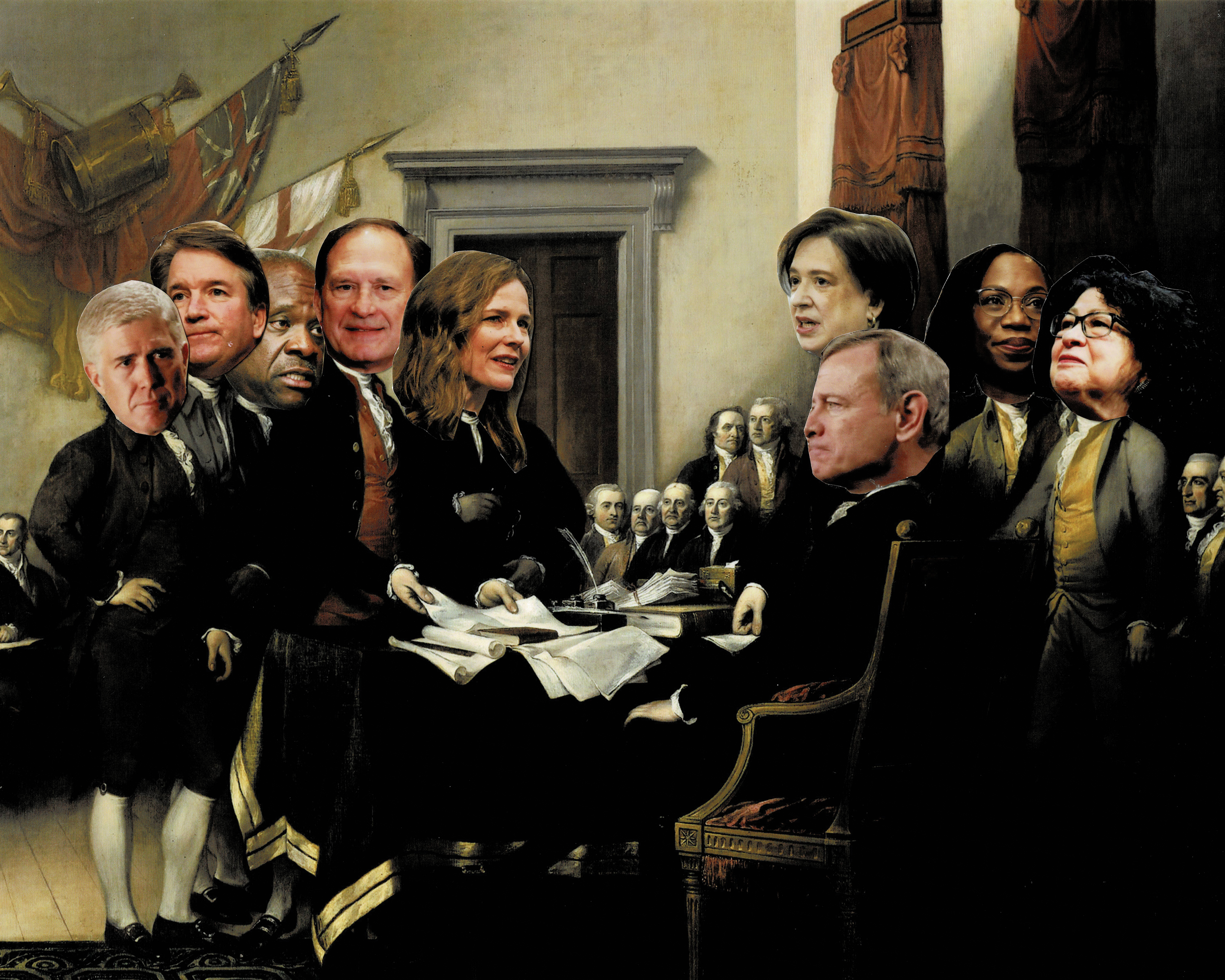
The Constitution says very little about the Supreme Court – its role is outlined in just a few sections. The document truly does not delve deeply into the size, structure, or detailed operation of our nation’s highest Court. Despite knowing the difficulties of constitutional interpretation, the framers deliberately chose not to prescribe a specific method of interpretation. Instead, much of the Constitution utilizes broad language designed to withstand the test of time and ensure its applicability even in changing circumstances (Supreme Court of the United States n.d.). While they could have tried to dictate the proper method of interpretation – originalism, living constitutionalism, Thayerism, and so on –they did not (these specific terms were developed long after the drafting of the Constitution). This strategic decision made by the framers has allowed justices expansive freedom in deciding constitutional questions and spawned a seemingly permanent divide on the question of constitutional interpretation.
To explore the connection between the framers’ choices in drafting the Constitution and the interpretive decisions made by Supreme Court justices, this article will analyze the Constitution’s language, the insights on interpretation found in the Federalist Papers, and the reasons behind the inevitable divide in constitutional interpretation.
A Broad Constitution
The Constitution was written in 1787 and ratified the following year when the ninth state, New Hampshire, ratified it. It is “the world’s longest surviving written charter of government” (U.S. Senate n.d.). Though there are many nuanced reasons for its longevity, this success is generally attributed to its wisdom in employing separation of powers, checks and balances between the branches of government, allowance for amendments, and general flexibility. Relevant to our focus, flexibility is the factor to which we should pay attention. Specifically, flexibility regarding its application. In the Supreme Court ruling of McCulloch v. Maryland, Chief Justice Marshall wrote:
“A constitution, to contain an accurate detail of all the subdivisions of which its great powers will admit, and of all the means by which they may be carried into execution, would partake of the prolixity of a legal code, and could scarcely be embraced by the human mind.” (17 U.S. 316, 407, 1819)
When Marshall says “all the means by which they may be carried into execution,” he is directly addressing interpretation. His point is that to dictate the methods of interpretation, the framers would have been embarking on an overly verbose mission that, in the end, could hardly be interpreted by the human mind. Although Marshall was not a framer of the Constitution, he provided valuable insight into the impossibility of instructing interpretation.
Pursuing a narrow wording of the Constitution would not only have been a futile mission, but broader language comes with its own advantages. First and foremost, broadness allows for applicability in changing circumstances. For example, when the First Amendment declares, “Congress shall make no law… abridging the freedom of speech,” (U.S. Const. amend. I) it allows this principle to adapt to modern contexts, such as speech on social media. Had the framers been more specific, enumerating all forms of protected speech, many contemporary examples could have been left ambiguous or unprotected. Building on this, broadness can protect even those rights that are not listed. This concept was raised by James Madison when he explained that “the enumeration in the Constitution, of certain rights, shall not be construed to deny or disparage others retained by the people” (U.S. Const. amend. IX), this idea was later codified in the form of the Ninth Amendment. While broadness has the defect of leaving interpretation up in the air, it also serves a very important role in creating a functional constitution.
A Look into the Federalist Papers
The U.S. Constitution’s broad and flexible nature has placed much of its interpretation in the hands of the judiciary, an outcome that key figures in its creation foresaw and debated. When we examine how the leading proponents of the Constitution addressed the issue of interpretation, we see a mix of trust in judicial discretion balanced with an expectation that the Constitution should remain supreme – not susceptible to judicial activism.
In many regards, it is this debate on trust that underlies the ambiguousness surrounding methods of interpretation. It has become evident that granting the courts the freedom to interpret the Constitution was necessary to ensure they could properly check and balance the other branches of our government. Without this freedom, judicial review could not have been invented and legitimized by way of Marbury v. Madison (5 U.S. 137, 1803). Through all of this, one thing remains clear – the framers believed some degree of interpretive freedom is necessary for the courts to function properly. We see this in Federalist No. 78, where Alexander Hamilton writes:
“The interpretation of the laws is the proper and peculiar province of the courts. A constitution is, in fact, and must be regarded by the judges, as a fundamental law. It therefore belongs to them to ascertain its meaning, as well as the meaning of any particular act proceeding from the legislative body.” (Hamilton 1788)
Here, Hamilton highlights the intention to leave interpretation up to the courts. The idea is that through the mechanism of judicial review, the Court can ensure “that the will of the whole people, as expressed in their Constitution, would be supreme over the will of a legislature, whose statutes might express only the temporary will of part of the people” (Supreme Court of the United States n.d.). In other words, judicial review allows courts to invalidate laws that conflict with the Constitution, ensuring that the fundamental law remains the ultimate guiding principle of governance. Thus, leaving interpretation to the judiciary was a necessary step in establishing a crucial check on the legislative and executive branches. Without this authority, the courts would lack the power to enforce constitutional limits, undermining the balance of power and the protections embedded in the Constitution.
To this point, James Madison had generally feared that leaving interpretation up to the legislature, rather than the judiciary, would have left constitutional questions subject to political bargaining, and the “Constitution would be reduced to a battleground of competing factions, political passion, and partisan spirit” (Supreme Court of the United States n.d.). For this reason, it was decidedly not the place for the framers to have given extensive guidance as to which method of interpretation is preferred.
What does this mean for preferred methods of interpretation?
The flexibility in the Constitution’s wording and the ambiguity in its application seems to have been largely an intentional strategic decision on the part of the framers. This approach has allowed for applicability in changing circumstances and ensured that the Court could serve its duty as a check on the other branches of government. But how has this approach manifested in actual Supreme Court rulings? And what methods of interpretation have justices favored as a result?
The answer is rather anticlimactic: Justices must determine for themselves how to interpret the Constitution within the framework of precedents, legal norms, and constitutional text. Historically, they have adopted a wide variety of interpretive approaches. The framers’ strategic decisions have directly led to a system where no single method has risen to the top as the categorically correct approach. This is not to say that proponents of each method do not have compelling reasons as to why their preferred method is best or correct. Rather, the result of the framers’ choices has produced an enduring and seemingly irreconcilable battleground over constitutional interpretation. This battleground has shaped landmark cases where justices, divided by their interpretive philosophies, have delivered conflicting opinions – often with lasting consequences for American law and society.

Moss Magnusson is a senior at Binghamton University, double majoring in political science and PPL (politics, philosophy, and law). Originally from Rhinebeck, NY—a small upstate town in the Hudson Valley—Moss has gained valuable experience during his time interning on Capitol Hill, where he contributed to writing congressional records and other legislative materials. While deeply engaged in his political science studies, he also enjoys spending time with friends, playing tennis, and reading. After graduating this spring, Moss plans to work for a year while preparing for the LSAT, with the goal of attending law school the following fall.
References:
Hamilton, Alexander. 1788. “Federalist No. 78.” In The Federalist Papers. Avalon Project, Yale Law School. https://avalon.law.yale.edu/18th_century/fed78.asp.
Marbury v. Madison, 5 U.S. 137 (1803)
McCulloch v. Maryland, 17 U.S. 316 (1819)
Supreme Court of the United States. n.d. “Constitutional Interpretation.” Supreme Court of the United States. https://www.supremecourt.gov/about/constitutional.aspx.
U.S. Senate. “The Constitution of the United States: A Transcription.” U.S. Senate. https://www.senate.gov/about/origins-foundations/senate-and-constitution/constitution.htm.

 Happy Medium
You must be logged in to post a comment.