
Max Drucker, Foreign Affairs
The 2024 British General Election resulted in a landslide victory for the Labour Party, a historic development for the United Kingdom. The Labour victory marked the end of uninterrupted Conservative domination in the British House of Commons since 2007. The United Kingdom’s Conservative Party has undergone a tumultuous past few years, largely stemming from Boris Johnson’s actions as Prime Minister. Boris Johnson most famously instigated the Brexit movement, the UK’s withdrawal from the European Union. The aftereffect of Brexit plunged the UK into immediate economic decline, a contentious issue left unresolved by the last two prime ministers Liz Truss and Rishi Sunak. Keir Starmer, the new Labour Prime Minister, has inherited a country in recession and in dire need of economic and political reform. Given Boris Johnson’s actions at removing the UK from Europe, Keir Starmer must balance reintegration with Europe while persevering with Brexit.
On Brexit
Of the various pledges made by Keir Starmer toward British rejuvenation, growing relations with Europe are high on the agenda. Labour has made it clear they intend to negotiate a veterinary agreement with the EU to foment smoother trade, a clear attempt to reverse Britain’s disappearance from the European economy (Webber 2024). The absence of Britain from a codependent European market had catastrophic consequences on the British economy and the average Briton. The Mayor of London, Sadiq Khan, published a report citing Cambridge Econometrics on the effects of Brexit on the United Kingdom. The report declares that due to Brexit, the average Briton was down nearly £2,000 in 2023. The report further emphasizes that due to Brexit there have been 3 million jobs lost across the UK, with 500,000 jobs lost in London alone (Patel 2024). Khan notes that if the government wishes to remedy the swift economic decline the UK is facing, relations with the European Union must be rebuilt (Khan 2024). This report directly attributes the decline in the British economy to the lack of connection to the greater European market, accomplished by Brexit. The obvious solution to reverse Brexit’s effects would be to rejoin the European Union.
However, Keir Starmer’s promises to the British people have not been to reverse Brexit, but to implement countermeasures to ensure the revitalization of the British economy. This entails the nullification of decadent trade barriers, the prevention of unnecessary border checks, and the reduction of inflation toward food prices (Labour 2024). As Brexit was a multi-faceted concept not entirely based on yielding economic benefits, it is interesting to see the Labour Party refrain from bashing it. The Labour Party’s manifesto intentionally lacks an emphasis on Brexit’s effects on the British economy while proposing numerous ways to revise the direct economic ramifications of Brexit. Instead, the Labour Party attributes the economic decline brought on by the Conservatives to the “lack of acceptance regarding a benefit of the community” and a failure to acknowledge the need for government cooperation with British Business (Labour 2024). The Labour Manifesto regarding the reconstruction of relations states that “With Labour, Britain will stay outside of the EU. But to seize the opportunities ahead, we must make Brexit work. We will reset the relationship and seek to deepen ties with our European friends, neighbors and allies. That does not mean reopening the divisions of the past” (Labour 2024). Labour regarding Britain’s time in the EU as ‘divisions of the past’ indicates they harbored discontent, further corroborating a narrative that Britain can economically suffice independently.
Many Britons found Brexit promising, aside from the economic thought, because of the prospect of reclaiming Britain for the British. A nationalistic fervor centered around migration left an indelible impression on Britons who felt as though the culmination of displaced refugees and the EU’s Schengen area were altering the ethnic makeup of the UK. The slogan “take back control” became commonly affiliated with the Brexit movement, indicative of the revanchism toward Britain’s imperial past and fall from grace (BPP 2016). This form of populism has been on the rise in many Western countries, such as the United States, France, and Germany (Gavel 2024). Conservative politicians, such as David Frost, maintain a Euro-skeptic narrative that returning to Europe would continue to chip away at the country’s national independence (Stone 24).
A Domestic and International Outlook Toward Change
Many abroad are wary of Britain’s prospective European resurgence, given their initial aptitude for leaving. The Deputy Prime Minister of Ireland, Micheál Martin, provided a rather cynical take on Starmer’s European policy. Martin stated there would be no ‘à la carte’ for the United Kingdom simply because a pro-European government is in power. While many politicians share Martin’s concerns, many heads of state have readily announced their support for Starmer. Ursula von der Leyen, President of the European Commission, declared that the European Union would look forward to discussing possible means of cooperation between the two entities. However, many EU politicians agree more with Martin and wish to see the British government agree to EU trade conformity before anything else. The return to an EU single market ruling is a concern of the British government, as aspects of the EU such as these initially brought contempt regarding the British economy and economic independence.
On the home front, Britons are having a change of heart toward the European Union and the likeliness of rejoining. Keir Starmer has explicitly stated that he has no interest in rejoining the bloc on behalf of the UK. However, the British people have expressed great interest in a return to the EU. Recent polling revealed that 59% of Britons would vote to rejoin the European Union if a referendum was held, with 41% voting to remain out. (Smith 2024).
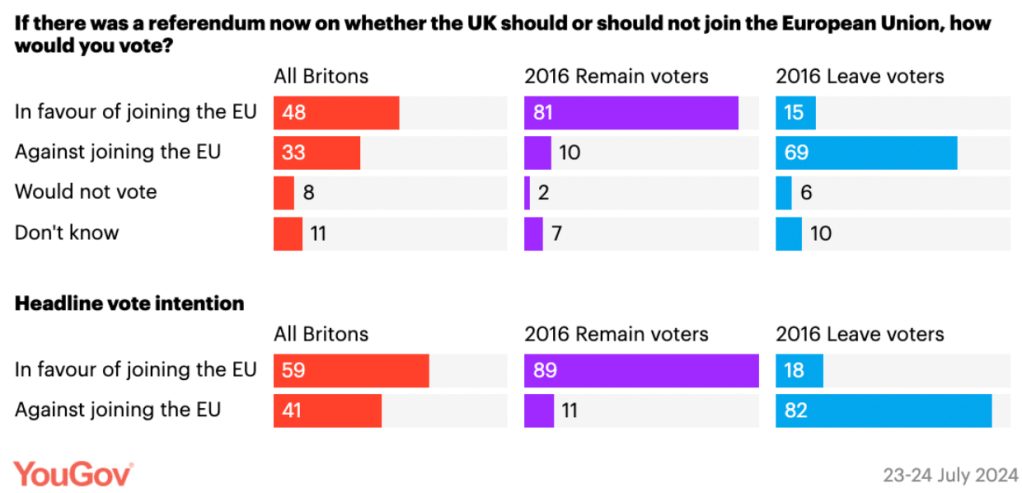
While Starmer remains adamant on maintaining nominal British independence, he must contend with European demands concerning a British reprisal and growing pro-European fervor at home. Starmer intends to accomplish this feat by bolstering economic ties between the UK and the EU while simultaneously tending to domestic growth, such as increasing taxes on the elites, defending the National Healthcare System (NHS), and working with trade unions.
Populism was a driving force, perhaps the most important force, in the execution of Brexit. However, the Conservative British politicians have fallen out of favor with the people due to the immense economic decline brought about by Brexit. Keir Starmer is aware that much of his voter base does not completely loathe Brexit and still identifies with aspects of the movement. Starmer has made it clear that he intends to reconvene with Europe increasingly more so than previous Conservative politicians had, while leaving EU membership off the table. Given populism was the force that drove Brexit into reality, could populism be the force to drive Britain back into Europe?

Max Drucker is a senior-year student from Brooklyn, NY. He’s majoring in Political Science with a double minor in Religious Studies and Genocide and Mass Atrocity Prevention (GMAP). He mostly concentrates on the global affairs facet of Political Science. He was fortunate enough to spend a semester in Vienna, Austria studying International Relations. In his free time, he enjoys listening to music, hanging out with his cats, and playing the guitar and bass.
References:
Bui, Ha. 2024. “London’s economy after Brexit: Impact and implications” Cambridge Economics, September 28. https://www.camecon.com/what/our-work/londons-economy-after-brexit-impact-and-implications/
BPP, LSE. 2016. “How Brexiteers appealed to voters’ nostalgia” The London School of Economics and Political Science, September 28. https://blogs.lse.ac.uk/politicsandpolicy/how-brexiteers-appealed-to-voters-nostalgia/
Gavel, Doug. 2024. “Why is support for populism rising in the West?” Harvard Kennedy School, September 28. https://www.hks.harvard.edu/faculty-research/policy-topics/politics/why-support-populism-rising-west
Ridley, Hollie. 2024. “Kickstart Economic Growth” The Labour Party, September 28. https://labour.org.uk/change/kickstart-economic-growth/
Sadiq, Khan. 2024. “New report reveals UK economy is almost £140 billion smaller because of Brexit” Mayor of London, September 28.https://www.london.gov.uk/new-report-reveals-uk-economy-almost-ps140billion-smaller-because-brexit#:~:text=The%20new%20report%2C%20by%20Cambridge,of%20Brexit%2C%20the%20report%20reveals.
Starmer, Keir. 2024. “My Pledges to You” Keir Starmer, September 28. https://www.clpd.org.uk/wp-content/uploads/2020/10/Keir-Starmers-10-Pledges.pdf
Statista. 2024, “In hindsight, do you think Britain was right or wrong to vote to leave the European Union?” Statista, September 28. https://www.statista.com/statistics/987347/brexit-opinion-poll/
Stone, Jon. 2024. “Irish prime minister: EU open to Keir Starmer’s Brexit plan” Politico, September 28. https://www.politico.eu/article/europe-brexit-ireland-united-kingdom-keir-starmer-simon-harris/
Smith, Matthew. 2024. “Labour does not have a mandate to take Britain back into the EU, says public” YouGov, September 28.https://yougov.co.uk/politics/articles/50317-labour-does-not-have-a-mandate-to-take-britain-back-into-the-eu-says-public.
Webber, Esther. 2024. “6 things UK Prime Minister Keir Starmer wants to fix in his first month” Politico, September 28. https://www.politico.eu/article/uk-prime-minister-keir-starmer-speech-win-jobs-immigration-government-reform/

 Happy Medium
You must be logged in to post a comment.