By Kieran Grundfast, Elections
The 2024 presidential election campaign, characterized by a quick succession of unexpected and shocking twists and turns, is likely to result in an incredibly close election. Most polls show Vice President Kamala Harris and former President Donald Trump in a dead heat in the seven battleground states. Vice President Harris has a slight lead in national polls but is well within the margin of error. In elections as close as this, barring systematic polling errors, the outcome will be highly dependent on which campaign can turn out the most voters and persuade the remaining, but minor, proportion of voters that have yet to make up their minds. In this context, infrequent voters, often called low-propensity voters, can have a highly significant but uncertain impact on the election outcome. Indeed, as will become apparent, these voters have driven a large part of the narrative of this election and are a focus of both campaigns.
Put simply, low-propensity voters participate in elections irregularly, or in some cases not at all, despite being eligible to vote. Several major pollsters active in this election identify low-propensity voters by asking survey respondents whether they voted in the last three or four nationwide elections (Hopkins 2024; Brownstein 2024). Those eligible to vote but who voted in none or only one of these elections are considered low-propensity voters. They compare against high-propensity voters who participated in all or most of the last few national elections. Demographic data of identified irregular voters in pollster surveys show that low-propensity voters are from traditionally Democratic-leaning constituencies. That is, taken as a group, they tend to be younger, poorer, and racial or ethnic minorities.
Additionally, they are more likely to be registered Democrats or identify as Democratic-leaning independents. However, low-propensity voters span the partisan-ID spectrum (Cohn 2024). These voters also tend to take a grim view of American politics and report disenchantment with the political process, the two major parties, and often the candidates themselves, a possible explanation for their non-participation compared to frequent voters (Thomson-Deveaux et al. 2020; Montanaro 2020).
In the context of this election, some unusual and significant patterns related to these voters have emerged in the polling data. Before dropping out of the race, President Biden was underwater with low-propensity voters who responded to pollster surveys. Aggregated survey results from polls conducted by NBC in May showed President Biden leading by four points with respondents who said they voted in 2020 and 2022; among those who voted in 2020 but not 2022, Former President Trump led by 12 points. This lead swelled to 20 points among those who said they did not vote in 2020 or 2022 (Brownstein 2024). Of this latter group, 65% disapproved of Biden’s performance in office when asked. Similar patterns emerged in polling by ABC and the NYT/Siena College (Cohn 2023; Cohn 2024; Hopkins 2024). These patterns were also consistent when measured across several other respondent variables, such as race and age, meaning the level of political engagement or participation has predictive value when determining how a person may vote.
Essentially, the lead in national and battleground state polling that Trump opened over Biden before his exit from the race was driven by gains in support among low-propensity voters, and as Nate Cohn, an NYT polls and elections analyst, puts it, “To the extent that has not been true in New York Times/Siena College polling in the last eight years, disengaged voters are driving the overall polling results and the storyline about the election” (Cohn 2024).
This is significant not just because these voters, on average, are part of traditionally Democratic-leaning constituencies such as young, non-white, and lower-income voters but also because it contradicts conventional knowledge and observed electoral patterns in American politics. In this scenario, higher turnout would almost certainly benefit Trump, contradicting decades of observations that Democratic candidates, especially those for president, perform better when turnout is higher; this is precisely because in prior decades, holding other variables constant, low-propensity voters were more likely to support Democrats when they did turn out (Fowler 2024; Hopkins 2024). The inverse is also significant, as the GOP in recent decades performed better when turnout was lower—for example, in the 2014 midterm elections—precisely because higher-propensity voters leaned Republican.
Of course, it is difficult to tell whether these voters will turn out in significant enough numbers in November to have a measurable impact on the race’s outcome. Indeed, the pitfalls of this trend for Trump and the GOP appeared two years ago when Democrats overperformed expectations in the 2022 midterm elections, in part because high-propensity voters shifted toward them in an election where turnout tends to be lower than in general elections (Cohn 2023; Hopkins 2024). Some relevant experts have also predicted that turnout this November will not match that seen in 2020. One expert predicts 15–20 million fewer voters will participate in the November election compared to 2020 and notes that the total number of registered voters in May 2024 is down significantly from the same point in 2020 (Brownstein 2024). The Trump Campaign is well aware of the role turnout, both of infrequent voters and in general, will play in the outcome of the race, given the statistical tie between the former President and current Vice President, and has made turning out low-propensity voters a central part of their campaign strategy (Fowler 2024; Roarty & Swartz 2024). Although their turnout will be hard to predict, the stark gap in survey results that opened up along the lines of voter participation likely means that the outcome of this election will be highly sensitive to the makeup of the electorate (Cohn 2024).
It is essential to ask ourselves what could have prompted such an unexpected and potentially transformative shift among low-propensity voters and the opening of the “participation gap” in presidential race polling. Analysis from the NYT shows that these voters have distinctive views compared to high-propensity Democratic or independent voters. They get their news in unique ways, with an outsized proportion receiving it primarily through social media (Cohn et al. 2024). Compared to their regular or high-frequency counterparts, infrequent voters are likelier to report the economy as their top issue, as opposed to democracy and abortion for frequent Democratic-leaning voters or immigration for frequent-Republican voters, and have a poorer view of the economy under President Biden (ibid.). They are also more likely to state that they want “fundamental change” in the US and report a dislike for the President based on age and performance concerns while maintaining a preference for down-ballot Democratic candidates (ibid.). All in all, it seems that the disapproval of President Biden – particularly the economy’s performance during his administration – and concerns around his age drove infrequent voters, including many Democratic-leaning ones, to vote for Trump.
However, President Biden dropped out of the race in July. Do the patterns in the relevant polling data described above persist now that Vice President Harris is the Democratic nominee? By the time Biden exited the race, he was trailing Trump by about three percentage points in the Real Clear Politics (RCP) national polling average. He also was behind Trump in virtually every battleground state (RealClearPolitics 2024). Harris has improved on these numbers, maintaining a small but persistent two-point lead in the national polling average. She is in a statistical tie with Trump in battlegrounds (RealClearPolitics 2024). Harris has improved over Biden with the electorate at large. She has made up ground with Democratic and Democratic-leaning voters who were either defecting from Biden or, at the very least, not enthusiastic about his candidacy. However, as shown by the continued closeness of the race in the polls, Trump’s newfound support with low-propensity voters and those from traditionally Democratic-leaning constituencies is only muted, not erased, perhaps indicating that their shift toward Trump cannot be attributed solely to their view of the Biden Administration. Recent polls that show continued strength for Trump among young Hispanic men speak to this fact (Morin 2024). The Trump Campaign continues to center them in their overall electoral strategy, especially in battleground states. The Harris campaign, meanwhile, is actively seeking to make up ground lost under Biden with these same constituencies.
If the patterns that have emerged in this election’s polling data do play out among the electorate on Election Day, it would represent a significant change in the dynamics of American politics. It would have long-term implications for both major parties’ electoral strategies. The common belief that higher voter turnout almost always benefits Democrats and, by extension, that lower turnout benefits Republicans would no longer be true. The Democratic and Republican parties need to rethink how they connect and energize voters and the exact voters they should appeal to. Democratic voter turnout strategies based on maximizing turnout among younger, lower-income, and non-white voters will need to be revised. Likewise, Republicans would need to build a long-term strategy to connect with more irregular voters from communities they have not commonly focused on reaching in prior elections, particularly younger, non-white, and lower-income voters if they wish to capitalize on the potential electoral benefits of these recent trends. Moreover, if political participation becomes another cleavage along which partisan polarization develops, and election outcomes become even more sensitive to voter turnout dynamics, electoral politics in the United States will become even more volatile.

Kieran Grundfast is a Senior from Brookhaven, New York, majoring in Political Science. After finishing his undergraduate degree, he hopes to pursue a master’s in International Relations. He has prior experience volunteering on two campaigns for local offices back on Long Island, and he most recently completed an internship at the Library of Congress. He likes to work out and be in nature. His favorite sports team is the New York Rangers.
References:
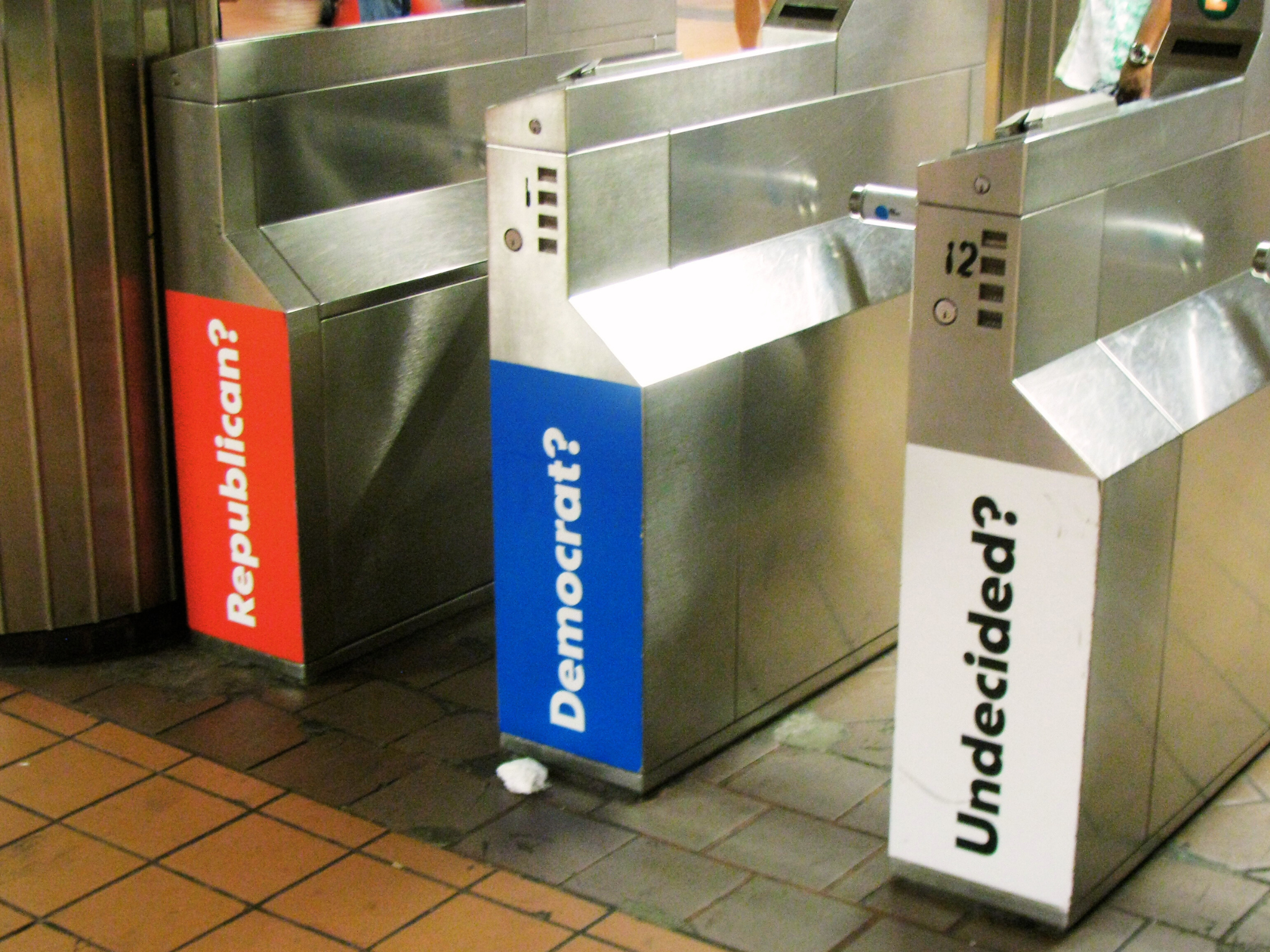
Photo credit: Eden, Janine and Jim from New York City, CC BY 2.0 https://creativecommons.org/licenses/by/2.0, via Wikimedia Commons
Brownstein, Ronald. 2024. “Analysis: The Unusual Turnout Dynamic That Could Decide the 2024 Election | CNN Politics.” CNN, May 29. https://www.cnn.com/2024/05/29/politics/turnout-2024-election-analysis/index.html.
Cohn, Nate. 2023. “Why Less Engaged Voters Are Biden’s Biggest Problem.” The New York Times, October 30. https://www.nytimes.com/2023/10/30/upshot/biden-voters-midterms-2024.html.
Cohn, Nate. 2024. “The Shaky Foundation of Trump’s Lead: Disengaged Voters.” The New York Times, May 24. https://www.nytimes.com/2024/05/24/upshot/trump-biden-polls-voters.html.
Cohn, Nate, Charlie Smart, and Ethan Singer. 2024. “If Everyone Voted, Would Biden Benefit? Not Anymore.” The New York Times, June 15. https://www.nytimes.com/2024/06/15/upshot/election-democrats-republicans-turnout-trump.html.
Fowler, Stephen. 2024. “Donald Trump’s Big Get-out-the-Vote Strategy in Arizona and Georgia? Donald Trump.” NPR, July 12. https://www.npr.org/2024/07/12/nx-s1-5032965/trump-force-47-maga-organizing-georgia-arizona.
Hopkins, Dan. 2024. “The Less You Vote, the More You Back Trump.” ABC News, April 10. https://abcnews.go.com/538/vote-back-trump/story?id=109090626.
Morin, Rebecca. 2024. “Harris Losing Ground with Young Latino Men, Exclusive USA-TODAY Polls Find.” USA TODAY, October 7. https://www.usatoday.com/story/news/politics/elections/2024/10/07/harris-trump-latino-voters-nevada-arizona/75530730007/.
Montanaro, Domenico. 2020. “Poll: Despite Record Turnout, 80 Million Americans Didn’t Vote. Here’s Why.” NPR, December 15. https://www.npr.org/2020/12/15/945031391/poll-despite-record-turnout-80-million-americans-didnt-vote-heres-why.
Roarty, Alex and Katherine Swartz. 2024. “Trump Is Trying to Make Up Ground by Reaching Out to Voters Who Hate Politics.” NOTUS, October 4. https://www.notus.org/trump-2024/trump-voters-who-hate-politics.Thomson-DeVeaux, Amelia, Jasmine Mithani and Laura Bronner. 2020. “Why Millions Of Americans Don’t Vote.” FiveThirtyEight, October 26. https://projects.fivethirtyeight.com/non-voters-poll-2020-election/.

 Happy Medium
You must be logged in to post a comment.