By Max Drucker, Foreign Affairs
On October 7th, South Africa formally requested the Taiwanese government to move its unofficial embassy out of the administrative capital of Pretoria to Johannesburg. This move has been largely interpreted as South Africa conceding to China by subverting relations with Taiwan to strengthen relations with the former. South Africa officially cut ties with Taiwan in 1997 after it officially recognized the Communist Chinese Party as China’s legitimate governing authority. The nation has maintained an unofficial Taiwanese liaison office in the capital. South Africa wishes to continue the informal relationship with Taiwan, but nevertheless describes its embassy as a ‘trade office.’ South Africa’s request to move the Taiwanese embassy reflects the non-political and non-diplomatic relationship South Africa has with Taiwan. This demonstrates the international norm that capitals are reserved for official foreign embassies and high commissions (Barlett 2024). However, Taiwan has moved to reject South Africa’s embassy exchange, seeing it as a breach of a bilateral agreement made between the two countries in 1997 following South Africa’s withdrawal of Taiwanese recognition. The clash has forced South Africa to decide whether or not it is worth pandering to the Chinese at the cost of an economic relationship with Taiwan.
Understanding BRICS
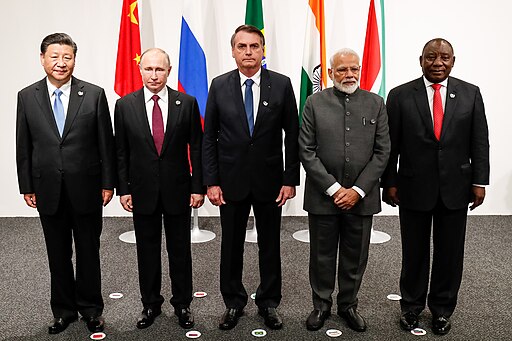
South Africa’s appeasement of China can be attributed to China’s integral role as South Africa’s largest trading partner and their shared membership in the organization known as “BRICS”. BRICS began as an international forum between Brazil, Russia, India, China, and South Africa (forming an acronym for its name), and has since grown to include members such as Egypt, Ethiopia, the UAE, and Iran. The constituent states of BRICS represent an organized challenge to international organizations such as the European Union, NATO, and the G7. The BRICS states challenge Western institutions such as the World Bank and the United Nations, as they believe they are disadvantaged by the Western-oriented international order (Ferragamo 2024). However, BRICS is more an international symbol than a functional organization. Their goal of challenging the US dollar has made little to no progress, and there have been very few gains toward reforming institutions such as the World Bank and the IMF, and it suffers from internal discord through contested geopolitical confrontations between the constituent members (O’Neill 2024). Relations between member states such as India, China, and Russia have been strained by historical and contemporary conflict, which greatly complicates concrete multilateralism. BRICS represents a symbolic challenge to the Western-built world order but is often misconstrued as something more than just a platform for contentious and isolated states.
South Africa’s Relationship with Taiwan
It is important to frame the dissonance between South Africa and Taiwan as a conflict manufactured by China that has nothing to do with their shared membership in BRICS. China’s policy toward Taiwan is centered around depleting international recognition of the state. It has been employing this strategy by implementing economic and developmental investment projects in impoverished states across Africa and Asia, with the caveat that these states sever ties with Taiwan. Given that South Africa has already recognized China, ceasing Taiwanese recognition nearly thirty years ago, South Africa is consolidating its partnership with China by further alienating Taiwan. South Africa has warned of drastic measures if the unofficial Taiwanese embassy is not moved. The Taiwanese foreign minister Lin Chia-Long stated Taiwan was considering closing South Africa’s own liaison office in Taipei in response to South Africa’s demand. The initial threat South Africa presented to Taiwan–that Taiwan relocates the office to Pretoria or risk its shutdown–poses a major loss in trade, travel, and educational exchange to both states (AP News 2024).
In an eerie sense of déjà vu, Taiwan was posed with the same ultimatum by the Nigerian government in 2017, following the reveal of a $40 billion Chinese investment plan into Nigeria. The Nigerian government used the same rationalization that South Africa used for their relocation–namely, that relations between the two states haven’t changed given Nigeria’s recognition of China in 1971, and that acknowledging the unofficial embassy as a trade office was simply a clearer distinction of relations (CNBC 2017). Similarly, Taiwan protested Nigeria’s request but decided the best choice was to move from the Nigerian capital Abuja to Lagos, Nigeria’s commercial hub. This poses the question of whether Taiwan would concede to South Africa as they did with Nigeria. This form of isolation is not new to the Taiwanese government; however, as international recognition and cooperation dwindle, China’s threat of annexation looms greater.
The Bigger Picture
Given Taiwan’s geographic and historical proximity to the mainland, China is simultaneously Taiwan’s largest trading partner and biggest threat. The Chinese government adamantly views Taiwan as a historic province of China and dismisses any claims of Taiwanese sovereignty. The United States policy toward China and Taiwan supports the People’s Republic of China as the sole Chinese nation but also maintains a guarantee of Taiwanese sovereignty. The United States’ partnership with Taiwan was founded on the Cold War narrative of communism against capitalism and has since grown into the contemporary issue of authoritarianism against democracy. United States Republican senator Marsha Blackburn outlined this idea in a recent statement in which she condemned the actions of the South African government and called on the Biden administration to take a harsher stance toward South Africa (Yu-Chen 2024). The implications of a Taiwanese concession to the South African government enable Chinese attempts to undermine Taiwanese sovereignty, which only places China closer to realizing its territorial ambitions.

Max Drucker is a senior-year student from Brooklyn, NY. He’s majoring in Political Science with a double minor in Religious Studies and Genocide and Mass Atrocity Prevention (GMAP). He mostly concentrates on the global affairs facet of Political Science. He was fortunate enough to spend a semester in Vienna, Austria studying International Relations. In his free time, he enjoys listening to music, hanging out with his cats, and playing the guitar and bass.
References
AP News. 2024. “South Africa asks Taiwan to move its unofficial embassy out of the capital” AP News. https://apnews.com/article/south-africa-taiwan-office-china-971930e1d381d44f7d63170aefdf12bd
Bartlett, Kate. 2024. “South Africa bows to Chinese pressure to move Taiwan office, analysts say” Voices of America. https://www.voanews.com/a/south-africa-bows-to-chinese-pressure-to-move-taiwan-office-analysts-say/7830219.html
CNBC. 2017. “Nigeria trims ties with Taiwan as it courts China” CNBC. https://www.cnbc.com/2017/01/13/nigeria-gets-40-billion-from-china-tells-taiwan-to-move-out-of-capital.html
Ferragamo, Mariel. 2024. “What Is the BRICS Group and Why Is It Expanding?” Council on Foreign Relations. https://www.cfr.org/backgrounder/what-brics-group-and-why-it-expanding
O’Neill, Jim. 2024. “The BRICS Still Don’t Matter” Project Syndicate. https://www.project-syndicate.org/commentary/moscow-brics-summit-expanded-bloc-still-rudderless-and-ineffective-by-jim-o-neill-2024-10
Yu-Chen, Chung. 2024. “U.S. urges ‘engagement’ with Taiwan amid South Africa office dispute” Focus Taiwan. https://focustaiwan.tw/politics/202410240008
Image Credit: Palácio do Planalto, CC BY 2.0 https://creativecommons.org/licenses/by/2.0, via Wikimedia Commons

 Happy Medium
You must be logged in to post a comment.