By Travis Rayome, Political History
For a majority of Americans, no policy has had more of an impact on livelihood than employment contracts. Employment contracts lay out all terms and conditions regarding workers filling a certain position at a given firm, such as wages, job responsibilities, and terms of employment. Employers set these terms and conditions, and workers may either agree to the contract and accept the position, or reject the contract and lose the opportunity, as employers move on to hire someone more agreeable. This means that, alone, workers are at the behest of employers, who are the sole authors of the contracts and require workers to either accept them as-is or seek employment elsewhere. The primary way workers maintain security in their positions while influencing their contracts is through labor unions. Labor unions are collective organizations of workers in a given firm, industry, or profession, and are formed to negotiate contracts with employers for all workers in the union’s sphere of influence, even if they are not members. Unions leverage their bargaining power through the threat of collective labor action, which can slow, damage, or halt a firm or industry’s operations until a settlement is reached. Such action includes overtime bans (refusing to work overtime hours), workplace occupation (refusing to leave the workplace), slowdowns (minimizing productivity), and strikes (refusing to work outright). The process of labor negotiations determines whether labor action takes place. Representatives from both management and the union each put forth proposals for contract changes and negotiations. Once the representative teams have agreed on new terms, they verify with their respective groups whether to move ahead with ratifying the settled contract. If a settlement is not reached before a given deadline, a mediator can be employed or the union may take labor action. At the time of writing, SAG-AFTRA, the union representing actors in home entertainment media, is striking against the Hollywood video game industry after major developers and publishers refused their contract proposals. These would have guaranteed protections against exploitation through AI technology, which would allow studios to replace performers with “digital replicas.”
Labor unions–the foundation of labor negotiations–benefit all workers in proximity to them, even in unrelated fields. Among the seventeen states with the highest density of unions, the average minimum wage is 19% higher than the average minimum wage across the entire country. Likewise, the median annual income is over $6,000 higher than the national average (Banerjee et al. 2021). There is a significant correlation between labor union density and pro-labor public legislation in the same area, meaning states with a larger union presence are more likely to pass laws that guarantee protections for all workers (Galvin 2020). Labor unions have historically advocated for increasing the minimum wage, allowing for more family leave, and fighting workplace discrimination (Galvin 2020). Those states with the highest density of unions have elected to expand Medicaid coverage for their citizens and have passed more paid leave laws than other states (Banerjee et al. 2021).
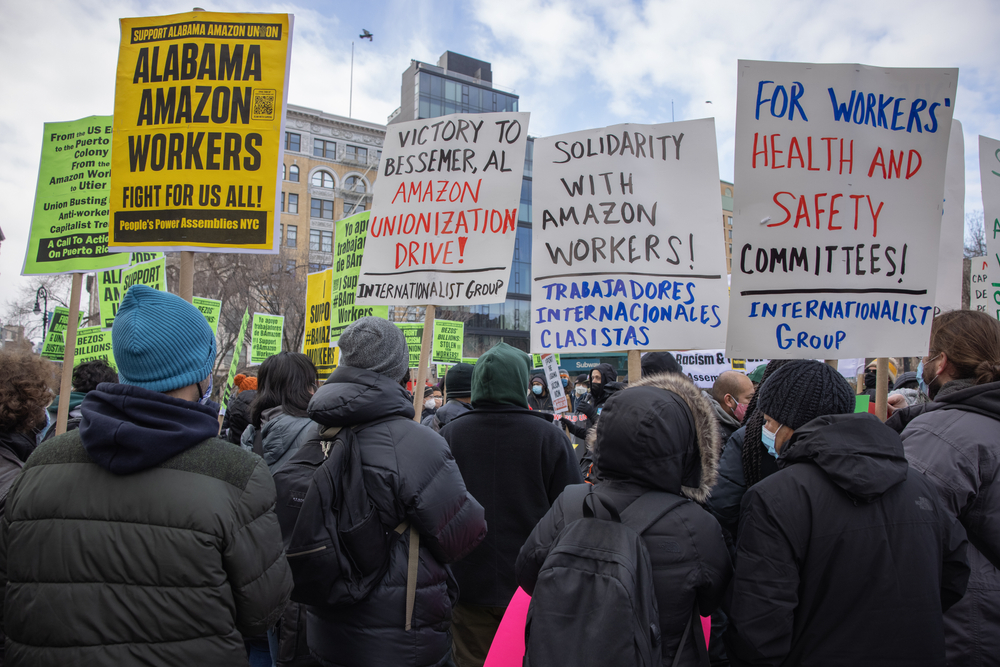
Labor negotiations can come up against numerous obstacles on the path to reaching a fair resolution. Corporations have a history of utilizing their massive wealth and influence to push anti-union policies. In March 2024, several multinational corporations infamous for their vigorous union-busting efforts and abuse of workers–such as Amazon, Starbucks, and SpaceX–directly challenged the National Labor Relations Act, which established the National Labor Relations Board, the agency responsible for enforcing labor regulations and protecting unions. These corporations argue the legislation is unconstitutional, therefore suing for its repeal. Similarly, corporations lobby with, compose, and donate money to anti-worker groups like ALEC and the National Right to Work Committee, which in turn utilize PACs and lobbying groups to encourage anti-worker legislation. Such legislation often include right-to-work policies, which prohibit union security agreements, and contractual requirements delineating the affiliation workers can or must have with their workplace union. Prohibiting these agreements would undermine unions’ influence over contracts and exclude new hires from membership, thereby preventing labor action. Additionally, employers have a history of directly interfering with negotiation efforts through making unofficial contract promises, turning workers against the union, harassing union members outside of the workplace, delaying negotiations, or disrupting the negotiations schedule. Since workers labeled ‘gig workers’ and independent contractors have fewer legal protections, earn lower wages, receive no benefits, and can more easily be replaced, employers will classify workers as such in order to circumvent labor regulations and prevent unionization and potential negotiations. Labor negotiations can often become long and arduous due to employer pushback. Starbucks Workers United, the union representing Starbucks stores based in Ithaca, New York, was targeted by the corporation while organizing in 2022 and 2023. Ithaca Starbucks locations began unionizing in April of 2022, only for negotiations to be halted, sometimes for months at a time, as the corporation began to shut down Ithaca locations that June. The union sued in response, and so the NLRB took on the Starbucks case in November 2023. A verdict was reached indicting Starbucks for union-busting in July of 2023, and judges ordered the reopening of the closed Ithaca locations in September of 2024–meaning that despite ultimately failing to union-bust, Starbucks’ efforts delayed negotiations by at least two years. Starbucks has claimed it both adheres to labor laws and respects unions, but the more than ninety unsettled workers’ claims of labor rights violations in 2023 indicate otherwise (Muñoz and Senzon 2023). These tactics–halting negotiations, antagonizing workers, stalling legal action indefinitely–are common strategies among anti-union employers. With President-elect Donald Trump’s intentions to dismantle regulatory bodies, they could become even more routine for labor negotiations–leading to reduced wages, benefits, and protections across the country.
The troubling future for labor unions reflects an existing trend of labor struggle. The number of unions has already declined significantly over the past forty years. The share of American workers in unions has decreased from 20.8% in 1983 to just 10% in 2023 (Pew Research 2024). In recent years, however, public opinion has shifted in favor of unions. Since 2008, the proportion of Americans who approve of unions has risen from 48% to 70% (Gallup Polls 2024). This change demonstrates that Americans increasingly favor unions regardless of federal administration, and could reflect an increased concern for their workers’ welfare, given the benefits that they provide. A Pew Research poll conducted in March 2024 echoes a similar sentiment, showing that 54% of Americans see the decline of union membership as bad for the country, and around 60% see the decline as bad for working people in particular. Younger generations are more likely to support unions as well, with millennials and Generation Z viewing the decline of unions less favorably than older generations (Pew Research 2024).
The conflict between labor unions and employers has persisted long before our living memory. The Harlan County War, for example, was a prolonged conflict between unionized coal miners and mine owners in Kentucky. In the early 1930s, armed struggle between striking workers and the mine operators’ cohort of hired muscle, police, politicians, and the United States Military erupted over concerns regarding poor conditions and low wages. The War was prolonged when the mine operators and local officials enacted what the governor of Kentucky called a “reign of terror” over the entirety of the decade, which entailed the bombing, shooting, and beating of their disgruntled workers.
Labor unions are of chief importance to the future of America, as the leverage they maintain in negotiating contracts is the largest advantage that the vast majority of workers have in achieving better conditions, wages, and benefits. However, employers can always be expected to undermine the presence and influence of unions for their own self-interest. This means that the agenda the new Trump administration has for labor is not a new one; it is the same agenda that business owners have always had, as seen in the Harlan County War. At the same time, the benefits provided by union presence are being increasingly recognized and, while slow, public perception is shifting more to favor unions. Only time will tell how labor negotiations will be impacted by the coming administration, but if current trends are any prediction of the future, the current economic conditions facing workers will continue to cause the American people to become increasingly pro-labor.

Travis Rayome is an English and Economics major from Alexandria, Virginia. He hopes to work for humanitarian NGOs around the Washington, DC area, continue writing on politics and economics, and play music. His areas of political interest are propaganda and information dissemination, structural violence and inequality, and power distribution within and between nation states.
References
American Federation of Labor and Congress of Industrial Organizations. 2024. “What Unions Do.” https://aflcio.org/what-unions-do
Banerjee, Asha. 2021. “Unions Are Not Only Good for Workers, They’re Good for Communities
and for Democracy.” Economic Policy Institute, December 15.
https://www.epi.org/publication/unions-and-well-being/.
Berry, Aurora. 2024. “Judge Orders Reopening of 2 Unionized Starbucks Stores in Ithaca That Closed.” WSKG, September 16. https://www.wskg.org/2024-09-16/judge-orders-reopening-of-2-unionized-starbucks-stores-in-ithaca-that-closed.
Gallup Polls. 2024. “Labor Unions.” https://news.gallup.com/poll/12751/labor-unions.aspx.
Galvin, Daniel J. 2021. “Labor’s Legacy: The Construction of Subnational Work Regulation.” ILR Review, October. https://journals.sagepub.com/doi/10.1177/0019793920943831.
Greenhouse, Steven. 2024. “Major US Corporations Threaten to Return Labor to ‘Law of the Jungle’.” The Guardian, March 10. https://www.theguardian.com/us-news/2024/mar/10/starbucks-trader-joes-spacex-challenge-labor-board.
Husak, Corey. 2019. “How US Companies Harm Workers by Making Them Independent Contractors.” Equitable Growth, July 31. https://equitablegrowth.org/how-u-s-companies-harm-workers-by-making-them-independent-contractors/.
Muñoz, Gabriel and Senzon, Julia. 2023. “Starbucks Found Guilty of Violating Labor Laws in Ithaca Closure.” The Cornell Daily Sun, July 7. https://cornellsun.com/2023/07/07/starbucks-found-guilty-of-violating-labor-laws-in-ithaca-closure/.
National Education Association. 2024. “How Does Collective Bargaining Work? A Step-by-Step Guide.” https://www.nea.org/sites/default/files/2022-07/How%20Does%20Collective%20Bargaining%20Work%3F%20A%20Step-by-Step%20Guide.pdf (accessed 14 November 2024).
SAG-AFTRA, 2024. “We’re Fighting for the Survival of Video Game Performers.” August 19. https://www.sagaftra.org/were-fighting-survival-video-game-performers.
Union Busting Playbook. 2024. “Union Busting Playbook.” Communications Workers of America. https://unionbustingplaybook.com/.
United Steel Workers. 2024. “Who is Behind These Anti-Worker Bills?” https://m.usw.org/act/campaigns/rtw/resources/who-is-behind-these-anti-worker-bills.Van Green, Ted. 2024. “Majorities of Adults See Decline of Union Membership as Bad for the U.S. and Working People.” Pew Research Center, March 12. https://www.pewresearch.org/short-reads/2024/03/12/majorities-of-adults-see-decline-of-union-membership-as-bad-for-the-us-and-working-people/.

 Happy Medium
You must be logged in to post a comment.