By Moss Magnusson, Political Theory
It’s a worrying paradox—information used to evaluate trust in the media is itself vulnerable to distrust.
If you ever try writing on a topic such as trust in media, you might find yourself in an infinite regression, similar in difficulty to answering “What came before the Big Bang?” Read one report, check the “AllSides” media bias score, and then wonder: “What’s the AllSides media bias score for AllSides?” For the sake of sidelining this regression, and for the sake of transparency, I’m going to be using AllSides (a media bias evaluator) as a baseline. Sites like these are key players in regaining the public trust in mainstream media. However, this dilemma highlights a deeper issue within media literacy—without a universally trusted standard, assessments of media trustworthiness can become circular or self-defeating. For Americans, amongst whom trust in the media is at an all-time low, this circularity is exactly what makes trusting the media so difficult. In this article, I will evaluate the current state of trust in mainstream media, investigate how we got here, and consider a path forward.
What are the statistics on media trust?
Partisanship has made this task a little easier by indicating that there is a consensus in the numbers across the political divide—Americans’ trust in the media is at an all-time low. A poll from Gallup (AllSides bias score: 0) that was covered by both Fox News (AllSides bias score: 3.88/6), and The New Yorker (AllSides bias score: -4.2/-6) indicated that “Americans continue to register record-low trust in the mass media” (Gallup 2022); (Allsides, n.d.). (A negative AllSides score indicates a left-leaning bias and a positive score indicates a right-leaning bias.) The poll, released in mid-October, shows a decline in trust among all Americans but particularly, across three groups: self-identified Democrats, Republicans, and independents. Below are the respective charts from Gallup, who started polling these questions in the early ‘70s and returned to them in the mid-’90s:
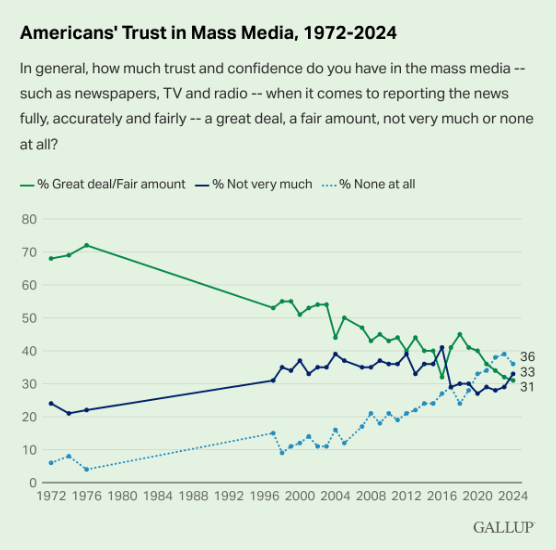
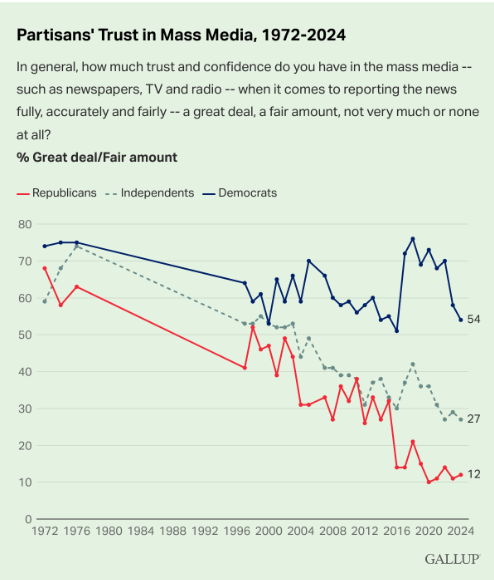
Besides an ominously persistent decline in trust overall, the first graph shows that U.S. adults have reversed the trends we’d hope to see concerning trust in mass media: 36% reported having no trust at all, 33% reported having not very much trust, and 31% reported having a great deal of trust (Gallup 2022). As Gallup noted, this is “the third consecutive year [that] more U.S. adults have no trust at all in the media…than trust it a great deal or fair amount” (Gallup 2022). The second graph illustrates that, despite the widely differing levels of trust across partisan groups, they have all been trending downward over the last six years.
With trust dwindling, mainstream media faces weighty challenges, the most concerning of which involves a shift to alternative forms of media. These forms of media are concerning because, to be used effectively, these sources—Facebook, X (formerly Twitter), podcasts, and the like—must be approached by consumers with an added level of caution. Deriving news from these sources can sometimes mean simply viewing a popular yet unresearched post that, on many occasions, is not subject to any form of fact-checking. Such is the case on platforms like X, which, in recent years, has seemingly done a very poor job of blocking misinformation.
With added levels of uncertainty, consumers should be more weary of these forms of media. But a recent poll conducted by the Pew Research Center (AllSides bias score: 0) indicates that this isn’t necessarily so (Allsides, n.d.). An October 16th poll indicated that Republicans are now almost as likely to trust information from social media as they are from national news outlets (Pew Research Center 2024). Although their trust in social media aligns closely with that of Democrats, Republicans’ trust in national news has dropped by thirty percentage points since 2016. Trust in local news remains relatively high for both groups, though Republicans consistently express less trust than Democrats.
This trend is not solely partisan—age also plays a significant role in influencing trust in media sources.
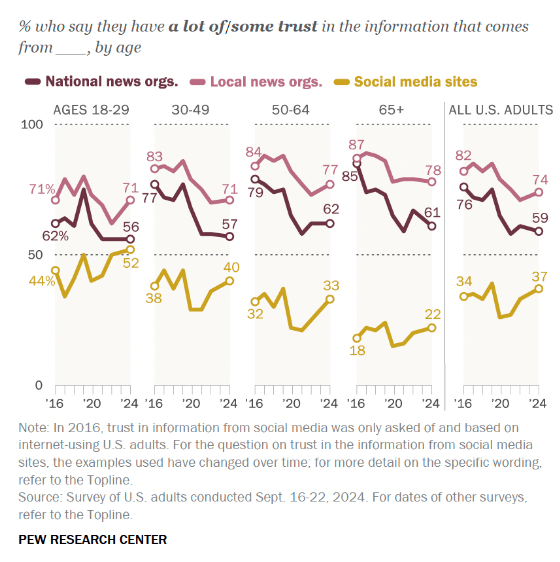
The perceived interchangeability between national news organizations and social media is also seemingly true for adults under thirty (Pew Research Center 2024). Here, young adults have almost equal trust in national news outlets as they do in social media, at 56% and 52% respectively.
How did we get here?
Jesse Halcomb, writing for the Pew Research Center, says that when investigating the cause of these trust issues, “we ought to be cautious about oversimplifying a decades-long phenomenon” (Pew Charitable Trusts 2024). He considers the problem to have three broad and intertwining causes: increased political polarization, heaps of new media platforms, and economic difficulties faced by the news industry (Pew Charitable Trusts 2024). It is not unreasonable to claim that recent Trumpian rhetoric has likely accelerated mistrust in mainstream media and that this is a likely explanation for Republicans’ diminished trust compared to other groups. (“Donald Trump has called journalists and news outlets ‘fake news’ nearly 2,000 times since the beginning of his presidency, averaging more than one daily broadside against the press over the last four years”) (Woodward 2020). But trust in the media is diminishing across partisan lines and the essential question still remains: are these grievances legitimate? Journalists are far more likely to be Democrats than they are Republicans. A 2022 poll from Syracuse University found that the number of journalists who identified as Republican was only around 3.4% compared to 36.4%, 51.7%, and 8.5% for Democrats, Independents, and ‘Other,’ respectively (Willnat et al. 2022). Other studies have found similarly small numbers of Republicans in journalism. This may help explain lopsided trust in mass media.
As for the heaps of new media platforms, more does not equal better. Media outlets took advantage of a quickly realized exploit: attacking the credibility of the mass media was an easy way to grow their brand (Pew Charitable Trusts 2024). When the news began to diversify in this way, and Americans were no longer relying on one of three major news outlets, as they were in the ‘70s, a partisan sort began to emerge. Overtly biased news stations grew in numbers and became more acceptable. This diversification, coupled with the arrival of the internet, put an economic strain on the once-booming news industry (Pew Charitable Trusts 2024). This squeeze necessitated a large reduction in the number of journalists working for newspaper companies. With the loss of journalists came less diverse reporting and competition with the web for advertising revenue (Pew Charitable Trusts 2024). What followed was simply a worse news product that left readers disinterested in the quality of the journalism and skeptical of the business’ motivations (Pew Charitable Trusts 2024).
What is the path forward?
Outlets such as the Washington Post have begun trying to take back the reins on the trust issue. Most recently, they abstained from a long-established tradition of endorsing a presidential candidate. In an opinion piece entitled “The hard truth: Americans don’t trust the news media,” Washington Post owner Jeff Bezos writes this about the decision: “By itself, declining to endorse presidential candidates is not enough to move us very far up the trust scale, but it’s a meaningful step in the right direction” (Washington Post Editorial Board 2024). This decision was a contentious one, leading three editorial board members to step down in the wake of over 200,000 canceled Post subscriptions (NPR 2024). Whether you agree with the endorsement decision or not, it demonstrates that both people and media companies are ready and willing to take large steps to rectify this trust issue.
James Coan, co-founder and Executive Director of “More Like US”—an organization focused on bridging the partisan divide—has explored the relationship between increasing partisanship and declining trust while mapping out potential solutions. Coan writes mostly on his efforts to reduce polarization—described above as a direct contributor to the erosion of trust. He has proposed numerous solutions to polarization that, in my view, would have the effect of increasing trust in the media, namely, his idea of a “unifying news,” which “would provide informative and newsworthy content, but also other data or context that facilitates greater social cohesion” (The Fulcrum 2024b). This type of content would specifically showcase bipartisan victories, shared goals, and other stories of collaboration (The Fulcrum 2024b).
Furthermore, Coan notes that it’s possible to take direct steps to increase trust (The Fulcrum 2024a). This can be achieved by showcasing cross-partisan similarities (as is done by AllSides’ Similarity Hub and More Like US), portraying people across the political spectrum positively (an approach taken by Bridge Entertainment Labs), and encouraging civil discourse, as many groups in the #ListenFirst Coalition do (The Fulcrum 2024a). Through these methods, Coan aims to present a pathway toward reducing polarization. The potential solutions to this multi-decade issue can sometimes be expressed simply. For James Coan, it’s about “adding more trust” and “reducing polarizing rhetoric and behavior” (The Fulcrum 2024a). However, he acknowledges that while the vision may be straightforward, the path is far from easy. Achieving this kind of change demands a unified effort, one that encourages a critical and constructive approach to media, grounded in compassion and thoughtfulness.
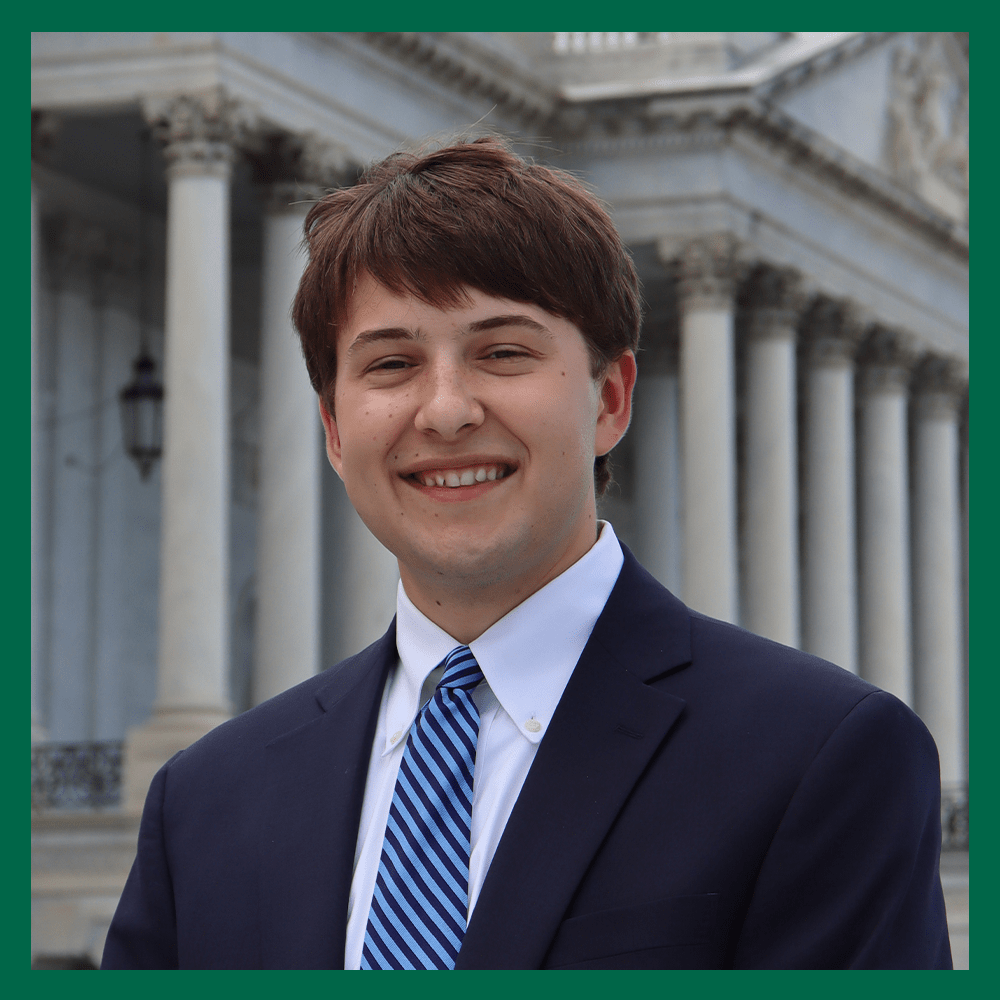
Moss Magnusson is a senior at Binghamton University, double majoring in political science and PPL (politics, philosophy, and law). Originally from Rhinebeck, NY—a small upstate town in the Hudson Valley—Moss has gained valuable experience during his time interning on Capitol Hill, where he contributed to writing congressional records and other legislative materials. While deeply engaged in his political science studies, he also enjoys spending time with friends, playing tennis, and reading. After graduating this spring, Moss plans to work for a year while preparing for the LSAT, with the goal of attending law school the following fall.
References
AllSides. n.d. “Fox News Media Bias.” AllSides. https://www.allsides.com/news-source/fox-news-media-bias (November 22, 2024).
AllSides. n.d. “New Yorker Media Bias.” AllSides. https://www.allsides.com/news-source/new-yorker (November 22, 2024).
AllSides. n.d. “Pew Research Media Bias.” AllSides. https://www.allsides.com/news-source/pew-research (November 22, 2024).
Gallup. 2022. “Americans’ Trust in Media Remains Near Record Low.” https://news.gallup.com/poll/651977/americans-trust-media-remains-trend-low.aspx (November 22, 2024).
National Public Radio (NPR). 2024. “Washington Post Faces Internal Turmoil over Bezos’ Endorsement of President.” October 28. https://www.npr.org/2024/10/28/nx-s1-5168416/washington-post-bezos-endorsement-president-cancellations-resignations (November 22, 2024).
Pew Charitable Trusts. 2024. “Media Mistrust Has Been Growing for Decades. Does It Matter?” Trend Magazine, Fall 2024. https://www.pewtrusts.org/en/trend/archive/fall-2024/media-mistrust-has-been-growing-for-decades-does-it-matter (November 22, 2024).
Pew Research Center. 2024. “Republicans, Young Adults Now Nearly as Likely to Trust Info from Social Media as from National News Outlets.” Pew Research Center Short Reads. https://www.pewresearch.org/short-reads/2024/10/16/republicans-young-adults-now-nearly-as-likely-to-trust-info-from-social-media-as-from-national-news-outlets/ (November 22, 2024).
The Fulcrum. 2024a. “Building Trust among Americans.” The Fulcrum. https://thefulcrum.us/bridging-common-ground/building-trust-among-americans (November 22, 2024).
The Fulcrum. 2024b. “The Importance of Non-Partisan News.” The Fulcrum. https://thefulcrum.us/civic-engagement-education/non-partisan-news (November 22, 2024).
Washington Post Editorial Board. 2024. “Jeff Bezos’ Leadership at the Washington Post Sparks Debate about Trust.” The Washington Post, October 28. https://www.washingtonpost.com/opinions/2024/10/28/jeff-bezos-washington-post-trust/ (November 22, 2024).
Willnat, Lars, David H. Weaver, and Cleve Wilhoit. 2022. The American Journalist Under Attack: Key Findings 2022. Syracuse, NY: S.I. Newhouse School of Public Communications, Syracuse University.
Woodward, Alex. 2020. “‘Fake News’: A Guide to Trump’s Favourite Phrase – and the Dangers It Obscures.” The Independent, October 2. https://www.the-independent.com/news/world/americas/us-election/trump-fake-news-counter-history-b732873.html (November 22, 2024).

 Happy Medium
You must be logged in to post a comment.