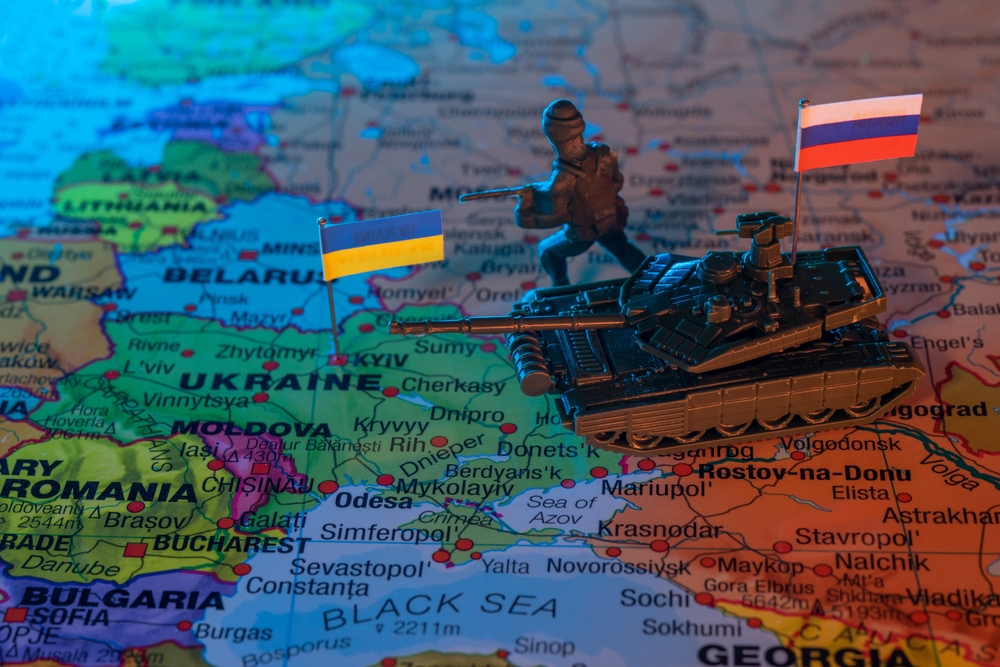
By Hunter Loren, Current Affairs
Recently, Russian and Ukrainian envoys agreed to a tentative limited ceasefire deal in the Black Sea that would temporarily halt targeting all commercial vessels in the region, as well as strikes on energy facilities after intense negotiations in Riyadh, Saudi Arabia. The deal has not yet been implemented, and since the agreement the Russian Federation has introduced preconditions on accepting the deal. These include the lifting of sanctions, and the Russian foreign minister Sergey Lavrov also implored the U.S. to enforce the new deal allowing cargo ships to pass through the Black Sea. Since the talks, Russia has launched drone attacks at the Ukrainian port city Mykolaiv. Despite continued drone strikes, the White House has hailed the talks so far as progress towards an eventual full ceasefire. With the war now in its fourth year, just how likely is a ceasefire and subsequent path to peace?
The Current State of the War
After threatening the Ukrainian capital Kyiv with its initial incursion, the Russian offensive begun in February 2022 was pushed out entirely of northern Ukraine, and has since been ground to a halt with only marginal gains in territory throughout the country’s southeast and most of the fighting concentrated in the Donetsk, Luhansk, Zaporizhia, and Kherson oblasts. The Ukrainian war effort has largely been supplied by a joint commitment between the U.S. and European Union to give military aid to Ukraine, with the U.S. having contributed roughly 114.2 billion Euros and Europe giving 132.3 billion Euros (Kiel Institute for the World Economy 2024).

The vast majority of American aid to Ukraine came from the Biden administration, which saw the start of the war and showed staunch support for funding the Ukrainian defense against Russia. Since the latest U.S. presidential election, however, American foreign policy has endured a dramatic shift. In contrast to the Biden administration, the new Trump administration has made ending the war in Ukraine a top priority amid continuing arms shipments to the country. Trump has put mixed forms of pressure on both Russia and Ukraine to come to peace talks instead of taking a wholly pro-Ukrainian approach. Since January, the U.S. has demanded a mineral deal in Ukraine, which possesses 5% of the world’s “critical raw materials” including graphite (a key component of electric vehicles), titanium, and lithium (Abdurasulov and Plummer 2025). On February 28, Ukrainian president Volodymyr Zelenskyy visited the White House in part to discuss a potential mineral deal, which the U.S. deemed would repay the aid it has given. The meeting ended early, with the Ukrainian leader asked to leave the White House after a sequence of beratements ensued on live television. The U.S. briefly paused its military aid to Ukraine as well as intelligence assistance, but restored the services soon after Russian troops advanced on Ukrainian positions in Kursk (Stone and Banco 2025). The mineral deal has still not been signed. The events at the White House meeting, in addition to past comments about the Ukrainian state and its leader—referred to as a dictator by President Trump in February—indicated that the new figureheads of American foreign policy are not nearly as sympathetic to the Ukrainian war effort as its predecessors have been.
The State of Ceasefire Deals
In light of President Zelenskyy’s White House visit, British and French leaders Keir Starmer and Emmanuel Macron have worked to amp up European influence on the matter, including pushing for their own ceasefire plan. After meeting with leaders of 18 countries (including Ukraine) on March 2, four points were agreed upon:
- Keep military aid flowing into Ukraine, and continue increasing economic pressure on Russia
- Any lasting peace must ensure Ukrainian sovereignty and security with Ukraine present at all peace talks
- To boost Ukraine’s defensive capabilities to deter future invasions
- To develop a “coalition of the willing” to defend a deal in Ukraine and to guarantee peace afterwards
The proposed coalition of the willing would likely be a permanent presence of forces from the UK, France, the Baltic States, Finland, and Canada acting as peacekeepers in Ukraine. This plan has since been dismissed as “pure fantasy” by Lavrov (Tass 2025).
The propositions that have had the most success in engaging Russia have been from the U.S.; these also include the most concessions to Russian demands. One of President Trump’s main foreign policy goals throughout the campaign for the 2024 election was ending the war as soon as possible, which he claimed would happen in 24 hours (Lederer 2024). Months later, there is still no sign of a permanent ceasefire or lasting peace deal. The Trump administration has laid out its own plan for an end to the Russo-Ukrainian war, which would begin with a full 30-day ceasefire along the current frontlines, and, crucially, would dispel any aspirations of joining NATO Ukraine might have (Ross 2025). The U.S. has also ruled out providing security guarantees and supporting Ukrainian aspirations of gaining back Russian-occupied territory in its southeast, as concessions to Russia. Ukraine was initially discontent with this plan for numerous reasons; the most obvious is that Russia currently occupies roughly a fifth of prewar Ukraine, and Zelenskyy has made clear that under no circumstances will he recognize the legitimacy of territorial concessions. The second is the lack of trust in the U.S.’s backing of Ukraine should any deal be violated by Russia. After all, Ukraine inherited a massive stockpile of Soviet nuclear weapons after its independence, and agreed to give them up in exchange for a U.S. security guarantee in 1994—a promise that was broken in 2014 when Russia annexed Crimea and began supporting separatist movements in Donetsk and Luhansk. Interestingly, however, Ukrainian president Zelenskyy actually accepted the Trump administration’s 30-day ceasefire plan and has since worked to, essentially, call Putin’s bluff (Kottasová et al.). Given Russian resistance to a full ceasefire agreement, Ukraine’s acceptance of the proposal largely works in the country’s favor, as a way of proving itself as the more willing party to negotiate.
How Likely is a Ceasefire?
The main obstacle to a ceasefire deal has been Russia. Recently, Putin claimed that the current Ukrainian government lacks the legitimacy to sign a peace deal, and would implore new “elections” to oust Zelenskyy before accepting peace (Greenale and Landale 2025). There are three likely reasons for Putin’s resistance. First, since sanctions were placed on Russia at the beginning of the war, the Russian economy has shifted almost entirely to a wartime economy. As a result of incredibly high military spending—which reached 5.9% of its GDP by 2025—the war has actually benefited some idle parts of the country that have long been in economic decline (World Bank 2025). Defense factories in rural parts of the country have been operating at full capacity since 2022, leading to record low unemployment . Putin likely believes that Russia’s economy can continue running hot if inflation can be managed through interest rate hikes, which reached a record 21% last December (Kolyandr 2025). Second, Trump’s willingness to downplay Ukraine’s struggles may fuel maximalist intentions: Ukraine’s total demilitarization and Russian annexation of the four oblasts it occupies. Lastly, ending the war could jeopardize Putin’s hold on power domestically. The Russian president has made it clear that a ceasefire in Ukraine doesn’t actually help Russia in any way, agreeing to the deal in the Black Sea because the real battle is being waged on the ground. Russia will likely only accept a peace deal that would see Ukraine assume Finland’s Cold-War status, when the Nordic nation wasn’t quite part of the Soviet sphere, but was neither permitted to join Western alliances and maintained a forced policy of neutrality. Until the war becomes a complete stalemate, or Russia is given enough concessions to allow effective control of Ukraine, it is unlikely that a ceasefire will be accepted or honored in the long term.

Hunter Loren is a Political Science/Economics major from Great Neck, NY. After his undergraduate years, he aims to pursue a masters degree in International Relations. Building on previous experience in IR tutoring, Hunter intends to shed light on happenings in more unknown parts of the world. When he was nine years old he had an email correspondence with the president of Lithuania and he enjoys motorsports, baseball, and guitar.
References
Abdurasulov, Abdujalil, and Robert Plummer. 2025. “What Minerals Does Ukraine Have and What Are They Used For?” BBC News, March 5, 2025. https://www.bbc.com/news/articles/c20le8jn282o
Cadier, Alex. 2025. “You Can’t Trust Russians — Europe’s Ukraine Peacekeeping Plans Face One Obvious Hurdle.” The Kyiv Independent, March 29, 2025. https://kyivindependent.com/you-cant-trust-the-russians-europes-ukraine-peacekeeping-plans-face-one-obvious-hurdle/
Rachel Clun. 2025. “Black Sea Ceasefire: Why Crucial Ukraine-Russia Deal May Never Work Despite Concessions Made to Putin.” The Independent, March 31, 2025. https://www.independent.co.uk/news/world/europe/black-sea-ceasefire-ukraine-russia-war-putin-b2724725.html
Greenall, Robert, and James Landale. 2025. “Putin Floats Idea of UN-Led Government in Ukraine.” BBC News, March 27, 2025. https://www.bbc.com/news/articles/crlxl37wnnyo (March 31, 2025).
Harward, Christina, Nicole Wolkov, Davit Gasparyan, Olivia Gibson, Daria Novikov, George Barros, and Frederick W. Kagan. 2025. “Russian Offensive Campaign Assessment, March 5, 2025.” Institute for the Study of War, March 5.
Kiel Institute for the World Economy. 2025. “Ukraine Support Tracker.” Kiel Institute for the World Economy, March 31, 2025. https://www.ifw-kiel.de/topics/war-against-ukraine/ukraine-support-tracker/
Kolyandr, Alexander. 2025. “Addicted to War: Undermining Russia’s Economy.” Center for European Policy Analysis, February 5, 2025. https://cepa.org/comprehensive-reports/addicted-to-war-undermining-russias-economy/
Kottasová, Ivana, Lauren Kent, Alex Marquardt, and Jennifer Hansler. 2025. “Ukraine Agrees to Proposal for Ceasefire with Russia as US Restores Aid and Intel Sharing.” CNN, March 12, 2025. https://www.cnn.com/2025/03/11/world/ukraine-us-talks-saudi-arabia-intl/index.html
Ross, Tim. 2025. “Trump’s Ukraine Ceasefire Plan: What We Know So Far.” POLITICO, March 12, 2025. https://www.politico.eu/article/donald-trump-ceasefire-plan-ukraine-jeddah-saudi-arabia-russia-fighting/
Starcevic, Seb. 2025. “EU Offers Its Own ‘Win-Win’ Minerals Deal to Ukraine.” POLITICO, February 25, 2025. https://www.politico.eu/article/critical-minerals-rare-earths-deal-eu-not-donald-trump/
Stone, Mike, and Erin Banco. 2025. “How Trump’s Ukraine Military Aid Halt Affects US Defense Industry.” Reuters, March 4, 2025. https://www.reuters.com/world/trump-halts-military-aid-ukraine-what-does-that-mean-2025-03-04/
TASS Russian News Agency. 2025. “Lavrov Dismisses EU’s Ukraine Mission Plans as ‘Dreamers’ Fantasy.” TASS, March 25, 2025. https://tass.com/politics/1933681
Wong, Vicky. 2025. “Starmer Announces ‘Coalition of the Willing’ to Guarantee Ukraine Peace.” BBC News, March 3, 2025. https://www.bbc.com/news/articles/c9vygkzkkrvo
World Bank. 2025. “Military Expenditure (% of GDP) – Russia.” World Bank Open Data. https://data.worldbank.org/indicator/MS.MIL.XPND.GD.ZS?locations=RU

 Happy Medium
You must be logged in to post a comment.