
By Chase Quinn, Elections
Image: Rawpixel.com
Voters in New York City are set to go to the polls on November 4th to elect a new mayor. In the months leading up to the election, the race has been jam packed. Currently, the four main candidates in the race are Zohran Mamdani (Democrat), Eric Adams (Independent), Andrew Cuomo (Independent), and Curtis Sliwa (Republican). In June, Mamdani shook the political stage by successfully winning the Democratic primary against both incumbent Eric Adams and former governor Andrew Cuomo, forcing the two to run as independents.
Political campaigns often require a lot of money to run. Some notable costs are travel, advertisement, organization, staff wages, legal fees, and many more. For political candidates, attracting funds and utilizing them efficiently can make or break a campaign. Financing is a large component of running a successful operation, and looking at where the money is coming from often tells its own story aside from the one presented to voters by candidates themselves. The New York City Campaign Financing Board runs an initiative known as “Follow the Money,” where campaign finance data from political candidates is tracked and recorded in an effort to make public elections more transparent (NYC Campaign Finance Board 2025). Using this data, I compiled a number of visualizations based on factors such as public versus private funding, independent expenditures, and donation contributions. First, however, let’s take a quick look at the current state of the race.
A Brief Overview of the Race
Based on recent data taken from The New York Times, I averaged the findings of the most recent seven polls (starting in September 2025) to account for variation between different pollsters. The data below is in the form of the projected percentage of votes for each candidate.

As shown by the most recent polling data, Mamdani commands a solid double-digit lead on the next biggest competitor, Andrew Cuomo, giving him an average margin of +18 percentage points. Currently, Cuomo and Mamdani are the main competitors, with Sliwa and Adams trailing far behind the two. Interestingly, Adams is polling the lowest despite having the advantage of incumbency. Now, onto the finances.
Public and Private Spending
The NYC Campaign Financing Board provides a financial incentive for candidates to run for office by matching certain qualified contributions to their campaign, known as “public” funding. This is meant to increase accessibility to public offices and reduce political corruption by amplifying funding from everyday New Yorkers and discouraging candidates from seeking funds from private interests such as SuperPAC groups (NYC Campaign Finance Board 2025). Public funding also encompasses any government, state, or city-wide program that provides campaigning funds to political candidates. Private funding includes all other forms of contributions, including the candidate’s personal resources, donations from individuals and organizations, and funds received from political action committees. Below is a chart including the public, private, total, and spending amounts for each candidate in the mayoral race.
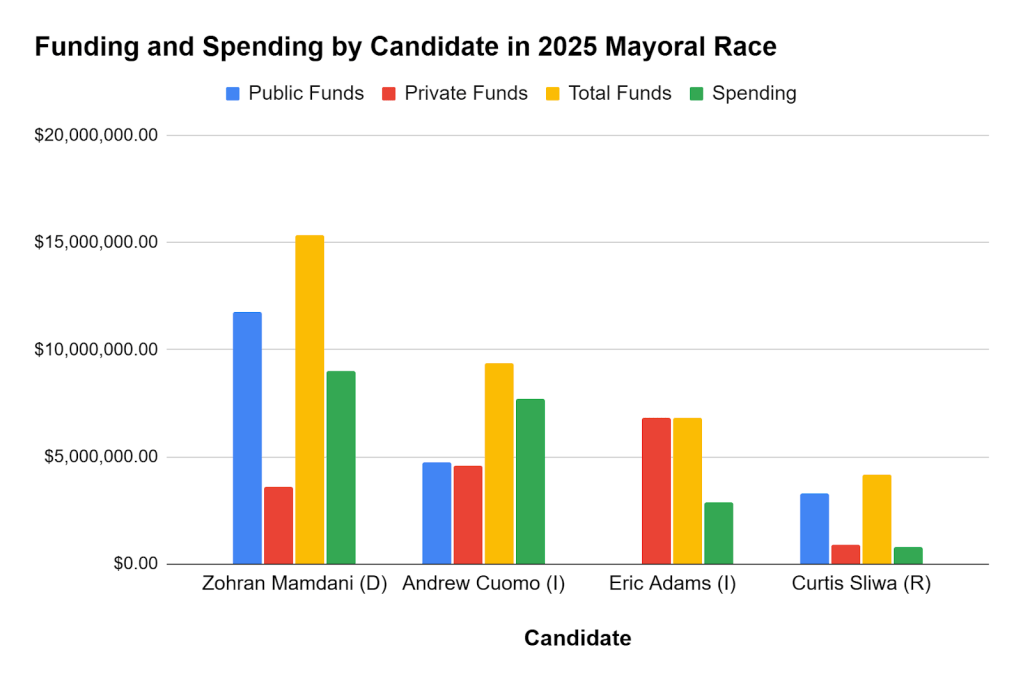
Analyzing the data shown on the left, Mamdani has received the greatest amount of public funding, more than the other three candidates combined. This is likely due to large amounts of individual donations to the Mamdani campaign, which are then matched by the Campaign Finance Board. Additionally, the Mamdani campaign beats out all other candidates in other areas except for in the private funding sector, of which Eric Adams holds the most. Andrew Cuomo has nearly equal amounts of public versus private contributions, while Sliwa’s combined funding has not yet broken the 5 million mark. Notably, Mamdani and Cuomo have the highest, and almost equal amounts of spending, which is to be expected considering they are the two main competitors. Additionally, the Adams campaign does not show any public funding. This is due to the finance board’s rejection of Adams’ eligibility for public funds matching. According to the board, “…his campaign had provided ‘incomplete and misleading’ information, and the board believed that the campaign had violated the law” (Fitzsimmons 2025).
Independent Expenditure
As defined formally by the Federal Elections Commission, independent expenditure is “…an expenditure for a communication that expressly advocates the election or defeat of a clearly identified candidate and which is not made in coordination with any candidate or their campaign or political party” (FEC 2025). In simpler terms, this is any spending in support or opposition of a candidate that is done by outside organizations not directly involved with any political campaign. Independent expenditure is often done by individuals or organizations with special interests that may benefit or be harmed by the election of a certain candidate. For example, if an oil company knows that a certain candidate will push for the adoption of clean-energy technology, the company has a vested interest in making sure that candidate does not win the election, as it will harm their business if they did. Data for independent expenditure by candidate is shown below. Data for Curtis Sliwa was not given by the finance board.

This graph contains very contrasting information for all three candidates listed. For one, Andrew Cuomo has a very large amount of independent expenditure supporting his campaign, almost 18.7 million dollars to be specific. Very little is spent on opposition to Cuomo. In contrast, Mamdani has a large amount of money (8.8 million) spent in direct opposition to his campaign, and very little in support of it. Eric Adams has very low values for every category, indicating that there is either not sufficient data or that outside groups are skeptical of his chances to win, thus choosing to put their money elsewhere.
The Campaign Finance Board provides data on which organizations spend money on independent expenditures, and here some observations are to be made. This data names representatives and the board of directors for each organization, and provides occupational data for these individuals as well. Some groups that have spent money in opposition to Mamdani are “Anyone but Mamdani” and “Committee for Sensible Government,” which are represented by individuals from real estate and law enforcement backgrounds, respectively. These expenditures are likely negative responses to some of Mamdani’s proposed policies, such as his “freeze the rent” initiative and his desire to reform the city police department. Looking at Cuomo’s support expenditures, the bulk of his support (14.9 million) has come from a corporation known as “Fix the City Inc,” which is primarily represented by members from various law firms, a consulting agency, a medical center, and a large corporate construction company. Unsurprisingly, this organization has also dumped 7.9 million dollars in opposition to Mamdani’s campaign, making up both a majority of Mamdani’s opposition and a majority of Cuomo’s support.
Donor Contributions
Lastly, let’s take a look at donor contributions to each candidate’s campaign. Using the data provided by the Campaign Finance Board, I constructed multiple visuals to represent the average amount of a donation given to each candidate’s campaign, as well as what percentage of donations to each campaign came from different sizes of donors.
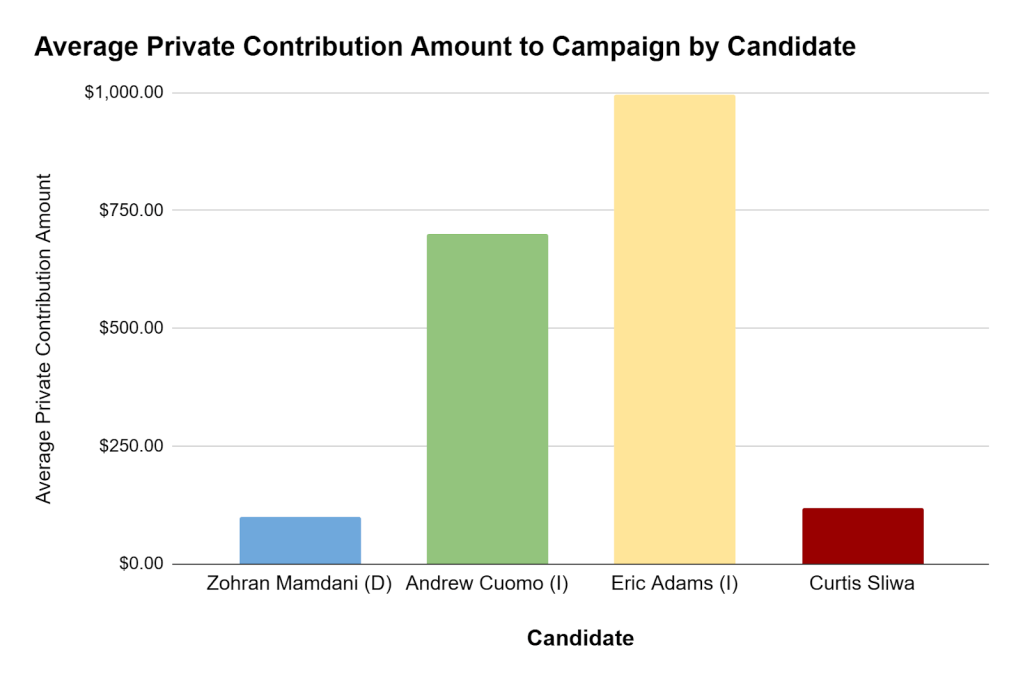
The above chart shows how large the average contribution to a candidate’s campaign is. Notably, Cuomo and Adams have very large donation amounts, signifying that they receive a large degree of their funding from larger and wealthier donors. In contrast, Sliwa and Mamdani have very small average donations, showing that a lot of their donations come from smaller and less wealthy donors.
Next is a collection of pie charts that show the percentage of private campaign contributions that come from various sizes of donors. Small donors are classified as those between $1-$175. Medium donors are those between $176-$999. Large donors are those greater than $1000. Each is coordinated by color.

As noted from previous data, Mamdani and Sliwa get a large majority of their private donations from small donors, likely representing less wealthy middle-class individuals. Cuomo has a nearly equal share of donors from each category, with medium-sized donors making up the greatest amount (39%). This signifies broad support for Cuomo from all levels of wealth. Also notable is the number of large donors that make up the greatest amount (47%) of Adam’s private funding, with medium-sized donors (41%) following close behind. This represents large support for Adams from wealthy donors.
Closing
Financing a campaign is a huge undertaking, and looking at the data involved can tell its own story. However, the mayoral race is far from done, and there is still ample time for new developments and changes of support. Andrew Cuomo and Eric Adams have been urging each other to drop out of the race, leaving space for a one on one showdown with Mamdani (Mena 2025). If this does indeed happen, it could shift Mamdani’s lead and amplify tensions in the race. For now, however, the best we can do is wait. Voting opens in NYC for the mayoral race on November 4th, from 6 am to 9 pm, and the early voting period is from October 25th to November 2nd.
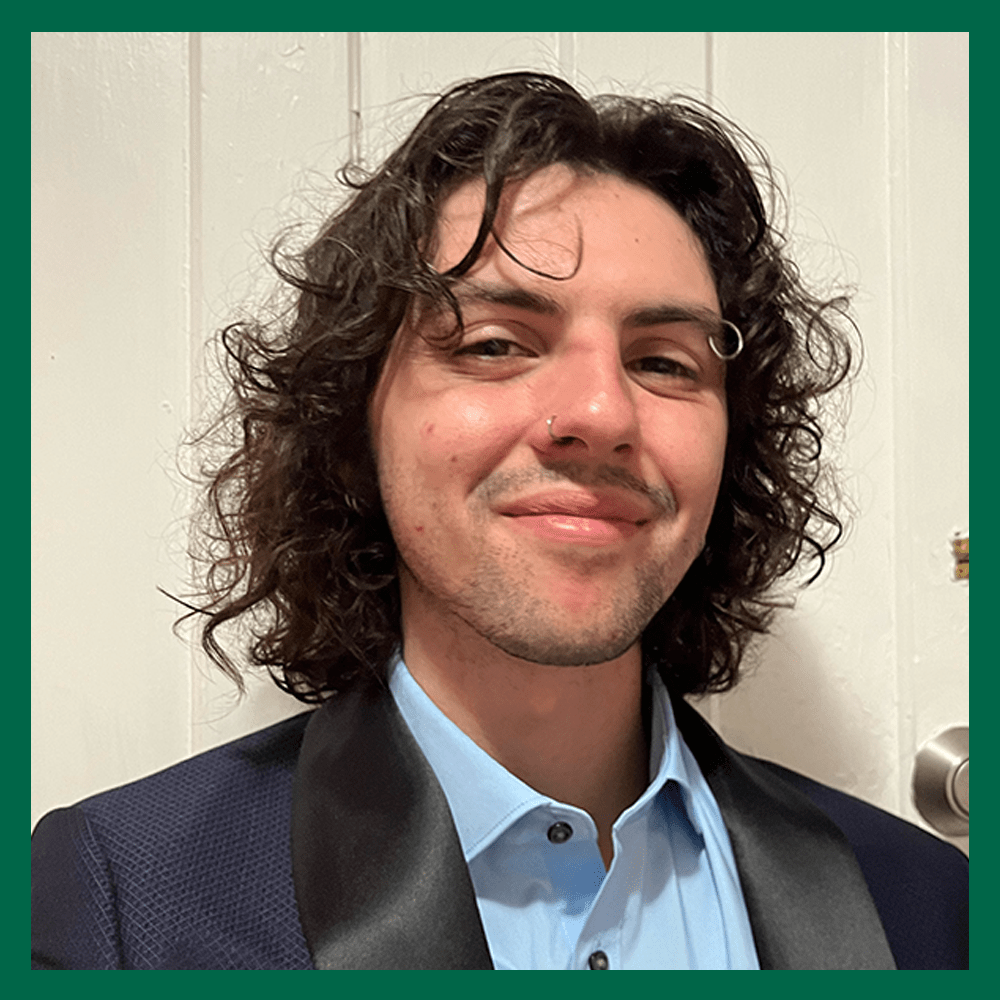
Chase Quinn is a senior at Binghamton University serving as the elections reporter. He studied journalism at Hunter College for two years before transferring to Binghamton to pursue a bachelors in Political Science and Master’s in Public Administration. He was born and raised in the town of Pine Plains, New York. Post-college he plans to conduct research on policy and law and aims to work in the public sector. In his free time, Chase likes to read, spend time outdoors, create art, and make jewelry.
References:
“Understanding Independent Expenditures.” FEC.gov. https://www.fec.gov/help-candidates-and-committees/candidate-taking-receipts/understanding-independent-expenditures/ (September 24, 2025).
Cabreros, Irineo et al. 2025. “New York City Mayoral Election 2025: Latest Polls.” The New York Times. https://www.nytimes.com/interactive/polls/nyc-mayoral-election-polls-2025.html (September 24, 2025).
“Campaign Finance Summary.” 2025. Campaign Finance Summary 2025 Citywide Elections. https://www.nyccfb.info/VSApps/WebForm_Finance_Summary.aspx?as_election_cycle=2025 (September 24, 2025).
“Law & Rules.” Law & Rules | New York City Campaign Finance Board. https://www.nyccfb.info/law (September 24, 2025).
“How It Works.” How It Works | New York City Campaign Finance Board. https://www.nyccfb.info/program/how-it-works/ (September 24, 2025).
“Upcoming Elections 2025.” Upcoming Elections 2025 | NYC Board of Elections. https://www.vote.nyc/elections (September 24, 2025).
Fitzsimmons , Emma G. 2025. “Eric Adams Is Again Denied Public Matching Funds for His Campaign – The New York Times.” Eric Adams Is Again Denied Public Matching Funds for His Campaign. https://www.nytimes.com/2025/08/06/nyregion/eric-adams-public-matching-funds-denied-re-election.html (September 29, 2025).
Mena, Kelly. 2025. Adams, Cuomo call on each other to drop out. https://ny1.com/nyc/all-boroughs/politics/2025/07/07/mayor-adams-cuomo-dropping-out (October 7, 2025)

 Happy Medium
You must be logged in to post a comment.