By Eren Filizler, Foreign Affairs
Photo:
In recent years, Türkiye’s political trajectory has become one of the most debated cases in comparative politics due to its rapid transformation from a democratically promising EU candidate to an increasingly authoritarian system. Academics, policymakers, and international observers have highlighted Türkiye as a critical example of how elected governments can gradually erode democratic institutions while maintaining formal electoral procedures. Intensifying political repression, the restructuring of state institutions, and deepening polarization have raised fundamental questions about the nature and durability of Türkiye’s current regime type. Against this backdrop, the classification of Türkiye’s political system has gained renewed attention, particularly following the arrest of Ekrem İmamoğlu—widely regarded as the main opposition’s strongest presidential contender—and the escalating pressure on the CHP. These changes have led academics to reevaluate whether Turkey is moving toward a more hegemonic and consolidated authoritarian model or if it continues to fit in the category of competitive authoritarianism.
Political scientists have long defined Türkiye’s regime as a hybrid regime, typically referred to as a competitive authoritarian regime. Competitive authoritarianism was conceptualized by Levitsky and Way in 2010 and established in the literature. This concept is formally used to describe regimes with multi-party systems and regular elections, but also regimes with oppression of the opposition, systematic inequalities, and unfair competition. Türkiye has been frequently used as a model country by political scientists, particularly since 2016. There has been a notable development recently; following the arrest of the main opposition’s presidential candidate, Istanbul Mayor Ekrem İmamoğlu, and the escalation of political pressure on the main opposition party, the CHP (Republican People’s Party), some proponents of the competitive authoritarian thesis have partially abandoned this thesis and begun to argue that Türkiye is moving toward a hegemonic authoritarian regime (Esen and Gumuscu 2025). This article will analyze recent developments in Türkiye, the dynamics of the regime, and its future.
Conceptual Framework
According to Levitsky and Way, competitive authoritarian regimes are defined by three main characteristics. First, the partisan exploitation of state institutions. Second, the systematic favoritism of the ruling party over the opposition. Third, the creation of unfair competition against dissidents (Levitsky and Way 2010). Türkiye meets all these criteria. Especially after the failed coup attempt in 2016, numerous purges were carried out within the bureaucracy, and Erdoğan loyalists were appointed to fill the vacant positions. During this period, the country operated under a state of emergency for an extended period. During this period, a referendum was held to abandon the parliamentary system and transition to a presidential system with less separation of powers. Following these developments, political pressure on the opposition in Türkiye increased, with some politicians being arrested and trustees being appointed to replace some elected mayors. These events further reinforced Türkiye’s authoritarianism
The government in Türkiye can easily censor dissent using state apparatuses. It also uses the judiciary as a tool to suppress politicians and, by controlling almost 90% of the media, alienates Türkiye from a democratic environment. (Kizilkaya 2023). However, it cannot be said that Türkiye was a democratic country before the AKP. For many years, the military and bureaucracy in Türkiye had been a threat to elected officials through a tutelary regime, interfering with them. The AKP came to power during a period of intense military pressure, combating this tutelage and eliminating its threat. The AKP, in its early days of struggling with this tutelage, had provided Türkiye with one of its most democratic periods due to the EU negotiations and the Copenhagen criteria (Kirişci and Sloat 2019). However, the subsequent failure of the EU negotiations—which was due to the EU dragging its feet rather than the AKP—and the AKP filling the power vacuum as the tutelage weakened, made the AKP more authoritarian (Kirişci and Sloat 2019).
The New Rising Star: Ekrem İmamoğlu
In the 2018 presidential election, the opposition, unable to even take Erdoğan to a second round, was shaken. The following year, in the local elections, the CHP announced an unexpected candidate for Istanbul: Ekrem İmamoğlu. It was a bold decision for a city of 16 million, representing one-fifth of Türkiye’s population. While many believed the opposition had been foolish and had lost the election from the outset, Ekrem İmamoğlu misled them and narrowly won Istanbul, a city that had been under AKP rule for 15 years (BBC 2019). However, the Supreme Election Council, claiming irregularities, annulled the Istanbul elections and ordered a rerun. This decision was clearly politically motivated, as in the past, while opposition requests to annul elections were rejected, the ruling party’s request was accepted. This annulment backfired on the government, and Ekrem İmamoğlu was re-elected for a second term, widening his 13,000-vote lead to 800,000 (Sayin 2019). After suffering this injustice, his body language, eloquence, and bold statements directly targeting Erdoğan, made him the new star of Turkish politics and, according to the polls, the only candidate who can beat Erdoğan.
In the 2023 presidential elections, six opposition parties from different political spectrums formed an alliance but faced a serious candidate crisis. For a long time, the nomination process was undecided, and Ekrem İmamoğlu was one of the leading candidates. However, the government, viewing İmamoğlu as a threat, filed “political” lawsuits against him through the judiciary under its control. During this process, it was rumored that İmamoğlu’s candidacy would be eliminated due to the possibility of a political ban, and CHP Chairman Kemal Kılıçdaroğlu was selected as the candidate (Michaelson and Narli 2022). Kılıçdaroğlu, who didn’t have a very good image among the public, was heavily criticized. To calm the backlash, it was announced that Ekrem İmamoğlu would also be Vice President. However, after a highly controversial election, the opposition suffered another defeat and lost to Erdoğan. Allegations that some opposition figures were actually working for Erdoğan are still being debated.
While the opposition was completely shattered after this loss and voters were plunged into despair, the CHP changed its chairman at a turbulent congress and, with an extraordinary performance in local elections, became the leading party again after 47 years (BBC 2024). Ekrem İmamoğlu, on the other hand, easily defeated one of the ruling party’s most prominent figures despite the heavy state support for his opponent and maintained his political momentum.
İmamoğlu’s Arrest
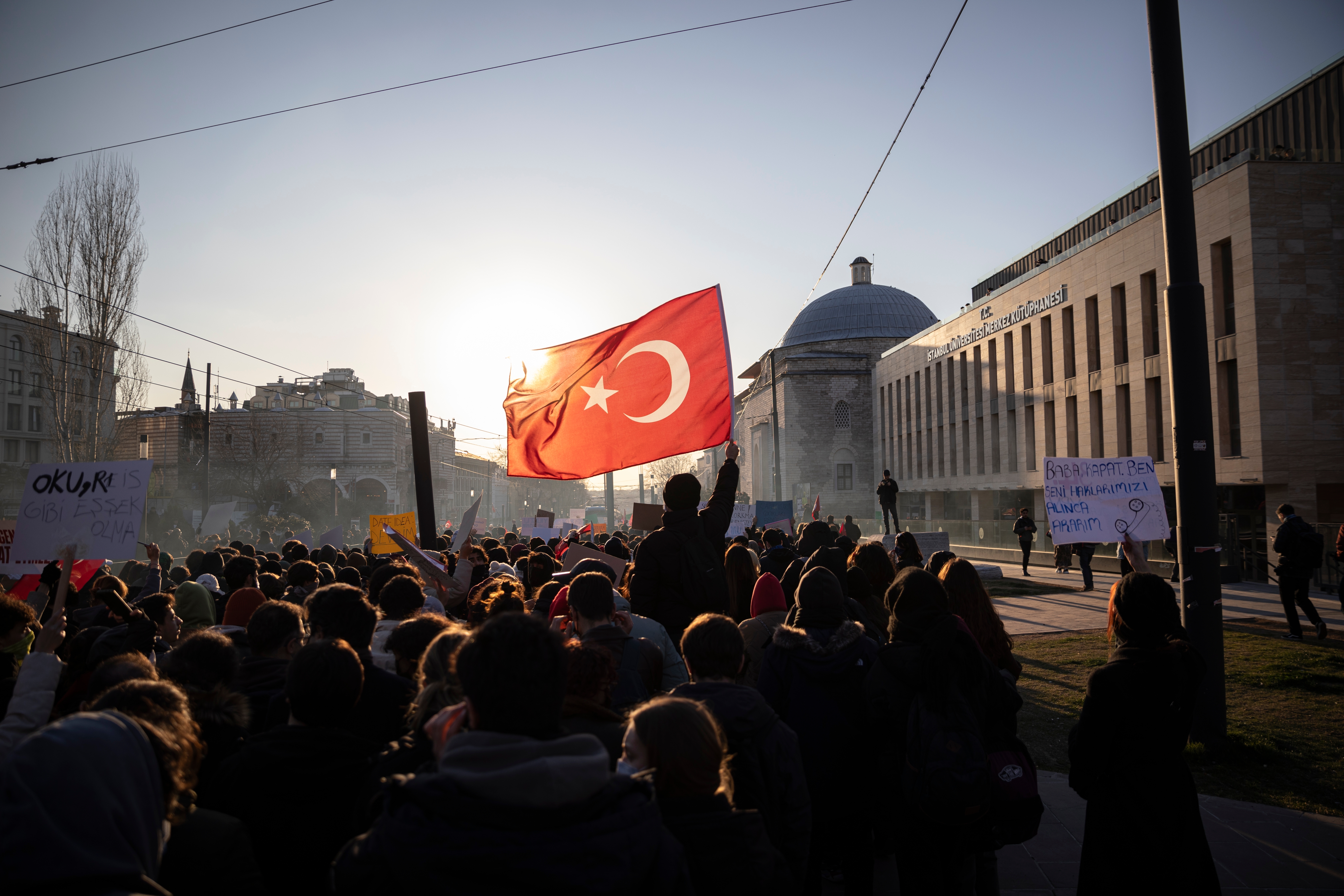
İmamoğlu, who submitted his official presidential application by collecting 15 million signatures, was arrested on the morning of March 19, 2024 by police who arrived at his home on charges of university degree irregularities and corruption. This arrest warrant sparked widespread protests unlike anything the Republic of Türkiye had seen in a long time. The protesters were mostly Gen Z university students. The high level of police violence, the arrests of many students, and the intervening holiday brought the protests to a swift conclusion (Bianet 2025). İmamoğlu has been in custody since that day and is still on trial.
Kurdish Issue
One of the recent political turning points in Türkiye is undoubtedly the Kurdish issue. The Kurdish political movement has undoubtedly suffered the most severe blow during the AKP’s authoritarianism. Selahattin Demirtaş, once a groundbreaking and shining star of politics, was arrested on terrorism charges while he was the chairman of the HDP (the party of the Kurdish political movement) and is still in detention. Many other Kurdish politicians, like Demirtaş, remain in prison. Furthermore, trustees have long been appointed to municipalities won by the HDP, usurping the will of the people. However, in October 2024, the ruling far-right Nationalist Movement Party’s (MHP) calls for a solution and peace to the Kurdish issue caused astonishment in politics because the MHP had long maintained its political existence as the antithesis of the Kurdish movement. Initially hesitant to respond to the MHP’s call, the AKP later supported it (Sayin 2024). Having consolidated a significant vote share a year earlier by labeling the opposition terrorists for collaborating with the Kurds, the ruling party made a significant U-turn and launched the “Türkiye Without Terrorism” process. A parliamentary commission was established, and Abdullah Öcalan, the founding leader of the PKK (the armed wing of the Kurdish movement), who had been imprisoned and barred from communicating with the outside world for years, was allowed to meet with politicians (Sayin 2025).
For a long time, the reason for this transformation, which no one understood, was initially attributed to a survival issue. The MHP argued that the country was at a critical juncture and faced existential threats. This process, which many people initially failed to understand and attempted to be disguised as political, was driven by geopolitical developments in the Middle East following October 7th. It was also driven by Türkiye, which played the most significant role in the Syrian revolution and aimed to establish regional leadership and gain profit in the reshaped region. Some believe that this process was initiated to prevent Kurds in the region from cooperating with Israel after relations with them became strained (Laciner 2025). In May 2025, upon Öcalan’s call, the PKK dissolved itself after 47 years and began to disarm its guerrillas and evacuate critical locations (Durukan 2025).
General Analysis
Although Türkiye is often viewed as a competitive authoritarian state, Erdoğan can purge any politician he deems a threat, even ignoring ECHR rulings, and strip them of their political freedom. In this regard, especially after İmamoğlu’s arrest, some argue that the regime will continue as long as Erdoğan is alive or in his will. It is clear that calling the Turkish regime a typical competitive authoritarian regime would be a mistake; it is a sui generis regime. A country like Türkiye, amidst existential geopolitical dangers and the constant securitization of matters by the state, cannot be expected to achieve the level of democracy found in prosperous Western countries. When it comes to the Kurdish issue, resolving this issue will not only move Turkey forward in a democratic sense but will also create geopolitical comfort for the AKP and the chance to draw a strong opposition closer to itself in domestic politics.
The fate of the regime in Türkiye depends largely on its good relations with the West and the relationship between the MHP-AKP coalition. If the MHP leaves the alliance, the AKP will suffer a significant loss of votes, but an even greater defeat will be its loss of control of state apparatuses, as many MHP loyalists have gained important positions within the state during this alliance (Karakas 2023). The fact that Türkiye lacks self-sufficiency in resources, unlike those of Russia or China, is another factor that makes the regime vulnerable. Even though the government is authoritarian, the need for legitimacy persists due to these limited resources (Esen and Gumuscu 2025). Therefore, elections continue to serve as a major tool for legitimization for the government. It is challenging to grasp and analyze what is truly happening because most issues are settled behind closed doors and perceived as merely political maneuvering.

Eren Filizler is a senior-year student from Istanbul, currently pursuing a dual degree in Global and International Affairs at Binghamton University (SUNY) and Middle East Technical University (METU). While he is broadly interested in various areas of the social sciences, his main focus is on political economy. Outside of academics, Eren is an avid football enthusiast. He is also deeply interested in cinema, and his dream is to one day write and direct his own romantic comedies and dark comedy films.
References
BBC Türkçe. 2024. “Yerel seçimlerde kırmızı dalga: CHP’nin 47 yıl sonra elde ettiği seçim zaferi ne anlama geliyor?” BBC Türkçe, 1 Nisan 2024. https://www.bbc.com/turkce/articles/crgdklmmeyno
BİA Haber Merkezi. 2025. “19 Mart raporu: Yıkılan barikatla korku duvarı aşıldı.” Bianet, 29 Kasım 2025. https://bianet.org/haber/19-mart-raporu-yikilan-barikatla-korku-duvari-asildi-313993
Durukan, N. 2025. “PKK, ‘çatışma riski’ gerekçesiyle Zap’tan çekildiğini duyurdu.” T24, 17 Kasım 2025. https://t24.com.tr/haber/pkk-catisma-riski-gerekcesiyle-zap-tan-cekildigini-duyurdu,1276864
Esen, Berk and Sebnem Gumuscu. 2025. “How to Fight Turkey’s Authoritarian Turn.” Journal of Democracy 36 (3): 106–120. https://www.journalofdemocracy.org/articles/how-to-fight-turkeys-authoritarian-turn/
Karakaş, B. 2023. “AKP iktidarına yön veren aktör: MHP.” DW Türkçe, 2 Şubat 2023. https://www.dw.com/tr/akp-iktidar%C4%B1na-y%C3%B6n-veren-akt%C3%B6r-mhp/a-64584812
Kirişci, Kemal and Amanda Sloat. 2019. “The Rise and Fall of Liberal Democracy in Turkey: Implications for the West.” Brookings Institution. https://www.brookings.edu/articles/the-rise-and-fall-of-liberal-democracy-in-turkey-implications-for-the-west/
Kizilkaya, Emre. 2023. “Turkey: Erdogan’s grip on media threatens fair elections.” Chatham House – The World Today, 11 May 2023. https://www.chathamhouse.org/publications/the-world-today/2023-04/turkey-erdogans-grip-media-threatens-fair-elections
Laçiner, Ö. 2025. “Büyük Ortadoğu ve ikinci ‘Çözüm Süreci.’” Birikim Dergisi, Sayı 433, Mayıs 2025. https://birikimdergisi.com/haftalik/12044/buyuk-ortadogu-ve-ikinci-cozum-sureci]
Levitsky, Steven, and Lucan A. Way. 2010. Competitive Authoritarianism: Hybrid Regimes after the Cold War. Cambridge: Cambridge University Press.
Michaelson, Ruth and Deniz Barış Narlı. 2022. “Istanbul mayor Ekrem İmamoğlu sentenced to jail over ‘fools’ insult.” The Guardian, 14 December 2022. https://www.theguardian.com/world/2022/dec/14/istanbul-mayor-ekrem-imamoglu-sentenced-to-jail-over-fools-insult
Sayın, Ayşe. 2024. “Erdoğan, Bahçeli’ye Öcalan çıkışı için teşekkür etti.” BBC Türkçe, 30 Ekim 2024. https://www.bbc.com/turkce/articles/cwy1wn9pyz3o
Sayın, Ayşe. 2025. “Öcalan’la görüşmeden ilk detaylar: Ne kadar sürdü, neler konuşuldu?” BBC Türkçe, 25 Kasım 2025. https://www.bbc.com/turkce/articles/c20k755gde1o

 Happy Medium
You must be logged in to post a comment.