-
Cooperation and Contention: The Dynamic Relationship Between the United States and China

By Alyssa Hazen, US Policy
The United States and China have one of the world’s most complex relationships. The two countries have experienced periods of tension and cooperation over a range of issues. Key areas of conflict between the two include trade and economic practices. While the US and China have a critical trade relationship, they are also major competitors. The US has cited China’s economic policies as a point of contention, finding that the country’s practices related to trade and labor pose a threat to the United States’ own economic and security interests (US Government Accountability Office). This has led the US to take action against China, primarily through the imposition of tariffs, and China has shown retaliation in return. Despite tensions, the two countries remain economically connected—intertwined in a relationship that is crucial to the global economy.
US Tariffs
Since the inauguration of President Trump under his second term, the administration has made it a priority to impose tariffs on imports from other countries. The Trump administration’s economic policy is designed to protect domestic industries and American workers, address the trade deficit, and raise government revenue. In the first month of his presidency, Trump imposed tariffs using the International Emergency Economic Powers Act (IEEPA). He declared that the threat posed by the flow of illegal immigrants and drugs from Mexico, Canada, and China constituted a national emergency under the act (White House 2025). The administration imposed a 25% additional tariff on imports from Canada and Mexico and a 10% additional tariff on China (White House 2025). The tariffs were established as a means of holding the countries accountable to their promises on curbing illegal immigration and stopping the flow of drugs into the US. The administration argued that the tariffs are a way to protect the United States’ national interest and security, as well as the safety of American citizens. Trump imposed further tariffs in April. Once again using the IEEPA, Trump declared that foreign trade practices constituted a national emergency. The administration issued a 10% tariff increase on imports from all countries, arguing that this was necessary due to the threat posed by the trade deficit and lack of reciprocity in trade relationships (White House 2025). The administration highlighted China’s non-market policies, in particular, arguing that these policies gave China global dominance. This had repercussions on the US industry and trade deficit, leading to job losses and a national security threat as a result of an increased reliance on foreign supply chains (White House 2025).
During April, the Trump administration’s tariffs caused increasingly more conflict between the US and China. Under US Section 232, a provision in the Trade Expansion Act of 1962, the president can adjust imports that threaten national security. Under this provision, Trump imposed tariffs on steel, aluminum, and automobiles. These tariffs were an effort to counter the flood of these materials from China in global markets (Peterson Institute For International Economics 2025). Following the implementation of these tariffs and those imposed under the IEEPA, US tariffs grew to 145% on all imports from China as of April 11th. In retaliation, China’s tariffs on US imports rose to 125% (Council on Foreign Relations).
China’s Response
China responded to the United States’ tariffs by means of retaliation. While China imposed tariffs back at the US, its primary mode of retaliation took the form of depriving the US of investment. China, which is dependent on soybean production from other countries, imports three-fifths of soybeans traded in the global market (Bradsher 2025). Since late May, China had been boycotting purchasing soybeans from the United States, in response to Trump’s tariffs. Last year, China had exported $12.6 billion worth of soybeans, but as of late September, this has entirely dropped (Draper 2025). In retaliatory tariffs, the total duties that China imposed on US grown soybeans reached 34% (Rappeport 2025). This has caused a severe strain on American farmers, who are running out of space to store soybeans as well as facing financial struggles as a result of a declining export rate.
In addition to boycotting the purchase of American soybeans, China also deprived the US from investing in its rare earth metals. China curbed exports on rare earth metals in October, in an attempt to claim more control over the manufacture of technology (Bradsher and Tobin 2025).
Rare earth metals are essential in the production of computer chips, magnets, and the systems in cars. Many major US-based companies, such as Nvidia and Apple rely on the export of these metals to manufacture their products (Bradsher and Tobin 2025). Limiting exports of these rare earth metals would allow China to exploit the dominance it has over this sector and compete with the United States’ leadership in the global technology market.
Deal Making
Both the United States and China threatened to raise tariffs exponentially in the months immediately following Trump’s inauguration, but extended a truce until November to facilitate deal making. In late October, Trump met with China’s President Xi Jinping. The two leaders reached a trade deal that ensured the protection of the United States’ national security and workers, in addition to lower tariffs imposed upon China (White House 2025). Under the deal, China is to suspend export controls on rare earth metals, reduce the flow of drugs into the US, suspend its retaliatory tariffs, and resume exporting American soybeans. In return, the US is to curb tariffs imposed on China and extend the expiration of investigations into China’s unfair trade practices (White House 2025).
Conclusion
The relationship between the United States and China continues to be defined by a balance between economic interdependence and strategic rivalry. Tariff escalations under the Trump administration showcase how quickly tensions can rise when one country’s trade and economic practices are framed as a threat to another’s national security interests. As both nations imposed increasingly severe measures, economic costs mounted on both sides. Yet, despite these tensions, the willingness of both countries to negotiate a deal underscores the importance of cooperation between major world powers in maintaining global stability. While conflict remains a persistent characteristic of the United States’ and China’s relationship, methods of resolution exist when economic interests are at stake for both sides. The United States and China are bound by an interdependent economic system that requires cooperation despite contention.

Alyssa Hazen is a sophomore and political science major from Brooklyn, New York, as well as an Associate U.S Policy Reporter at Happy Medium. She plans on attending law school after graduating from Binghamton and hopes to pursue a career in corporate law. She is most interested in studying the intersection of politics and the environment. In her spare time, she enjoys reading and playing the guitar.
References
Bradsher, Keith. 2025. “In Tariff Standoff With Trump, China Boycotts American Soybeans.” New York Times. September 4 https://www.nytimes.com/2025/09/04/business/china-soybeans-trump-tariffs.html?searchResultPosition=2
Bradsher, Keith and Meaghan Tobin. 2025. “China Clamps Down Even Harder on Rare Earths.” New York Times. October 9 https://www.nytimes.com/2025/10/09/business/china-rare-earth-exports.html
Council on Foreign Relations. 2025. “U.S.-China Relations.” https://www.cfr.org/timeline/us-china-relations
Draper, Kevin. 2025. “China Bought $12.6 Billion in U.S. Soybeans Last Year. Now, It’s $0.” New York Times. September 25 https://www.nytimes.com/2025/09/25/business/china-soybean-sales-farmers.html?searchResultPosition=3
Peterson Institute For International Economics. 2025. “US-China Trade War Tariffs: An Up-to-Date Chart.” November 10 https://www.piie.com/research/piie-charts/2019/us-china-trade-war-tariffs-date-chart
Rappeport, Alan. 2025. “China’s Snub of U.S. Soybeans Is a Crisis for American Farmers.” New York Times. September 15 https://www.nytimes.com/2025/09/15/business/china-us-soybeans-farming.html?searchResultPosition=4
The White House. 2025. “Fact Sheet: President Donald J. Trump Imposes Tariffs on Imports from Canada, Mexico and China.” February 1 https://www.whitehouse.gov/fact-sheets/2025/02/fact-sheet-president-donald-j-trump-imposes-tariffs-on-imports-from-canada-mexico-and-china/
The White House. 2025. “Fact Sheet: President Donald J. Trump Declares National Emergency to Increase our Competitive Edge, Protect our Sovereignty, and Strengthen our National and Economic Security.” April 2 https://www.whitehouse.gov/fact-sheets/2025/04/fact-sheet-president-donald-j-trump-declares-national-emergency-to-increase-our-competitive-edge-protect-our-sovereignty-and-strengthen-our-national-and-economic-security/
The White House. 2025. “Fact Sheet: President Donald J. Trump Strikes Deal on Economic and Trade Relations with China.” November 1 https://www.whitehouse.gov/fact-sheets/2025/11/fact-sheet-president-donald-j-trump-strikes-deal-on-economic-and-trade-relations-with-china/ U.S. Government Accountability Office. “U.S. – China Relations.” https://www.gao.gov/u.s.-china-relations
-
Deportations for Tariffs: How the Trump Administration is Using Foreign Policy to Achieve Domestic Goals

By Ameen Kimdar, US Policy
Deportations and tariffs have been on the top of the agenda for the White House since the beginning of the second Trump administration in January of this year. Running on a campaign of populism and nationalism, Donald Trump promised supporters that the United States would make a show of strength by forcibly removing foreign nationals from the country by any means necessary and by putting an end to “unfair” trade deals that benefited foreign countries more than the US. Prior to entering office, experts anticipated that Trump’s foreign policy would be based on a reciprocal approach to diplomacy, viewing relationships as “transactional” (Cha 2024). Both policies, mass deportations and protectionist trade policies, have become intertwined tools in a larger strategy of coercive diplomacy. In particular, the administration’s usage of third-country deportations, the practice of deporting individuals to a country that they have no connection with, demonstrates how immigration enforcement has become a bargaining chip to achieve goals in trade policy and other foreign policy areas that the US has an interest in.
The White House has leveraged tariff threats and other intimidation tactics to persuade smaller, often-aid dependent developing nations in Latin America, Africa and Asia into accepting deportees from countries unrelated to their own. Likewise, cooperation on deportations has been used as a precondition for favorable trade terms and tariff exemptions. This practice has drawn controversy within the United States from migrant rights organizations and from countries that have resisted or opposed becoming a “dumping ground” for immigrants. However, many countries have welcomed this approach to dealing with the US, and have leveraged their position as an easy way to get on the US’ good side in other areas such as trade policy.
During the first Trump administration, one of the largest challenges that ICE officials faced was deported migrants’ home countries refusing to accept their citizens back. In 2017, the US put visa restrictions on Eritrea, Cambodia, Guinea, and Sierra Leone for refusing to accept thousands of migrants that had been convicted of crimes in the United States and were sentenced to deportation. ICE officials claimed that sanctions were necessary to pressure these countries into accepting deportees out of US custody (Nixon 2017). Among other issues, the second Trump administration has taken a much more aggressive direction with achieving policy goals, and the introduction of third-country deportations have become a major part of its immigration policy.
Beginning at the start of Trump’s return to the White House, 5000 migrants were sent on military aircraft to Guatemala and Mexico (Stewart and Ali 2025), while Colombia’s left-wing president Gustavo Petro refused to accept what he described as “inhumane” treatment of migrants. After Trump threatened massive tariffs and visa suspensions on Colombia, Petro was forced to back down and accept deportations via military aircraft, as the US is the largest trading partner of the South American nation (Stewart and Griffin 2025).
In February, aggressive deportations escalated, with the first recorded instance of third-country deportations occurring in Panama and Costa Rica. Three flights carrying 300 deportees from Africa and Central Asia arrived in Panama, where they were first held in a hotel, and those who refused were sent to a prison camp in the jungle (Wong et al. 2025). Later that month, Costa Rica accepted 200 deportees from China, India, Nepal and Yemen (Wong et al. 2025). Almost all of the US deportees in Central America were later released and sent to their countries of origin after their lawyers sued the governments holding them (Wong et al. 2025). This occurred amidst massive pressure on Panama from Trump, who had publicly stated a desire to regain control of the Panama Canal, which had been returned to the small country in 1977 by Democratic president Jimmy Carter. Panama is an important destination for migrants crossing the Darien gap between South and Central America en route to the United States (Zamorano 2025).
One of the most publicized cases of third-country deportations occurred in the following month, when hundreds of accused Venezuelan gang members were sent to El Salvador’s infamous CECOT prison. Salvadoran president, Nayib Bukele, a close ideological partner with Trump, has garnered international attention for his extreme measures on gang violence, an issue that has plagued the nation for decades. On the other hand, Venezuela has severed ties with the United States since 2019, due to ideological differences and US support for the Venezuelan opposition. The US paid El Salvador roughly $6 million to host the alleged Venezuelan gangsters in their maximum-security prison, and invoked a “zombie” law from 1798 to authorize the decision, the Alien Enemies Act, which permits the president to deport noncitizens during wartime (Al Jazeera 2025). Venezuelan deportees were also accepted by Honduras, a country that has experienced strained relations with the US in recent years for its close relations with Venezuela. Honduran president Xioamara Castro had previously threatened to expel a US military base in the country over threats of mass deportations, but buckled under US pressure (Olivares 2025). Trump officials claimed that the migrants were a part of a criminal gang known as Tren de Aragua, which he has also accused of being tied to the Venezuelan government, which CIA and NSA sources have disputed (Olivares 2025). Among the deportees was Kilmar Abrego Garcia, a Salvadoran man living in the US legally, wrongfully deported in an “administrative error” (Al Jazeera 2025).
By summer, the third-country deportations expanded into Africa, where human rights groups have expressed the most amount of concern for the safety and wellbeing of migrants. In early Julyeight migrants convicted of robbery, murder, and sexual assault were deported to South Sudan that the State Department has listed as unsafe for American citizens to visit. Only one of the migrants was actually from South Sudan, while the rest were from Myanmar, Mexico, Cuba, Vietnam and Laos. This occurred after a legal battle while the migrants were being temporarily detained in a shipping container in the small African nation of Djibouti (Hagan 2025). Earlier, the Trump administration had revoked all South Sudanese visas and accused the world’s youngest nation of “taking advantage of the US” by refusing to take deportees (Al Jazeera 2025). The following week, the US deported five migrants convicted of crimes including child rape and murder to the tiny southern African country of Eswatini, despite all of the men coming from Vietnam, Laos, Jamaica, Cuba and Yemen. Commentators noted that Eswatini, an absolute monarchy with a poor human rights record, is dependent on the US for its largest export, sugar (Muia 2025). By August, deportations extended to Uganda, a country that had previously experienced strained relations with the US under the Biden administration for its anti-LGBTQ laws, and is also severely threatened by US sanctions on its agricultural exports (Lawal 2025). Rwanda, another African country with a poor human rights record, accepted seven US deportees from unrelated countries (Fleming 2025). Rwanda has cooperated with Israel and the UK on deportations, which was struck down by the UK Supreme Court over human rights violations in Rwanda (Sharma 2025). Nigeria, Africa’s most populated country, refused to cooperate on Venezuelan deportations, and was hit with visa restrictions, which the US embassy in Abuja denied was related to migration policy (Booty 2025). Later, Ghana accepted deportations of Nigerians, and denied they were being held in prisons in Ghana, rather they were sent back to their home countries (Riccardi 2025). On the other hand, Burkina Faso, which has become fiercely hostile towards the US in recent years, refused to accept any deportations on an ideological basis (Banchereau 2025). Outside of Africa, partially-recognized Kosovo has accepted 50 migrants, promising to return them home (Camilo 2025).
A New York Times investigation found that the State Department has approached 51 countries across the developing world to accept deportations in exchange for concessions in other areas, including foreign aid and trade policy. A State Department cable identified Angola, Libya, Morocco, Tunisia, Rwanda, Togo, Mauritania, Tajikistan and Turkmenistan as target countries for third-country deportations, in spite of abysmal human rights violations and civil wars occurring in most of these countries (Wong et al. 2025). Leaked documents showed the State Department pressured war-torn Ukraine into accepting third-country deportations as a part of conditions on receiving aid from its primary benefactor (Taylor et al. 2025). Prior to a White House meeting with leaders from Liberia, Senegal, Mauritania, Gabon and Guinea-Bissau, US officials requested that these countries cooperate with deportations, as these countries have been reeling from the consequences of the cancellation of USAID (Gramer et al. 2025).
The Trump administration’s usage of third-country deportations have become emblematic of its aggressive and transactional foreign policy, with countries gaining favorable positions on trade policy and their human rights records if they help Trump achieve his domestic goals. While some governments have resisted, it appears that they cannot afford trade wars with the US.
As previously mentioned, these deportations have faced several legal challenges and have garnered controversy by migrant rights organizations. The Immigration and Nationality Act (INA) allows the Department of Homeland Security to deport migrants to countries other than their country of origin, but the nature of these deportations have been challenged in court (Metzler 2025). Federal courts initially blocked the South Sudan deportations on the grounds that they were not protected from torture, but the Supreme Court allowed for the deportations to occur anyways (Charalambous and Garcia 2025). In another case, federal courts ruled that they were unable to prevent Trump from carrying out deportations to Ghana (Cameron 2025).
Another source of contention regarding third-country deportations is the necessity of the process altogether. Lawyers representing Mexican nationals deported to Libya and South Sudan claimed that the Trump administration never actually asked Mexico about accepting these deportations, which was corroborated by Mexican president Claudia Sheinbaum (Cooke and Hesson 2025). They also noted that Mexico has accepted thousands of deportees in the past, implying that the home country governments of deportees are not being properly informed of deportations. They instead suggested that the intention of third-country deportations is to intimidate migrants into self-deporting to avoid being sent to a much more hostile foreign country. A similar view was expressed by Doris Meissner, former Commissioner of the Immigration and Naturalization Service under Bill Clinton, stating the reason for third-country deportations to be “fear and intimidation and ultimately, incentivizing self deportation” (Montoya-Galvez 2025).
In spite of legal challenges and human rights concerns, the Trump administration hasn’t slowed down the usage of third-country deportations. Instead, it has double downed on the as a deterrent and a display of strength, framing it as a restoration of American sovereignty. Supporters of the policy view it as a necessary move to correct what they view as decades of exploitation of the US in trade and migration policy by weaker countries. Critics view it as a deliberate violation of human rights and international norms to intimidate migrants into not entering the US and pressure foreign countries to accept US trade terms. Regardless of their true intentions and legal challenges, third-country deportations have become a major weapon of Trump’s coercive diplomacy.
References
Banchereau, Mark. 2025. “Burkina Faso Rejects Proposal to Accept Deportees from the US.” AP News. https://apnews.com/article/burkina-faso-united-states-deportees-982e4a4645a78eed9603ac6a9d60f21d (November 8, 2025).
Booty, Natasha. 2025. “Nigeria Can’t Take Venezuelan Deportees from US, Says Yusuf Tuggar.” BBC. https://www.bbc.com/news/articles/c23gz78v5jjo.
Cameron, Chris. 2025. “Federal Judge Declines to Intervene for Migrants Deported to Ghana.” The New York Times. https://www.nytimes.com/2025/09/16/us/politics/judge-migrants-deported-ghana.html.
Camilo Montoya-Galvez. 2025a. “Kosovo Agrees to Accept U.S. Deportations of Migrants from Other Countries.” Cbsnews.com. https://www.cbsnews.com/news/kosovo-accept-u-s-deportations-of-migrants-from-other-countries/.
———. 2025b. “U.S. Broadens Search for Deportation Agreements, Striking Deals with Honduras and Uganda, Documents Show.” Cbsnews.com. https://www.cbsnews.com/news/us-deportation-agreements-honduras-uganda/.
Cha, Victor. 2024. “How Trump Sees Allies and Partners.” Csis.org. https://www.csis.org/analysis/how-trump-sees-allies-and-partners.
Charalambous, Peter, and Armando Garcia. 2025. “Judge Blocks Administration from Deporting Noncitizens to 3rd Countries without Due Process.” ABC News. https://abcnews.go.com/US/judge-blocks-administration-deporting-noncitizens-3rd-countries-due/story?id=120951918.
Cooke, Kristina, and Ted Hesson. 2025. “The US Said It Had No Choice but to Deport Them to a Third Country. Then It Sent Them Home.” Reuters. https://www.reuters.com/world/americas/us-said-it-had-no-choice-deport-them-third-country-then-it-sent-them-home-2025-08-02/.
Fleming, Lucy. 2025. “Rwanda-US Migrant Deal’s First Group of Deportees Arrive, Says Spokesperson.” BBC. https://www.bbc.com/news/articles/ckg4xp2my0vo.
Gramer, Robbie, Alexander Ward, and Tarini Parti. 2025. “Exclusive | U.S. Pushes More African Countries to Accept Deported Migrants.” The Wall Street Journal. https://www.wsj.com/politics/policy/u-s-pushes-more-african-countries-to-accept-deported-migrants-b6f330c5 (November 8, 2025).
Hagan, Rachel. 2025. “US Deports Eight Men to South Sudan after Legal Battle.” BBC. https://www.bbc.com/news/articles/c80p315krr4o.
Lawal, Shola. 2025. “What Will Uganda Gain from Accepting US Deportees?” Al Jazeera. https://www.aljazeera.com/economy/2025/8/23/what-will-uganda-gain-from-accepting-us-deportees.
Metzler, Jacqueline. 2025. “What Are Third-Country Deportations, and Why Is Trump Using Them?” Council on Foreign Relations. https://www.cfr.org/article/what-are-third-country-deportations-and-why-trump-using-them.
Muia, Wycliffe. 2025. “US President Donald Trump’s Administration Deports Five Migrants to Eswatini.” BBC. https://www.bbc.com/news/articles/clyze8mvzdgo.
Nixon, Ron. 2017. “Trump Administration Punishes Countries That Refuse to Take Back Deported Citizens.” Nytimes.com. https://www.nytimes.com/2017/09/13/us/politics/visa-sanctions-criminal-convicts.html (November 7, 2025).
Olivares, José. 2025. “Venezuelan Immigrants Deported from US to Venezuela via Honduras.” the Guardian. https://www.theguardian.com/us-news/2025/mar/24/venezuela-immigrants-us-honduras.
Riccardi, Nicholas, Chinedu Asadu, and Edward Acquah. 2025. “Ghana Says African Immigrants Deported by the US Have Returned Home.” AP News. https://apnews.com/article/us-ghana-deportations-trump-third-countries-africa-efbec16e3725e3065b2578ccc7a175a2.
Sharma, Yashraj. 2025. “Is Trump Using Africa as a ‘Dumping Ground’ for Criminals?” Al Jazeera. https://www.aljazeera.com/features/2025/7/25/is-trump-using-africa-as-a-dumping-ground-for-criminals.
Staff, Al Jazeera. 2025a. “Can Trump Legally Deport US Citizens to El Salvador Prisons?” Al Jazeera. https://www.aljazeera.com/news/2025/4/16/can-trump-legally-deport-us-citizens-to-el-salvador-prisons.
———. 2025b. “Why Has Trump Revoked All South Sudanese Visas?” Al Jazeera. https://www.aljazeera.com/news/2025/4/7/why-has-trump-revoked-all-south-sudanese-visas.
Stewart, Phil, and Idrees Ali. 2025. “Exclusive: US Military Aircraft with Deported Migrants Lands in Guatemala, Officials Say.” Reuters. https://www.reuters.com/world/americas/us-military-aircraft-with-deported-migrants-lands-guatemala-official-says-2025-01-27/.
Stewart, Phil, and Oliver Griffin. 2025. “Trump Heaps Tariffs on Colombia after It Refuses Migration Deportation Flights.” Reuters. https://www.reuters.com/world/americas/colombias-petro-will-not-allow-us-planes-return-migrants-2025-01-26/.
Taylor, Adam, Sarah Blaskey, and Siobhán O’Grady. 2025. “Trump Team Urged Ukraine to Take U.S. Deportees amid War, Documents Show.” The Washington Post. https://www.washingtonpost.com/national-security/2025/05/06/trump-ukraine-deportees/.
Wong, Edward, Zolan Kanno-Youngs, Hamed Aleaziz, and Minho Kim. 2025. “Inside the Global Deal-Making behind Trump’s Mass Deportations.” The New York Times. https://www.nytimes.com/2025/06/25/us/politics/trump-immigrants-deportations.html.Zamorano, Juan. 2025. “Nearly 300 Deportees from US Held in Panama Hotel as Officials Try to Return Them to Their Countries.” AP News. https://apnews.com/article/panama-trump-migrants-darien-d841c33a215c172b8f99d0aeb43b0455.
-
Trump Administration Opens Arctic Wildlife Refuge to Oil Drilling

By Abigail West, US Policy
Trump Administration Opens Arctic Wildlife Refuge to Oil Drilling
Photo credit: Vladimir EndovitskiyTrump announced in October that he would open the entire 1.56 million acres of the Arctic National Wildlife Refuge’s Coastal Plain to oil and gas leasing. These lands are sacred to the Gwich’in Nation, home to irreplaceable wildlife, wilderness, and cultural values, and have never seen industrialization. The Secretary of the Interior, Doug Burgum, held a press conference in October to confirm that the Department of the Interior will open the Coastal Plain to maximum oil and gas development to benefit corporate polluters (EarthJustice 2025).
These action packages were designed to improve public health and safety for Alaskans, advance energy development, and revamp land and resource management across the state. Along with reopening the Coastal Plain of the Arctic National Wildlife Refuge, the King Cove–Cold Bay Road corridor will be established via a land exchange, right-of-way permits for the Ambler Road will be finalized, and land allotments for eligible Alaska Native veterans of the Vietnam War will be offered (DOI 2025). The Amber Road permits are costly and have been opposed by 88 Alaska Native Tribes and First Nations, and will cause substantial harm to wildlife, including caribou.
Alaska’s Arctic warming is 3-5 times higher than anywhere else in the world, in a phenomenon known as Arctic amplification. This accelerated warming is primarily due to the ice-albedo feedback loop, in which the Arctic loses its reflective ice and snow cover, allowing darker ocean and land beneath to absorb more heat, creating a cycle that drives faster warming (EPA 2024). This explanation means that Arctic oil drilling will have disastrous effects on Alaskans and countless other Americans. The Arctic National Wildlife Refuge is home to numerous animals, including providing essential habitat for species such as Porcupine caribou, denning polar bears, and other wildlife (Harvard, 2025).
In 1980, the Alaska National Interest Lands Conservation Act (ANILCA) (NPS, 1980) designated 1.5 million acres of the Arctic National Wildlife Range, known as the Coastal Plain, for gas development. No lease sales were made until 2021, when Congress passed the Tax Cuts and Jobs Act in 2017. This Act required the Secretary of the Interior to conduct at least two lease sales over 10 years. Under President Trump, the Interior issued 9 of 11 leases totaling 437,804 acres. President Biden paused all activities related to BLM’s Coastal Plain Oil and Gas Leasing Program in January 2021 through Executive Order 13990 (Federal Register 2021). Trump recently reversed this by allowing oil drilling and development leases to continue. Trump believes that opening up the Coastal Plain will ‘unleash’ domestic energy and reverse years of more restrictive policies, including Biden’s pause on lease cancellation (White House 2025). Lease sales allow companies to bid for the right to explore and potentially drill an area, and the actual development of oil comes years later, after permits are acquired and infrastructure is built. For example, places that have never seen industrialization or been touched by humans, construction, infrastructure development, seismic testing, and pipeline construction will be introduced. Trump and the Interior argue this will strengthen energy security, support “local control,” and unlock “promising untapped energy resources.”
The Gwich’in Nation Steering Committee condemns the actions the Trump Administration took to open the entire Coastal Plain, claiming the plan is a threat to the Porcupine Caribou calving and nursery grounds there, and therefore to their entire way of life. The Gwich’in call the Coastal Plain of the Arctic Refuge, Iizhik Gwats’an Gwandaii Goodlit, which means “the sacred place where life begins” in their language. The Porcupine Caribou are essential to the nutritional, cultural, and spiritual needs of the Gwich’in Nation, and they have been fighting to protect the calving grounds of the Porcupine Caribou herd for decades. Any disruption to these lands in the Arctic Refuge, according to the Gwich’in, would negatively affect their health and migration routes. Kristen Moreland, executive director of the Gwich’in Steering Committee, stated that “this action by the Trump administration is a direct attack on the Gwich’in, who have for decades been a voice for the caribou and stood against the destruction of the Arctic Refuge. A leasing program that would open the entire Coastal Plain completely ignores the impacts that oil and gas development would have on the land, on wildlife, and on our communities,” (Gwich’in Steering Committee 2025).
Earthjustice, NRDC, and others call the Trump Administration’s decision to open up the entire Coastal Plain a “massive public lands attack” that auctions off treasured lands to fossil fuel companies. These groups have concerns about burning oil from ANWR, which would increase greenhouse gas emissions, and about backslides on U.S. climate commitments.
Alaska Governor Mike Dunleavy and other state economic officials have voiced support for expanding oil drilling in the state. In June, U.S. Environmental Protection Agency (EPA) Administrator Lee Zeldin, U.S. Department of the Interior Secretary Doug Burgum, and U.S. Department of Energy Secretary Chris Wright outlined the impact President Trump’s One Big Beautiful Bill (OBBB) will have on unleashing energy and economic growth in Alaska. The state’s energy sector employs about 8% of all payrolls and generates nearly one-fifth of total business earnings, the fourth-highest share among states (Anchorage Daily News 2025). This legislation will protect approximately 14,000 full-time equivalent jobs over the next four years while creating thousands more. In an interview with the Anchorage Daily News, Administrator Zeldin and Secretaries Burgum and Wright stated that “With the passage of OBBB, Alaska will be liberated from the radical environmentalism that has kept its extraordinary resources locked away for far too long. It reverses the damage of the Biden administration by opening federal lands and waters to oil, gas, coal, geothermal and mineral leasing while rescinding every so-called ‘green’ corporate welfare subsidy from Democrats’ ‘Inflation Reduction Act.’” (EPA 2025) Republicans cast environmental opposition as “blocking progress” and harming working families in Alaska; they say technological advances can minimize environmental harm.
As Indigenous nations and environmental groups are expected to sue again arguing violations of NEPA, the Endangered Species Act, and treaty/Trust obligations, there is always a possibility that this expansion will be reversed. As a reminder, Biden’s Interior Department suspended and later canceled the original leases, citing legal and environmental flaws in the Trump-era review. Earlier this year, a federal judge in Alaska held that the Biden administration lacked authority to cancel the leases unilaterally, sending the issue back to Interior—and effectively clearing a path for the new Trump team to proceed.
“The repeal of the Biden-era Record of Decision for the Arctic Leasing Program, and the move to open over 1.56 million acres of public land for auction has the potential to cause irreparable damage to the Gwich’in way of life,” said Galen Gilbert, First Chief of the Arctic Village Council. As oil executives size up the Coastal Plain, and the first lease sale could come within months, the Gwich’in and many other lawyers and activists prepare for a long battle against the Trump Administration and over whether oil drilling in the Arctic National Wildlife Range is in the name of climate and nature protection.

Hi, my name is Abby West, I’m from Westchester NY, my role at HM is Associate Reporter-U.S. Policy. My majors are PPL and History, I am a sophomore, and I am on the pre-law track. I plan on going to law school after graduating early and pursuing an MBA. My research interests are in U.S. politics and policy, international affairs, and human rights. For my extracurriculars, you can find me on E-board for RENA Fashion Magazine and Binghamton Upcycle Project, as well as a part of Moot Court, Pipe Dream, the Food Co-Op, and working at Dick’s Sporting Goods. I also have my own political blog called ImpactInTen!
References
a52d663b_admin. 2025. “Gwich’in Nation Condemns Actions by the Trump Administration to Open Entire Coastal Plain of the Arctic Refuge to Oil and Gas Development.” Gwich’in Steering Committee. https://gwichinsteering.org/gwichin-condemn-arctic-refuge-drilling/ (Accessed November 26, 2025).
“Alaska (U.S. National Park Service).” https://www.nps.gov/locations/alaska/index.htm (Accessed November 25, 2025).
“Arctic National Wildlife Refuge — Oil and Gas Development – Environmental and Energy Law Program.” https://eelp.law.harvard.edu/tracker/arctic-national-wildlife-refuge-oil-and-gas-development/ (Accessed November 25, 2025).
“Interior Takes Bold Steps to Expand Energy, Local Control and Land Access in Alaska | U.S. Department of the Interior.” 2025. https://www.doi.gov/pressreleases/interior-takes-bold-steps-expand-energy-local-control-and-land-access-alaska (Accessed November 24, 2025).
“Opinion: Alaska’s energy renaissance awaits, and the One Big Beautiful Bill is the key to unlocking it.” Anchorage Daily News. https://www.adn.com/opinions/2025/06/08/opinion-alaskas-energy-renaissance-awaits-and-the-one-big-beautiful-bill-is-the-key-to-unlocking-it/ (Accessed November 26, 2025).
“Protecting Public Health and the Environment and Restoring Science To Tackle the Climate Crisis.” 2021. Federal Register. https://www.federalregister.gov/documents/2021/01/25/2021-01765/protecting-public-health-and-the-environment-and-restoring-science-to-tackle-the-climate-crisis (Accessed November 26, 2025).
“Trump Administration Opens the Entire Coastal Plain of the Arctic National Wildlife Refuge to Oil and Gas Leasing.” Earthjustice. https://earthjustice.org/press/2025/trump-administration-opens-the-entire-coastal-plain-of-the-arctic-national-wildlife-refuge-to-oil-and-gas-leasing (Accessed November 24, 2025).
“Unleashing Alaska’s Extraordinary Resource Potential.” 2025. The White House. https://www.whitehouse.gov/presidential-actions/2025/01/unleashing-alaskas-extraordinary-resource-potential/ (Accessed November 26, 2025).
US EPA, OA. 2025. “ICYMI: Administrator Zeldin in Anchorage Daily News: ‘Alaska’s energy renaissance awaits, and the One Big Beautiful Bill is our key to unlocking it.’” https://www.epa.gov/newsreleases/icymi-administrator-zeldin-anchorage-daily-news-alaskas-energy-renaissance-awaits-0 (Accessed November 26, 2025).
US EPA, OAR. 2024. “Drivers of Climate Change in the Arctic.” https://www.epa.gov/climateimpacts/drivers-climate-change-arctic (Accessed November 25, 2025).
-
The Story of Populist Rhetoric and Image in the Age of Information

By Morgan Reed-Davis, Political Theory
“Eat the Rich.” “Power to the People.” “Make America Great Again.” These populist slogans pop up everywhere, from graffiti under an overpass to TikTok “For You” pages. The basic populist message—“the people” versus “the elites”—isn’t new. It was used by American revolutionaries in the 1700s, rebellious farmers in the late 19th century, and even anti-communist politicians in the 1950s (Gillon 2025). But over the past half-century, populist rhetoric has dramatically increased on both the right and left.
So what changed? While there’s no definitive answer, there are plenty of questions worth exploring. This article tackles four of them: What is populism? What does populism look like in 2025? What caused its rise, and how is it related to the phones in our back pocket?
What is populism?
Unlike other political ideologies, populism has a fluid definition. Its rhetoric splits society into the “people” and the exploitative “elites” (Pappas 2019).The message is fundamentally anti-establishment, and revolves around concerns of social and economic change, government corruption, and uplifting the voice of the “common people.” What makes the definition fluid is that these factors change depending on who defines “the people” and “the elites.”
On the left, the “elites” are typically billionaires, corporate giants, and hard-right conservatives (Ruth-Lovell 2025). Left-wing populists tend to push progressive policies like taxing the rich and affordable healthcare (Macedo and Mansbridge 2019). The “people” are often the working-class, minorities, and other leftists. On the right, “the elites” are usually framed as government insiders, the liberal media, and cultural outsiders like immigrants (Nadeem 2021). Right-wing populists champion economic policies such as deregulation and tariffs, as well as social issues related to national identity and traditional values. In this case, the “people” are often conservative blue-collar workers, most of whom are nostalgic for the traditionally conservative America of the past.
It’s important to note that political theorists often use the term “populist” pejoratively. A historic ultra-nationalist flavor of populism that has made the term synonymous with authoritarians and double-dealing demagogues. However, populism in the modern day, at least, in America, challenges that definition.
Case study: Zohran Mamdani and Donald Trump
Let’s start with Zohran Mamdani. The 34-year-old former assemblyman from Queens shocked the nation when he won the NYC mayoral race in November (NBC 2025). Mamdani identifies as a democratic socialist, setting him apart from the democrat-led establishment. Mamdani led a successful grassroots campaign, personally walking with supporters on the streets of New York, eating with locals, visiting gay bars, and connecting with a diversity of NYC communities (Cuevas 2025). His message—that NYC had become unaffordable and he could fix it—resonated with New Yorkers who’d been struggling to afford the city’s skyrocketing cost of living (Mamdani 2025). Mamdani’s promises include rent freezes for rent-stabilized tenants, new affordable homes, universal childcare, and a faster public transit system (McKurdy 2025).
On the right-wing side of populism is President Donald Trump. His first significant political swing was his 2016 presidential run, and he casted himself as no-nonsense outsider with a business expertise that could fix the American economy (Duignan 2025). Worried about China, immigration, and loss of American industry, Trump pushed economic and social policies like tax cuts, deportations, and aggressive tariffs. His 2024 campaign repeated this formula, focusing on deportations, tariffs, and undoing the damage he said the previous administration caused (Esomonu 2025). In both instances, he gave working- and middle-class conservatives a romantic vision: he could “Make America Great Again” (Volle 2025). Trump and Mamdani may land on opposite ends of the political spectrum, but they share an outsider status, charisma, and an anti-establishment message that makes them populist.
What caused the increase in populist rhetoric?
There are plenty of theories. Neoliberalism’s effects on labor markets and income inequality, the loss of national identity, and even the collapse of the Soviet Union in 1991 are all considered by political theorists as possible starting points (Cox 2018). However, in light of today’s social-media-savvy politicians, one theory seems the most plausible. The theory posits that politics, entertainment, and information began to blend in the age of television. Populism– which requires a showmanship almost adjacent to entertainment – not only survived but thrived in this new environment.
Television became the dominant medium in the 1960s, forcing politicians to adapt to its emphasis on convenience and performance. Television is a medium for entertainment that centers around an oversimplified, dramatized, emotion-driven “logic of mass media” (Gianpietro 2008). As the “logic of mass media” became more widespread, more of the public began measuring a politician by their image and simplistic message rather than their merit. What that means is that politicians and political debate needed to have some sort of entertainment value (i.e., showmanship) to “survive” on television, which had become the ultimate medium to get the attention of potential voters.
For example, take the first televised debate between Nixon and Kennedy in 1960. Appealing to an audience accustomed to sitcoms and hour-long newscasts, the Nixon-Kennedy debate was scheduled for only an hour and interrupted by advertisements (Library of Congress). By comparison, the Lincoln-Douglas debates of 1858 were three hours long with no intermission. Kennedy was composed and well-spoken; Nixon, on the other hand, spent the hour looking shifty and out of place. Nixon himself pointed out his fatal mistake: “I paid too much attention to what I was going to say and too little to what I looked” (Time 1968). In the age of television, politicians were incentivized to take on a specific role: a man of style, a celebrity of sorts. This “role” became a reality. 1981, Ronald Reagan, a former Hollywood star, became the first celebrity president and the prototype for modern American populism (Lundskow 1994).
The fusion of politics and entertainment continued as information became more abundant in the 1980s and 90s. Before the 1990s, the big three media companies (NBC, ABC, CBS) controlled the television industry (Allen, Stevens, Thompson 2025). However, the 90s saw the multiplication of news channels, the dawn of the 24-hour news cycle, the rise of multiple TV households, and the rise of the computer (Blumler and Kavanagh 1999). Americans had far more choices in information and entertainment, meaning that media organizations had adapted to the public’s expectations to keep their attention. News broadcasters made efforts to make politics palatable, while politicians began acting more personable on screen. Along with this, new stations that wished to inform and persuade had to compete with “infotainment” (i.e., cooking shows, talk shows, and magazines) designed to merge information with the fiction of TV personalities (Diehl 2024). Competing with the likes of Oprah Winfrey and Who Wants to Be a Millionaire, politicians had to sell their image—their “brand”—just as much as they had to sell their message.
As a result, presidential campaign strategies leaned heavily on marketability and media appearances. For example, news coverage of an alleged 12-year affair nearly ended Bill Clinton’s 1992 presidential campaign. After an interview on 60 Minutes, his popularity rebounded, and he resumed his campaign under the slogan “It’s the economy, stupid” and the self-given nickname “comeback kid” (Levy 2025). While the media has influenced politics in the past, in this digital age, it can immediately destroy and revitalize a career; politicians who could charm some of the public and the press, such as Bill Clinton, had a better chance of being the latter.
In the 2000s to 2020s, the boundaries between politics, entertainment, and information continued to blur as social media changed people’s perceptions of information, creation, and attention. In the early 2000s, information proliferated at an unprecedented rate, with content jumping from news channels to Wikipedia articles to blog posts. The invention of the iPhone in 2007 made a surplus of information available to users at any time and place (Britannica 2025). As for the creation of political commentary, journalists weren’t necessarily intermediaries anymore. With social media, users could be both producers and consumers of political discourse; someone could skim a CNN article, latch onto a detail, and publish it for the world (or their 15 followers) to see.
In the 2020s, fifteen-second short-form content like TikToks and Instagram reels fracture and decontextualize political information. It’s not uncommon to scroll through a For You page, stumble on footage of a political violence, and then, not even 15 seconds later, see A.I.-generated brainrot. In the age of social media, millions of people (i.e., influencers, journalists, celebrities) and millions of pieces of information (i.e., articles, TikToks, ebooks) compete for people’s attention. There are so many choices and clamoring voices, one is dizzied by the thought of having to decide what information is worth paying attention to. In a way, attention is a form of currency. It’s easy to make a bad investment if one can’t predict the rate of return.
At face value, populism is a safe bet. Its rhetoric is palatable and attractive, and doesn’t require any mental gymnastics to understand. Populists provide a checklist of promising policies, have the flair of a celebrity, and often share the public’s disdain for the stiff, over-media-prepped politicians of the current establishment. Not to mention, social-media-savvy populists like Mamdani and Trump (or at least Trump in his first term) connect to their supporters directly and immediately, almost becoming one of “the people” by sharing a digital space. One doesn’t need to exert too much time or energy deciding which politicians are worth their attention; populists catch their attention naturally.
Perhaps, this is what makes populism so alarming. The “people versus the elites” rhetoric appeals to emotions—to anxieties of the future, frustrations with the present, love for the past. Populists may be well-intentioned or they may be deceptive, but either way emotion-driven rhetoric and a celebrity image define their campaigns. Emotion may be important for political dialogue, but logic and attention are essential. And in an age where logic and attention is hard to come by, and political dialogues are becoming increasingly contentious, populists are stealing both.

Morgan Reed-Davis is a junior from Carver, MA double-majoring in English Literature & Rhetoric and Philosophy, Politics, and Law (PPL). After graduation, she plans to attend law school and one day fulfill her lifelong dream of having a pet rabbit. As a political theory reporter, Morgan is deeply interested in researching political rhetoric, the attention economy, and LGBTQ theory, among other things. In her free time, she enjoys crocheting/knitting, writing, reading, and hobby jogging.
References
Allen, Steve, Thompson, Robert J.. “Television in the United States”. Encyclopedia Britannica, 21 Jul. 2025, https://www.britannica.com/art/television-in-the-United-States. Accessed 24 November 2025.
Blumler and Kavanagh. The Third Age of Political Communication: Influences and Features: Political Communication: Vol 16, No 3, 1999, www.tandfonline.com/doi/abs/10.1080/105846099198596.
Britannica Editors. “iPhone”. Encyclopedia Britannica, 21 Nov. 2025, https://www.britannica.com/technology/iPhone. Accessed 24 November 2025.
Britannica Editors. “Ronald Reagan”. Encyclopedia Britannica, 20 Nov. 2025, https://www.britannica.com/biography/Ronald-Reagan. Accessed 23 November 2025.
Cox, Michael. Understanding the Global Rise of Populism, LSE IDEAS, Feb. 2018, http://www.lse.ac.uk/ideas/Assets/Documents/updates/LSE-IDEAS-Understanding-Global-Rise-of-Populism.pdf.
Cuevas, Eduardo. “How Zohran Mamdani Won NYC: Be Everywhere. Talk to Everyone. Focus on Affordability.” USA Today, Gannett Satellite Information Network, http://www.usatoday.com/story/news/politics/2025/11/07/how-zohran-mamdani-won-nyc-mayor/86580734007/. Accessed 24 Nov. 2025.
Diehl, Paula, ‘Populism, Celebrity Politics, and Politainment’, in Giuseppe Ballacci, and Rob Goodman (eds), Populism, Demagoguery, and Rhetoric in Historical Perspective (New York, 2024; online edn, Oxford Academic, 24 Oct. 2024), https://doi-org.proxy.binghamton.edu/10.1093/oso/9780197650974.003.0013, accessed 24 Nov. 2025.
Duignan, Brian. “Donald Trump”. Encyclopedia Britannica, 23 Nov. 2025, https://www.britannica.com/biography/Donald-Trump. Accessed 24 November 2025.
Esomonu, Eunice, et al. “Tracking Trump’s Presidential Promises.” AP News, AP News, 19 May 2025, apnews.com/projects/trump-campaign-promise-tracker/.
Gillon, Stephen. “Why Populism in America Is a Double-Edged Sword.” History.Com, A&E Television Networks, 28 May 2025, http://www.history.com/articles/why-populism-in-america-is-a-double-edged-sword.
Gianpietro Mazzoleni, “Populism and the Media,” in Twenty-First Century Populism: The Spectre of Western European Democracy, ed. Daniele Albertazzi and Duncan McDonnell (Hampshire, UK; New York: Palgrave Macmillan, 2008
Levy, Michael. “United States presidential election of 1992”. Encyclopedia Britannica, 27 Oct. 2025, https://www.britannica.com/event/United-States-presidential-election-of-1992. Accessed 24 November 2025.
Library of Congress. “Today in History – October 21 | Library of Congress.” Congress.Gov, http://www.loc.gov/item/today-in-history/october-21/. Accessed 24 Nov. 2025.
Lundskow, George. “Smiles, Styles, and Profiles: Claim and Acclaim of Ronald Reagan as Charismatic Leader.” Social Thought & Research, vol. 21, no. 1/2, 1998, pp. 185–214. JSTOR, http://www.jstor.org/stable/23250037. Accessed 24 Nov. 2025.
Mamdani, Zohran. “Zohran Kwame Mamdani on Instagram: ‘Every Politician Says New York Is the Greatest City in the World. but What Good Is That If No One Can Afford to Live Here? I’m Running for Mayor to Lower the Cost of Living for Working Class New Yorkers. Join the Fight. Zohranfornyc.Com/Donate.’” Instagram, http://www.instagram.com/reel/DDS6ZafOnrU/?utm_source=ig_web_copy_link&igsh=MzRlODBiNWFlZA. Accessed 24 Nov. 2025.
Macedo, Stephen, and Jane Mansbridge. “Populism and Democratic Theory | Annual Reviews.” Populism and Democratic Theory, 2019, http://www.annualreviews.org/content/journals/10.1146/annurev-lawsocsci-101518-042843.
McKurdy, Kara. “Zohran Mamdani for New York City.” Platform, 2024, http://www.zohranfornyc.com/platform.
Nadeem, Reem. “5. Populist Right.” Pew Research Center, Pew Research Center, 9 Nov. 2021, http://www.pewresearch.org/politics/2021/11/09/populist-right/.
NBCUniversal Media. “NYC Mayor Election 2025 Results: Zohran Mamdani Wins.” NBCNews.Com, NBCUniversal News Group, 20 Nov. 2025, http://www.nbcnews.com/politics/2025-elections/new-york-city-mayor-results.
“Nixon’s Hard-Won Chance to Lead.” Time, Time, 15 Nov. 1968, time.com/archive/6657071/nixons-hard-won-chance-to-lead/.
Pappas, Takis S., ‘What Causes Populism?’, Populism and Liberal Democracy: A Comparative and Theoretical Analysis (Oxford, 2019; online edn, Oxford Academic, 23 May 2019), https://doi.org/10.1093/oso/9780198837886.003.0003, accessed 23 Nov. 2025.
Ruth-Lovell SP, Wiesehomeier N. Populism in Power and Different Models of Democracy. PS: Political Science & Politics. 2025;58(1):87-90. doi:10.1017/S104909652400043X
Volle, Adam. “MAGA movement”. Encyclopedia Britannica, 3 Oct. 2025, https://www.britannica.com/topic/MAGA-movement. Accessed 24 November 2025.
-
The Electoral College and Antimajoritarianism
By Chase Quinn, Elections
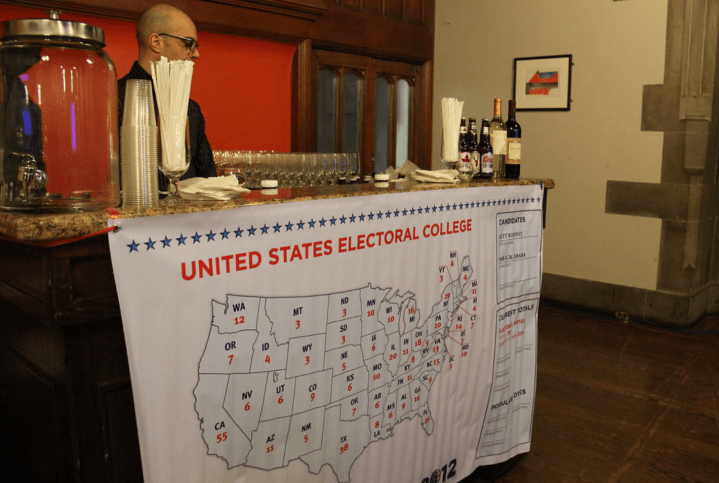
The United States prides itself on democratic and egalitarian values. Despite this, we choose to elect our executive by means of an Electoral College, which due to its nature, sometimes produces antimajoritarian election outcomes. These results go against the wishes of a majority of voters. This is easiest explained by looking at the popular vote in our presidential elections. Since the founding of the country, anti-majoritarian results have happened a total of five times in our presidential elections. The two most recent were in 2000 and 2016. In 2000, Al Gore lost the election to Geroge W. Bush despite winning the popular vote by over 500,000 votes, while Hillary Clinton lost to Donald Trump in 2016 despite winning 3 million more votes than him (American Presidency Project 2024). Both are cases in which candidates won the presidency despite winning less votes than their opponents. The other three antimajoritarian elections were in 1824, 1876, and 1888.
Margins for the 1984-2020 presidential elections are shown in Figure 1, with graph color corresponding to the winning party for that year’s election. Margins represent the amount of votes that a candidate won or lost the popular vote by. A negative margin represents candidates that won the election despite losing the popular vote.

Created by Chase Quinn using data provided by https://www.fec.gov/introduction-campaign-finance/election-results-and-voting-information/
In a comparative sense, the electoral college is an institution very specific to the United States. No other country in the world uses a system like this to elect their executive office, instead using direct elections (Sacher 2024). Contrary to popular belief, in the United States we do not directly elect our president, the electoral college does. Proponents of reform argue that utilizing a direct election method would be more democratic, as it would utilize a “one person one vote” framework where each individual vote is truly considered equal and not affected by the state where one lives. To illustrate this, we can look at the proportion of electoral college votes to state populations.
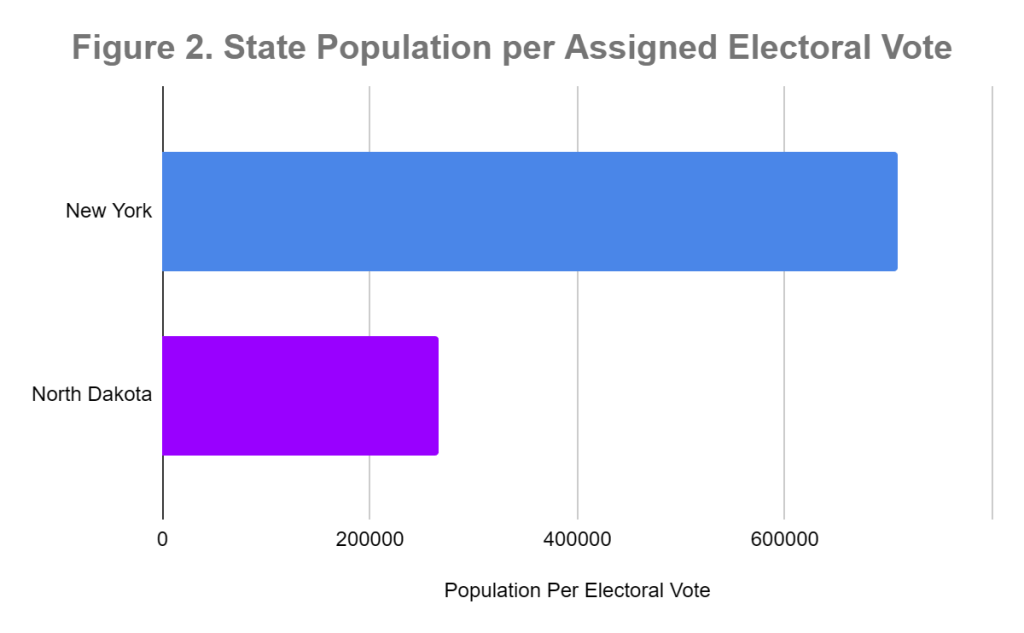
Advocates of electoral college reform point out that the weight of individual votes differs between states and disproportionately benefits states with low populations. Take for example North Dakota, the fourth least populous state, compared with New York, the fourth most populous state. North Dakota has a total of 3 electoral college votes, while New York has 28.
Created by Chase Quinn using data provided by https://www.census.gov/popclock/
A simple calculation of the proportion of population to electoral votes in each state shows some discrepancies, shown in Figure 2. Despite the drastic difference in populations, individual votes have much less weight in New York than they do in North Dakota. For every electoral college vote assigned to North Dakota, there is a population of 265,523 individual voters, more than half of the amount it takes in New York of 709,445 individual voters per electoral vote assigned. Individual votes in more populous states are given less weight than those in less populous states, despite the fact that populous states make up a greater proportion of overall population and thus represent more people. For reference, comparing state populations to the total population of the United States, New York makes up 5.7% of total population while North Dakota makes up only 0.23%, showing that New York has 25x more people than North Dakota. Electoral college votes are assigned to states based on proportion to population, but the minimum number of votes assigned to each state is three. If this minimum were to be removed, sparsely populated states like North Dakota would have less than three electoral votes as they represent proportionally much less people than populous states.
Nullified Votes and Safe States
Another criticism of the electoral college is that it routinely renders large proportions of the country’s vote to be null and void. If you are a Republican living in a heavily-leaning Democratic state, for example, your vote in the Presidential election is essentially meaningless. Every election your vote is cast, but it makes no dent on the overwhelming state majority that votes Democrat, giving all of your state’s electoral votes to the opposing party and rendering your vote as having essentially no effect on the race.
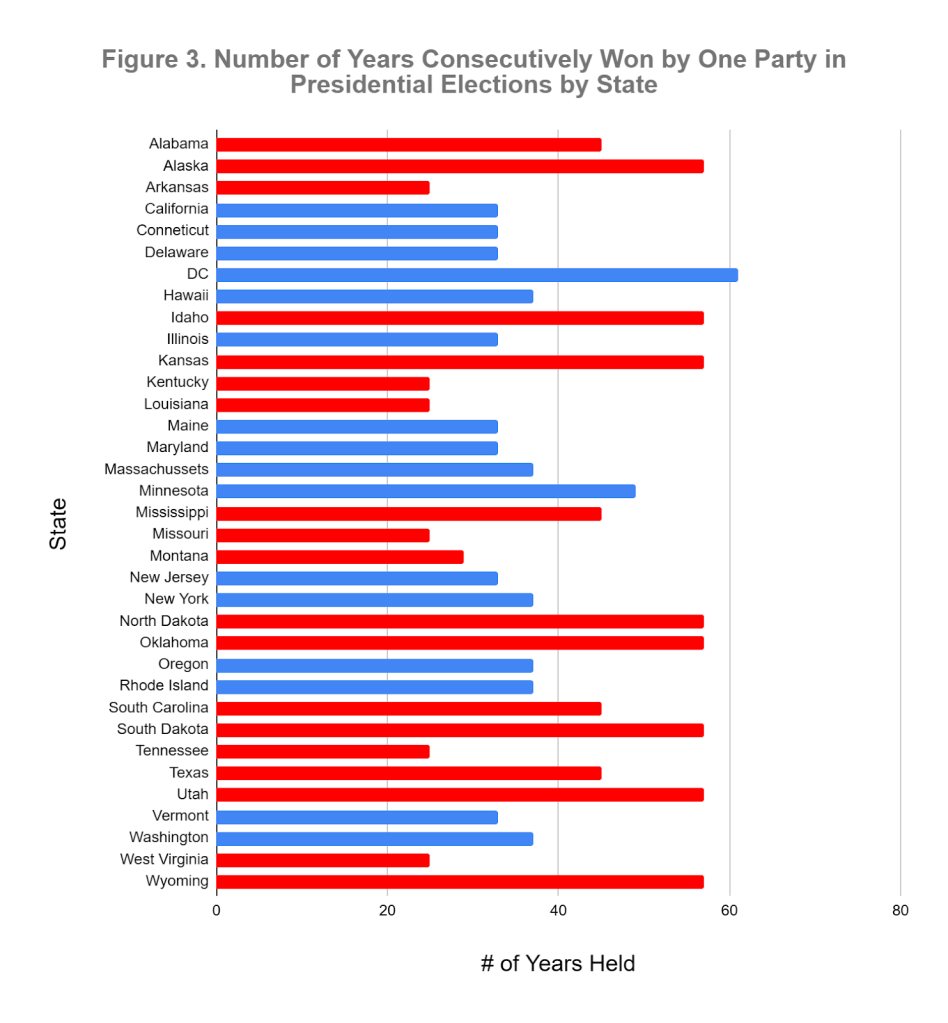
This is an especially prevalent issue in political “safe” states. These are states in which political beliefs stay relatively stable, and in which the same party has stayed dominant for an extended amount of time (in this case for 20 years or more). Alaska is a great example of this. For the past 15 presidential elections Alaska has voted Republican, marking a 57 year long period where the majority of voters have not changed their general political stances. If you are a Democrat or align with any other party in Alaska, however, your vote has been considered meaningless for the last 57 years, as a vote that does not produce any electoral college votes is useless in the overall election. Figure 3 shows the number of years that different states have been consecutively under one party control in presidential elections. This data only includes politically safe states and excludes swing states. Each state is color coded by the party in control. Note that despite not being one of the 50 states, DC is included as it is given three electoral votes and treated as its own electoral entity under the 23rd Amendment.
Created by Chase Quinn using data provided by https://www.fec.gov/introduction-campaign-finance/election-results-and-voting-information/
This is an issue that ascends partisanship, with nullified votes happening to both Democrats and Republicans as well as third parties across the country on every presidential election. The electoral college thus puts a heavier emphasis on swing states, which have very close margins and are easier to flip from party to party. As such, swing states are high priority targets for presidential campaigns, as flipping a single state could mean victory. Political competition has shifted to swing states so much that politically safe states have been observed to have lower voter turnout than swing states. During the 2016 election, 80% of states labeled “battleground states” by NPR reported higher voter turnout than the national average (Kurtzleben 2016).
Voters in noncompetitive states face a dilemma. For example, say you are an Alaskan Republican voting in the 2028 presidential election. Alaska has voted Republican for 57 straight years and is very likely to vote Republican again. You’re satisfied with the results, but why bother going to the polls if you know that your party is going to win anyway? In the same vein, if you are a Democrat or third party voter in Alaska, it seems hopeless to cast a vote in an election that seems to be lost from the get go. On either side of the aisle voters are discouraged from casting their votes, leading to less political competition and less representation.
Reform
Examining issues like this then begs the question, why do we still have the electoral college? In widespread national studies, polling has consistently shown that a majority of voters would prefer to see the electoral college removed and replaced by a national system of voting, similar to how other countries do it. A 1981 national poll found that 75% of Americans favored the abolition of the Electoral College (West 2020). Over the years, however, sentiments have been changing, with new trends emerging among partisans. Despite this, there is still a majority of support in favor of doing away with the Electoral College. A more recent Gallup survey done during the 2000 Presidential Election found that 73% of Democratic respondents supported abolition, while only 46% of Republicans did as well (West 2020).
Abolition of the Electoral College faces two major issues: conflicting interests, and unanimous consensus. The main way to realistically reform our Presidential voting system would be to pass a constitutional amendment, which requires a very strong consensus of at least two-thirds of both chambers of Congress. While it is not entirely unrealistic, it is definitely difficult. Even if a reform bill manages to pass this threshold, it must also be ratified by at least three quarters of states to be considered valid. Past measures to do away with the electoral college have come close to success, but ultimately failed, such as an attempt done in 1969-1970 (Silva 2013).
Then there’s also competing political interests. Both dominant parties in the United States benefit from the electoral college to some degree. In politically safe states, the electoral college provides an easy way to gain votes while nullifying those of the opponents. Candidates can rely on safe states for large amounts of their electoral votes and focus on fewer crucial swing states to try and win the election. Remember from Figure 3, a majority of states are considered politically safe and political attitudes typically change little from election to election. The electoral college also makes the political system less competitive considering the possible impact of third parties on elections. It’s extremely difficult for third parties to gain any sort of traction in a national presidential election because they face such high thresholds to secure electoral votes. The last time a third party candidate won any states was in 1968, when George Wallace won 46 electoral votes running under the American Independent Party, but even he was still far from victory (The American Presidency Project n.d). Democrats and Republicans both benefit from this effect, as it keeps competition from additional parties essentially nonexistent.
As a result of these factors, there’s conflicting motivations for current party politicians to advocate for reform. And with politics becoming increasingly polarized between Democrats and Republicans, they probably have other things on their minds besides abolishing the electoral college.

Chase Quinn is a senior at Binghamton University serving as the elections reporter. He studied journalism at Hunter College for two years before transferring to Binghamton to pursue a bachelors in Political Science and Master’s in Public Administration. He was born and raised in the town of Pine Plains, New York. Post-college he plans to conduct research on policy and law and aims to work in the public sector. In his free time, Chase likes to read, spend time outdoors, create art, and make jewelry.
References
Woolley, J. T., & Peters, G. (2024, November 6). Presidential election margin of victory. Presidential Election Margin of Victory | The American Presidency Project. https://www.presidency.ucsb.edu/statistics/data/presidential-election-mandates
Woolley, J. T., & Peters, G. (n.d.). 1968: The American presidency project. 1968 | The American Presidency Project. https://www.presidency.ucsb.edu/statistics/elections/1968
Sacher, J. M. (2024, September 16). Why does the U.S. still have an electoral college?. University of Central Florida News. https://www.ucf.edu/news/why-does-the-u-s-still-have-an-electoral-college/
Silva, R. C. (2013, September 2). The Lodge-Gossett resolution: A critical analysis: American political science review. Cambridge Core. https://www.cambridge.org/core/journals/american-political-science-review/article/abs/lodgegossett-resolution-a-critical-analysis/98DF1DCFC665D06C399A6D64C1DBBDB6
Kurtzleben, D. (2016, November 26). Charts: Is the electoral college dragging down voter turnout in your state?. NPR. https://www.npr.org/2016/11/26/503170280/charts-is-the-electoral-college-dragging-down-voter-turnout-in-your-state
West, D. M. (2020). It’s time to abolish the Electoral College Policy . Brookings Institution. https://www.brookings.edu/wp-content/uploads/2019/10/big-ideas_west_electoral-college.pdf
Population clock. United States Census Bureau . (n.d.). https://www.census.gov/popclock/
Election results and voting information. Federal Elections Commission . (n.d.). https://www.fec.gov/introduction-campaign-finance/election-results-and-voting-information/
-
A Longstanding Program in Danger: The History of the US SNAP Program
By Jadyn Schoenberg, Political History
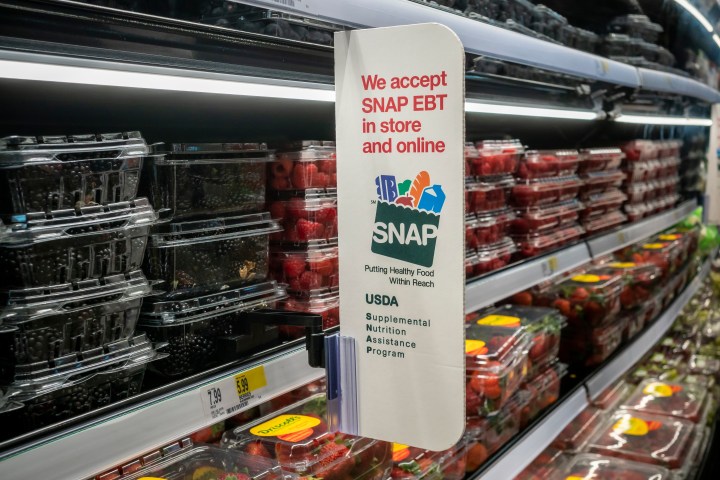
The Supplemental Nutrition Assistance Program (SNAP) is the United States’ largest program aimed at combating hunger. However, it is currently under attack by the Trump administration, and millions of Americans are at risk of their welfare benefits being cut. The government is funding 65% of the SNAP program benefits, claiming that it is all they can afford. In early November 2025, John J. McConnell Jr., a Rhode Island federal judge demanded the government pay 100% of what SNAP recipients are entitled to. The federal government agreed, but then rescinded their promise after states had dealt out the full benefits to their respective recipients. Rhode Island Governor Dan Mckee stated about Trump retracting his claims, “he intentionally created chaos for states across the country playing games with people’s ability to feed their families, weaponizing hunger, and gaslighting the American people. It’s inhumane” (Smith 2025). Trump’s attempts to weaken the SNAP program reflects the most recent transformation to an ever-changing program that has been remodeled by government legislation throughout history.
The History of SNAP Benefits
The first food stamp program in the U.S. was introduced during the Great Depression. In the four year duration of the program, 20 million Americans facing food insecurity were helped, but the program was designed to be temporary and ceased in 1943, when the unemployment epidemic in the U.S. was rectified. A food stamp program would not return until the Pilot Food Stamp Program was introduced in 1961 by President John F. Kennedy. The early food stamp programs were characterized by a purchase requirement, in which participants had to spend their own money on stamps to acquire food at a discounted price. A major expansion of the program occurred following Lyndon Johnson’s passage of the Food Stamp Act in 1964 which outlawed discrimination in food stamp distribution, removed limits on the kind of items people could purchase with food stamps, and made the program a permanent fixture in American society. (A Short History of SNAP 2025). This legislation came in the midst of Johnson’s Great Society policies aimed at combating poverty in the U.S.
Through the 1960s and 1970s, the program continued to grow from a recipient standpoint, and also in terms of the quantity of states providing these benefits. The rapid expansion of the program led to concerns over the price of providing food stamps to so many people, and it facilitated the passage of several pieces of legislation such as the Food Stamp Act Amendment of 1970, which limited the quantity of food people could purchase with subsidies to what constituted a “nutritionally adequate diet.” In addition, to buy food stamps, people had to prove that they were taking initiative to make their own money with proof of employment and spending at least thirty percent of their income on food before the government stepped in to provide assistance (A Short History of SNAP 2025).
Despite the limitations the Food Stamp Act Amendment implemented, the program would continue to grow with the Agriculture and Consumer Protection Act of 1973, which expanded the program to all states and facilitated the program’s nationalization by 1974. The program was made more accessible with the passing of the Food and Agriculture Act of 1977, which eliminated the purchase requirement, meaning people no longer had to pay for food stamps. Restrictions on food stamp collection were further mitigated when the Food Stamp Act of 1985 downgraded the requirements for enrolling in benefits from having a job to solely participating in the Employment and Training Program, which was legally required in all states (A Short History of SNAP 2025).
Access to food stamps was facilitated by the nationwide implementation of Electronic Benefit Programs in 2002 after the passage of the Personal Responsibility and Work Opportunity Reconciliation Act. The EBT programs effectively removed physical food stamps, allowing people to collect their benefits via swiping a government-issued card (A Short History of SNAP 2025).
Food welfare assistance followed a cyclic pattern of expanding and then contracting. Each time the program expanded, laws were passed that restricted the program, and when the program reached lulls, legislation was implemented to increase participation. An example of this is with the Federal Agriculture Improvement and Reform Act of 1996 and the Farm Security and Rural Investment Act of 2002. For example, upon the program expanding in the 1980s, immigrants were barred from receiving the benefits; however, six years later this decision was reversed when immigrants who, after five years of living in the U.S., were permitted to collect food stamps. This reversal came during a period of participation decline in the 1990s (A Short History of SNAP 2025).
In 2008, The Food, Conservation and Energy Act substantially increased funding to these programs by over a billion dollars each year. Per this Act, the program was officially titled the Supplemental Nutritional Assistance Program (SNAP). Following the 2008 recession, the program experienced continuous growth (A Short History of SNAP 2025). However, the program is currently in danger of a serious contraction; but this should not come as a surprise to the American populace, as Republican administrations generally tend to target welfare programs.
Democrats and Republicans on Food Stamps
The political right and left generally have different perspectives regarding the distribution of welfare benefits. Republicans intend to minimize government funding for welfare programs, such as SNAP, and want to decrease the money spent on these programs by decreasing the amount of recipients of these benefits. Republicans want to add more work requirements, making the benefits less attainable for the unemployed. On the other hand, Democrats are proponents of expanding welfare programs, simplifying the process of joining the program and collecting its benefits, and are against tightening the work requirements (Farley 2025). The most recent government shutdown was the result of disagreements between Congressional Democrats and Republicans over government funding for Obamacare subsidies. Due to the shutdown, Congress failed to renew funding for SNAP assistance, leaving millions with the risk of food insecurity.
Although expansions and cuts of welfare programs have occurred during Democrat and Republican administrations, the most notable growths of food-based welfare occur during Democratic presidencies and the most notable cuts during Republican leadership. For example, the food stamp program became permanent in American society under Democrat President Lyndon B. Johnson, and the purchase requirement for food stamps was eliminated, which ultimately made food stamps easier to obtain in 1977 under Democrat President Jimmy Carter. In contrast, the legislation that restricted food stamp purchases to only the items that constituted a “nutritionally adequate diet” occurred under the Nixon administration. Lastly, the Food, Conservation and Energy Act of 2008 that sought to increase funding for these programs was initially vetoed by Republican President George W. Bush, and it only passed because the veto was overridden by a Democrat-dominated Congress.
The recent threats to welfare programs place the food security of many Americans in jeopardy, but they are evidence of a longstanding pattern in American society of Republican leaders reducing government spending on welfare benefits.

Jadyn Schoenberg is a sophomore majoring in Philosophy, Politics and Law from Commack, NY. She is an Associate Political History Reporter, who plans to attend law school in the future. Her political interests include democratic backsliding, international law and legal history. Aside from writing, she enjoys playing ultimate frisbee and spending time outdoors.
References
“A Short History of SNAP.” Food and Nutrition Service U.S. Department of Agriculture, August 29, 2025. https://www.fns.usda.gov/snap/history.
Farley, Robert. “Democrats and Republicans Clash Over SNAP Contingency Funds.” FactCheck.org, October 31, 2025. https://www.factcheck.org/2025/10/democrats-and-republicans-clash-over-snap-contingency-funds/.Smith, Tovia, Chandelis Duster, and Jennifer Ludden. “Trump Administration Again Asks Supreme Court Intervene on Order for Full SNAP Benefits.” NPR, November 10, 2025. https://www.npr.org/2025/11/09/nx-s1-5603417/full-snap-benefits-trump-states-order.
-
The end of politics? A brief analysis of Türkiye in the context of competitive authoritarianism
By Eren Filizler, Foreign Affairs
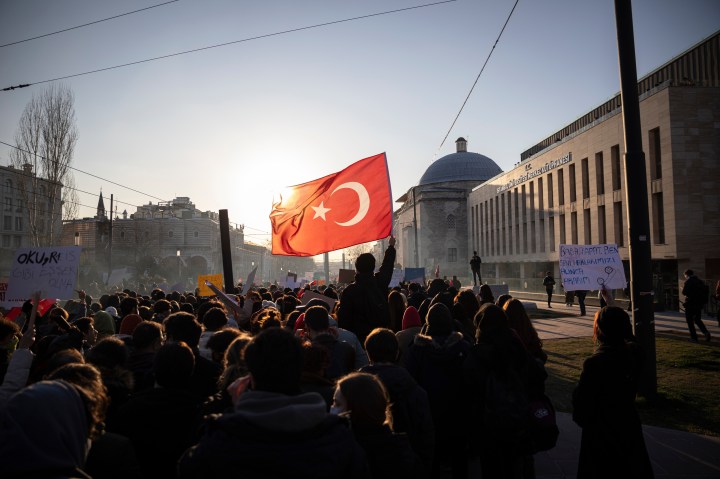
Photo:In recent years, Türkiye’s political trajectory has become one of the most debated cases in comparative politics due to its rapid transformation from a democratically promising EU candidate to an increasingly authoritarian system. Academics, policymakers, and international observers have highlighted Türkiye as a critical example of how elected governments can gradually erode democratic institutions while maintaining formal electoral procedures. Intensifying political repression, the restructuring of state institutions, and deepening polarization have raised fundamental questions about the nature and durability of Türkiye’s current regime type. Against this backdrop, the classification of Türkiye’s political system has gained renewed attention, particularly following the arrest of Ekrem İmamoğlu—widely regarded as the main opposition’s strongest presidential contender—and the escalating pressure on the CHP. These changes have led academics to reevaluate whether Turkey is moving toward a more hegemonic and consolidated authoritarian model or if it continues to fit in the category of competitive authoritarianism.
Political scientists have long defined Türkiye’s regime as a hybrid regime, typically referred to as a competitive authoritarian regime. Competitive authoritarianism was conceptualized by Levitsky and Way in 2010 and established in the literature. This concept is formally used to describe regimes with multi-party systems and regular elections, but also regimes with oppression of the opposition, systematic inequalities, and unfair competition. Türkiye has been frequently used as a model country by political scientists, particularly since 2016. There has been a notable development recently; following the arrest of the main opposition’s presidential candidate, Istanbul Mayor Ekrem İmamoğlu, and the escalation of political pressure on the main opposition party, the CHP (Republican People’s Party), some proponents of the competitive authoritarian thesis have partially abandoned this thesis and begun to argue that Türkiye is moving toward a hegemonic authoritarian regime (Esen and Gumuscu 2025). This article will analyze recent developments in Türkiye, the dynamics of the regime, and its future.
Conceptual Framework
According to Levitsky and Way, competitive authoritarian regimes are defined by three main characteristics. First, the partisan exploitation of state institutions. Second, the systematic favoritism of the ruling party over the opposition. Third, the creation of unfair competition against dissidents (Levitsky and Way 2010). Türkiye meets all these criteria. Especially after the failed coup attempt in 2016, numerous purges were carried out within the bureaucracy, and Erdoğan loyalists were appointed to fill the vacant positions. During this period, the country operated under a state of emergency for an extended period. During this period, a referendum was held to abandon the parliamentary system and transition to a presidential system with less separation of powers. Following these developments, political pressure on the opposition in Türkiye increased, with some politicians being arrested and trustees being appointed to replace some elected mayors. These events further reinforced Türkiye’s authoritarianism
The government in Türkiye can easily censor dissent using state apparatuses. It also uses the judiciary as a tool to suppress politicians and, by controlling almost 90% of the media, alienates Türkiye from a democratic environment. (Kizilkaya 2023). However, it cannot be said that Türkiye was a democratic country before the AKP. For many years, the military and bureaucracy in Türkiye had been a threat to elected officials through a tutelary regime, interfering with them. The AKP came to power during a period of intense military pressure, combating this tutelage and eliminating its threat. The AKP, in its early days of struggling with this tutelage, had provided Türkiye with one of its most democratic periods due to the EU negotiations and the Copenhagen criteria (Kirişci and Sloat 2019). However, the subsequent failure of the EU negotiations—which was due to the EU dragging its feet rather than the AKP—and the AKP filling the power vacuum as the tutelage weakened, made the AKP more authoritarian (Kirişci and Sloat 2019).
The New Rising Star: Ekrem İmamoğlu
In the 2018 presidential election, the opposition, unable to even take Erdoğan to a second round, was shaken. The following year, in the local elections, the CHP announced an unexpected candidate for Istanbul: Ekrem İmamoğlu. It was a bold decision for a city of 16 million, representing one-fifth of Türkiye’s population. While many believed the opposition had been foolish and had lost the election from the outset, Ekrem İmamoğlu misled them and narrowly won Istanbul, a city that had been under AKP rule for 15 years (BBC 2019). However, the Supreme Election Council, claiming irregularities, annulled the Istanbul elections and ordered a rerun. This decision was clearly politically motivated, as in the past, while opposition requests to annul elections were rejected, the ruling party’s request was accepted. This annulment backfired on the government, and Ekrem İmamoğlu was re-elected for a second term, widening his 13,000-vote lead to 800,000 (Sayin 2019). After suffering this injustice, his body language, eloquence, and bold statements directly targeting Erdoğan, made him the new star of Turkish politics and, according to the polls, the only candidate who can beat Erdoğan.
In the 2023 presidential elections, six opposition parties from different political spectrums formed an alliance but faced a serious candidate crisis. For a long time, the nomination process was undecided, and Ekrem İmamoğlu was one of the leading candidates. However, the government, viewing İmamoğlu as a threat, filed “political” lawsuits against him through the judiciary under its control. During this process, it was rumored that İmamoğlu’s candidacy would be eliminated due to the possibility of a political ban, and CHP Chairman Kemal Kılıçdaroğlu was selected as the candidate (Michaelson and Narli 2022). Kılıçdaroğlu, who didn’t have a very good image among the public, was heavily criticized. To calm the backlash, it was announced that Ekrem İmamoğlu would also be Vice President. However, after a highly controversial election, the opposition suffered another defeat and lost to Erdoğan. Allegations that some opposition figures were actually working for Erdoğan are still being debated.
While the opposition was completely shattered after this loss and voters were plunged into despair, the CHP changed its chairman at a turbulent congress and, with an extraordinary performance in local elections, became the leading party again after 47 years (BBC 2024). Ekrem İmamoğlu, on the other hand, easily defeated one of the ruling party’s most prominent figures despite the heavy state support for his opponent and maintained his political momentum.
İmamoğlu’s Arrest
İmamoğlu, who submitted his official presidential application by collecting 15 million signatures, was arrested on the morning of March 19, 2024 by police who arrived at his home on charges of university degree irregularities and corruption. This arrest warrant sparked widespread protests unlike anything the Republic of Türkiye had seen in a long time. The protesters were mostly Gen Z university students. The high level of police violence, the arrests of many students, and the intervening holiday brought the protests to a swift conclusion (Bianet 2025). İmamoğlu has been in custody since that day and is still on trial.
Kurdish Issue
One of the recent political turning points in Türkiye is undoubtedly the Kurdish issue. The Kurdish political movement has undoubtedly suffered the most severe blow during the AKP’s authoritarianism. Selahattin Demirtaş, once a groundbreaking and shining star of politics, was arrested on terrorism charges while he was the chairman of the HDP (the party of the Kurdish political movement) and is still in detention. Many other Kurdish politicians, like Demirtaş, remain in prison. Furthermore, trustees have long been appointed to municipalities won by the HDP, usurping the will of the people. However, in October 2024, the ruling far-right Nationalist Movement Party’s (MHP) calls for a solution and peace to the Kurdish issue caused astonishment in politics because the MHP had long maintained its political existence as the antithesis of the Kurdish movement. Initially hesitant to respond to the MHP’s call, the AKP later supported it (Sayin 2024). Having consolidated a significant vote share a year earlier by labeling the opposition terrorists for collaborating with the Kurds, the ruling party made a significant U-turn and launched the “Türkiye Without Terrorism” process. A parliamentary commission was established, and Abdullah Öcalan, the founding leader of the PKK (the armed wing of the Kurdish movement), who had been imprisoned and barred from communicating with the outside world for years, was allowed to meet with politicians (Sayin 2025).
For a long time, the reason for this transformation, which no one understood, was initially attributed to a survival issue. The MHP argued that the country was at a critical juncture and faced existential threats. This process, which many people initially failed to understand and attempted to be disguised as political, was driven by geopolitical developments in the Middle East following October 7th. It was also driven by Türkiye, which played the most significant role in the Syrian revolution and aimed to establish regional leadership and gain profit in the reshaped region. Some believe that this process was initiated to prevent Kurds in the region from cooperating with Israel after relations with them became strained (Laciner 2025). In May 2025, upon Öcalan’s call, the PKK dissolved itself after 47 years and began to disarm its guerrillas and evacuate critical locations (Durukan 2025).
General Analysis
Although Türkiye is often viewed as a competitive authoritarian state, Erdoğan can purge any politician he deems a threat, even ignoring ECHR rulings, and strip them of their political freedom. In this regard, especially after İmamoğlu’s arrest, some argue that the regime will continue as long as Erdoğan is alive or in his will. It is clear that calling the Turkish regime a typical competitive authoritarian regime would be a mistake; it is a sui generis regime. A country like Türkiye, amidst existential geopolitical dangers and the constant securitization of matters by the state, cannot be expected to achieve the level of democracy found in prosperous Western countries. When it comes to the Kurdish issue, resolving this issue will not only move Turkey forward in a democratic sense but will also create geopolitical comfort for the AKP and the chance to draw a strong opposition closer to itself in domestic politics.
The fate of the regime in Türkiye depends largely on its good relations with the West and the relationship between the MHP-AKP coalition. If the MHP leaves the alliance, the AKP will suffer a significant loss of votes, but an even greater defeat will be its loss of control of state apparatuses, as many MHP loyalists have gained important positions within the state during this alliance (Karakas 2023). The fact that Türkiye lacks self-sufficiency in resources, unlike those of Russia or China, is another factor that makes the regime vulnerable. Even though the government is authoritarian, the need for legitimacy persists due to these limited resources (Esen and Gumuscu 2025). Therefore, elections continue to serve as a major tool for legitimization for the government. It is challenging to grasp and analyze what is truly happening because most issues are settled behind closed doors and perceived as merely political maneuvering.

Eren Filizler is a senior-year student from Istanbul, currently pursuing a dual degree in Global and International Affairs at Binghamton University (SUNY) and Middle East Technical University (METU). While he is broadly interested in various areas of the social sciences, his main focus is on political economy. Outside of academics, Eren is an avid football enthusiast. He is also deeply interested in cinema, and his dream is to one day write and direct his own romantic comedies and dark comedy films.
References
BBC Türkçe. 2024. “Yerel seçimlerde kırmızı dalga: CHP’nin 47 yıl sonra elde ettiği seçim zaferi ne anlama geliyor?” BBC Türkçe, 1 Nisan 2024. https://www.bbc.com/turkce/articles/crgdklmmeyno
BİA Haber Merkezi. 2025. “19 Mart raporu: Yıkılan barikatla korku duvarı aşıldı.” Bianet, 29 Kasım 2025. https://bianet.org/haber/19-mart-raporu-yikilan-barikatla-korku-duvari-asildi-313993
Durukan, N. 2025. “PKK, ‘çatışma riski’ gerekçesiyle Zap’tan çekildiğini duyurdu.” T24, 17 Kasım 2025. https://t24.com.tr/haber/pkk-catisma-riski-gerekcesiyle-zap-tan-cekildigini-duyurdu,1276864
Esen, Berk and Sebnem Gumuscu. 2025. “How to Fight Turkey’s Authoritarian Turn.” Journal of Democracy 36 (3): 106–120. https://www.journalofdemocracy.org/articles/how-to-fight-turkeys-authoritarian-turn/
Karakaş, B. 2023. “AKP iktidarına yön veren aktör: MHP.” DW Türkçe, 2 Şubat 2023. https://www.dw.com/tr/akp-iktidar%C4%B1na-y%C3%B6n-veren-akt%C3%B6r-mhp/a-64584812
Kirişci, Kemal and Amanda Sloat. 2019. “The Rise and Fall of Liberal Democracy in Turkey: Implications for the West.” Brookings Institution. https://www.brookings.edu/articles/the-rise-and-fall-of-liberal-democracy-in-turkey-implications-for-the-west/
Kizilkaya, Emre. 2023. “Turkey: Erdogan’s grip on media threatens fair elections.” Chatham House – The World Today, 11 May 2023. https://www.chathamhouse.org/publications/the-world-today/2023-04/turkey-erdogans-grip-media-threatens-fair-elections
Laçiner, Ö. 2025. “Büyük Ortadoğu ve ikinci ‘Çözüm Süreci.’” Birikim Dergisi, Sayı 433, Mayıs 2025. https://birikimdergisi.com/haftalik/12044/buyuk-ortadogu-ve-ikinci-cozum-sureci]
Levitsky, Steven, and Lucan A. Way. 2010. Competitive Authoritarianism: Hybrid Regimes after the Cold War. Cambridge: Cambridge University Press.
Michaelson, Ruth and Deniz Barış Narlı. 2022. “Istanbul mayor Ekrem İmamoğlu sentenced to jail over ‘fools’ insult.” The Guardian, 14 December 2022. https://www.theguardian.com/world/2022/dec/14/istanbul-mayor-ekrem-imamoglu-sentenced-to-jail-over-fools-insult
Sayın, Ayşe. 2024. “Erdoğan, Bahçeli’ye Öcalan çıkışı için teşekkür etti.” BBC Türkçe, 30 Ekim 2024. https://www.bbc.com/turkce/articles/cwy1wn9pyz3o
Sayın, Ayşe. 2025. “Öcalan’la görüşmeden ilk detaylar: Ne kadar sürdü, neler konuşuldu?” BBC Türkçe, 25 Kasım 2025. https://www.bbc.com/turkce/articles/c20k755gde1o
-
Evangelical Christianity and American State Ideology: A Historical Review
By Travis Rayome, Political History
When the 13 colonies were established throughout the 16th-18th centuries, the myriad Christian denominations that found themselves in the New World began integrating religious practices into the laws of their respective colonies. Some, like the Virginia Colony, integrated themselves into the Old World’s theocratic structures; the first Virginia House of Burgesses meeting in 1619 established compulsory attendance of the Church of England (also known as the Anglican Church) and passed laws mandating that all Virginians do “God’s service” in accordance with Anglican teachings (Marcus 2022). However, other colonies, primarily the Pilgrims and Puritans of New England, came to North America to distance themselves from Europe’s religious hegemonies (in particular, Catholicism and Anglicanism) and established their societies on unique religious structures. No matter how they related to existing Christian institutions, though, many of the 13 colonies were explicitly theocratic. Religion was emphasized and participation was often enforced by colonial governments as a binding force between colonists coming from different localities and cultures in Europe, something to enforce social cohesion and moral order (Marcus 2022).
However, before America was founded, new colonial governments and religious movements promoted the idea of a range of diverse and independent religious cultures practicing under a secular government, which influenced the decision of the Founding Fathers to enact the separation of church and state. Maryland was founded in 1634 with built-in religious tolerance in order to provide a safe haven for English Catholics, who were facing persecution both in England and across the other colonies, despite them being a minority in the colony and Maryland’s laws flipping back and forth between persecution and protection in the 17th and 18th centuries. Rhode Island was founded by Roger Williams, a former Massachusetts resident who was religiously persecuted and expelled by the colony in 1635 and sought to create a new society founded on religious liberty for all people. Today, Newport, Rhode Island, a key early settlement, boasts the nation’s oldest Synagogue, built in 1763 (Marcus 2022). Pennsylvania was founded in 1680 by William Penn, a member of the then-reviled Quaker denomination of Christianity, whose religious beliefs rejected hierarchy and led to Pennsylvania enshrining religious tolerance and inviting Christians of all denominations. Leading up to the American Revolution, the First Great Awakening of Christianity in America saw the religion become more diverse and decentralized, giving rise to prominent Protestant denominations such as Methodism, Baptism, and Presbyterianism, making it harder for colonial governments to govern in adherence with just one doctrine. Key to the First Great Awakening and binding together these new denominations and communities was the prominence of evangelism, a doctrine whose popularity will end up guiding Christianity’s development as a fixture of American society. Evangelism describes a movement within Protestant denominations prioritizing evangelization, or the spreading of the Gospel. Thomas S. Kidd, an American Christian historian, describes evangelism as an emphasis on spiritual renewal (Kidd xiv). The movement centralizes the religious mission to convert people to Christian values by preaching the gospel, including incorporating them into institutional policy, seen in how colonial and later state governments would govern in accordance with a religious doctrine and in politicians on all levels of government performing their duties in accordance with their own religious beliefs (Johnston 2018). While the diversity of American Christianity means that the values themselves vary between sects, the drive to evangelize American society among American Christian institutions is a common influence on local, state, and even federal laws across our nation’s history.
The Founding Fathers, while being Christian themselves and some describing their work as divinely inspired (James Madison Federalist 37), diverted from the precedent of evangelism and theocratic governance of the colonies in favor of a secular, more egalitarian system. For example, the Constitution barred religious tests and oaths for public officials, with the Federalists citing that, while on the surface promoting accountability and affirming the merit of these figures, such a system could be exploited by bad-faith actors willing to lie and use Christian doctrine to further their own interests. Instead, they argued that democracy would provide better results, as the people could decide for themselves whether a leader was worthy rather than their worthiness being based on supposed adherence to specific values. Because of the decentralization and rapid proliferation of new Churches across the budding nation (by the time of the Constitution’s writing, no one denomination was dominant across all 13 colonies), religion became seen as a matter of personal belief, the kind of subjective value that democratic representation was meant to represent the diversity of as opposed to promoting a singular vision as “objective” (James Madison Memorial Fellowship Foundation). For this reason, the separation of church and state enshrined in the Constitution was seen as a measure to prevent tyranny, keeping one ideology from having outsized influence over the nation. In the Constitution, the separation appears as a clause of the First Amendment, dubbed the “Establishment Clause,” which bars the government from establishing or favoring any religion. The Supreme Court case Everson v. Board of Education (1947) established the bounds of the separation between church and state as the inability for the government to establish or support a religious institution, aid any or all religions, influence individuals to attend or avoid religious services, or punish individuals on the basis of religious beliefs or practices (Wex 2025).
Despite the areligious status of the United States government, Christianity remained dominant in American culture throughout the period of Westward Expansion following the nation’s establishment. The Second Great Awakening, beginning in the early 1800s, saw preachers and clergy traveling the country to evangelize communities across the 13 colonies and beyond through “revival” town-hall-esque meetings, also saw religious sermons become moving performances meant to convert the masses and inspire worshipers to promote and carry out the mission of God through further evangelism. These revivals personalized religious practices and made the Church into a place for both community and political messaging on top of religious practice. This strategy was highly effective, with churches reporting hundreds of thousands of new converts across the budding nation in the 1830s (The Faith Project 2003).
During the Second Great Awakening, American Evangelical Christianity became a “Civil Religion,” where the United States’ national mythos became intertwined with the faith as a means of instilling both patriotism in Christians and Christianity within Americans. The principles of evangelism, namely the emphasis on the expansion of the Christian faith and incorporation of Christian values into all facets of life, synthesized with the United States’ political goals. The United States government did not need to explicitly support Christianity, thereby violating the Establishment Clause; instead, through the intertwining of evangelicalism with patriotism brought on by the Second Great Awakening, the concept of “America” was imbued with divine importance. Values key to justifying America’s founding such as liberty, freedom, and democracy took on sacred meanings akin to Grace and Virtue within the Gospels, and became absolutist justifications for the nation’s actions. As noted by historian Donald M. Scott: “Americans did not consider their new nation to be simply another nation among nations, but a providentially blessed entity charged to develop and maintain itself as the beacon of liberty and democracy to the world” (Scott 2013). The USA as a project became something sacred, with the rapid spread of evangelism informing a “specialness” with which America was viewed by Evangelical Christians. This meant that the history of America was of Biblical importance to many, and the political aspirations of the United States such as the expansion of its territory into the western frontier, growth of its economy and industrial capabilities, and strengthening of its global influence, became part of the same mission to evangelize as much of America as possible within mainstream culture. This is the basis for Manifest Destiny and illustrates how the concept, propagated in the Second Great Awakening, motivated settlers to claim more and more Native land to expand America’s borders: the perception of America’s divine importance and destiny, the evangelical mission to fulfill America’s providential mission as a political, economic, colonial, and religious project.
After World War II, Christianity became more openly intertwined with the United States’ culture and political ambitions. The synonymization of freedom, democracy, and other American values with Christian virtue allowed for the United States to assign moral value to their Cold War efforts, positioning communism and Soviet influence in other nations. In a 1969 address to the nation addressing the US invasion of Vietnam, which by that point had resulted in the deaths of 31,000 American soldiers, President Richard Nixon demonstrated subtextually notions of providential destiny with which evangelism regards America and its prosperity, the synonymization of Christian virtues with American values, and the obligation of the people to promote the proliferation of these values: “Today we have become the strongest and richest nation in the world. And the Wheel of destiny has turned so that any hope the world has for the survival of peace and freedom will be determined by whether the American people have the moral stamina and the courage to meet the challenge of free world leadership” (Nixon 1969).
Moving beyond subtext into more explicit evangelist policies in the postwar period, the Pledge of Allegiance, meant to reaffirm school-age children’s loyalty to the United States, was amended in 1954 to refer to America as “one nation under God,” an explicit reframing of the United States’ identity as an inherently Christian nation. On top of promoting Christianity, by adding this into the Pledge of Allegiance, American schoolchildren are instilled with an inherent association of America with the divine, making evangelist attitudes towards America that justify decisions like the Vietnam War and Manifest Destiny more normalized even among non-Christian or areligious students. This change also signals the increasing bias the American government has shown for Evangelical Christianity over the past century, and the slow replacement of subtextually Christian messaging with unquestionably religious language can be seen as inevitable given how connected American political rhetoric has been to evangelicalism over the course of the nation’s history.
This transition into Christian nationalist language, that frames the United States as inherently Christian and pushes Christianity to the center of US policy and culture, has reached new heights with each successive administration in the 21st Century. President George H.W. Bush and his son, later president George W. Bush, never shied away from promoting their faith, incorporating it into policy decisions and public statements and encouraging the American people to be Christian (Johnston 2018). George W. Bush is even quoted as claiming that God told him to invade Iraq in a private meeting in 2003, showing that evangelical influence in politics is not just an element of messaging, but even motivates policy decisions behind the scenes (Cornwell 2005). The history of America is the history of Evangelical Christianity: the two have grown in tandem over the past 250 years, fueled each other’s rise in prominence, and influenced each other’s developments. The growing openness with which post-WWII United States policy reflects evangelical values is not a shift away from the secular nature of the government as described in the Constitution; instead, it is a way of articulating The United States of America’s deep ties to the evangelical movement that reflects the longstanding influence that each have had on each other since the first settlers arrived in the New World.

Travis Rayome is an English and Economics major from Alexandria, Virginia. He hopes to work for humanitarian NGOs around the Washington, DC area, continue writing on politics and economics, and play music. His areas of political interest are propaganda and information dissemination, structural violence and inequality, and power distribution within and between nation states.
References
Cornwell, Rupert. 2005. “Bush: God told me to invade Iraq.” The Independent, October 7. https://www.independent.co.uk/news/world/americas/bush-god-told-me-to-invade-iraq-6262644.html.
Marcus, J.S. 2022. “The Surprising Religious Diversity of America’s 13 Colonies.” History, July 25. https://www.history.com/articles/religion-13-colonies-america.
Logan, Samuel T. and Kidd, Thomas. 2008. “‘The Great Awakening: The Roots of Evangelical Christianity in Colonial America’ by Thomas S. Kidd.” Modern Reformation, July 1. https://www.modernreformation.org/resources/articles/the-great-awakening-the-roots-of-evangelical-christianity-in-colonial-america-by-thomas-s-kidd.
Wex Definitions Team. 2025. “Separation of Church and State.” Legal Information Institute at Cornell University, June. https://www.law.cornell.edu/wex/separation_of_church_and_state.
James Madison Foundation. “The Founders and the Freedom of Religion: An Introduction.” https://www.jamesmadison.gov/system/files/assets/teach-the-constitution/lessons/01_FoundersFreedomReligion.pdf.
Scott, Donald M. 2013. “The Religious Origins of Manifest Destiny.” National Humanities Center. https://nationalhumanitiescenter.org/tserve/nineteen/nkeyinfo/mandestiny.htm.
The Faith Project. 2003. “The Second Great Awakening: Jubilee and Social Change.” PBS. https://www.pbs.org/thisfarbyfaith/journey_2/p_3.html.
Nixon, Richard. 1969. “Address to the Nation on the War in Vietnam.” November 3. https://www.presidency.ucsb.edu/documents/address-the-nation-the-war-vietnam.
Johnston, Lori. 2018. “George H.W. Bush Helped Lead GOP Toward Evangelicalism.” The Salt Lake Tribune, December 1. https://www.sltrib.com/religion/2018/12/01/george-hw-bush-helped/.
-
Turning Back The Planet’s Clock

By Hatim Husainy, Sustainability
Photo: Dmitry Makeev, CC BY-SA 4.0Climate Change is an extremely complicated problem.
The Earth is an extremely delicate system—it has many layers and each of them interact with the others in ways we are still not completely sure about. This means that, when there is an imbalance, even a small one, it creates a huge change in the planet’s weather, temperature, and biological systems.
The best example of this phenomenon is climate change. Carbon dioxide, or CO2, even at today’s elevated levels, makes up about .04% of the Earth’s atmosphere. (NASAa 2024)
This is a 50 percent increase from pre-industrial levels, and it has a huge impact on the Earth system.
This is not the only way we observe “small” changes having huge implications. We have accidentally been changing cloud formation over the sea for decades because of the sulfur we’ve been putting in fuels. Without sulfur, the fuels in ships now burn much cleaner, but with fewer clouds, the ocean is actually heating faster. Importantly, this truly doesn’t consider the emissions saved with clean-burning fuels, which still might make this change worth it even with the loss of cloud cover. (Harvey et al. 2024)
It is tempting to think of climate change as a problem that is mostly on the political and economic level. And while it may be true that the dynamics of humans have reached our hand to the heavens and put many lives at risk. Not just human lives, but many of the species of plants and animals that rely on a steady, predictable climate are now either at risk of extinction or will be soon. There is no time to make the wide-ranging political and economic realignment necessary to preserve the biosphere that exists today before it is too late.
And so, we must consider radical action. What changed once can be changed again. To understand what type of action might be needed, it’s worth returning to the engine driving the crisis: the greenhouse effect. In short, the Earth warms because gases like CO2 trap the heat energy that we get from the Sun, so when there’s an increase in CO2 concentration in the atmosphere, the planet gets hotter. (NASAb 2024)
Current climate “interventions” focus on reducing the amount of CO2 we are putting into the atmosphere. What these approaches tend to overlook is that even if we dropped to zero new emissions overnight, the acceleration of global warming would drop to zero but its velocity would remain. In other words, the amount of CO2 still in the atmosphere will keep the Earth heating long enough to cause biosphere-level collapse. The only way to find the time to develop technologies that can accelerate the process of getting CO2 back to preindustrial levels is to address the other part of the equation: decreasing the heat that Earth takes in from the Sun directly.
If we can alter the start of the equation by limiting the amount of energy that enters the Earth’s atmosphere, we can cool it down. This idea is described by scientists as solar geoengineering. Essentially, the particular mechanism is to create more clouds in the upper atmosphere so more sunlight is reflected. This could be accomplished by introducing more particles into the atmosphere—some scientists suggest sea salt for ease of access, while others propose sulfur dioxide because that is what has been proven to lower atmospheric temperatures when volcanoes throw large amounts of it into the atmosphere.
In comparison to making the hugely expensive transition from fossil fuels to renewable resources, geoengineering is incredibly cheap, not just in terms of real dollars, but also human labour-hours and mineral resources. Climate change is a challenge that will take time and money to solve: we must research carbon-capture farming, crops like hemp, kelp, and algae, and retool the entire energy apparatus of the US. In comparison to the cost of these new energy infrastructures and other research and development, geoengineering is relatively cheap. For an estimated 2 billion dollars a year, we buy valuable time to make these changes. (Harvard 2018) Even the research and development would be relatively inexpensive, because it is less creating an entirely new scientific process and more “an exercise in the application of existing tools from aerosol science, atmospheric science, climate research, and applied aerospace engineering”. (Keith 2017)
Of course, such a valuable and far-reaching stopgap cannot be deployed focusing only on scientific and financial viability. We must also consider governance: who would be consulted on what the resting temperature of the globe should be? There are also important effects to consider when we are ready to stop—or if we are forced to.
The big question of governance is this: how do we get people to agree on what the earth’s temperature should be? Inherent to geoengineering is the ability to lower the Earth’s temperature; how far should we lower it? Some governments would massively benefit from an Earth warmer than preindustrial levels, much of the Siberian tundra may defrost at a sustained higher temperature. On the other token, cooling the Earth to cooler than pre-industrial levels would make desert reclamation easier in the Sahara or Mongolian desert (Davies 2025). Grant Davies argues that this is possible to agree on, as a global community, only under two conditions. First—countries need to gather in a process they see as fair, and arrive at a conclusion together—maybe agreeing on a temperature corridor that would be acceptable. Then, the countries that lose out in this arrangement would be compensated in order to maintain their buy-in. Ideally, this would be made easier by the already widespread process of carbon recognition that would need to simultaneously occur to make good use of the time we are buying. A “corridor” that keeps us within a tenth of a degree of preindustrial levels would do a lot of good. It would reverse somewhere between 150 and 400 years of global temperature rise in a matter of decades. This could be great—icebergs should cease to melt and perhaps even begin to grow again, ocean acidification would slow and coral reefs would have a chance to stabilize and recover, and total ecological collapse could potentially be avoided.
The other big worry that lies right between issues of science and governance is termination shock. If for some reason the geoengineering program were to suddenly grind to a halt, it would be a big problem. The rapid cooling we had carefully engineered would quickly become reckless warming as the Earth returns to a degree and a half hotter than pre-industrial levels. Termination shock is an issue we can avoid—maintaining true global buy-in would be a very important element, for there would be relatively few parties looking to sabotage a hypothetical geoengineering program. Additionally, implementing geoengineering as a temporary solution and not our long-term strategy would make us less dependent on it and enable creating a timeline to slowly roll the program back once we are at a net-negative energy infrastructure.
In addition to termination shock, there are other scientific barriers to be considered. The increased cloud formation might slow photosynthesis or induce new extreme weather events. Additionally, direct tampering with the Earth’s delicate systems of weather might destabilize critical forces like monsoon winds of atmospheric currents, which could create unprecedented droughts, floods, or endanger agricultural yields (Lazard 2025). The biggest scientific problem is the data gap. We have not run small or medium scale experiments; much of the current literature relies on natural experiments (like volcanic eruptions or the sulfur fuel discussed earlier) but that is relatively small scale in relation to what a global cooling effort would look like.
There are many other problems that climate scientists have raised with geoengineering, in both theory and practice. Some of these are argued by Mike Hulme in his book “Can Science Fix Climate Change?” (London School Of Economics 2014). Hulme argues that climate change is an important opportunity to reconsider how we view humanity’s place in the world, rather than simply determining a new science fix in order to not change our lifestyles (Hulme 2014). His arguments are less focused on the political and economic forces that create and exacerbate climate change more on the philosophical opportunity to reconsider the way we see secularism in our society and the postmodern “consensus.” He argues that climate change has resulted in a huge decentralization of thought—that, “Instead of the end of history, what we are witnessing is a flowering of the irrepressible diversity of human beliefs, ideologies and scepticisms” (Hulme 2014). That it is a moment for humans to reevaluate their views of their relationship with the natural world and the idea of nature, and reconsider how we live.
Much remains to be seen on the question of geoengineering. There are still big questions in science, the governance is still being built, and the societal question of what happens afterward remains unanswered (Woodwall Research Center 2023). Geoengineering (changing the atmosphere on the molecular level) is a big change to propose. There are big questions about knock-on effects. But we are already doing geoengineering. We have already manipulated the atmosphere on the molecular level, and we are seeing the knock-on effects of an atmosphere with more CO2 than it can handle. We live on a rapidly warming planet not because of human technology but in spite of it. We have renewable energy that is scalable and all the tools we need to build a carbon-neutral society. The time is running out for us to put our technology into practice before we are forced to consider more radical solutions. We wield an unthinkable amount of power over nature—that gives us a responsibility to protect it.

Hatim Husainy is a freshman from Smithtown, NY, studying political science. He is in the early phases of a research project on human rights in the Binghamton area. In addition to the Happy Medium, he participates in Moot Court, Model United Nations, and Citizens Climate Lobby. He plans to pursue law school after his undergraduate degree, and from there, he plans to save the world.References
Davies, G. (2025). Regulating geoengineering. Climate Technology and Law in the Anthropocene, 186–208. https://doi.org/10.2307/jj.18323828.13
Harvey, C., Harvey, C., & News, E. (2024, August 14). Cleaned up shipping emissions have revealed additional global warming. Scientific American. https://www.scientificamerican.com/article/cleaned-up-shipping-emissions-have-revealed-additional-global-warming/
Hulme, M. (2014). Climate change and virtue: An apologetic. Humanities, 3(3), 299–312. https://doi.org/10.3390/h3030299
Keith, D. W. (2017). Toward a Responsible Solar Geoengineering Research Program. Issues in Science and Technology, 33(3), 71–77. https://doi.org/https://www.jstor.org/stable/44577362
London School Of Economics. (2014, November 5). Book review: Can science fix climate change? by Mike Hulme – LSE review of books. LSE Review of Books – the latest social science books reviewed by academics and experts. https://blogs.lse.ac.uk/lsereviewofbooks/2014/08/27/book-review-can-science-fix-climate-change-by-mike-hulme/
NASA. (2024a, October 22). The atmosphere: Getting a handle on carbon dioxide – NASA science. NASA. https://science.nasa.gov/earth/climate-change/greenhouse-gases/the-atmosphere-getting-a-handle-on-carbon-dioxide/
NASA. (2024b, October 23). What is the greenhouse effect? – NASA science. NASA. https://science.nasa.gov/climate-change/faq/what-is-the-greenhouse-effect/
Olivia Lazard. (2025). Geoengineering: Assessing risks in the era of planetary security. Carnegie Endowment for International Peace.
School of Engineering, H. (2018, November 28). Calculating solar geoengineering’s technical costs. Home Page. https://seas.harvard.edu/news/2018/11/calculating-solar-geoengineerings-technical-costs
Woodwall Research Center. (2023). (rep.). Solar Geoengineering Research & Governance. Falmoth, MA. https://www.jstor.org/stable/resrep55078
-
What’s at Stake: Binghamton Mayoral Race
By James Kang, New York Politics
In New York City, the mayoral race has taken a dramatic turn, with former governor Andrew Cuomo attempting to close the gap against Democratic Socialist Zohran Mamdani. Despite being a newcomer to politics, Mamdani’s sudden rise has rocked the New York City political landscape, as voters ponder the possibility of a Democratic Socialist for New York City Mayor.
However, just a few hours north in the city of Binghamton, another mayoral race reflects a similar sense of uncertainty as Republican incumbent Jared Kraham faces Democratic challenger Miles Burnett. Like Cuomo, Kraham emphasizes his experience as a primary reason to be the best choice for Mayor. In a similar vein, Burnett prioritizes a social media campaign and promotes a new approach to governance. With this in mind, let’s take a look at the candidates, listed in alphabetical order, and their policies for Binghamton.
Miles Burnett
Miles Burnett was born in a Southside family of union members, which contributed to his interest in community engagement and leadership. Before launching his mayoral campaign, Burnett served as the Deputy Chief of Staff for State Senator Lea Webb, where he worked to advance legislation and secure funding for the Southern Tier. Burnett also managed municipal budgets while working as an aide to New York City Council Member Andrew Cohen and led economic development projects as the Executive Director of a nonprofit organization. Additionally, when he was Executive Director, Burnett worked on improving public safety and sanitation initiatives. Burnett is currently pursuing a Bachelor’s Degree in Liberal Arts/Extension Studies (ALB) with a concentration in Social Sciences, a field of study in Government, and a minor in Sustainability at the Harvard Extension School. He is currently running as a Democrat and part of the Working Families Party (Burnett 2025).
Jared Kraham
Jared Kraham is currently Binghamton’s 51st and youngest Mayor. Before taking office, he served as Binghamton’s Deputy Mayor for nearly eight years. Kraham was born in a small-business family, which contributed to his first-hand experience of running small businesses and creating jobs. In college, Kraham earned a bachelor’s degree in Political Science and Broadcast Journalism from Syracuse University. Prior to his time as Deputy Mayor, Kraham’s experience reflected his passion for baseball. In high school, Kraham worked as a public announcer for the Binghamton Mets and he later secured funding for NYSEG Stadium when he worked for City Hall. During his time as Binghamton Mayor, Kraham focused on projects transforming properties and housing, while supporting law enforcement and other first responders to lower Binghamton’s crime rates. He is currently running as a conservative in the Republican Party (Kraham 2025).
Binghamton Police Chief
For context, Binghamton Police Chief Joseph Zikuski has resigned, which took effect on October 6. Zikuski, who has been Chief of the Binghamton Police Department since 2008, was investigated as a result of an incident involving his girlfriend in Johnson City on July 18. A video surfaced on Facebook showing Zikuski’s girlfriend Susan Rice arguing with a group of people, including two teenagers. Despite being off-duty, Zikuski was present and didn’t stop his girlfriend from committing acts of violence. As a result, Rice was arrested and “charged with endangering the welfare of a child, harassment, and trespass in the second degree.” As previously mentioned, an outside investigation was initiated by Mayor Kraham, but results haven’t been publicized. Additionally, until Binghamton appoints a new chief, acting Police Chief John C. Ryan is leading the Binghamton Police Department (WSKG 2025).
Thus, one of the concerns of the Binghamton public was the outside investigation and the appointment of a new Binghamton police chief. In response to these concerns, Burnett suggested considering four candidates who have taken the Civil Service Exam. He also highlighted that public opinion should factor into the appointment of the next chief. While Kraham shared Burnett’s sentiment, he did so with caution as he utilized Ithaca as an example to remind the public of the issues that can occur with the public appointing a police chief (WSKG 2025). Briefly, the Ithaca police chief “was selected after a search process involving interviews with representatives from the police department, the city’s Human Resources department, the Greater Ithaca Activities Center and the Community Justice Center” (The Ithaca Voice 2025).
Housing
Housing has been one of the most important issues associated with this election. After all, both candidates recognize that there is a housing crisis in Binghamton. For Burnett, he wants to make student housing providers pay their fair share, while holding absentee landlords accountable. Additionally, Burnett wants to establish affordable housing units while supporting first time homeowners. Burnett interconnects housing with homelessness and safety, proposing to fund emergency shelters and add more code enforcement officers (Burnett, 2025).
For Kraham, he believes that the COVID-19 pandemic has heavily impacted the housing crisis in various ways. During his tenure as Mayor, Kraham prioritized constructing affordable housing units in Binghamton and claimed that they would soon be open to the public. In addition to the project pipeline, Kraham wants to expand mental health resources in partnership with Broome County, but aims to partner with the state and federal governments as well. Kraham expresses his disapproval of the Trump administration and their shutdown of Community Development Block Grants (WSKG 2025).
Blue bags
Blue bags have been another primary issue associated with this election. For Burnett, he wants to keep trash collection public and collaborate with the Department of Public Works. Moreover, he addresses his plan to make trash collection easier and consistent while exploring waste management alternatives (Burnett 2025). For Kraham, he highlighted that the fairest, most environmentally-friendly method of trash collection would be to pay as you throw. Briefly, the pay-as-you-throw policy “charges people for the amount of trash they toss out” (World Economic Forum 2025). He also addressed that Binghamton had free recycling collection and yard waste, which saved taxpayers’ money (WSKG 2025).
Voting
The early voting period is from October 25 to November 2 and Election Day is on November 4. If you are registered in Broome County, you can visit the Broome County Board of Elections website for a full election list. Likewise, if you are registered in New York City, visit the New York City Board of Elections website for more information. All voters can visit Vote411.org to find personalized ballot information for wherever they are in the United States.

James Kang is a senior from Queens, New York, majoring in political science. After graduation, James plans to go to law school. During high school and going into college, James wrote articles and worked with representatives, such as Congresswoman Grace Meng of New York’s 6th district. During this past summer, James worked as an intern in the office of United States Senator Lea Webb of the 52nd district and Josh Riley, who is the Democratic candidate for New York’s 19th Congressional district. Outside of politics, James enjoys playing the piano and basketball.
References
Burnett, Miles. “Miles Burnett for Mayor.” Miles Burnett for Binghamton. https://www.burnettforbinghamton.com/.
Butler, Matt. 2025. “Ithaca Police Department Picks Cornell PD Head as New Deputy Chief.” The Ithaca Voice. https://ithacavoice.org/2025/09/ithaca-police-department-picks-cornell-pd-head-as-new-deputy-chief/.
Kraham, Jared. “Meet Jared: Jared Kraham for Mayor.” Jared Kraham. https://www.jaredformayor.com/meet-jared.
WSKG | By Celia Clarke. 2025. “Binghamton Mayoral Candidates Face off in Live WSKG Debate.” WSKG. https://www.wskg.org/regional-news/2025-10-16/binghamton-mayoral-candidates-face-off-in-live-wskg-debate.
-
Subscribe
Subscribed
Already have a WordPress.com account? Log in now.
 Happy Medium
You must be logged in to post a comment.