
By Hunter Loren, Current Affairs
The twentieth century featured many rapidly growing economies around the world. Much of East Asia–notably Taiwan, South Korea, Singapore, and Japan–jumped from largely agrarian economies to low-cost manufacturing centers to advanced economies in the span of only a few decades (Quibria 2002). In recent decades, however, more and more fast growing economies around the world are struggling to transition from developing to advanced.
What Is Brain Drain?
Brain drain occurs when highly educated and productive participants in an economy leave their home country to pursue better opportunities in another country. Since the 1900s, the most productive members of labor forces around the world have overwhelmingly moved from developing economies to advanced ones. Though there are many reasons why rich countries are rich and poor countries are poor, a large modern contributing factor is emigration. The growth of interconnected global economies has allowed brain drain to materialize, which many developing regions have been grappling with in recent decades. The incentives of emigration vary from better payment opportunities and improved lifestyle potential to escape from violence, corruption, or persecution.
Advanced Economies: What Are the Push and Pull Factors?
There is no set definition for what truly classifies a state as having an advanced economy, though economists generally agree that an advanced economy has a GDP per capita of at least $20,000, a high Human Development Index (HDI) score, and a well-functioning and fairly regulated market system (Corporate Finance Institute n.d.). As countries reach a stage of development that allows for the reliable provision of education and employment, many skilled laborers recognize opportunities to go abroad for better salaries. In India, for example, the average salary for an engineer in 2024 was roughly ₹600,000 INR, or about $10,000 USD (TimesPro 2024). Should an engineer in India find work in the United States, they could potentially earn ten times that amount (US Bureau of Labor Statistics 2024). The American H-1B visa program, which grants foreign nationals permission to work in the U.S. for occupations that requires a bachelor’s degree or higher in a specific field for competitive salaries, overwhelmingly grants entry to skilled Indian laborers, who received 78% of the 265,777 visas issued in 2023 (Jonko 2025). Most workers send remittances, essentially creating a Catch-22. Young and intelligent workers have incentives to leave India and earn better wages elsewhere, directing more money into India while little progress is made in its domestic industries. This pattern perpetuates a cycle that stunts the growth of Indian production as the country exports more people. With the largest diaspora in the world at over 35 million, India’s brain-drain problem has yet to show signs of slowing down (Saini 2018).
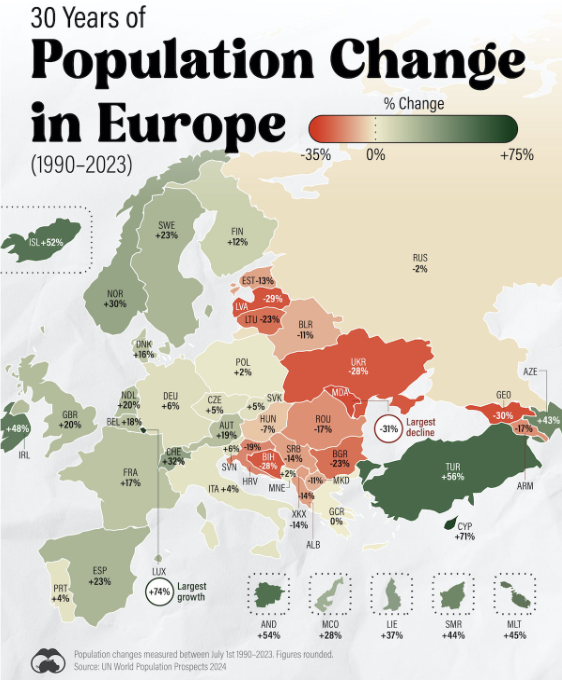
While India faces a growing exodus of talent, its overall population continues to increase, recently surpassing China as the world’s most populous country (Hertog et al. 2023). Other regions of the world are experiencing their own emigration problems paired with rapid population declines. The most severe declines currently reside in Eastern Europe. Since gaining independence from the USSR, Eastern European states have made significant strides towards incorporation in the Western sphere. After 45 years of Communist rule, the economic output of every state in Eastern Europe lagged behind those of Western Europe. In efforts to further integrate into the West, Eastern European states joined the European Union in waves in 2004 and 2007. While European integration has increased development and per capita GDP throughout each state , the freedom of movement and employment opportunities abroad have also accelerated Eastern Europe’s brain drain, such as in Romania: “Romania’s emigrant population increased from 1.3 million to 3.6 million, or even 4 million. In other words, almost 20% of the people born in Romania no longer live in the country” (Rapoza 2016; Hegedűs 2022; Tiut and Teacă 2023).
The Demographic Issue
An overall aging population is a common issue among developed and developing economies alike. With total fertility rates of less than 2.0, the minimum average number of children per family necessary to sustain a population, aging populations have contributed to strains on the workforce in many countries. France, one of the most developed nations economically, is facing a demographic crisis as their replacement rate sits at 1.79. This compelled the nation to raise the retirement age from 62 to 64 (The Associated Press 2023). With a growing percentage of elderly citizens granted social security and lower tax revenues from a decreasing workforce, aging populations are a detriment to economic growth. While this trend exists throughout most developed and developing economies, emigration of skilled workers from lower-income countries only compounds this process. Lower-income countries not experiencing population growth will feel the negative effects the most because a higher proportion of their jobs involve physical labor, which, unlike service or office jobs, is seldom performed by the elderly. If a majority of people become too old to work, a significant strain would be placed on those who can—either directly, as a greater percentage of the workforce would specialize in elderly care, or indirectly via higher taxes to cover the costs of maintaining an aging population.
Are There Any Solutions?
While EU accession causes state labor markets to open up, easing the process to go abroad for work, there is potential for curbing the impact of brain drain in the long term. An interesting case of a country appearing to surmount the crest of a brain drain lies with Lithuania. Since gaining independence from the USSR in 1990, its population has declined from 3.7 million to 2.7 million people (Turauskaitė 2024). Most emigrants since its independence have been of working age, contributing to a low fertility rate and an aging population domestically. Nonetheless, remittances have aided Lithuania’s economy and reduced competition in the job market has kept unemployment suppressed. According to the International Organization for Migration (IOM) Lithuania, long-term outcomes of emigration may be beneficial. In recent years, there has been an increase in returning emigrants. In 2022, Lithuania enjoyed “the highest net positive migration since the country’s independence, with more than 75,000 Lithuanians returning to Lithuania in the last four years—18,000 more than those who left” (Turauskaitė 2024). This observation is largely attributable to shifts in national spending meant to attract talent from Lithuanian expatriates, with initiatives such as Bring Together Lithuania.
Is Lithuania’s experience a fluke? Population growth in the nation is only a recent phenomenon, and it is the only country in the entirety of Eastern Europe experiencing a net increase in migrants. Is there any way to truly reverse brain drain? Or are developing economies today stuck below a glass ceiling?
It is, of course, everyone’s right to choose a better life. A brain drain cannot stop if the benefits of going abroad outweigh opportunities at home. It is the imperative of states with developing economies to create conditions that encourage citizens to stay. States need domestic talent to create economic opportunities, and despite losing much of their own, some developing economies have used their resources to attract foreign talent. The UAE, for example, has attracted foreign talent via grassroots development and economic opportunity (Al Maktoum 2014). Perhaps it is investing in people that can reverse brain drain. Ideas, innovations, and dreams are all future capital. If states can attract great minds today, then great things will happen tomorrow.

Hunter Loren is a Political Science/Economics major from Great Neck, NY. After his undergraduate years, he aims to pursue a masters degree in International Relations. Building on previous experience in IR tutoring, Hunter intends to shed light on happenings in more unknown parts of the world. When he was nine years old he had an email correspondence with the president of Lithuania and he enjoys motorsports, baseball, and guitar.
References
Associated Press. 2023. “Macron’s Pension Age Overhaul Sparks Unrest in France.” NPR, April 15. (https://www.npr.org/2023/04/14/1170238212/macrons-pension-age-france).
Badruddin, Asad. 2016. “Reverse the Brain Drain.” Stanford Social Innovation Review, October 3. (https://ssir.org/articles/entry/reverse_the_brain_drain#).
Corporate Finance Institute. 2024. “Developed Economy.” Corporate Finance Institute. (https://corporatefinanceinstitute.com/resources/economics/developed-economy/).
European Commission. 2024. “Population in European Neighbourhood East Countries.” Eurostat Statistics Explained. (https://ec.europa.eu/eurostat/statistics-explained/index.php?title=Population_in_European_Neighbourhood_East_countries#:~:text=This%20reflects%2C%20among%20other%20factors,65%20years%20in%20their%20populations).
Hegedűs, Eszter. 2022. “Brain Drain in Central and Eastern Europe.” Hype and Hyper, November 19. (https://hypeandhyper.com/brain-drain-in-central-and-eastern-europe/).
Hertog, Sara, Patrick Gerland, and John Wilmoth. 2023. “India Overtakes China as the World’s Most Populous Country.” UN Department of Economic and Social Affairs (DESA) Policy Briefs, June 15. (https://doi.org/10.18356/27081990-153).
Jonko, Anushree. 2025. “India Breaks Silence on the H-1B Visa Debate: Here’s What You Need to Know.” NDTV, January 4. (https://www.ndtv.com/world-news/india-breaks-silence-on-the-h-1b-visa-debate-heres-what-you-need-to-know-7398818).
Oxford Reference. 2024. “Entry Title.” Oxford Reference. (https://www.oxfordreference.com/display/10.1093/oi/authority.20110803095524120).
Quibria, M. G. 2002. “Growth and Poverty: Lessons from the East Asian Miracle Revisited.” ADB Institute Research Paper 33. February.
Rapoza, Kenneth. 2016. “Lithuania and the Euro: One Year Later, the Romance Continues.” Forbes, January 10. (https://www.forbes.com/sites/kenrapoza/2016/01/10/lithuania-and-the-euro-one-year-later-the-romance-continues/).
Saini, Pragya. 2024. “The Great Indian Brain Drain: Talent on the Move.” Indiatimes, January 31. (https://www.indiatimes.com/thought-starter/great-indian-brain-drain).
TimesPro. 2024. “Engineer Salary.” TimesPro, August 7. (https://timespro.com/blog/engineer-salary).
Tiut, Andrei, and Ana Maria Teacă. 2024. “Emigration from Romania: Impact and Legacy.” Österreichische Gesellschaft für Europapolitik, April 5. (https://www.oegfe.at/policy-briefs/emigration-from-romania-impact-and-legacy/?lang=en).
Turauskaitė, Barbora. 2024. “Lithuania Lost a Million Citizens to Emigration: How Did It Happen?” LRT.lt, April 5. (https://www.lrt.lt/en/news-in-english/19/2263911/lithuania-lost-a-million-citizens-to-emigration-how-did-it-happen).
U.S. Bureau of Labor Statistics. n.d. “Architecture and Engineering Occupations.” Occupational Outlook Handbook. https://www.bls.gov/ooh/architecture-and-engineering/
Visual Capitalist. 2023. “Mapped: How Europe’s Population Has Changed (1990-2023).” Visual Capitalist. (https://www.visualcapitalist.com/mapped-how-europes-population-has-changed-1990-2023/).
World Economic Forum. 2014. “Sheikh Mohammed bin Rashid Al Maktoum: How the UAE Is Combating Brain Drain.” World Economic Forum, October 6. (https://www.weforum.org/stories/2014/10/sheikh-mohammed-bin-rashid-al-maktoum-brain-drain-uae/).


You must be logged in to post a comment.