-
Flatten the Hierarchy, Flatten the Emissions – A Horizontal Approach to Climate Change

By Hatim Husainy, Sustainability
Climate change is a pretty simple problem, at its core.
We cut down all the trees, drained all the swamps, dammed all the rivers, and then started burning oil. We cut out the earth’s lungs and got addicted to smoking.
Since the problem is seen as quite complicated, it should first be discussed why the problem is simple. Humans know how to live in harmony with nature. Rivers with consistent flooding, like the Nile, can be harnessed with agriculture that counted on the flood, by planting crops that would not be ripped away when the current accelerated and thrived in many depths (Kielmas 2022). By adjusting our way of living to the planet, we arrive at an uneasy truce with Mother Nature. But that truce was recently broken.
In his book, The Solutions are Already Here: Strategies for an Ecological Revolution from Below, Peter Gelderloos defines the contemporary climate crisis as an extension of the long-running tendency towards ecological crisis. He argues that the problem cannot simply be seen as an extension of the way science and technology have developed, but as an extension of and trend from colonialism. When a society relies on maintaining large military forces of control, the imperial state of extraction quickly uses up all available local resources, and the empire goes seeking more (Gelderloos 2022).
He argues that this trend was present before many of the technological breakthroughs that defined the industrial age and onward – that Athenian soil during its imperial era was dangerously overstretched, that the Romans chopped down all their trees to build their navy, and so they needed to find more lumber elsewhere. While we no longer live in the age of singular, unquestioned empires, the legacy of what came before and the potential of what comes after are both shaped by the dynamics and philosophies that Gelderloos describes.
As an example, dams are often wielded as tools of oppression. When a river is dammed, it creates inundation: land once used for fishing, flood agriculture, and other practices becomes submerged under artificial lakes. The safety that dams promise is often an illusion. When floods inevitably come, they are far more destructive because the river can no longer regulate itself. What looks like a neutral engineering choice is in fact a political one. Less “useful” land is sacrificed for energy and calm, usually without real community consultation—and often at the expense of Indigenous lands and livelihoods (Johnson 2024). Dams and water management show how seemingly apolitical technologies carry deeply political consequences. Recognizing this is key to any meaningful climate response, because escaping the crisis will depend as much on justice and governance as on science and technology.
The Great Green Wall is an international initiative in the Sahel—the region to the south of the Sahara desert in Africa—to dig in and, through a number of strategic plantings, regenerative agriculture practices, and intelligent resource management, stop the Sahara from growing any further, and to provide a model of what anti-desertification can look like. (The Great Green Wall Initiative). In India, the Room for the River project seeks to improve flow and make space for the river, a process that can calm floods and lessen their human cost, but also open up a return to ways of existing alongside the rivers that may have been forgotten (Rethinking The Future 2019).
The Green Revolution was a series of scientific advancements in the field of agriculture that was largely adopted and refined after World War II. The new technologies, such as new fertilizers, new watering systems, pesticides, and mechanisation at scale, have dramatically improved crop yields around the world. Growing yields fed a growing planet—as the human population of Earth grew, these practices made sure hunger was never an issue of supply. They were slowly killing the planet. Widespread use of pesticides and artificial fertilizers have had a number of downstream effects, from changing the chemical balance of local rivers to leaks that put all life in the area at risk. These new farming practices have been highly water-intensive and are focused on profit above all else, and so often disregard caloric efficiency in favor of monetary efficiency (Shiva 1991). A maintenance of some tech, like mechanisation, a building out of others, like genetically modified crops, and a rolling back of some, like over-fertilisation and flood-farming, can maintain these high crop yields in the long term (Charles 2013) (Kuhn 2025). A return to older, more holistic practices like fallow years—when sections of land are set aside to allow their soil to recover—and crop rotation will also play a critical part in shifting practices as core to our lives as the way our food is produced, toward practices that try to harness the environment rather than defy it.
Additionally, there are novel practices that are now coming up to the point of usefulness as climate mitigation techniques that provide many side benefits as well. For instance, the United States Department of Energy recently made significant progress in growing big kelp farms at scale (Eger et al. 2025). Kelp performs really well at carbon capture, but is also edible and even convertible to biofuel as necessary (Xu et al. 2023). On the slowly greening roofs of New York City, new ways of thinking about how farming and urban environment can interact with each other are being considered, with early experiments in urban beekeeping proving quite successful (Lewis 2021). Over time, perhaps greener cities would have been networks-integrated hives that serve to pollinate plants across the city and maintain genetic diversity.
The problem of climate change or ecological collapse should not be seen as a problem of technology. The problem is not that we have mastered nature—the achievement of that mastery was a neutral act. The problem is that, under the current way the state and economy are structured, the moment we were capable of bending nature to our will, we did so. Short-sighted politicians and CEOs alike focus on bending the land to their will without true democratic oversight or long-term vision. The technologies of dams and drills and those of reforestation and regenerative agriculture can be tools of oppression. They can also, with democratic planning and conscious engineering, be tools of liberation. Technology alone won’t save us. What matters is who controls it and whether decisions are made democratically. Only then can the tools we build serve liberation rather than domination.

Hatim Husainy is a freshman from Smithtown, NY, studying political science. He is in the early phases of a research project on human rights in the Binghamton area. In addition to the Happy Medium, he participates in Moot Court, Model United Nations, and Citizens Climate Lobby. He plans to pursue law school after his undergraduate degree, and from there, he plans to save the world.
References
Charles, D. (2013, March 7). In a grain of Golden Rice, a world of controversy over GMO Foods. NPR. https://www.npr.org/sections/thesalt/2013/03/07/173611461/in-a-grain-of-golden-rice-a-world-of-controversy-over-gmo-foods
Eger, A. M., Wood, G. V., & Byrnes, J. (2025). An environmental niche exploration tool for kelp forest management. Ecology and Evolution, 15(6). https://doi.org/10.1002/ece3.71459
Gelderloos, P. (2022). The solutions are already here: Strategies for ecological revolution from below. Pluto Press.
The Great Green Wall Initiative. Great Green Wall. (n.d.). https://thegreatgreenwall.org/about-great-green-wall
Johnson, G. (2024, June 18). The US acknowledges northwest dams have devastated the region’s native tribes. AP News. https://apnews.com/article/columbia-snake-river-dams-tribes-58f5c6737df3c3e141cbc8e1cd4926ca
Kielmas, M. (2022, March 24). What did ancient Egyptian farmers do while the Nile flooded?. Sciencing. https://www.sciencing.com/did-ancient-egyptian-farmers-nile-flooded-18466/
Kuhn, M. (2025, August 8). 10 cutting-edge technologies that could change how we fight climate change. Climate Cosmos. https://climatecosmos.com/renewable-energy/10-cutting-edge-technologies-that-could-change-how-we-fight-climate-change/
Lewis, P. (2021a, November 18). Rooftop beekeeping: Honey bees in the Sky. Backyard Beekeeping. https://backyardbeekeeping.iamcountryside.com/beekeeping-lifestyle-topics/rooftop-beekeeping-honey-bees-in-the-sky/
Lewis, P. (2021b, November 18). Rooftop beekeeping: Honey bees in the Sky. Backyard Beekeeping. https://backyardbeekeeping.iamcountryside.com/beekeeping-lifestyle-topics/rooftop-beekeeping-honey-bees-in-the-sky/
RTF. (2019). An in-depth understanding of the room for the river project. Rethinking The Future. https://www.re-thinkingthefuture.com/case-studies/a12200-an-in-depth-understanding-of-the-room-for-the-river-project/
Shiva, V. (1991). The violence of the Green Revolution: Ecological degredation and political conflict. Zed.
Xu, S., Yu, Z., Zhou, Y., Yue, S., Liang, J., & Zhang, X. (2023). The potential for large-scale kelp aquaculture to counteract marine eutrophication by nutrient removal. Marine Pollution Bulletin, 187, 114513. https://doi.org/10.1016/j.marpolbul.2022.114513
-
Follow the Money: Campaign Financing in the NYC Mayoral Election

By Chase Quinn, Elections
Image: Rawpixel.comVoters in New York City are set to go to the polls on November 4th to elect a new mayor. In the months leading up to the election, the race has been jam packed. Currently, the four main candidates in the race are Zohran Mamdani (Democrat), Eric Adams (Independent), Andrew Cuomo (Independent), and Curtis Sliwa (Republican). In June, Mamdani shook the political stage by successfully winning the Democratic primary against both incumbent Eric Adams and former governor Andrew Cuomo, forcing the two to run as independents.
Political campaigns often require a lot of money to run. Some notable costs are travel, advertisement, organization, staff wages, legal fees, and many more. For political candidates, attracting funds and utilizing them efficiently can make or break a campaign. Financing is a large component of running a successful operation, and looking at where the money is coming from often tells its own story aside from the one presented to voters by candidates themselves. The New York City Campaign Financing Board runs an initiative known as “Follow the Money,” where campaign finance data from political candidates is tracked and recorded in an effort to make public elections more transparent (NYC Campaign Finance Board 2025). Using this data, I compiled a number of visualizations based on factors such as public versus private funding, independent expenditures, and donation contributions. First, however, let’s take a quick look at the current state of the race.
A Brief Overview of the Race
Based on recent data taken from The New York Times, I averaged the findings of the most recent seven polls (starting in September 2025) to account for variation between different pollsters. The data below is in the form of the projected percentage of votes for each candidate.

As shown by the most recent polling data, Mamdani commands a solid double-digit lead on the next biggest competitor, Andrew Cuomo, giving him an average margin of +18 percentage points. Currently, Cuomo and Mamdani are the main competitors, with Sliwa and Adams trailing far behind the two. Interestingly, Adams is polling the lowest despite having the advantage of incumbency. Now, onto the finances.
Public and Private Spending
The NYC Campaign Financing Board provides a financial incentive for candidates to run for office by matching certain qualified contributions to their campaign, known as “public” funding. This is meant to increase accessibility to public offices and reduce political corruption by amplifying funding from everyday New Yorkers and discouraging candidates from seeking funds from private interests such as SuperPAC groups (NYC Campaign Finance Board 2025). Public funding also encompasses any government, state, or city-wide program that provides campaigning funds to political candidates. Private funding includes all other forms of contributions, including the candidate’s personal resources, donations from individuals and organizations, and funds received from political action committees. Below is a chart including the public, private, total, and spending amounts for each candidate in the mayoral race.
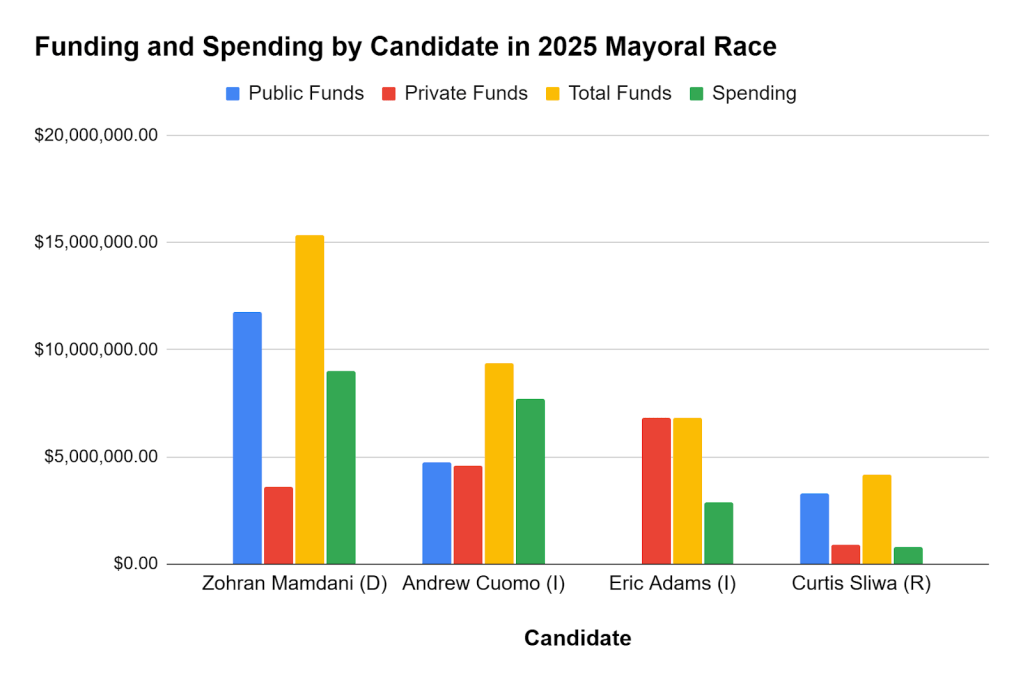
Analyzing the data shown on the left, Mamdani has received the greatest amount of public funding, more than the other three candidates combined. This is likely due to large amounts of individual donations to the Mamdani campaign, which are then matched by the Campaign Finance Board. Additionally, the Mamdani campaign beats out all other candidates in other areas except for in the private funding sector, of which Eric Adams holds the most. Andrew Cuomo has nearly equal amounts of public versus private contributions, while Sliwa’s combined funding has not yet broken the 5 million mark. Notably, Mamdani and Cuomo have the highest, and almost equal amounts of spending, which is to be expected considering they are the two main competitors. Additionally, the Adams campaign does not show any public funding. This is due to the finance board’s rejection of Adams’ eligibility for public funds matching. According to the board, “…his campaign had provided ‘incomplete and misleading’ information, and the board believed that the campaign had violated the law” (Fitzsimmons 2025).
Independent Expenditure
As defined formally by the Federal Elections Commission, independent expenditure is “…an expenditure for a communication that expressly advocates the election or defeat of a clearly identified candidate and which is not made in coordination with any candidate or their campaign or political party” (FEC 2025). In simpler terms, this is any spending in support or opposition of a candidate that is done by outside organizations not directly involved with any political campaign. Independent expenditure is often done by individuals or organizations with special interests that may benefit or be harmed by the election of a certain candidate. For example, if an oil company knows that a certain candidate will push for the adoption of clean-energy technology, the company has a vested interest in making sure that candidate does not win the election, as it will harm their business if they did. Data for independent expenditure by candidate is shown below. Data for Curtis Sliwa was not given by the finance board.

This graph contains very contrasting information for all three candidates listed. For one, Andrew Cuomo has a very large amount of independent expenditure supporting his campaign, almost 18.7 million dollars to be specific. Very little is spent on opposition to Cuomo. In contrast, Mamdani has a large amount of money (8.8 million) spent in direct opposition to his campaign, and very little in support of it. Eric Adams has very low values for every category, indicating that there is either not sufficient data or that outside groups are skeptical of his chances to win, thus choosing to put their money elsewhere.
The Campaign Finance Board provides data on which organizations spend money on independent expenditures, and here some observations are to be made. This data names representatives and the board of directors for each organization, and provides occupational data for these individuals as well. Some groups that have spent money in opposition to Mamdani are “Anyone but Mamdani” and “Committee for Sensible Government,” which are represented by individuals from real estate and law enforcement backgrounds, respectively. These expenditures are likely negative responses to some of Mamdani’s proposed policies, such as his “freeze the rent” initiative and his desire to reform the city police department. Looking at Cuomo’s support expenditures, the bulk of his support (14.9 million) has come from a corporation known as “Fix the City Inc,” which is primarily represented by members from various law firms, a consulting agency, a medical center, and a large corporate construction company. Unsurprisingly, this organization has also dumped 7.9 million dollars in opposition to Mamdani’s campaign, making up both a majority of Mamdani’s opposition and a majority of Cuomo’s support.
Donor Contributions
Lastly, let’s take a look at donor contributions to each candidate’s campaign. Using the data provided by the Campaign Finance Board, I constructed multiple visuals to represent the average amount of a donation given to each candidate’s campaign, as well as what percentage of donations to each campaign came from different sizes of donors.
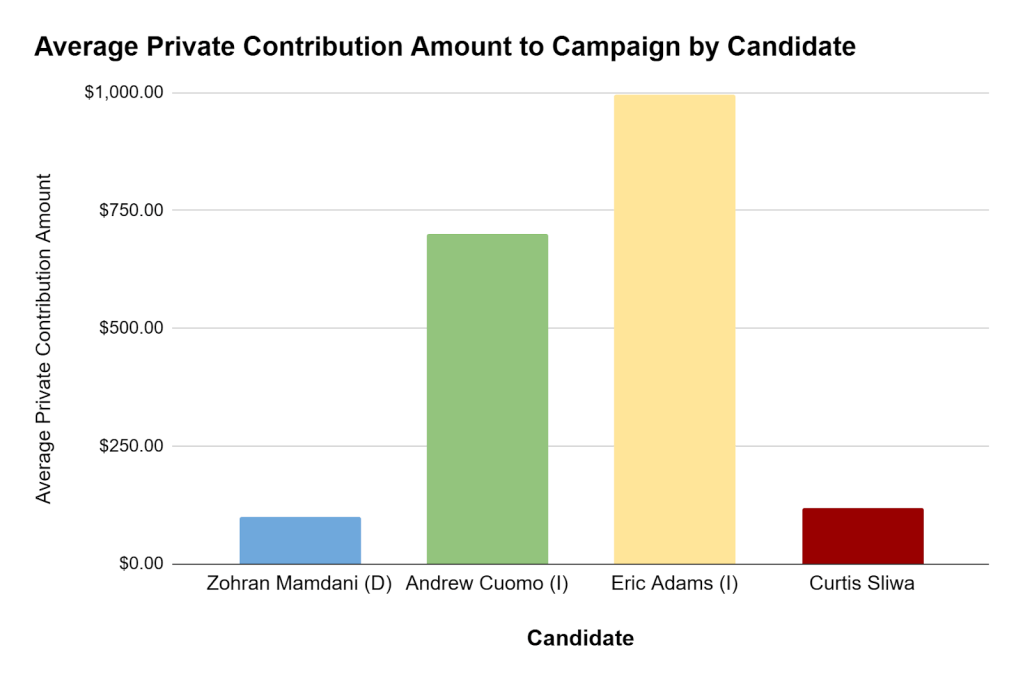
The above chart shows how large the average contribution to a candidate’s campaign is. Notably, Cuomo and Adams have very large donation amounts, signifying that they receive a large degree of their funding from larger and wealthier donors. In contrast, Sliwa and Mamdani have very small average donations, showing that a lot of their donations come from smaller and less wealthy donors.
Next is a collection of pie charts that show the percentage of private campaign contributions that come from various sizes of donors. Small donors are classified as those between $1-$175. Medium donors are those between $176-$999. Large donors are those greater than $1000. Each is coordinated by color.

As noted from previous data, Mamdani and Sliwa get a large majority of their private donations from small donors, likely representing less wealthy middle-class individuals. Cuomo has a nearly equal share of donors from each category, with medium-sized donors making up the greatest amount (39%). This signifies broad support for Cuomo from all levels of wealth. Also notable is the number of large donors that make up the greatest amount (47%) of Adam’s private funding, with medium-sized donors (41%) following close behind. This represents large support for Adams from wealthy donors.
Closing
Financing a campaign is a huge undertaking, and looking at the data involved can tell its own story. However, the mayoral race is far from done, and there is still ample time for new developments and changes of support. Andrew Cuomo and Eric Adams have been urging each other to drop out of the race, leaving space for a one on one showdown with Mamdani (Mena 2025). If this does indeed happen, it could shift Mamdani’s lead and amplify tensions in the race. For now, however, the best we can do is wait. Voting opens in NYC for the mayoral race on November 4th, from 6 am to 9 pm, and the early voting period is from October 25th to November 2nd.

Chase Quinn is a senior at Binghamton University serving as the elections reporter. He studied journalism at Hunter College for two years before transferring to Binghamton to pursue a bachelors in Political Science and Master’s in Public Administration. He was born and raised in the town of Pine Plains, New York. Post-college he plans to conduct research on policy and law and aims to work in the public sector. In his free time, Chase likes to read, spend time outdoors, create art, and make jewelry.
References:
“Understanding Independent Expenditures.” FEC.gov. https://www.fec.gov/help-candidates-and-committees/candidate-taking-receipts/understanding-independent-expenditures/ (September 24, 2025).
Cabreros, Irineo et al. 2025. “New York City Mayoral Election 2025: Latest Polls.” The New York Times. https://www.nytimes.com/interactive/polls/nyc-mayoral-election-polls-2025.html (September 24, 2025).
“Campaign Finance Summary.” 2025. Campaign Finance Summary 2025 Citywide Elections. https://www.nyccfb.info/VSApps/WebForm_Finance_Summary.aspx?as_election_cycle=2025 (September 24, 2025).
“Law & Rules.” Law & Rules | New York City Campaign Finance Board. https://www.nyccfb.info/law (September 24, 2025).
“How It Works.” How It Works | New York City Campaign Finance Board. https://www.nyccfb.info/program/how-it-works/ (September 24, 2025).
“Upcoming Elections 2025.” Upcoming Elections 2025 | NYC Board of Elections. https://www.vote.nyc/elections (September 24, 2025).
Fitzsimmons , Emma G. 2025. “Eric Adams Is Again Denied Public Matching Funds for His Campaign – The New York Times.” Eric Adams Is Again Denied Public Matching Funds for His Campaign. https://www.nytimes.com/2025/08/06/nyregion/eric-adams-public-matching-funds-denied-re-election.html (September 29, 2025).
Mena, Kelly. 2025. Adams, Cuomo call on each other to drop out. https://ny1.com/nyc/all-boroughs/politics/2025/07/07/mayor-adams-cuomo-dropping-out (October 7, 2025)
-
The One Big Beautiful Bill: Outcomes for Noncitizen Healthcare and New York’s Response

By Sanna Wilber, Managing Editor
Photo: Navy Medicine on UnsplashOn July 4th, 2025, President Trump signed into law the One Big Beautiful Bill Act (OBBBA). At the end of June, as the bill ricocheted between the House and the Senate, our timelines were barraged by political pundits analyzing its far-reaching effects. However, the subject that garnered the most bipartisan attention was changes in federally funded health insurance programs. The bill proposed significant changes to both Medicaid and the Affordable Care Act Marketplace—a proposition that was largely met with concern from Americans across the political spectrum. The Congressional Budget Office estimated that the cuts to Medicaid would amount to $700 billion and result in more than 10 million people losing healthcare coverage (Kearney et al. 2025).
However, the nature of that loss—how it would be implemented and when—has largely been underreported as Americans anticipate changes in their ability to access healthcare. Additionally, as the bill traveled between chambers, many of the proposals that were making headlines were altered, dropped, or otherwise accomplished administratively. While the majority of people who rely on federally funded healthcare are citizens, it is also a prerogative of the government to provide healthcare for immigrants. Following OBBBA, the federal government has changed which legally residing noncitizens and undocumented individuals are eligible for coverage. This has left states scrambling as they face decreased support for programs that had previously ensured access to healthcare for everyone, including most noncitizens. Yet, questions abound: Which programs are anticipating the highest cuts and who will be impacted? Additionally, how will this affect New York state, which has the 4th highest population of unauthorized immigrants nationwide and the second largest enrollment in Medicaid? (Venditti 2025; New York State Division of Budget 2025).
The question of who should benefit from tax funded services is a contentious debate; especially whether noncitizens and people with irregular migration should qualify for these services. Political debates aside, the ongoing litigation and constant changes in policies regarding immigration have made previously standard medical access unpredictable for these communities. For instance, under OBBBA, what constitutes a qualified immigrant has changed. Under this new definition, previously recognized categories such as refugees, asylees, parolees, and persons in temporary protected status are no longer eligible for Medicaid coverage. However, children and pregnant women are exempt from these changes and can expect to receive healthcare coverage (Bronner 2025). While there is a “grace period” as states adapt to the OBBBA provisions, this change in Medicaid eligibility is effective October 1, 2026 (Welcome.US 2025).
The second change in eligibility is who is able to buy into federally subsidized insurance. Effective January 1, 2027, most legally residing noncitizens will no longer be able to access Marketplace insurance through federally funded subsidies that were qualified under the Affordable Care Act (Welcome.US 2025). Known as the Essential Plan in New York state, this program provides coverage for people who may not qualify for Medicaid but still need assistance covering the oftentimes exorbitant monthly premiums. Currently, in New York state alone, 500,000 noncitizens will lose access to health insurance via the ACA due to OBBBA.
Alarmingly, a number of noncitizens enrolled in the Essential Plan have likely already lost access to their insurance due to administrative changes from The Center for Medicare and Medicaid Services (CMS). Noncitizens who are in the United States under the Deferred Action for Childhood Arrivals (DACA)—more widely known as Dreamers—saw their ACA eligibility revoked earlier this year. CMS finalized the decision to strike Dreamers from the definition of “lawfully present” noncitizens, which makes DACA recipients ineligible to purchase coverage through the ACA Marketplaces ahead of the deadline from OBBBA. Additionally, the very existence of the DACA program is in limbo with ongoing litigation, putting the legal presence of Dreamers at risk once again (KFF 2025).
As the House and Senate added their signature provisions to OBBBA, policymakers wanted a penalty for states that allowed noncitizens access to federally funded healthcare. That penalty would take the form of lowering the state’s federal support for medicaid called FMAP. However, that penalty was struck down by the Senate Parliamentarian making the majority of the changes in health insurance an issue of eligibility (Bronner 2025).
While New York’s FMAP won’t be facing any penalties for insuring noncitizens through Medicaid, the removal of the provision came at a cost to other areas of federal funding. Noncitizen Emergency Care is funded through FMAP and covers medical treatment for noncitizens in life-threatening situations. Funding cuts may only be a small component to the healthcare revisions, yet in the case of noncitizen emergency care this effect will be acute; under the new rate, New York state would have lost over $200 million in federal assistance for noncitizen emergency care in 2024 (Bronner 2025).
As mentioned above, funding cuts are only one dimension of the changes in healthcare coverage for noncitizens—revisions in eligibility will be the primary cause for loss of healthcare coverage in the months to come. However, these two factors, combined with the changes in federal spending in New York state, will drive up monthly insurance costs for insureds across the board. Insurance programs benefit from having a large population of insureds in which the majority are healthy and only use insurance for annual doctors’ visits or the occasional blood test. While there will be a portion of insureds who are unhealthy, their bills will be the minority and the average medical bill will be balanced by the number of relatively healthy individuals. However, if a program loses a large number of its insureds—like Dreamers or other immigrants who were previously covered—the ratio of relatively healthy policy holders to unhealthy ones changes. Coupled with the broader changes in federal support for New York’s health economy and the ACA coverage nationally, this will potentially lead to less healthy individuals—with low healthcare spending—buying into the Marketplace. Without the balancing from the healthy insureds, the average yearly medical expenses will increase. This phenomenon, known as adverse selection, will drive up insurance premiums as insurers increase spending to match the needs of their needier policyholders (American Academy of Actuaries 2023). For Qualified Health Plans in New York State, the average family can expect a 4.5% increase in their monthly premiums which translates to $300 per month (Bronner 2025). Nationwide, due to other changes from OBBBA, ACA healthcare premiums are expected to increase by more than 75% in the next year (Simmons-Duffin 2025). Just as noncitizens lose access to federally subsidized insurance plans like the Essential Plan, buying into insurance will become more inaccessible as premiums increase in the next year.
As the provisions in OBBBA are implemented across the nation, New York State is considering its response. On May 9, 2025 NYS lawmakers closed on a $254 billion budget for the 2026 fiscal year. Under OBBBA, New York will have to recoup a projected $750 million in federal payments till the year’s end and $3-5 billion long term (New York State Division of Budget 2025). Changes in NYS’ federal support less than two months after the state agreed on a new budget has triggered varied responses from state leaders. Some conservative lawmakers see this as a chance for the state to embrace a more minimalist budget and address alleged insurance fraud. However, Hochul and other Democrats are scrambling to recoup the lost federal assistance. There were rumors that the state would hold a special legislative session so leaders could adjust the budget for the following year. However, NYS’ legislature authorized Hochul and the New York State Division of the Budget to adjust the budget before the regular session begins in January 2026 (Plants 2025).
As New York presses onward, politicians will continue reckoning with the changes OBBBA brings to healthcare. While many unauthorized immigrants and noncitizens will be dropped from Medicaid and other federally subsidized programs, NYC Care is still an option alongside Noncitizen Emergency Care if leadership allocates enough funds to make up for federal losses. The One Big Beautiful Bill Act is not a fleeting piece of legislation; its provisions have set states on a track towards greater self-reliance and limited federal support. Come November, New Yorkers will vote on a new mayor and next year upstate will join the city in deciding who will lead the Empire state. Yet, these elections are more than superating polarization and power grabs. They are opportunities for New Yorkers to truly parse through the partisanship and determine what policies will shape the future of wellbeing in New York—from the snowcapped Adirondacks to the jubilance of Uptown, we decide the future.

Sanna Wilber, Managing Editor for the Happy Medium, is a senior in political science with a global studies minor. She grew up in the Finger Lakes region of New York where she enjoyed being civically engaged from a young age; be that working with the village government or interning at the Cornell Cooperative Extension. Her current academic interests include Caribbean politics, healthcare access, and family-supportive policies. Outside of her academic pursuits Sanna enjoys painting, podcasts, and perpetually trying to attain fluency in Spanish. After graduating, she intends on getting a master’s degree in public health.
References
Bronner, Jillian. 2025. “An Analysis of the One Big Beautiful Bill Act (OBBA’s) Impact on Healthcare for New York.” Rockefeller Institute of Government,
Kearney, Audrey, et al. 2025 “KFF Health Tracking Poll: The Public’s View of Funding Reductions in Medicaid.” KFF. June 6. https://www.kff.org/medicaid/kff-health-tracking-poll-the-publics-views-of-funding-reductions-to-medicaid/.
KFF. 2025. “Federal Medical Assistance Percentage (FMAP) for Medicaid and Multiplier.” KFF. https://www.kff.org/medicaid/state-indicator/federal-matching-rate-and-multiplier/?currentTimeframe=0&sortModel=%7B%22colId%22:%22Multiplier%22,%22sort%22:%22desc%22%7D.
KFF. 2025. “Key Facts on Deferred Action for Childhood Arrivals (DACA).” KFF. February 11. https://www.kff.org/racial-equity-and-health-policy/key-facts-on-deferred-action-for-childhood-arrivals-daca/.
New York State Division of the Budget. 2025. Healthcare: Expenditures & Projections, FY 2025. Albany, NY: New York State Division of the Budget. https://www.budget.ny.gov/pubs/archive/fy25/ex/book/healthcare.pdf.
New York State Division of Budget. 2025. First Quarterly Update, FY 2026 Enacted Budget Financial Plan. Albany, NY: New York State Division of the Budget. https://www.budget.ny.gov/pubs/archive/fy26/en/fy26fp-en-q1.pdf.
Plants, Ron. 2025. “NYS Democratic lawmakers to discuss the impact of federal funding cuts on state Medicaid, SNAP, climate programs.” 2WGRZ. July 10. https://www.budget.ny.gov/pubs/archive/fy26/en/fy26fp-en-q1.pdf.
Simmons-Duffin, Selena. 2025. “ACA health insurance will cost the average person 75% more next year, research shows.” NPR. July 18. https://www.npr.org/sections/shots-health-news/2025/07/18/nx-s1-5471281/aca-health-insurance-premiums-obamacare-bbb-kff.
Venditti, Bruno. 2024. “Mapped: Unauthorized Immigrants by State.” Visual Capitalist. June 6. https://www.visualcapitalist.com/mapped-unauthorized-immigrants-by-state/.
Welcome.US. 2025. “How the ‘big, beautiful bill’ impacts newcomers.” Welcome.US. August 5. https://welcome.us/explainers/how-the-big-beautiful-bill-impacts-newcomers.
2023. “Risk Pooling: How Health Insurance in the Individual Market Works.” American Association of Actuaries. June. https://actuary.org/wp-content/uploads/2017/11/RiskPoolingFAQ071417.pdf.
-
What Has the Recent Rise in Campaign Spending Meant for Policy?
By Travis Rayome, Political History
The influence of moneyed interest in elections has become increasingly relevant in American politics over the past twenty years. This influence has reached new levels of concern in the second Trump Administration; over thirty different wealthy campaign donors, who collectively contributed hundreds of millions to Donald Trump’s 2024 presidential election campaign, have been appointed to key positions in his Cabinet (Matthews et. al 2024). The appointments of these donors to some of the highest positions in the American government highlight the power that political spending, specifically election spending, has increasingly held over the past few decades. Campaign spending can play a significant role in election outcomes, particularly when non-incumbent candidates are vying for public office (Le et. al 2024). This funding can come from individual donors, but is also often collected and distributed to a politician of choice through a political action committee, or PAC. The methods of donating to a campaign vary depending on the type of PAC, but they include funding for advertising and other partisan efforts, contributing directly to the campaign of the politician, and contributing to the political allies of a certain politician (Caltech 2025). Spending on elections can be seen as an extension of other systems of political spending like lobbying, where financial support is given to certain politicians because of (or, oftentimes, to encourage) their alignment with the donor’s interests. Given this understanding of campaign spending in contemporary politics, the appointment of numerous billionaire donors to Donald Trump’s Cabinet can be taken as an indication that the current system of election spending has led to private donors “buying” major influence over politics and interfering with public interest. Take SpaceX and Tesla CEO Elon Musk for example; his two companies are facing major investigations by numerous federal agencies for illegal and harmful practices. Despite this, he was granted leadership of the newly-founded Department of Government Efficiency (DOGE) in January 2025 after contributing $200,000,000 to Donald Trump’s campaign; within three months, DOGE issued major funding cuts and mass layoffs targeting those federal agencies while Musk’s companies received billions in subsidies and contracts from the federal government (Darmiento 2025). The conflict of interest between the public sector’s power and private interests’ ever-increasing control over it cannot be any more visible.
The deep ties to moneyed interests within the Trump Administration is not an unprecedented phenomenon; it is the culmination of nearly two decades of policy and the increasing presence of private funding in the American political system. The Supreme Court case Buckley v. Valeo (1975) confirmed that restrictions around campaign spending implemented by the Federal Election Campaign Act of 1971 are not in violation of the First Amendment, citing the greater potential for corruption and threats to the integrity of American democracy that unchecked contributions to politicians pose. However, opposing decisions made since then, such as the Supreme Court case Citizens United v. FEC (2010), have posed challenges to limiting campaign spending. In Citizens United, the Supreme Court ruled that spending on campaigns independent of party or candidate was protected by the First Amendment. In doing so, the Supreme Court not only set a precedent of applying First Amendment rights to corporations, but also gave rise to the Super-PAC. These PACs, whose operations are protected under the First Amendment as per Citizens United, contribute funds to marketing either side in an election without explicitly supporting a particular candidate or party, thereby making them “independent” under the law. This can help obscure major political contributions from billionaires and corporations to a particular politician’s campaign from public view and allow the contributors to avoid regulations. Super-PACs often complicate the process of tracking moneyed interest in politics and embolden private parties to spend more on elections (Brennan Center 2025).
Political spending, especially campaign spending, is not necessarily done by private parties to push for a single decision or policy from a candidate of interest. Instead, in many cases, contributions can be seen as a “favor.” So, even if the amount is relatively modest or the donor is not seeking a specific position on a specific policy, their spending helps build a relationship with the candidate, incentivizing them to act with private interest in mind. A notable example of this kind of funding is the Amazon.com PAC, who have donated between $1,000-10,000 to the Congressional campaigns of over 200 Representatives and over twenty Senators, with overall PAC spending split evenly between Republican and Democrat candidates (OpenSecrets 2025). This pattern, combined with Amazon’s annual expense of tens of millions of dollars in lobbying efforts and heavy employment of “revolving-door” candidates [i.e., government insiders hired as paid lobbyists/government relations employees, who make up around 70% of Amazon’s lobbying team], demonstrates how campaign spending is an integral part of the framework for transactional relationships between private organizations and politicians (OpenSecrets 2025).
But how does campaign spending translate into policy? Can a campaign donor be deemed responsible for the policy decisions of a candidate to whom they’ve donated? For a case study of the practical effects of campaign spending on policy, one can analyze the campaign financing of Representative Ritchie Torres (D-NY). Torres has received over $1.4 million in campaign contributions from the Pro-Israel lobby over the course of his Congressional career, with nearly half that amount coming specifically from the American Israel Public Affairs Committee (AIPAC), an organization dedicated to shifting public opinion on Israel’s military operations (OpenSecrets 2024). Torres represents New York’s 15th Congressional District, which comprises about half of the Bronx in New York City. Around 36.2% of Torres’ constituents live below the poverty line as of 2017, making it the poorest Congressional constituency in America (Johnson 2023). According to research from The Column, Torres has mentioned Israel around 2.5x more than he has brought up poverty in his public statements (“Israel” 337 times and “poverty” 143) between January 2021 and October 2023 (Johnson 2023). While not inherently “distracting” him from the economic concerns of his constituents, Torres’ support from the groups like AIPAC has resulted in pro-Israel advocacy becoming a large part of his public image, in many ways even more notable than his platform as an economic progressive. His vocal support for the military efforts of the Israeli Defence Force and efforts to improve the reputation of the Israeli state are woven through his public statements and often discussed more than the conditions facing his constituents. Thus, it can be inferred that the pro-Israel lobby’s seven-figure contribution to his Congressional campaign has influenced his conduct as a politician.
As already mentioned, New York’s 15th Congressional District is both the most impoverished constituency in the US and a constituency embedded within the heart of the country’s most expensive city, meaning Ritchie Torres’ constituents are deeply impacted by New York City cost-of-living soaring far beyond what is affordable to them (NYC Charter Revision Commission 2025). During his 2020 campaign for Representative of NY-15, Ritchie Torres received heavy criticism for his acceptance of over $800,000 in private funds from corporate landlords, land speculators, investment firms, and developers who were not only from outside Torres’ Congressional district, but also had an explicit financial stake in expensive real estate developments within it. For example, Mott Haven, a neighborhood within NY-15, saw a near-60% increase in rent in just two years leading up to Torres’ campaign and has a reputation among Torres’ campaign donors as a highly valuable real estate market (Olumhense and Velasquez, 2019). Torres’ succeeding runs for public office have continued the trend of large contributions from businesses with financial interest in the Bronx, with Torres receiving nearly $950,000 in funding from the real estate industry and over $1.6 million from the securities and investment industry in his 2024 campaign (OpenSecrets 2024).
The influence of these donations from private companies cannot be discounted when examining the kinds of policies that Ritchie Torres supports when it comes to housing, such as his own 2024 bill, The Accelerated Supply of Affordable Production Housing Act (ASAP). The act prioritizes private development as a primary solution to the nationwide housing crisis by allowing exceptions to volume caps on private activity bonds and expanding tax credits to private developers, incentivizing them to build more affordable units (Office of Representative Ritchie Torres 2024). The solution benefits Torres’ campaign donors by giving them direct financial incentives to build housing in his district. In doing so, Torres’ policy prioritizes private-sector-led solutions that may potentially provide some more affordable units in the short run. Private-sector-led solutions, however, do not effectively address the deeper issues with the housing market, prevent harmful land speculation, nor curb the harmful practices that spur rapid increases in the cost of living in places like the Bronx’s Mott Haven. An analysis of housing market policies conducted for Harvard Business Review puts it best: “While nudging developers and landlords with incentives can marginally increase the supply of housing, they ultimately rest on a ‘trust the market’ strategy that has to date failed to solve the problem” (Callaci and Vaheesan 2024).
The form of influence campaign funding takes can appear complex from the outside, but internally it can be seen as a system of “favors,” where a private organization contributes to a candidate’s election in exchange for goodwill that the politician can build upon by pushing certain policies or narratives that suit the interests of the donor. This can be in small amounts spread across hundreds of politicians, as seen with Amazon.com’s PAC, or it can be in large contributions made to relevant candidates of interest, as seen in real estate and investment firms in New York funding the Congressional campaigns of Ritchie Torres. No matter the type, given the appointment of numerous billionaire donors to high-ranking positions in Donald Trump’s second administration, the influence of campaign funding as a whole is a serious and prescient issue facing the United States, and given its escalation since the ruling on Citizens United vs. FEC, will likely remain one until its current upward trend is reversed.

Travis Rayome is an English and Economics major from Alexandria, Virginia. He hopes to work for humanitarian NGOs around the Washington, DC area, continue writing on politics and economics, and play music. His areas of political interest are propaganda and information dissemination, structural violence and inequality, and power distribution within and between nation states.
References
Caltech Science Exchange. 2025. “Campaign Funding Explained: How Are Political Campaigns Financed?” https://scienceexchange.caltech.edu/topics/voting-elections/campaign-funding-finance-explained.
Le, Thanh, et. al. 2024. “Money in Politics: How Does It Affect Election Outcomes?” SAGE Open 14.4 (October). https://doi.org/10.1177/21582440241279659.
Brennan Center for Justice. 2025. “Influence of Big Money.” https://www.brennancenter.org/issues/reform-money-politics/influence-big-money.
Oyez. “Buckley v. Valeo.” https://www.oyez.org/cases/1975/75-436.
Oyez. “Citizens United v. FEC.” https://www.oyez.org/cases/2008/08-205.
OpenSecrets. 2025. “PAC Profile: Amazon.com.” https://www.opensecrets.org/political-action-committees-pacs/amazon-com/C00360354/summary/2024.
OpenSecrets. 2025. “Amazon.com Profile.” https://www.opensecrets.org/orgs/amazon-com/summary?id=D000023883.
OpenSecrets. 2025. “Rep. Ritchie Torres – Campaign Finance Summary.” https://www.opensecrets.org/members-of-congress/ritchie-torres/summary?cid=N00044346.
Callaci, Brian and Vaheesan, Sandeep. 2024. “The Market Alone Can’t Fix the US Housing Crisis.” Harvard Business Review, September 12. https://hbr.org/2024/09/the-market-alone-cant-fix-the-u-s-housing-crisis.
Office of Representative Ritchie Torres. 2024. “Congressman Ritchie Torres Introduces The Accelerated Supply of Affordable Production Housing Act (ASAP Housing Act).” October 24. https://ritchietorres.house.gov/posts/congressman-ritchie-torres-introduces-the-accelerated-supply-of-affordable-production-housing-act-asap-housing-act.
New York City Charter Revision Commission. 2025. “The Housing Crisis and New York City.” New York City Economic Development Corporation. https://edc.nyc/housing-crisis-and-new-york-city.
Olumhense, Ese and Velasquez, Josefa. 2019. “Ritchie Torres Reaps Real Estate Cash in Bronx Congress Run.” The City, October 21. https://www.thecity.nyc/2019/10/21/ritchie-torres-reaps-real-estate-cash-in-bronx-congress-run/.
Johnson, Adam. 2023. “Ritchie Torres Represents the Poorest District in the US. But He Mentions Israel 236% More Than He Mentions Poverty.” The Column, October 20. https://www.columnblog.com/p/ritchie-torres-represents-the-poorest.
-
Tariff, Tariffs, Tariffs: Who Really Pays?

By Halina de Jong-Lambert, Economic Policy
Photo: Randy Caparoso, CC BY-SA 4.0 , via Wikimedia CommonsWe’ve all heard the word surface again and again in the news recently, from Trump’s policy agenda to numerous countries responding with reciprocal tariffs. Their effects span from countries, rates, and goods. The question is, just how impactful is this oft-wielded economic policy, and what kind of impact will it wield on us, the American consumers?
A tariff is a tax imposed by the government on goods and services imported from other countries, with the hopes of bolstering domestic production over imports. In theory, the tariff raises costs for the foreign competitor, leading them to reduce their exports to us, forcing us to buy more closer to home. However, the reality is a bit more complicated. The Congressional Budget Office describes the effect of tariffs on output and GDP as “ambiguous”: it can prompt consumers to buy more domestically, but the subsequent cost increase for goods decreases purchasing power and can cause firms to delay investments. The general consensus among economists is that free trade policies like low tariffs increase economic growth more than the protectionist policy of high tariffs. This has encouraged the growth of free trade policies internationally in recent decades. (Congressional Budget Office 2025)
Tariffs, while meant to be singular in impact, often end up ricocheting between industries and consumers as businesses balance between absorbing the increased cost and passing it on to consumers. Walmart’s struggle to absorb the recent sharp increase in international tariffs is a telling example. The company, known for providing affordable prices for a range of necessities from food to furniture, drew headlines in May 2025 when a company earnings call was leaked where CEO Doug McMillion said the company isn’t “able to absorb all the pressure given the reality of narrow retail margins.” (USA Today 2025) Despite the company earning more than $165 billion in first-quarter revenue for 2025 according to Investopedia, Walmart Corporate Affairs Director Joe Pennington indicated a wary future outlook. In an email to Investopedia, he explained, “We have always worked to keep our prices as low as possible and we won’t stop. We’ll keep prices as low as we can for as long as we can given the reality of small retail margins.” (Investopedia 2025) Soon after, Walmart CFO and Executive Vice President told CNBC that prices could rise as early as the end of that month. (CNBC 2025)
President Trump responded to Walmart’s situation by posting on Truth Social, “Walmart made BILLIONS OF DOLLARS last year, far more than expected. Between Walmart and China they should, as is said, ‘EAT THE TARIFFS’, and not charge valued customers ANYTHING.” (CNBC 2025)
The dilemma of how to face this sharp cost comes in a different form for smaller companies. Imagine you own a small vineyard in southern France (dream!), making a select variety of Sauvignon Blanc that you know American consumers can’t get enough of. It’s March 2025: Trump just passed a luxury and wine goods tax on France, and you just got the news that you will now face a 25% tariff on all the bottles of your golden liquid you want to ship to the US. (The Global Statistics 2025) Will you follow Trump’s advice? Chances are, you can’t afford to simply absorb this sharp increase in costs. Given you certainly don’t have a roomier profit margin than Walmart, you face two options. Either stop selling to the US, and lose a significant portion of your consumer base, or raise your prices and hope consumers will keep buying. What will you do?
If your goods are deemed a “luxury,” your consumer base will likely be pretty unresponsive to a change in price, as they have the funds to cover it and are used to paying a higher price to be able to say their wine hails from Saint-Émilion. In this case, you can simply raise your prices to pay the tariff, shifting the tariff burden to your consumers.
But most goods, especially within the sweeping range Trump has imposed, are not luxuries. Take India as an example. Some of the goods and services we rely on them for include information technology and software services. We consume over half their exports in this category as well as pharmaceuticals, as India is colloquially known as the pharmacy of the world. (The Kanso 2025) This has made the US’s August 2025 50% tariff against India, as reported by CNBC, the subject of skepticism from leading economists. (CNBC 2025)
So when high tariffs hit, where do they fall? On domestic consumers, and hard. But it doesn’t come directly; part of the sneaky reciprocal effects of tariffs is that they increase production and labor costs for the same home producers they are meant to protect, including major corporations (Brookings 2025). Reuters reported that automakers, consumer goods producers, and airlines are the worst hit sectors, with the pharmaceutical giant Johnson and Johnson and major airlines like Southwest Airlines and American Airlines reporting significant financial hits and profit margin warnings (Reuters 2025). In the key oil and gas sector of the US economy, a Dallas Fed Survey published September 24th reported rising input costs across all firms and a steep drop in the company outlook index, indicating a bleak outlook on the future among executives (Dallas Federal Reserve 2025). As Walmart CEO Doug McMillon vocalized, even major corporations can’t absorb a steep input cost hike forever; eventually, they will impart those added costs onto consumers. As labor, input, and production costs rise, American consumers are likely to be faced with increasingly uncomfortable prices from a range of previously reliably affordable companies.
The Consumer Price Index, which tracks price fluctuations for a collection of urban consumer goods like groceries and medical care, shows an increase in the prices of these goods by 2.9% since last August (for context, the Federal Reserve aims to maintain a 2% long-run inflation rate). This is a .2% increase from this June and July. Even excluding more volatile food and energy prices, inflation has risen 3.1% since last year. (Investopedia 2025) Inflation being a bellwether for many aspects of the economy, it is difficult to pin its recent rise entirely on tariffs. But a recent joint survey of CFOs from the Atlanta and Richmond Federal Reserve Banks, in partnership with Duke’s Fuqua School of Business, found that tariffs were the top issue cited by executives, and that, although “confusion” around tariffs was starting to dissipate, they admitted more price hikes are in the future. (Richmond Federal Reserve, 2025)
As a result of President Trump’s insistent tariff policies, American consumers are faced with higher prices at home and on imported alternatives for necessary items. In late August 2025, small personal orders, like a bag of Brazilian coffee beans, started facing import tariffs coming into the US for the first time. The result? Many companies, in the same position as our cash-strapped French vineyard, have had no choice but to charge the tariff to American customers. CNBC, in an article titled, “New Tariff rules bring ‘maximum chaos’ as surprise charges hit consumers”, reported that many Americans have faced shipping costs that far exceed the price of what they purchased for goods imported from abroad. (CNBC 2025)
As tariffs continue to dominate US economic policy and ricochet around the globe, they are prompting increasingly harsh responses from other nations. China, who had previously purchased roughly 54% of all US Soybean exports according to WAVY Norfolk, imposed retaliatory tariffs on US soybeans followed by an all-out purchasing ban in May (WAVY Norfolk 2025). How other countries and US companies may continue to respond to rolling tariffs is uncertain; but calls from economists and business leaders provide a pressing warning to the American people that the brunt of the burden is likely to fall on them.

Halina, a Junior majoring in Economic Analysis and minoring in Political Science and Music from Manhattan, NY, is The Happy Medium’s Head Economic Policy Reporter! Her research interests include economic development and macroeconomic policy, sparked by her participation in Binghamton’s Source Project Program, where she examined a 2008 Universal Basic Income Study based in Otjivero, Namibia. She enjoys running, traveling, and binge-watching shows with her roommates, and hopes to one day work as a public sector economic analyst or economist for a Federal Reserve Bank or state Division of Budget.
References
Archana. 2024. “15 Indian Imports That America Can’t Do Without.” The Kanso. https://thekanso.com/indian-imports-that-america-cant-do-without/ (October 8, 2025).
Wessel, David, and Elijah Asdourian. 2025. “What Are Tariffs, and Why Are They Rising?” Brookings. https://www.brookings.edu/articles/what-are-tariffs-and-why-are-they-rising/ (October 9, 2025).
Barber, Rachel. 2025. “Walmart Says to Expect Price Hikes Due to Tariffs. What Will Get More Expensive and When?” USA Today. https://www.usatoday.com/story/money/2025/05/21/walmart-price-hikes-when/83766451007/
(October 9, 2025).
“CFOs Report Increased Optimism as Uncertainty Fades.” Richmondfed.org. https://www.richmondfed.org/research/national_economy/cfo_survey/data_and_results/2025/20250924_data_and_results (October 10, 2025).
“Dallas Fed Energy Survey.” Dallasfed.org. https://www.dallasfed.org/research/surveys/des (October 8, 2025).
“France Tariffs 2025.” 2025. The Global Statistics. https://www.theglobalstatistics.com/france-tariffs/ (October 8, 2025).
Marino-Nachison, David. 2025. “President Trump Says Walmart Should ‘Eat the Tariffs.’” Investopedia. https://www.investopedia.com/president-trump-says-walmart-should-eat-the-tariffs-11737234 (October 8, 2025).
“MSN.” Msn.com. https://www.msn.com/en-us/money/markets/company-finance-chiefs-say-mood-is-lifting-but-tariffs-set-to-push-prices-higher-fed-survey-shows/ar-AA1NcZ6I (October 8, 2025).
Winters, Mike, and Gabriel Cortés. 2025. “From Bananas to Toys, These 5 Charts Show How Much Costs Have Risen since Trump’s Tariffs Went into Effect.” CNBC. https://www.cnbc.com/2025/09/13/charts-how-much-costs-have-risen-since-trump-tariffs-went-into-effect.html?msockid=3638572f5680667d35cc431857e76725 (October 8, 2025).
Hyatt, Diccon. 2025. “Inflation Is Running High—Here’s What Experts Expect for the Rest of the Year.” Investopedia. https://www.investopedia.com/inflation-is-running-high-what-experts-expect-for-q4-2025-11816488 (October 9, 2025).
-
Green Colonialism and Environmental Racism: A Case Study in the Democratic Republic of Congo

By Hatim Husainy, Sustainability
“Poor Countries are not ‘under-developed’; they are over-exploited” – (Parenti, 1986)
Nothing in this world is free. The effort toward global decarbonization that has become a critical priority for much of the international community comes with its immediately obvious hurdles. The large-scale rollout of renewable energy production, the mass electrification of oil- and gas-powered sectors, and the scaling down of animal agriculture are all wide-scale and far from easy. Stakeholders in the industries under the hammer are often the first obstacle that policymakers consider appeasing, and this focus, while justified, often means that attention is lost from other important points of friction.
Renewable energy demand has had a huge spike recently, and all of the most important technologies, such as solar panels and batteries, require minerals like cobalt, tin, and tungsten. Copper and cobalt are particularly abundant in Congo, with mining in the Democratic Republic of Congo (DRC) dating back to the 14th century (Cromwell, 2024). Today, 70% of the world’s cobalt is found in the DRC (Bushiru & Arian, 2025). This scramble for resources has led many scholars and activists to use the term “green colonialism.” “Green colonialism” can be defined as the extension of the colonial relations of plunder and dispossession—as well as the dehumanization of the other—in the era of the so-called green transition. (Hamouchen, 2024) It is a new chapter in an old story: the exploitation of the Global South for the benefit of the Global North. Too often, this shift is underwritten by the same patterns of extraction and inequality that fueled colonial expansion. Nowhere is this more evident than in the Democratic Republic of Congo, where the mining of cobalt—essential to renewable technologies—has revived a violent, neo-colonial scramble for resources under the banner of green progress.Despite the riches the people stand on, the DRC is one of the five poorest countries in the world (Emina, 2024). It has one of the highest infant mortality rates on earth, is struggling both to establish a strong system of public education and to enforce labor laws in and around the mines, and is caught up fighting a civil war with a Rwandan-backed militia known as the M23 movement (Hofnung, 2025). Notably, the land occupied by M23 houses some of the most productive mines in the nation. Under M23 rule, reports suggest that exploitation surrounding the mines has reached crisis levels (Ilunga, 2024). Despite dedicating more than a quarter of its government budget to fund its military and hiring foreign mercenaries, neither the mercenaries nor the government troops have been able to effectively fight M23 and their Rwandan backers. In addition to open conflict with M23, the DRC has been in a cold war with Rwanda for at least 25 years, during the Rwandan presidential term of Paul Kagame, who makes claims on much of the eastern DRC.
Extractive practices and industries have always plagued Congo. (Hoser, 2023) Its early days of colonial rule saw it known as the “Congo Free State” under King Leopold II, whose colonial agents were known for chopping the hands off of people who could not make their rubber production quotas (Momodu, 2025). The Free State government was staffed nearly exclusively by Belgians and acted largely as a copper and precious metal extraction colony for the pockets of King Leopold and, eventually, the Belgian government. Once the Belgian government took over the colony, they ended some of the most egregious activities. However, they continued colonial exploitation, siphoning the immensely profitable resources from the country and minimizing the amount of wealth given to the people. When Congo became independent, it became inflamed by functional and inter-ethnic conflict. When the Belgians conceded Congo’s independence, they took almost all of their bureaucrats, leaving Congo with almost no governing structure.
Years of violence ensued regarding the direction the country should go, and eventually, power consolidated under Mobutu Sese Seko, who renamed Congo to Zaire and ruled the country like a warlord. Despite his anticolonial rhetoric, he often went on lavish spending sprees far from home and rarely reinvested resources into the people. Subsequently, the spillover of refugees from Rwanda, some fleeing the genocide, others the response, ignited the First Congo War, a civil war, then the Second Congo War, an internationalized conflict with most of the powerful nations of Africa involved in one way or another and a death toll of three million. By the end of the Second Congo War, the DRC was established and began to try to heal from the unresolved rules of its many years of colonial and warlord rule. Its population has begun to boom, with its 112 million people expected to reach 192 million by 2050, and 362 million by the end of the century (Emina, 2024).
In addition to the economically unfair effects of imperial extraction on the DRC on a big scale, the inequities of mining continue on smaller scales as well. Many—already limited—workers’ rights laws in the DRC only apply to people employed by the mines. These laws mandate personal protective equipment and limit working hours. However, they are circumvented by “artisanal mining” — where people living in the surrounding mines sift through the dirt of the mines’ outskirts and separate the valuable minerals from it. Many of these artisanal miners are children, another violation of DRC law. Much of the cobalt that comes from the DRC is extracted in this way and mixed into the “clean cobalt” later in the supply chain, sometimes domestically in the DRC and sometimes incorporated into Rwandan exports (Davie, 2022). Sometimes artisan mining is legal, and sometimes it is not. However, either way, without proper protective equipment, regular exposure to these minerals has been found to have a variety of negative effects, including increased rates of cancer (Bushiru & Arian, 2025). Legally, companies must fence off the mines and protect the public. However, this responsibility is rarely fully addressed, and there are often major spillovers of dangerous materials from the mines even outside of artisanal mining. This dynamic—where poor, racialized communities bear environmental costs for wealthier nations—is called environmental racism. In the DRC, it manifests through toxic mining runoff, child labor, and underfunded infrastructure.
The DRC’s mining industry is extremely opaque. Mining company employees and artisan miners extract cobalt. The conditions employees work under, beyond those imposed by labor law, are largely unknown, but there are credible reports of extreme disciplinary behavior, including beating of employees in mines (Davie, 2022). Once mining companies extract cobalt, they ship it back to their home country, China. Before this “clean” cobalt leaves the country, some companies will (illegally) buy artisan-mined cobalt and purposely mix it into the officially mined cobalt. Beyond basic extraction, the approaches of the mining companies, especially those based in China, are largely unknown. Employees are essentially working in the dark—how much money are the companies making? Are they being paid a fair wage? How long will they stick around?
Many renewable technology companies move toward the idea that the purchase and implementation of their technologies are intrinsically more ethical than those of fossil fuel-based ones because they do not contribute to the climate crisis. This idea is fundamentally flawed. It isn’t enough for decarbonization to shift from bad working conditions in US based coal mines to bad conditions in cobalt mines in the DRC. To move away from the extractive industry, we must include a serious shift away from exploiting workers. Cobalt and its associated rare earths enable some of the most profitable businesses in history—Amazon, Apple, Tesla, and Samsung all rely on these minerals to make their immensely profitable products.
However, even with their reliance on the DRC to facilitate the global business of weaning the earth off fossil fuels, colonial extraction patterns continue. In early April, the capital city of Kinshasa experienced devastating flooding that killed 70 and displaced almost 20,000 people (Kamale, 2025). This flooding and the death that comes with it are preventable. Kinshasa is struggling to cope with rapid growth and is not built to handle the sudden bouts of rain or flooding of the Congo River (Bola et al., 2025). The same sustainable development that Congolese cobalt fosters abroad is denied to cities like Kinshasa because they lack the resources to fund them, leaving them vulnerable to natural disasters. Disasters that, mind you, are growing more frequent due to climate change caused largely by developed nations. This pattern of the lifestyle of one community causing environmental problems and a poorer community experiencing the consequences is another example of environmental racism.
Environmental racism and green colonialism are practices that are endemic in the DRC but not exclusive to it. These patterns of extractive development and unequal investment are part of how we arrived at the current state of global northern overconsumption, and we must find new ways to go about commerce if we are to fix these issues (Gelderloos, 2022). Global decarbonization is not just an act of industry and science—it is just as much one of politics and rhetoric. If the green transition simply repackages the logic of empire in biodegradable wrapping, it will fail both ethically and ecologically. A better world demands not just cleaner energy — but cleaner consciences.
Hatim Husainy is a freshman from Smithtown, NY, studying political science. He is in the early phases of a research project on human rights in the Binghamton area. In addition to the Happy Medium, he participates in Moot Court, Model United Nations, and Citizens Climate Lobby. He plans to pursue law school after his undergraduate degree, and from there, he plans to save the world.
References
Bisoka, A. N. (2025). The war in the DRC: Unveiling the hidden power of agency. GIC network. https://www.gicnetwork.be/the-war-in-the-drc-unveiling-the-hidden-power-of-agency/
Bola, G., Trigg , M., & Tshimanga, R. (2025, April 17). Why Kinshasa keeps flooding – and why it’s not just about the rain. The Conversation. https://theconversation.com/why-kinshasa-keeps-flooding-and-why-its-not-just-about-the-rain-254411
Bushiru, N., & Arian, H. (2025, March). The DRC’s cobalt. Heyzine PDF To Flipbook – Online flipbook maker. https://heyzine.com/flip-book/photo-DRCCobalt#page/2
Cromwell, S. (2024, June 24). Katanga Cross. Timothy S. Y. Lam Museum of Anthropology. https://lammuseum.wfu.edu/2020/09/katanga-cross/
Davie, M. (2022, February 24). Blood Cobalt: The Congo’s Dangerous and Deadly Green Energy Mines | Foreign Correspondent. YouTube. https://www.youtube.com/watch?v=_V3bIzNX4co
Emina, J. (2024, April 25). DRC has one of the fastest growing populations in the world – why this isn’t good news. The Conversation. https://theconversation.com/drc-has-one-of-the-fastest-growing-populations-in-the-world-why-this-isnt-good-news-209420
Encyclopædia Britannica, inc. (2025, March 29). Mobutu Sese Seko. Encyclopædia Britannica. https://www.britannica.com/biography/Mobutu-Sese-Seko
Gathmann, S. (2025, March 2). Rwanda, M23 and the conflict in Congo explained | Start Here. YouTube. https://www.youtube.com/watch?v=-xSSoIOxP3E
Gelderloos, P. (2022). The solutions are already here: Strategies for ecological revolution from below. Pluto Press.
Hamouchen, H. (2024, July 26). Green Colonialism – DECOLONIAL Centre. DECOLONIAL CENTRE . https://decolonialcentre.org/2024/02/23/green-colonialism/
Hofnung, T. (2025, January 29). DR congo: Precious minerals at the heart of the conflict in Kivu. https://international.la-croix.com/world/dr-congo-precious-minerals-at-the-heart-of-the-conflict-in-kivu
Hoser. (2023). The Miserable Story of The Congo. YouTube. https://www.youtube.com/watch?v=4INpgF4YPhA
Ilunga, P. (2024, July). How illegal mining is Fuelling War in DR Congo | Nation. https://nation.africa/africa/news/how-illegal-mining-is-fuelling-war-in-dr-congo-4687902
Kamale, J. (2025, April 8). Death toll from flooding in Congo’s capital reaches 33 as officials race to support victims. AP News. https://apnews.com/article/congo-flooding-kinshasa-ndjili-river-water-emergency-eefce789882a533f15bf3e824e39e574
Momodu, S. (2025, March 6). Congo Free State (1885-1908). BlackPast.org. https://www.blackpast.org/global-african-history/congo-free-state-1885-1908/
Mukpo, A., Carver, E., Shankar, P., Kimbrough, L., Derouin, S., Molla, M. A.-M., Alvarado, A. C., Ellis, C., Fabro, K. A., Radwin, M., Cannon, J., & Zuker, F. (2025, February 25). How illicit mining fuels violence in eastern DRC: Interview with Jean-Pierre Okenda. Mongabay Environmental News. https://news.mongabay.com/2025/02/how-illicit-mining-fuels-violence-in-eastern-drc-interview-with-jean-pierre-okenda/
Parenti, M. (1986, April). “The Yellow Lecture.”
YouTube. https://www.youtube.com/watch?v
-
Hochul vs. Trump: Congestion Pricing

By James Kang, New York Politics
Gridlock is a term that was coined in New York City, referring to the traffic congestion preventing the efficient functioning of the city’s network of intersections, particularly in Manhattan. The term has existed since the emergence of America’s car culture in the 1900s when New York officials believed that a toll system would be the best solution to the traffic problem in Manhattan. However, New York officials have recently developed an ambitious experiment to resolve traffic control: congestion tolling. For decades, New York officials have debated the structure of the tolling system. It wasn’t until January 5, 2025 that Governor Kathy Hochul introduced the Congestion Relief Zone tolling policy under the Metropolitan Transportation Authority (MTA).
With the introduction of the tolling policy, New Yorkers offered mixed reactions. Supporters hoped the congestion pricing would benefit the state enough to upgrade the city’s transportation system, making it safer and more efficient. On the other hand, opponents argued that the tolling system would contribute to inflationary pressures, hurting people’s wallets and adding pollution to areas outside of the congestion pricing zone (New York University 2025).
However, New York officials, especially Governor Hochul, have recently faced a tougher opponent: the federal government. On January 30, 2025, a little over a week after President Donald Trump’s inauguration, the Trump administration considered stopping the NYC congestion pricing program, introducing the possibility of a legal battle between the state and federal government. But what has happened since?
Congestion Relief Zone Tolling
According to the US Department of Transportation, congestion pricing is defined as “a way of harnessing the power of the market to reduce the waste associated with traffic congestion” (US Department of Transportation 2025). With this definition in mind, the MTA has been charging vehicles that enter the Congestion Relief Zone. The zone consists of “local streets and avenues in Manhattan south of and including 60 Street” in order to reduce traffic congestion and pollution, improve the quality of life in New York City, and, most of all, raise revenue to improve public transit (MTA 2025).
When the MTA announced the NYC Congestion Pricing plan, a thorough structure was established. First, while toll rates are applicable 24/7, the rates vary by vehicle type, time of day, and payment type. The peak period toll rate will apply 5 AM-9 PM on weekdays and 9 AM-9 PM on weekends. All other times, drivers will be charged overnight toll rates, 75% less than peak period rates. In the case of vehicle types, passenger and small commercial vehicles pay $9 during the peak period through E-ZPass and $2.25 during the overnight period, which is when there is less congestion. As for motorcycles, the toll is $4.50 during the peak period and $1.05 overnight. All vehicle types are charged once a day. (MTA 2025)
For trucks and some buses, the toll is $14.40 during peak hours and $3.60 during the overnight period. Large trucks and tour buses pay a larger toll of $21.60 during peak and $5.40 overnight. On the other hand, taxis and for-hire vehicles with a NYC Taxi & Limousine Commission license are eligible for a smaller charge paid by the passenger. (MTA 2025)
Furthermore, information on other aspects of the toll structure is provided by the MTA. The MTA suggested that the easiest way for customers to pay the Congestion Relief Zone toll is through the E-ZPass tags regularly used to pay tolls on other roads, bridges, and tunnels. Those without an E-ZPass tag receive a bill to pay tolls by mail, but these are regarded as more expensive and less convenient to pay. The MTA even announced that discount plans are given to low-income drivers while exemption plans are available for individuals or organizations with disabilities. It also offered how the toll structure would phase over a six-year period, as it would increase from the initial $9 peak toll for cars to $12 in 2028 and $15 in 2031.
Benefits
The tolling system initially proved to be a success: “traffic in Manhattan’s central business district fell by 7.5% [in the week it was implemented] and 273,000 fewer cars entered the borough’s central business district” (Reuters 2025). A month since the program’s launch, “one million fewer vehicles in total have entered the congestion pricing zone, and buses to outer boroughs and New Jersey are moving much faster, with median time savings of 10 minutes” (NYC 2025). While January is perceived as a slow traffic month, the MTA acknowledges that traffic on crossings has been moving faster by 10-30%. In other words, the congestion pricing program demonstrated early signs of reducing Manhattan’s gridlock, which was perceived as one of the worst in the world.
Challenges and Federal Intervention
However, while the state of New York took a liking to the congestion pricing plan, the federal government thought otherwise. On January 20, 2025, New Jersey Governor Phil Murphy requested President Donald Trump through a letter to examine the congestion pricing plan in Manhattan: “As you know, last spring, New York officials unveiled a congestion tolling scheme . . . The resulting congestion pricing plan is a disaster for working- and middle-class New Jersey commuters and residents who need or want to visit lower Manhattan and now need to pay a big fee” (Murphy 2025).
As aforementioned, the Trump administration eventually announced efforts to remove the program, whereas New York officials emphasized the importance of keeping it. As Governor Kathy Hochul’s spokesman, Avi Small, has written in a statement, “America’s economy relies on New York City, and New York City relies on public transit” (Marcia Kramer and Jesse Zanger 2025). No final decision was established, but opponents of the congestion pricing have persistently pushed the Trump administration to examine the system. Meanwhile, legal experts argued that it was unlikely that the federal government would be involved with scrapping the congestion pricing program, as it could be challenged in court (Chen and Oreskes 2025).
Those legal experts were soon proven wrong on February 19, 2025: in a letter to Governor Hochul, US Transportation Secretary Sean Duffy informed her that the Trump administration plans to terminate their November 2024 agreement with the state under the Value Pricing Pilot Program (VPPP). The VPPP is a program that allows transportation agencies to utilize tolling or other pricing mechanisms to manage congestion on highways. (Conference Board 2025) Government authorities of any level are eligible and can apply for the program, which in this case Governor Kathy Hochul did. (Federal Highway Administration 2025) However, Duffy described congestion pricing as “backwards and unfair,” especially to small businesses (Zanger 2025).
On the same day, President Donald Trump posted on the social media platform Truth Social, asserting himself as a king while celebrating his administration for stopping the congestion pricing program. Trump wrote: “CONGESTION PRICING IS DEAD. Manhattan, and all of New York, is SAVED. LONG LIVE THE KING!” (Truth Social 2025). But Hochul did not easily give in to Trump’s demands, claiming that she is prepared to “fight back hard.” Hochul stated: “We offered up an olive branch, ‘We’ll work with you on infrastructure. Let’s redo Penn Station. Those areas were common ground. But once you draw first blood on us, we’re coming back hard. And I will be leading the resistance on policies like these where you’re hurting New Yorkers directly. This is our decision, not yours’” (Michel Martin 2025). As a result, Duffy announced that the Trump administration set March 21 as a new deadline for New York to end traffic congestion pricing.
However, as much as the efforts of the Trump administration persisted, so did the efforts of Governor Hochul. Both she and President Trump met on February 21 in the Oval Office for more than an hour. A Hochul spokesperson noted that “the pair ‘had a frank, candid conversation about New York’s key priorities including congestion pricing . . . Hochul also presented President Trump with a booklet on the early success of congestion pricing.’” (Mark Prussin 2025)
Conclusion and Future Outlook
The battle between the state and federal governments continued, as the MTA acknowledged that the tolling program remains in effect as of April. On March 20, Duffy directed a post on X to Governor Hochul addressing her “open disrespect towards the federal government” and that the Trump administration would “provide New York with a 30-day extension as discussions continue” (Duffy 2025).
In response to the tweet, Governor Hochul continued to praise the congestion toll on the next day by using herself as an example: she and the New York City press corps took an MTA bus going along 14th Street, demonstrating her confidence in the tolling system. Hochul added her belief that the Trump administration would eventually be willing to compromise with her: “I have a direct communication line to the president, and I feel confident that we’ll find a path forward that sustains this important source of not just revenue, but a way that stimulates a quality of life and a vitality in the city that we’ve not seen in a long time” (Hochul 2025).
It also seems that the MTA will not be backing down any time soon, as MTA Chair and CEO Janno Lieber announced that tolls won’t be removed unless there is a court order. Regardless, the MTA revealed that the program has benefitted not just traffic congestion, but has contributed to economic growth as well. As projected by the MTA, the toll generated $48.66 million between January 5th and 31st, with the net revenue being $37.5 million. (MTA 2025)
Overall, it remains uncertain what decision the Trump administration will stand by. While the administration expressed its distaste for Governor Hochul’s uncooperative nature, it appears more likely that officials will extend the deadline or end up advocating for the toll program. After all, New York officials, especially Hochul herself, have been extremely firm in their position about the congestion toll program and are certain that they can convince the Trump administration as well.

James Kang is a junior from Queens, New York, majoring in political science. After graduation, James plans to go to law school. During high school and going into college, James wrote articles and worked with representatives, such as Congresswoman Grace Meng of New York’s 6th district. During this past summer, James worked as an intern in the office of United States Senator Lea Webb of the 52nd district and Josh Riley, who is the Democratic candidate for New York’s 19th Congressional district. Outside of politics, James enjoys playing the piano and basketball.
References:
Chen, Stefanos, and Benjamin Oreskes. 2025. “Congestion Pricing Is at Risk. so Is the M.T.A.’s $68 Billion Plan.” The New York Times. https://www.nytimes.com/2025/03/26/nyregion/mta-budget-congestion-pricing.html (April 1, 2025).
Communications, NYU Web. 2025. “Congestion Pricing Takes on Manhattan Gridlock.” NYU. https://www.nyu.edu/about/news-publications/news/2025/january/manhattan-congestion-comes-to-an-intersection.html (April 1, 2025).
Conference Board. 2025. “Policy Alert: NYC Congestion Pricing.” The Conference Board. https://www.conference-board.org/research/CED-Newsletters-Alerts/nyc-congestion-pricing (April 1, 2025).
“Congestion Pricing Program in New York – MTA: Tolling.” MTA. https://congestionreliefzone.mta.info/tolling (April 1, 2025).
Federal Highway Administration. “Federal Tolling Programs.” FHWA. https://www.fhwa.dot.gov/ipd/tolling_and_pricing/tolling_pricing/vppp.aspx (April 1, 2025).
Kramer, Marcia, and Jesse Zanger. 2025. “President Trump Considering Ending Congestion Pricing, Highly-Placed Source Says.” CBS News. https://www.cbsnews.com/newyork/news/trump-hochul-discuss-ending-congestion-pricing-source/ (April 1, 2025).
Liam Quigley and Stephen Nessen, and Giulia Heyward. “In First Days of Congestion Pricing, New Yorkers See Signs of Reduced Gridlock.” Gothamist. https://gothamist.com/news/in-first-days-of-congestion-pricing-new-yorkers-see-signs-of-reduced-gridlock (April 1, 2025).
Martin, Michel. 2025. “New York Gov. Kathy Hochul Is Ready to ‘fight Back Hard’ against Trump’s Demands.” NPR. https://www.npr.org/2025/03/03/nx-s1-5311687/kathy-hochul-trump-resistance-congestion-pricing (April 1, 2025).
MTA. “MTA Releases Revenue from Congestion Relief Zone Tolling Showing Program in Line with Projections.” MTA. https://www.mta.info/press-release/mta-releases-revenue-congestion-relief-zone-tolling-showing-program-line-projections (April 1, 2025).
Prussin, Mark. “President Trump, New York Gov. Kathy Hochul Talk Congestion Pricing in Oval Office Meeting.” CBS News. https://www.cbsnews.com/newyork/news/donald-trump-kathy-hochul-meeting-congestion-pricing-nyc/ (April 1, 2025).
Zanger, Jesse, and Jeff Capellini. “NYC Congestion Pricing Approval Pulled by Trump Administration, but Hochul and MTA Vow to Fight.” CBS News. https://www.cbsnews.com/newyork/news/nyc-congestion-pricing-halted/ (April 1, 2025).
-
The Science of Spying: A Quick Glance into a Changing Field

By Mihaela Pranjkovic-Kovac, Science and Technology
Many of us conjure up a similar image of a stereotypical spy when we think of espionage. Disguises, black sunglasses, a jack of all trades, a guy who builds their gadgets, hacking on a black screen with green code; the list goes on. Having such stereotypes has made the world of spies and espionage seem like a fantastical one—one that is far removed from our real world. It makes the field seem limited to being viewed only on a movie screen. In reality, however, the changing world of espionage has real-life implications, particularly political ones.
While the exact number may never be known, considering the nature of the profession, it has been estimated that there are roughly 100,000 spies sent from around seventy countries to spy on the United States (Patterson 2017). Washington, D.C., has even colloquially been referred to as the spy capital of the world and is estimated to house around 10,000 spies (Beaujon et al. 2023). With that being said, it is no coincidence that the capital of one of the most politically powerful and relevant countries in the world happens to be the home to so many spies. Espionage is frequently an inherently political act. Oftentimes, the goal of espionage is to collect information about the political landscape and behind-the-scenes happenings of a country.
This very relationship to politics is the core engine in the formation of the Espionage Act. The act criminalizes spreading and conveying information that interferes with the affairs of the nation; this primarily applied to World War I at the time that Congress passed the act (National Constitution Center 2025). Continuing into the modern era, U.S. presidents and lawmakers still use intelligence collected by agencies like the Central Intelligence Agency (CIA) to shape and inform their foreign policy decisions (Dehlinger 2020). Some of the biggest foreign policy decisions, like the United States’ invasion of Iraq, have been made based on intelligence collected by the CIA. And so, it becomes compelling to delve into the ways the changing technologies have impacted modern espionage and its relation to politics.
Like many fields in the modern era, the primary way this change has been catalyzed is through the rise of “cyber” espionage. Cyberspace has provided spies with an entirely new field to take advantage of, especially with how much information takes up digital space in comparison to physical copies. This has led to new strategies being developed for collecting this information. Cyber intrusions as a result have become a real concern for many political institutions. According to the former NATO Secretary General Anders Fogh Rasmussen, there can be as many as over one hundred cyber intrusion attempts coming from many countries on a daily basis on NATO’s headquarters. The political nature of this is highlighted by the hacking of the U.S. Democratic National Committee’s emails by what is theorized to have been done by Russian spies. Cyber espionage is a large new field that countries have to account for, and was estimated to cost the global economy $2.1 trillion before 2020 (Pun 2017).
At the heart of the recent digital shift in espionage is the fact that the age of digitization has allowed for massive amounts of information to be compressed on small devices that are easy to preserve and transport. The impact of this on intelligence agencies is clear as the digital revolution has forced the CIA’s hand into taking new factors into considerations, such as how to recruit officers and where to train its personnel; it even led to a restructuring of the agency, including the Directorate of Operations which oversees espionage, and the Directorate of Science and Technology which is in charge of creating spy craft technology to assist in espionage (Dehlinger 2020).
Even the manner in which spies are recruited has changed drastically because of the digital age. There is the case of Kevin Mallory, a former CIA employee, who would end up facing twenty years in prison for spying on the United States. The way this subversion of allegiance began? He was targeted and convinced into spying for Chinese intelligence by a message on LinkedIn. An app that so many use for seemingly harmless reasons, such as searching for a job, networking, or building a professional profile, has direct connections to the world of espionage and led Kevin Mallory down a completely different path than the one he could have envisioned at his original job. It has been noted that the spotting process, known as ‘seeking out’ agents, has become much more time and cost-efficient by platforms such as LinkedIn. It has reached the point that the Federal Bureau of Investigation released a message announcing that anyone who has publicized the fact of their work for the United States government was at risk of being reached out to by foreign spies through platforms such as LinkedIn. The site allows for officials to disclose their security clearance in hopes of attracting potential employees, but like Kevin Mallory, they might end up drawing in an entirely new crowd—foreign spies. (Dehlinger 2020).
The technological developments of the modern age don’t just provide spies with benefits, but numerous new barriers to circumvent as well. The sharp increase in the utilization of biometric technology gave spies many novel issues to address. Former CIA Director Michael Morrell mentioned how these emerging and still-developing technologies make it exceedingly burdensome to travel while undercover (Dehlinger 2020). Cameras are able to take clearer pictures, mass information providing both a wealth of info on enemies and conversely on themselves, and messages to either help or harm are able to be sent in an instant. The contemporary field of espionage that spies have to navigate becomes a fine line to walk in order to remain effective and secretive.
While these are riveting cases to look at, they do raise a salient question: how many cyber spies are out there? The answer may very well never be concretely known, but providing insight into how the field has grown proves its salience. For example, North Korea allegedly has over 6,000 hackers that work to obtain money for the country’s nuclear program, and China is responsible for possibly one of the longest cybersecurity threats ever with its group APT10, which has attacked Japanese companies, stolen large amounts of data, and have targeted world trading routes (Broadcom). With its inherent secrecy and rapid technological developments, espionage remains a field that transcends its stereotypes, but may prove even more entertaining than any Hollywood depiction.

Mihaela Pranjkovic-Kovac is a political science major on the pre-law path from Liverpool, New York. She plans on attending law school after graduating from Binghamton in 2025, and her dream is to pursue International Human Rights Law. She is extremely passionate about politics and the power it has to shape lives- for better or worse. She interned at the Human Rights Quarterly over the summer as well as the Volunteer Lawyers Project of CNY. She enjoys reading in her free time and finding new music to listen to.
References
Beaujon, Andrew. Hruby, Patrick. Mullins, Luke. McNamara, Sylvie. 2023. “City of Spies: DC is the World Capital of Espionage.” Washingtonian, July 13. https://www.washingtonian.com/2023/07/13/city-of-spies-dc-is-the-world-capital-of-espionage/.
Broadcom. “What is Cyber Espionage?” Broadcom, https://www.broadcom.com/topics/cyber-espionage
Dehlinger, Kathryn. “Espionage in the Digital Age: How Technology is Impacting The Recruitment and Handling of Spies.” The University of Texas at Austin, May 13. https://repositories.lib.utexas.edu/server/api/core/bitstreams/96f241db-60be-4cb4-aa5e-7b5e833735ab/content.
National Constitution Center. 2025. “Espionage Act of 1917 and Sedition Act of 1918 (1917-1918).” National Constitution Center. https://constitutioncenter.org/the-constitution/historic-document-library/detail/espionage-act-of-1917-and-sedition-act-of-1918-1917-1918#:~:text=During%20World%20War%20I%2C%20President,interfere%20with%20the%20war%20effort.
Patterson, Thom. 2017. “Spies among us: Get a peek at their playbook.” CNN, July 18. https://www.cnn.com/2016/07/20/us/declassified-spycraft-espionage-gear-techniques/index.html.
Pun, Darien. 2017. “Rethinking Espionage in the Modern Era.” Chicago Journal of International Law, July 7. https://cjil.uchicago.edu/print-archive/rethinking-espionage-modern-era
-
A Change in Regime
By Max Drucker, Foreign Affairs
On December 8th, 2024, the Syrian Ba’athist Party and the Assad political dynasty were exhumed from the Syrian administration after a grueling decade of civil war. Since the start of the Arab Spring in 2011, the president of Syria, Bashar al-Assad, waged an all-out war on the country’s political insurgents. The Arab Spring was a chain of protests across North Africa and the Middle East that demanded civic freedoms from their authoritarian governments, attempting to loosen autocratic regimes’ grip over their people. Bashar al-Assad’s response to the popular opposition was to meet it with the Syrian army, mostly made up of conscripts from the Alawite minority population of Syria. Assad maneuvered poorly through over a decade of civil war, becoming wholly reliant on foreign intervention by the likes of Russia and Iran to maintain a destitute status quo. One of the most detrimental facets of the war for Assad, which led to the abrupt government takeover by the insurgents, was the absence of Russian support, with Russia recently embroiled in the drawn-out conflict with Ukraine and no longer able to maintain the same support originally pledged. Following ten years of conflict, the deposed president narrowly escaped justice at the hands of the Syrian people and was forced to flee to Russia. The vacuum of central power, coupled with the multitude of actors engaged in the Syrian civil war, has left most puzzled as to the direction Syria will now go. The possibility for the Syrian people to embrace democracy has never been more opportune; however, the transition from autocracy to democracy is never entirely seamless.
The Civil War
Syria’s civil war saw many participants throughout its duration, all with their respective interests and affiliations. The YPG (The People’s Defense Units) is a Kurdish militant group in Northern Syria aimed at securing political freedoms, decentralization, and, possibly, national independence from Syria. These objectives stood in stark contrast to the aims of al-Nusrah, an Islamist group with strong ties to al-Qaeda, which looked to oust the Assad government in order to expand its domain (Counter Terrorism Guide 2014). It must be emphasized that while coordination was established between the anti-regime groups, there was little in common between them doctrinally. However, once the dust settled from the regime’s collapse, the need for cooperation became imperative. The leader of the terrorist group Hayat Tahrir al-Sham, Ahmed al-Sharaa, became the interim president of Syria. The collective was closely connected and designated as an affiliate group to al-Nusrah, posing serious concerns for those inclined to see a non-Islamist government established in Syria. Interestingly, al-Sharaa has since decided to break from his Islamist background and move toward a more “Western-oriented” ideology, such that he may legitimize his rule and attract prospective bilateral partnerships with Western states. Al-Sharaa has made promises about a transparent and inclusive government, equal rights for women, relaxed imposition of Shari’a on the state’s religious minorities, and a popular political process to determine the expected Syrian constitution (Schenker 2025). Al-Sharaa’s recent declaration of Syria’s interim government has already included Druze and Alawite Syrians in his cabinet among the Sunni majority, signaling a willingness to amend the historic Alawite-dominated administration of the Assads (Al Jazeera 2025). Although al-Sharaa is making a concerted effort to depict his attempt to democratize Syria, it is difficult for many to forget his jihadist past so suddenly.
Growth of a Syrian Democracy
Democracy in the Middle East is sparse, only truly prevalent in Israel in modern history. Following the global process of decolonization, most Middle Eastern states aligned themselves with the Soviet Union during the Cold War, catalyzing a process that would enable authoritarian rule through a client-based relationship. Western intervention in the region prompted a tangible reactionary fervor among the masses, be it support of Israel or dictatorial Western-backed monarchies. Institutions commonly associated with democracy (i.e., state assemblies, parliaments, popular voting, elections, etc.) have been fictitiously appropriated by Middle Eastern autocratic regimes, serving to falsely legitimize autocratic rule. The region’s history exemplifies the observed lack of democracy in the Middle East in the current moment—a point which may prove difficult for Syria in attempts to drastically change its system of government.
One of the greater challenges for Syria on its path to democracy is its neighbor, Israel. Israeli involvement throughout the Syrian civil war stood to further destabilize Bashar al-Assad’s rule, the nation acting as one of the many external belligerents of the civil war. Israel’s most pivotal move was the annihilation of Hezbollah, an Iran-backed proxy group based out of Lebanon that continually propped up the Assad regime. Following the destruction of Hezbollah and the sudden dwindling of Russian aid, the Assad regime crumbled beneath the pressure of the insurgents. Following the regime’s downfall, Israel invaded Syria through the occupied Golan Heights toward Damascus, the Syrian capital, in hopes of expanding the demilitarized zone between the two states. Israel then began to shell Damascus and the Syrian countryside, much to the detriment of the interim Syrian government. Historically, Israel has had an incredibly strained relationship with Syria, as Syria has never formally recognized the former diplomatically. Currently, the Israeli government has admonished the interim Syrian government by concluding it is no more than a “terror group” from Idlib that took Damascus by force (Al Jazeera 2025). The Syrian government, headed by al-Sharaa and the UN, has petitioned against the Israeli bombings, with little action taken (Christou 2025). Israel, which could represent a strategic partnership for a democratic transition in Syria, has instead decided to erode ties with the new government. Netanyahu’s wartime government has been called into question by many due to its undemocratic actions, such as prospectively overhauling the Israeli judicial system, which has seen many Israelis protesting domestically against his rule and calling for new elections (Lonsdorf 2025). As Israel has long stood as a bastion of democracy in a sea of authoritarianism, it was thought that the country might have voluntarily assisted a transitional government for Syria instead of assuming a territorially ambitious attitude.
Syria’s path toward democracy is troubled, and it will be a difficult transition for a state that has never experienced true democracy to suddenly adopt democratic characteristics. The democratization of Syria will not be a simple or quick task and will certainly require foreign assistance, both monetarily and administratively. Recovering from a conflict that depleted a nation and people as much as the Syrian civil war did makes the challenge of democratization even more difficult. One can hope that al-Sharaa can maintain his secular aspirations, which may allow the country to secure funds for reconstruction from the World Bank organization. The interim government will need to overcome both domestic and international challenges so that it may build a better future for the Syrian people: one where they may decide their future.

Max Drucker is a senior-year student from Brooklyn, NY. He’s majoring in Political Science with a double minor in Religious Studies and Genocide and Mass Atrocity Prevention (GMAP). He mostly concentrates on the global affairs facet of Political Science. He was fortunate enough to spend a semester in Vienna, Austria studying International Relations. In his free time, he enjoys listening to music, hanging out with his cats, and playing the guitar and bass.
References
Al Jazeera. March 30, 2025. “Syrian president Al-Sharaa unveils transitional government” Al Jazeera Syria’s War
https://www.aljazeera.com/news/2025/3/30/syrian-president-unveils-transitional-government
Al Jazeera. April 8, 2025. “Why is Israel attacking Syria?” Al Jazeera Israel-Palestine Conflict
https://www.aljazeera.com/news/2025/3/30/syrian-president-unveils-transitional-government
Christou, William. February 25, 2025. “Israel strikes targets in Southern Syria after demanding demilitarisation” The Guardian
https://www.aljazeera.com/news/2025/3/30/syrian-president-unveils-transitional-government
Counter Terrorism Guide. April 14th, 2014. “Al-Nusrah Front” National Counter-Terrorism Center. https://www.dni.gov/nctc/groups/al_nusrah_front.html#:~:text=The%20group%20is%20committed%20not,ida%20in%20Iraq%20or%20Pakistan.&text=The%20Islamic%20State%20of%20Iraq,role%20in%20founding%20the%20group.
Lonsdorf, Kat. March 25, 2025. “Why Israel’s having some of its biggest protests since the war in Gaza began” NPR
https://www.npr.org/2025/03/25/nx-s1-5339490/israel-protests-netanyahu-hostages-gaza-war
Schenker, David. March 11, 2025. “Enough with the Hand-Wringing: Al-Sharaa is Better than Assad” The Washington Institute for Near East Policy
https://www.washingtoninstitute.org/policy-analysis/enough-hand-wringing-al-sharaa-better-assad
-
The Russo-Ukrainian War: The Current State of Ceasefires

By Hunter Loren, Current Affairs
Recently, Russian and Ukrainian envoys agreed to a tentative limited ceasefire deal in the Black Sea that would temporarily halt targeting all commercial vessels in the region, as well as strikes on energy facilities after intense negotiations in Riyadh, Saudi Arabia. The deal has not yet been implemented, and since the agreement the Russian Federation has introduced preconditions on accepting the deal. These include the lifting of sanctions, and the Russian foreign minister Sergey Lavrov also implored the U.S. to enforce the new deal allowing cargo ships to pass through the Black Sea. Since the talks, Russia has launched drone attacks at the Ukrainian port city Mykolaiv. Despite continued drone strikes, the White House has hailed the talks so far as progress towards an eventual full ceasefire. With the war now in its fourth year, just how likely is a ceasefire and subsequent path to peace?
The Current State of the War
After threatening the Ukrainian capital Kyiv with its initial incursion, the Russian offensive begun in February 2022 was pushed out entirely of northern Ukraine, and has since been ground to a halt with only marginal gains in territory throughout the country’s southeast and most of the fighting concentrated in the Donetsk, Luhansk, Zaporizhia, and Kherson oblasts. The Ukrainian war effort has largely been supplied by a joint commitment between the U.S. and European Union to give military aid to Ukraine, with the U.S. having contributed roughly 114.2 billion Euros and Europe giving 132.3 billion Euros (Kiel Institute for the World Economy 2024).
Current Frontlines of the Russo-Ukrainian War, March 2025 (ISW Press, 2025) The vast majority of American aid to Ukraine came from the Biden administration, which saw the start of the war and showed staunch support for funding the Ukrainian defense against Russia. Since the latest U.S. presidential election, however, American foreign policy has endured a dramatic shift. In contrast to the Biden administration, the new Trump administration has made ending the war in Ukraine a top priority amid continuing arms shipments to the country. Trump has put mixed forms of pressure on both Russia and Ukraine to come to peace talks instead of taking a wholly pro-Ukrainian approach. Since January, the U.S. has demanded a mineral deal in Ukraine, which possesses 5% of the world’s “critical raw materials” including graphite (a key component of electric vehicles), titanium, and lithium (Abdurasulov and Plummer 2025). On February 28, Ukrainian president Volodymyr Zelenskyy visited the White House in part to discuss a potential mineral deal, which the U.S. deemed would repay the aid it has given. The meeting ended early, with the Ukrainian leader asked to leave the White House after a sequence of beratements ensued on live television. The U.S. briefly paused its military aid to Ukraine as well as intelligence assistance, but restored the services soon after Russian troops advanced on Ukrainian positions in Kursk (Stone and Banco 2025). The mineral deal has still not been signed. The events at the White House meeting, in addition to past comments about the Ukrainian state and its leader—referred to as a dictator by President Trump in February—indicated that the new figureheads of American foreign policy are not nearly as sympathetic to the Ukrainian war effort as its predecessors have been.
The State of Ceasefire Deals
In light of President Zelenskyy’s White House visit, British and French leaders Keir Starmer and Emmanuel Macron have worked to amp up European influence on the matter, including pushing for their own ceasefire plan. After meeting with leaders of 18 countries (including Ukraine) on March 2, four points were agreed upon:
- Keep military aid flowing into Ukraine, and continue increasing economic pressure on Russia
- Any lasting peace must ensure Ukrainian sovereignty and security with Ukraine present at all peace talks
- To boost Ukraine’s defensive capabilities to deter future invasions
- To develop a “coalition of the willing” to defend a deal in Ukraine and to guarantee peace afterwards
The proposed coalition of the willing would likely be a permanent presence of forces from the UK, France, the Baltic States, Finland, and Canada acting as peacekeepers in Ukraine. This plan has since been dismissed as “pure fantasy” by Lavrov (Tass 2025).
The propositions that have had the most success in engaging Russia have been from the U.S.; these also include the most concessions to Russian demands. One of President Trump’s main foreign policy goals throughout the campaign for the 2024 election was ending the war as soon as possible, which he claimed would happen in 24 hours (Lederer 2024). Months later, there is still no sign of a permanent ceasefire or lasting peace deal. The Trump administration has laid out its own plan for an end to the Russo-Ukrainian war, which would begin with a full 30-day ceasefire along the current frontlines, and, crucially, would dispel any aspirations of joining NATO Ukraine might have (Ross 2025). The U.S. has also ruled out providing security guarantees and supporting Ukrainian aspirations of gaining back Russian-occupied territory in its southeast, as concessions to Russia. Ukraine was initially discontent with this plan for numerous reasons; the most obvious is that Russia currently occupies roughly a fifth of prewar Ukraine, and Zelenskyy has made clear that under no circumstances will he recognize the legitimacy of territorial concessions. The second is the lack of trust in the U.S.’s backing of Ukraine should any deal be violated by Russia. After all, Ukraine inherited a massive stockpile of Soviet nuclear weapons after its independence, and agreed to give them up in exchange for a U.S. security guarantee in 1994—a promise that was broken in 2014 when Russia annexed Crimea and began supporting separatist movements in Donetsk and Luhansk. Interestingly, however, Ukrainian president Zelenskyy actually accepted the Trump administration’s 30-day ceasefire plan and has since worked to, essentially, call Putin’s bluff (Kottasová et al.). Given Russian resistance to a full ceasefire agreement, Ukraine’s acceptance of the proposal largely works in the country’s favor, as a way of proving itself as the more willing party to negotiate.
How Likely is a Ceasefire?
The main obstacle to a ceasefire deal has been Russia. Recently, Putin claimed that the current Ukrainian government lacks the legitimacy to sign a peace deal, and would implore new “elections” to oust Zelenskyy before accepting peace (Greenale and Landale 2025). There are three likely reasons for Putin’s resistance. First, since sanctions were placed on Russia at the beginning of the war, the Russian economy has shifted almost entirely to a wartime economy. As a result of incredibly high military spending—which reached 5.9% of its GDP by 2025—the war has actually benefited some idle parts of the country that have long been in economic decline (World Bank 2025). Defense factories in rural parts of the country have been operating at full capacity since 2022, leading to record low unemployment . Putin likely believes that Russia’s economy can continue running hot if inflation can be managed through interest rate hikes, which reached a record 21% last December (Kolyandr 2025). Second, Trump’s willingness to downplay Ukraine’s struggles may fuel maximalist intentions: Ukraine’s total demilitarization and Russian annexation of the four oblasts it occupies. Lastly, ending the war could jeopardize Putin’s hold on power domestically. The Russian president has made it clear that a ceasefire in Ukraine doesn’t actually help Russia in any way, agreeing to the deal in the Black Sea because the real battle is being waged on the ground. Russia will likely only accept a peace deal that would see Ukraine assume Finland’s Cold-War status, when the Nordic nation wasn’t quite part of the Soviet sphere, but was neither permitted to join Western alliances and maintained a forced policy of neutrality. Until the war becomes a complete stalemate, or Russia is given enough concessions to allow effective control of Ukraine, it is unlikely that a ceasefire will be accepted or honored in the long term.

Hunter Loren is a Political Science/Economics major from Great Neck, NY. After his undergraduate years, he aims to pursue a masters degree in International Relations. Building on previous experience in IR tutoring, Hunter intends to shed light on happenings in more unknown parts of the world. When he was nine years old he had an email correspondence with the president of Lithuania and he enjoys motorsports, baseball, and guitar.
References
Abdurasulov, Abdujalil, and Robert Plummer. 2025. “What Minerals Does Ukraine Have and What Are They Used For?” BBC News, March 5, 2025. https://www.bbc.com/news/articles/c20le8jn282o
Cadier, Alex. 2025. “You Can’t Trust Russians — Europe’s Ukraine Peacekeeping Plans Face One Obvious Hurdle.” The Kyiv Independent, March 29, 2025. https://kyivindependent.com/you-cant-trust-the-russians-europes-ukraine-peacekeeping-plans-face-one-obvious-hurdle/
Rachel Clun. 2025. “Black Sea Ceasefire: Why Crucial Ukraine-Russia Deal May Never Work Despite Concessions Made to Putin.” The Independent, March 31, 2025. https://www.independent.co.uk/news/world/europe/black-sea-ceasefire-ukraine-russia-war-putin-b2724725.html
Greenall, Robert, and James Landale. 2025. “Putin Floats Idea of UN-Led Government in Ukraine.” BBC News, March 27, 2025. https://www.bbc.com/news/articles/crlxl37wnnyo (March 31, 2025).
Harward, Christina, Nicole Wolkov, Davit Gasparyan, Olivia Gibson, Daria Novikov, George Barros, and Frederick W. Kagan. 2025. “Russian Offensive Campaign Assessment, March 5, 2025.” Institute for the Study of War, March 5.
Kiel Institute for the World Economy. 2025. “Ukraine Support Tracker.” Kiel Institute for the World Economy, March 31, 2025. https://www.ifw-kiel.de/topics/war-against-ukraine/ukraine-support-tracker/
Kolyandr, Alexander. 2025. “Addicted to War: Undermining Russia’s Economy.” Center for European Policy Analysis, February 5, 2025. https://cepa.org/comprehensive-reports/addicted-to-war-undermining-russias-economy/
Kottasová, Ivana, Lauren Kent, Alex Marquardt, and Jennifer Hansler. 2025. “Ukraine Agrees to Proposal for Ceasefire with Russia as US Restores Aid and Intel Sharing.” CNN, March 12, 2025. https://www.cnn.com/2025/03/11/world/ukraine-us-talks-saudi-arabia-intl/index.html
Ross, Tim. 2025. “Trump’s Ukraine Ceasefire Plan: What We Know So Far.” POLITICO, March 12, 2025. https://www.politico.eu/article/donald-trump-ceasefire-plan-ukraine-jeddah-saudi-arabia-russia-fighting/
Starcevic, Seb. 2025. “EU Offers Its Own ‘Win-Win’ Minerals Deal to Ukraine.” POLITICO, February 25, 2025. https://www.politico.eu/article/critical-minerals-rare-earths-deal-eu-not-donald-trump/
Stone, Mike, and Erin Banco. 2025. “How Trump’s Ukraine Military Aid Halt Affects US Defense Industry.” Reuters, March 4, 2025. https://www.reuters.com/world/trump-halts-military-aid-ukraine-what-does-that-mean-2025-03-04/
TASS Russian News Agency. 2025. “Lavrov Dismisses EU’s Ukraine Mission Plans as ‘Dreamers’ Fantasy.” TASS, March 25, 2025. https://tass.com/politics/1933681
Wong, Vicky. 2025. “Starmer Announces ‘Coalition of the Willing’ to Guarantee Ukraine Peace.” BBC News, March 3, 2025. https://www.bbc.com/news/articles/c9vygkzkkrvo
World Bank. 2025. “Military Expenditure (% of GDP) – Russia.” World Bank Open Data. https://data.worldbank.org/indicator/MS.MIL.XPND.GD.ZS?locations=RU

-
Subscribe
Subscribed
Already have a WordPress.com account? Log in now.
 Happy Medium
You must be logged in to post a comment.