-
How Much Should We Care About the National Debt?

By Travis Rayome, Political History
The United States Government is around $36,220,000,000,000 in debt as of April 2025, according to figures calculated by the US Treasury. The figure is immense, exceeding America’s 2023 gross domestic product by trillions. The sheer scale of the debt informs why reducing it has been one of the current Trump Administration’s largest stated goals in their policy agendas so far. The debt arises from the Federal Government’s annual deficits, when the budgets adopted each year entail spending at a higher rate than the revenue raised through taxes and fees. The money comprising the annual deficit is borrowed in the form of debt securities such as bonds to allow for spending not already covered by revenues, which when aggregated over time, adjusted for inflation, and including interest, provides the final debt figure. The deficit has grown significantly each year since 2015, aligning with both consistent increases in annual federal spending over the past several decades and relatively stagnant revenues.
Above: US federal expenditures in relation to revenues from 1980 to 2023 (USAFacts Team 2024). But what are the implications of the nation being in debt? At such a large scale, the United States Government operating at a negative overall fiscal balance and increasing its debt with each passing year heightens the severity of a potential recession, which could cause a global economic crisis. This is because when the government sells bonds (securities purchased by the public that act as loans issued to the government) to resolve the deficit, thereby accruing debt, the lenders purchasing them do so with expectations of a return on their investment with interest over the bond’s lifetime. Investors are forward-looking, meaning that they purchase bonds based on how they expect them to perform. More mature bonds, which are paid off over the course of longer periods, are perceived as riskier investments due to their increased exposure to changes in macroeconomic trends, and so holders of longer-term government bonds tend to demand a higher yield. Investors must therefore anticipate that eventually, fiscal policy will adjust to balance the budget, meaning there is an implicit expectation that at some point in the future, the US Government will adjust spending and revenues to resolve budget deficits and compensate the investors who purchased its debt (Gokhale et. al 2023). As national debt accrues and fiscal policy trends towards larger and larger spending deficits, though, many economists predict that investors, expecting lower yields on their investment, will increasingly demand returns that the government cannot provide (Gokhale et. al 2023). Economists warn that this “snowball effect” could one day result in the government defaulting on its debt, which would plummet the value of government bonds, causing all those holding them to lose money, which would lead to a recession. Because markets rely on bonds as a stable-value asset for trading, this means that a government default could collapse the entire economy, as all of the transactions and assets backed by treasury bonds would lose value and vast amounts of existing wealth would evaporate. This implication has sharpened criticism of deficit spending as hazardous to the nation’s economic health.
Luckily, there are numerous methods of staving off potential crises caused by unsustainable debt. Congress can increase the debt limit of the United States Treasury, banks can take out loans from the Federal Reserve, and interest rates on bonds and other financial assets can be adjusted, among other fiscal and monetary mechanisms. While these actions can all help keep the economy running, they do not address the issue at the heart of the national debt: the United States Government’s revenues are insufficient to cover its spending.
The past 40 years of presidential administrations have fundamentally shaped the relationship between revenues and expenditures in modern America. Ronald Reagan’s approach to America’s fiscal position favored wide cuts to fiscal policy, hoping that the economic growth brought on by lowered government spending, deregulation of business, and sizable tax cuts to corporations and top earners would compensate for the lack of public investment. Reagan’s presidency saw the national debt triple from $995 billion to nearly $3,000,000,000,000 in his eight years, the largest increase in United States history up to that point (Yergin and Stanislaw 1998). In the 21st Century, George W. Bush’s further tax cuts for corporations and top earners and massive increases in military spending during the Iraq and Afghanistan Wars increased the national debt by upwards of trillions as well (Ruffing and Friedman 2013). While the Obama Administration’s heavy public investment successfully restarted economic growth after the Great Recession and reduced the annual deficit from over $1.4 trillion in 2009 to $430 billion in 2015 and $585 billion in 2016 (Jones 2020), the problem was far from solved by the end of his term as deficits remained and debt kept accruing due to large unfinanced expenditures such as corporate debt buyouts and continued regressive tax policies (Committee for a Responsible Federal Budget 2016). These decisions failed to address existing fiscal needs even if deficit spending saw a substantial downward trend under the Obama Presidency. Donald Trump’s first term saw the trend of sharply regressive tax policies and increased military spending continue, leaving office with $8,400,000,000,000 added to the national debt, the highest proportional increase under any president during peacetime (Committee for a Responsible Federal Budget 2024 and Sloan et. al 2021).
But what does a high national debt mean for the average person? What effects does it actually have on daily life? Critics of deficit spending argue that increasing debt is harmful to the economy and increases financial burdens on the public, on top of increasing the risk of a recession as discussed earlier. However, analyses of recent trends in fiscal and monetary policy suggest that the direct negative implications of rising spending deficits on the public might be overblown.
First, there is evidence to suggest that increasing national debt could be an unreliable predictor of recessions, contrary to assertions made by critics. The economy of the United States under the administration of President Joe Biden, who continued the pattern of high deficit spending and compounding national debt, saw production/GDP grow to exceed its potential while the yield curve was inverted (Statista 2024); i.e., investors expected lower yields on their longer-term bonds, a trend economists cite as prompting a recession (Gokhale et. al 2023), yet the economy grew. This signals that by itself, national debt does not inherently increase the risk of a recession and the assumption that deficit spending inherently harms the economy cannot be applied to contemporary America (Mason 2020). An analysis conducted for the Roosevelt Institute also found a notable lack of correlation between deficit and several key macroeconomic factors, meaning government borrowing does not “crowd out” private investment or drive up inflation on its own. Instead, the analysis found that deficit spending can actually help prevent a collapse in market activity and keep down unemployment by stimulating economic growth during periods of unsure economic health (Mason 2020).
Another common assertion made by critics of deficit spending is that a high national debt indicates a weak, insufficiently growing economy that is failing to serve the needs of the public adequately. However, recent studies have found that the connections drawn between deficits and tangible economic decline by traditional measures are less useful than previously thought in determining the real adverse effects of rising national debt on the public (Harrison 2021). Deficit spending has not been proven to consistently reduce economic growth, for example, given that the effects of economic decline (low wages, lack of market activity, slowed productivity growth, decreasing labor force participation, etc.) are often resolved through public investment targeted at driving up demand for spending, creating jobs, boosting growth in wages and productivity, and allowing for an increase in government revenues. This indicates that the relationship between deficit spending, national debt, and economic decline is rather nebulous and that the rules are not consistent enough for this kind of a blanket statement (Mason 2020, Auerbach and Gorodnichenko 2017). A good example of this complex relationship is the American Recovery and Reinvestment Act of 2009 (ARRA). Passed under the Obama Administration to jumpstart recovery from the Great Recession, the ARRA primarily focused on economic stimulation, injecting new funds into the economy to promote growth. The act required heavy deficit spending and increased the national debt, but the investments made through it were crucial in enabling a sustained economic recovery after the Great Recession and improving conditions for the public by creating millions of new jobs, boosting GDP significantly, and providing much-needed improvements to America’s infrastructure (Lew and Porcari 2017). As mentioned before, the annual deficit decreased consistently over the course of Obama’s tenure from 2009 onwards, showing that the benefits of savvy public investments like the ARRA have the potential to balance the federal budget. Even discounting its effects on the national debt, the ARRA was largely helpful in reducing financial burdens on average people by lowering the tax burden on working families, bolstering crucial social services, substantially increasing employment and spending, and providing easier access to affordable food and housing for millions (Bernstein and Spielberg 2016). So, given the effects of the ARRA, if stimulating growth requires a spending deficit, then that does not mean the entailing increase in debt is permanent nor inherently harmful to the lives of average people. The same goes for taxation: the harm of both tax cuts and increases is relative to the needs of the public, what taxes are spent on, and whether the burden of taxes is shared equitably.
An alternative to deficit spending proposed and implemented by many governments in the past is reducing government programs to save money. The thought is that following the cuts, because the market is no longer “crowded out” by government spending, private institutions will increase their activity and provide public services instead, and conditions for average people as well as the deficit will improve from growth led by the free market. In practice, though, past efforts to improve public welfare through the private sector have not been proven effective. As has been evidenced by recent market trends, the “crowding out” effect of government spending is too inconsistent to deem public investment inherently harmful to economic activity (Mason 2020). Furthermore, public disinvestment, deregulation, and cutting taxes on corporations and top earners to encourage market-led economic growth has not shown to actually bolster economic health, improve the lives of average people, nor address the national debt, as demonstrated by the Tax Cuts and Jobs Act of 2017 (TCJA)’s failure to increase the earnings of 90% of all workers while benefiting those already at the top heavily, thereby increasing inequality (Kennedy et al. 2022) and generating inequities in the tax burden. The TCJA’s goals of promoting free-market activity, as well, did not prove to actually affect general economic growth positively, if at all (Marr et. al 2024). The TCJA also cut off trillions in potential government revenues that could have reduced the national debt and improved social services, which are crucial in reducing inequality, strengthening the economy, and reliably alleviating financial burdens on the public (Anderson et. al 2016 and Madzinova 2017). In short, research has demonstrated that tax cuts at the top like the TCJA don’t benefit the majority of people in numerous key ways (Marr et. al 2024). In contrast with the outcomes of the post-recession economic stimulation of the ARRA, the increase in deficit spending and national debt due to the TCJA can be seen as a greater overall negative for public welfare because the policy failed to justify the resulting deficits/debt; it did not improve overall conditions, entail meaningful public investment, nor promote growth.
Resolving the national debt is relatively simple: it is a matter of how the government collects revenues and what they are spent on. Productive and conscious spending by the government can promote equitable economic growth that negates the harm of potential resulting deficits (Harrison 2021) and, along with responsible progressive taxation, can help adequately raise the revenues necessary to address public debt while bolstering long-term growth (Gale et. al 2015). The large, consistent increase of America’s national debt, given the complicated relationship between the variables that shape it, should not be seen solely as the result of a weak economy or an argument against public investment because it is an aggregate of deficits over time caused by both productive, pro-growth public investment such as the American Recovery and Reinvestment Act of 2009 and comparatively unproductive policies such as the Tax Cuts and Jobs Act of 2017. Whether or not national debt is a detriment to the economic health of the nation comes down to how public funds are used and the effects of the programs they are used on (Harrison 2021), as well as how the government decides to allocate its tax burden. Policies that favor regressive taxation and cutting spending, in practice, tend to both stifle economic growth and increase financial burdens on the public while equity-focused fiscal policies such as progressive taxation and savvy public investment have been demonstrated to promote growth and improve general conditions, This ensures that social services are properly funded, efficiently improve public welfare and stimulate the economy, and that the tax burdens and outcomes of public investments are equitable are key in ensuring sustainable economic growth and mitigating any potential harm posed by spending deficits and national debt.

Travis Rayome is an English and Economics major from Alexandria, Virginia. He hopes to work for humanitarian NGOs around the Washington, DC area, continue writing on politics and economics, and play music. His areas of political interest are propaganda and information dissemination, structural violence and inequality, and power distribution within and between nation states.
References:
Anderson, Edward, Jalles D’Orey, Maria Ana, Duvenack, Maren, and Esposito, Lucio. 2017. “Does Government Spending Affect Income Inequality? A Meta-Regression Analysis.” Journal of Economic Surveys 31: 961-87. https://doi.org/10.1111/joes.12173.
Bernstein, Jared, and Spielberg, Ben. 2016. “Preparing for the Next Recession: Lessons from the American Recovery and Reinvestment Act.” Center on Budget and Policy Priorities, March 21. https://www.cbpp.org/research/preparing-for-the-next-recession-lessons-from-the-american-recovery-and-reinvestment-act.
Committee for a Responsible Federal Budget. 2016. “Has President Obama Doubled the National Debt?” July 25. https://www.crfb.org/blogs/has-president-obama-doubled-national-debt.
Committee for a Responsible Federal Budget. 2024. “Trump and Biden: The National Debt.” June 24. https://www.crfb.org/papers/trump-and-biden-national-debt.
D’Agostino, Giorgio, Dunne, J. Paul, and Pieroni, Luca. 2017. “Does Military Spending Matter for Long-Run Growth?. Defence and Peace Economics 28.4, pp. 429-36. https://doi.org/10.1080/10242694.2017.1324723.
Gale, William G., Krupkin, Aaron, and Rueben, Kim. 2015. “The Relationship Between Taxes and Growth At the State Level: New Evidence.” National Tax Journal 68.4 (December), pp. 919-42. https://www.urban.org/sites/default/files/publication/79601/2000711-The-Relationship-Between-Taxes-and-Growth-at-the-State-Level-New-Evidence.pdf.
Gokhale, Jagadeesh, Smetters, Kent, and Paulson, Mariko. 2023. “When Does Federal Debt Reach Unsustainable Levels?” Wharton School of the University of Pennsylvania Budget Model, October 6. https://budgetmodel.wharton.upenn.edu/issues/2023/10/6/when-does-federal-debt-reach-unsustainable-levels.
Harrison, Shaun. 2021. “The Latest Economic Research Demonstrates Why Concerns About Federal Budget Deficits and U.S. Debt Levels are Overblown.” Equitable Growth, April 1. https://equitablegrowth.org/the-latest-economic-research-demonstrates-why-concerns-about-federal-budget-deficits-and-u-s-debt-levels-are-overblown/.
Jones, Chuck. 2020. “Trump’s Debts Are Racing Past Obama’s.” Forbes, February 1. https://www.forbes.com/sites/chuckjones/2020/02/01/trumps-deficits-are-racing-past-obamas/.
Kennedy, Patrick, Dobridge, Christine, Landefield, Paul, and Mortensen, Jacob. 2022. “The Efficiency-Equity Tradeoff of the Corporate Income Tax: Evidence from the Tax Cuts and Jobs Act.” Yale Economics, October 31. https://economics.yale.edu/sites/default/files/2023-01/The%20Efficiency-Equity%20Tradeoff%20of%20the%20Corporate%20Income%20Tax.pdf.
Lew, Shoshana, and Porcari, John. 2017. “Eight Years Later: What the Recovery Act Taught Us about Investing in Transportation.” Brookings Institute, February 22. https://www.brookings.edu/articles/eight-years-later-what-the-recovery-act-taught-us/.
Marr, Chuck, Jacoby, Samantha, and Fenton, George. 2024. “The 2017 Trump Tax Law Was Skewed to the Rich, Expensive, and Failed to Deliver on Its Promises.” Center on Budget and Policy Priorities, June 13. https://www.cbpp.org/research/federal-tax/the-2017-trump-tax-law-was-skewed-to-the-rich-expensive-and-failed-to-deliver.
Mason, J.W. 2020. “ Preventing Another Lost Decade: Why Large Federal Deficits Should Be Welcomed, Not Feared, in Today’s Economy.” Roosevelt Institute, December 16. https://rooseveltinstitute.org/wp-content/uploads/2020/12/RI_PreventingAnotherLostDecade_IssueBrief_202012.pdf.
Ruffing, Kathy, and Friedman, Joel. 2013. “Economic Downturn and Legacy of Bush Policies Continue to Drive Large Deficits.” Center on Budget and Policy Priorities, February 28. https://www.cbpp.org/research/economic-downturn-and-legacy-of-bush-policies-continue-to-drive-large-deficits.
Sloan, Allen, and Podkul, Cezary. 2021. “Donald Trump Built a National Debt so Big (Even Before the Pandemic) That It’ll Weigh Down the Economy for Years.” ProPublica, January 14. https://www.propublica.org/article/national-debt-trump.
Statista Research Department. 2024. “ Treasury Yield Curve In the United States As of October 16, 2024, by Maturity.” Statista, October 16. https://www.statista.com/statistics/1058454/yield-curve-usa/.
United States Treasury. 2004. “Debt versus Deficit: What’s the Difference?” TreasuryDirect, August 5. https://www.treasurydirect.gov/news/home-page-articles-archive/release-08-05-04/.
United States Treasury. 2025. “National Debt.” https://fiscaldata.treasury.gov/americas-finance-guide/national-debt/.
USAFacts Team. 2024. “How Has the Federal Budget Changed Over Time?” USAFacts, August 1. https://usafacts.org/articles/how-has-the-federal-budget-changed/.
Yergin, Daniel, and Stanislaw, Joseph. 1998. “The Commanding Heights.” Simon & Schuster, pp. 341-42. https://www.pbs.org/wgbh/commandingheights/shared/minitext/ess_reaganomics.html.
-
Who let the DOGE out? Will the Courts be able to muzzle Musk?

By Moss Magnusson, Political Theory
Vandalized Teslas, hundreds of protests, stormed dealerships, and scared owners—what’s going on here? The target is Elon Musk, owner of Tesla, and appointed “head” of Trump’s new Department of Government Efficiency (DOGE). The motive? A widespread belief that Musk has used his wealth to meddle in politics to the detriment of our democracy. The foundation for this belief is, among other things, Musk’s proximity to the President, his role in the 2024 Presidential election, and his new position at DOGE. This article will review the latter, examining the legality of DOGE and the flurry of legal challenges that have arisen since its inception.
As of late March, there have been at least 150 lawsuits—and counting—against the second Trump administration (Enrich 2025). Many of these challenges are directly related to his Department of Government Efficiency, which is essentially a rebranding and reorganization of the United States Digital Service—an Obama-era task force created to improve federal and executive websites (The White House 2025; Cohen 2025). Now, DOGE is entrusted with modernizing federal technology and software to maximize governmental efficiency and productivity (The White House 2025). This initiative aims to restore fiscal transparency within the government and save taxpayer money, so it is one that, in principle, everyone should support. However, this endeavor has two distinct possible motivations: one aimed at ensuring taxpayers receive maximum value from their contributions, and another aimed at using agency reforms as a pretext for cutting taxes. DOGE, seemingly, is primarily driven by the latter.
The execution of DOGE’s initiatives has been contentious, to say the least. To date, DOGE’s website reports an “estimated savings” of $140 billion. One such receipt on DOGE’s website declared a saving of $8 billion from a single contract for the Immigration and Customs Enforcement agency. After further investigation, this receipt turned out to be massively overstated and was, in fact, worth $8 million (Bhatia et al., 2025). Many of these declared savings lacked specific documentation and are unverifiable (Reid 2025).
DOGE has scoured over twenty federal agencies, gained access to personal data, and explored various avenues for cutting costs. Although there has been little transparency on DOGE’s efforts, some of the programs being scrutinized thus far include: Centers of Medicare and Medicaid Services, Consumer Financial Protection Bureau, Department of Education, Internal Revenue Service, National Institutes of Health, National Oceanic and Atmospheric Administration, and U.S. Agency for International Development (Pereira & Change 2025). After gaining access to these agencies’ data, DOGE has endeavored to shut down many of them, sending buyout offers to over 75,000 employees and termination notices to more than 25,000 (Reid 2025). Therefore, the bulk of the savings stems from mass layoffs, contract cancellations, and asset sales. One such layoff notice targeted government employees with a “probationary” status. Probationary status typically applies to employees in the early years of their tenure, which means these firings may have been aimed at hires from the Biden era. However, employees recently promoted to new departments can also hold this status, resulting in some qualified individuals in critical roles being affected by the initiative (Lemley 2025). The consequences of DOGE’s data access have been sweeping, leading to large-scale cuts that have eliminated tens of thousands of jobs and rendered many government services defunct. Most notably, the U.S. Agency for International Development and the Consumer Financial Protection Bureau have been effectively shut down, with thousands of employees dismissed or furloughed (Reid 2025).
These large-scale initiatives have faced pushback, resulting in numerous lawsuits, as many fight the questionable grounds leading to their termination and fear the constitutionality of such immense power being wielded by unelected officials. These lawsuits can be distilled into two broad legal challenges confronting DOGE, which question its constitutionality and use of government data in these initiatives. The consequences of these challenges will have long-standing impacts on our democracy and the nature of power in our executive branch. While I will outline the issues at play, a definitive conclusion on either of these issues is impractical, requiring answers to untested questions that only our courts can decide.
The Constitutionality of DOGE
The largest and perhaps most consequential grievance against DOGE questions its constitutionality. If Musk is heading the department as the president has claimed, then he should have been confirmed by the Senate in adherence with the Constitution’s appointments clause. Since this hasn’t happened, Musk’s apparent power would be running afoul of this clause and the principle of separation of powers.
The constitution outlines the separation of powers not just between the branches of government but also within each branch. Within the executive branch, the Constitution gives power to the president alone because only he is accountable to the people (Poon 2025). However, because the president is only one person, and he can’t carry out his duties alone, the Constitution permits unelected officials to wield executive power on his behalf (Poon 2025). Those who are permitted to wield such power are appointed by the president and must be confirmed by the Senate. This category of unelected official is called an “officer”. Additionally, there also exist unelected “employees” who do not wield such power but can similarly assist the president, such as advisors. Musk is claimed to fall under the second category—he holds an advisory position, which would not allow him to make actual decisions. His introduction to this position came after massive campaign donations to the Trump administration, GOP candidates, and his influential status as the world’s richest man and owner of multiple large companies.
DOGE was technically established via executive order as an office inside the White House that is headed by Amy Gleason, who previously worked at the original USDS and was an official from the first Trump administration. Therefore, according to the current administration’s stance, Elon Musk is not formally part of DOGE; he is a White House advisor with no actual authority of his own (Sneed 2025; Poon 2025). In this position, Musk can give orders to federal agencies with no real authority, and they technically have the power to ignore him. However, agencies will follow his orders because his orders are expected to be in alignment with the preferences of the president. As Michael Poon notes, writing for the Pacific Legal Foundation: “…if a conflict arose between an agency head and Musk, the president may be expected to take Musk’s side…his power comes from the expectation that the president would back Musk if an agency head disagreed with Musk’s recommendation—the power does not come from formal, independent decision-making authority vested in Musk” (Poon 2025). And, the same power dynamic is true for Gleason, who has no official executive power. The problem with this stance is that it runs contrary to reporting from government whistleblowers and the rhetoric used by Trump and Musk, for instance, posing with a chainsaw to signify the big cuts to come (Sneed 2025). It is also contentious because Musk’s lack of an official title, alongside purporting to make such large-scale changes, is a dangerous precedent for executive power and for the influence that rich people, without qualifications, can have on our democracy.
This unusual power dynamic and the conflicting accounts of Musk’s authority have led to mixed outcomes for constitutional challenges to DOGE in court. While critics have sometimes succeeded in temporarily blocking further cuts to programs like USAID, other efforts have faltered. Much of this legal uncertainty stems from the ambiguity surrounding Musk’s role within the agency and the broader question of DOGE’s classification as a government entity. Stanford Law Professor Mark Lemley notes, “There is a Schrödinger’s cat nature to this entity. It is a government entity when we want it to be and not a government entity otherwise” (Lemley 2025). This incongruity will likely come up in many of the legal disputes DOGE faces. However, in federal court, the White House has maintained that Musk is not, in fact, a formal part of DOGE.
Privacy Issues
The other key legal challenge to DOGE hinges on two, rather outdated, privacy laws—the Privacy Act of 1974 and the E-Government Act of 2002 (Sabin 2025). The Privacy Act came shortly after the Watergate scandal. It governs how agencies can use and share information they have on individuals. The law forbids agencies from freely sharing information about individuals throughout the government unless the reason for sharing that information meets a specified set of exceptions (Lemley 2025). Part of DOGE’s efforts rely on gathering this information, on past and present government employees, from the Office of Personnel Management (OPM). DOGE demanded access to this information from OPM, which includes social security numbers, age, gender identity, and a variety of other information (Lemly 2025). Once they obtained it, they used the information to send mass emails that sent termination notices and offered buyouts—this is the centerpiece of another lawsuit. They also shared this information across unsecured channels and mistakenly gave a “25-year-old DOGE staffer… temporary access to make changes to a federal payment system” (Chow 2025). Some of this information contained veterans’ bank account information, credit card numbers, and the identities of CIA agents whose lives sometimes depend on keeping this information private (Chow 2025; Lemley 2025).
These actions have led to a series of lawsuits and complaints, and have led some cybersecurity experts to declare it as one of the worst data breaches in US history (Chow 2025; Lemley 2025). And so, the center of these lawsuits hinges on the idea that DOGE did not have a legitimate claim to access this information from OPM in the first place, and once they did access it, they used it in reckless ways.
These lawsuits have similarly had varying degrees of success. One District, appointed by President Obama, Judge Randolph Moss, wrote “It is not the job of the federal courts to police the security of the information systems in the executive branch” (Whitehurst et al., 2025) Of the multiple lawsuits on DOGE, some have resulted in temporary stays on it’s data access (Sabin 2025). Others have had less success; laws like the Privacy Act came long before the computer systems we have today, and having not been frequently challenged, there is little precedent to say how they will apply in these cases. And, because these legal questions are unsettled, resolution will ultimately rest with the judiciary.

Moss Magnusson is a senior at Binghamton University, double majoring in political science and PPL (politics, philosophy, and law). Originally from Rhinebeck, NY—a small upstate town in the Hudson Valley—Moss has gained valuable experience during his time interning on Capitol Hill, where he contributed to writing congressional records and other legislative materials. While deeply engaged in his political science studies, he also enjoys spending time with friends, playing tennis, and reading. After graduating this spring, Moss plans to work for a year while preparing for the LSAT, with the goal of attending law school the following fall.References
Bhatia, Aatish, Josh Katz, Margot Sanger-katz, and Ethan Singer. 2025. “Doge Claimed It Saved $8 Billion in One Contract. It Was Actually $8 Million.” The New York Times. https://www.nytimes.com/2025/02/18/upshot/doge-contracts-musk-trump.html (April 14, 2025).
Chow, Andrew R. 2025. “Elon Musk’s Doge Poses Cybersecurity Risks, Experts Say.” Time. https://time.com/7268032/doge-cybersecurity-elon-musk/ (April 14, 2025).
Cohen, Matt. 2025. “The Legal Challenges to Elon Musk’s Doge, Explained.” Democracy Docket. https://www.democracydocket.com/analysis/the-legal-challenges-to-elon-musks-doge-explained/ (April 14, 2025).
Enrich, David. 2025. “Trump’s Not-so-Subtle Purpose in Fighting Big Law Firms – The New York Times.” The New York Times. https://www.nytimes.com/2025/03/29/business/trump-law-firms-lawsuits.html (April 14, 2025).
Lemley, Mark A., and Pam Karlan. 2025. “Suing Doge: Musk, Trump, and an Imperial Presidency.” Stanford Law School. https://law.stanford.edu/2025/02/25/suing-doge-musk-and-trump/ (April 14, 2025).
NG, Alfred. 2025. “The Law Everyone Is Suddenly Turning to Because of Doge – Politico.” Politico. https://www.politico.com/news/2025/03/06/doge-musk-court-privacy-sensitive-data-00211749 (April 14, 2025).
Pereira, Ivan, and Emily Chang. 2025. “Here Are All the Agencies That Elon Musk and DOGE Have Been Trying to Dismantle so Far.” ABC News. https://abcnews.go.com/Politics/elon-musks-government-dismantling-fight-stop/story?id=118576033 (April 14, 2025).
Poon, Michael. 2025. “Is Doge Unconstitutional? Let’s Dive In…” Pacific Legal Foundation. https://pacificlegal.org/is-doge-unconstitutional-lets-dive-in/ (April 14, 2025).
Reid, Tim. 2025. “Explainer: What Is Musk’s Doge, the Secretive Unit Operating in the Public Eye? | Reuters.” Reuters. https://www.reuters.com/world/us/what-is-elon-musks-doge-how-much-money-has-it-saved-us-taxpayers-2025-03-04/ (April 14, 2025).
Sabin, Sam. 2025. “Lawsuits against Elon Musk, Doge’s Data Access Hinge on Outdated Laws, Experts Say.” Axios. https://www.axios.com/2025/02/18/doge-elon-musk-privacy-laws (April 14, 2025).
Sneed, Tierney. 2025. “Is Doge Actually an Agency? The Answer Could Have Major Ramifications | CNN Politics.” CNN. https://www.cnn.com/2025/03/30/politics/doge-lawsuits-elon-musk-role/index.html (April 14, 2025).
White House, The. 2025. “Establishing and Implementing the President’s ‘Department of Government Efficiency.’” The White House. https://www.whitehouse.gov/presidential-actions/2025/01/establishing-and-implementing-the-presidents-department-of-government-efficiency/ (April 14, 2025).
Whitehurst, Lindsay, Chris Megerian, and Michael Kunzelman. 2025. “Doge Notches Courtroom Wins as Elon Musk Crusades to Slash Federal Government.” AP News. https://apnews.com/article/elon-musk-donald-trump-doge-legal-victories-faf05e6c80a488fe01edbccccd9207e8 (April 14, 2025).
-
“Oh Snap” Elections: A Guide to Canada’s Electoral Procedure and Party System

By Kieran Grundfast, Elections
Canadians, originally not due for new elections until October 20 of this year, will go to the polls on April 28, 2025, in a snap election called for by new Canadian Prime Minister (PM) and Liberal Party leader Mark Carney. Carney will face Conservative Party leader and member of parliament (MP) Pierre Poilievre, who, until recently, had successfully campaigned against the incumbent Liberal government to achieve a significant lead in the polls. The dynamics of this election—seeming initially to be fought on the basis of political issues such as immigration, housing supply and affordability, carbon taxes, and the premiership of former PM Justin Trudeau—have been turned on their head by the resignation of Trudeau, along with new diplomatic and economic disputes with the United States under the second administration of President Donald Trump. The change is seen most clearly in the recovery of the Liberal Party in election polling, which previously trailed significantly behind the Conservative Party. Several smaller parties are also competing in the upcoming elections. To better understand the elections, we must first understand the basics of Canada’s political and electoral system, the parties involved, and how they are responding to newly salient issues in Canadian international relations in the context of the snap elections.
The road to the elections begins with the resignation of former PM Justin Trudeau, who retained office from 2015 to 2025. Trudeau was a relatively popular PM, leading the Liberal Party to victory in the 2015, 2019, and 2021 elections until 2022. Trudeau and the Liberals became increasingly unpopular due to persistent economic issues stemming from COVID-19, voter dissatisfaction with his government’s immigration policy (which was regarded as too lax), internal scandals within his party and cabinet, and a carbon tax passed into law by his administration (Gillies 2024). Trudeau’s resignation as PM was preceded by the Conservative Party opening up a significant lead in pre-election polling, the loss of parliamentary seats that had long been considered safe Liberal constituencies in by-elections, and his own dismal approval ratings (Yousif and Murphy 2025). These developments led an increasing number of his Liberal MPs to call for his resignation as party leader and PM. Trudeau successfully resisted this effort until late last year when his Finance Minister, Chrystia Freeland, resigned, disagreeing with Trudeau’s approach to fiscal policy in the runup to the regularly scheduled fall elections and his initial approach to potential trade disputes with the new Trump administration. Freeland’s resignation was followed by the resignation of two more members of the former PM’s cabinet. Facing overwhelming internal pressure from the Liberals and intensely disliked by most Canadian voters, Trudeau resigned as PM and Liberal Party leader on January 3. He ceased being PM on March 14, 2025, when newly elected Liberal Party leader Mark Carney was sworn in as PM (Ljunggren and Smith 2025).
Now, there are two major contenders for PM in the upcoming election: Mark Carney and Pierre Poilievre. Carney, an economist and former UN envoy, has previously served as Governor of the Bank of Canada and the Bank of England–the Canadian and British equivalents of the U.S. Federal Reserve (Stevis-Gridneff and Isai 2025). He also previously worked as an informal economic advisor to Justin Trudeau during and after the COVID-19 pandemic and was made responsible for developing the Liberal Party’s economic growth platform in late 2024 (ibid.). On January 16, 2025, Carney announced his candidacy for the 2025 Liberal Party leadership election (which is somewhat analogous to party primaries in the U.S.) (Yousif 2025). Voting occurred from February 26 to March 9. Carney was elected party leader on the first ballot with about 86% of the vote, beating out his closest rival for the position, former Finance Minister Chrystia Freeland (Woods 2025). Carney is the first PM in Canadian history not to have held prior elected office and currently does not hold a seat in the Canadian House of Commons; however, he plans to contest one in the upcoming election (Tunney 2025). Pierre Poilievre is the current leader of the Conservative Party and an MP, making him the leader of the Official Opposition in Parliament. Poilievre has been an MP since 2004, serving in the cabinet of the last Conservative Canadian PM, Stephen Harper, as Minister of Democratic Reform and Employment and Social Development (Stevis-Gridneff and Isai 2025). Poilievre ran in the 2022 Conservative Party leadership election and won on the first ballot with about 70% of the vote (Tasker 2022). His leadership has seen the Conservatives win several by-elections (analogous to special elections in the U.S.) and, beginning in 2023 until recently, a double-digit percentage surge in support in opinion polls and surveys (CBC 2025).
Like the U.S., Canada has a single-member district plurality vote electoral system, also known as a first-past-the-post system (BBC 2025). Voters choose between candidates nominated to contest individual electoral districts, known as ridings, and the candidate that receives the most votes in a riding is elected to represent that riding as its MP (ibid.). Unlike the U.S., though, the candidate selection process for electoral districts in Canada is more centralized: nomination contests in ridings are limited to party members only, unlike some primary voting systems in some U.S. states, where anyone can vote in a primary (Brosseau 2022; Valihno 2025). Additionally, the party leadership in Canada has a far greater ability to vet and, at times, appoint candidates to contest ridings, bypassing local nomination contests in some instances. Candidates running under a party must also ultimately be approved by the leader of that party (ibid.). There are currently 343 seats in Canada’s House of Commons (BBC 2025). The party that receives the most seats in an election forms the government, with the party’s leader becoming Prime Minister (ibid.). The largest party in Parliament that is not a part of the government becomes the Official Opposition, with more public financing and parliamentary privileges than other opposition parties (ibid.). Given Canada’s multiparty system, the governing party rarely receives an absolute majority of votes cast and, at times, not even a majority of seats in Parliament. For example, in 2021, the Liberals lost the popular vote, receiving 32.62% of voter support compared to the Conservatives’ 33.74%. Though not a majority, they won the most seats of any party, winning in 160 ridings. They would go on to form a single-party minority government with external legislative support from a minor social-democratic party called the New Democratic Party (NDP). This organization of Canada’s legislature is somewhat analogous to that found in the U.S., where the majority party’s leader in the House of Representatives and Senate are usually selected as the Speaker of the House and Senate Majority Leader, respectively. However, unlike the U.S., the PM serves simultaneously as the executive and a member of the legislature.
Due to the current two-party system in the U.S., there are never situations in which no party holds a majority in either chamber of the legislature, unlike Canada’s House of Commons. Additionally, while Canada has a bicameral parliament, with the Senate serving as the upper chamber, all of its members are appointed, not elected, and the House of Commons is the dominant chamber in which the majority of bills originate and the majority of governance occurs (BBC 2025; Foot 2006). Finally, unlike the U.S., the incumbent government can be subject to a vote of no confidence in the House of Commons. If such a vote passes, the PM must either resign and let a new government form or dissolve Parliament and hold new elections (Basc and Gagnon 2017).
Four main parties will contest the upcoming elections: the Liberals, the Conservatives, the Bloc Québécois (BQ), and the New Democratic Party (NDP). As stated, the Liberal Party has been in power since the 2015 election and is generally a center-left party. They won 160 seats in the 2021 election. The Conservatives are the largest opposition party in the House of Commons, winning 119 seats in 2021. They are a center-right party that, under Pierre Poilievre’s leadership, has taken on a more populist character. The Bloc Québécois is the third-largest party in Parliament, winning 32 seats in the last election. Active only in the province of Quebec, the BQ is a regionalist party focused on French Canadians’ cultural and regional autonomy, with a generally center-left orientation on other issues. Finally, the NDP is the fourth-largest party in Parliament, winning 25 seats in 2021. They are a center-left to left-wing party based around social democracy, with some party factions advocating for democratic socialism.
On March 23, new PM Mark Carney called for snap elections on April 28 (Ljunggren and Smith 2025). This announcement is inseparable from the new economic and diplomatic conflicts with the U.S. under the second Trump administration: these include the newly placed, but still delayed, tariffs on Canadian imports—specifically, sectoral tariffs on industries critical to the Canadian economy, such as automotive and steel manufacturing—and continuing promises of eventual U.S. annexation (ibid.; Murphy 2025). Carney stated in his announcement that he needed a strong mandate to address these new disputes, declaring that President Donald Trump “wants to break us so America can own us.”. By calling for early elections, the PM seeks to capitalize on the recovery of the Liberal Party in the polls, beginning in January as a result of Trump’s rise to office and the resignation of Trudeau. For example, on January 20, 2025, the Conservative Party’s polling average in the CBC News poll tracker was about 45% to the Liberals’ 22%. Almost two months later, on March 19, their respective polling averages were virtually tied at about 37% each (CBC 2025).
The electoral prospects of BQ and the NDP have also changed dramatically, with both plummeting in the polls as their voters rally behind the Liberals in the face of volatile relations with Canada’s neighbor (CBC 2025). For the Liberal Party, disputes with the Trump administration have triggered a rally-around-the-flag effect. Before, voters were more eager for a change in government; now, they want stable and firm leadership. And while all parties and candidates have taken a tough line on the Trump administration’s actions, the Liberals have gained the most from the uncertainty as the incumbent party.
As relations with the U.S. become the dominant issue in the elections, other matters whose salience was dragging down support for the Liberals have become less important, with PM Carney seeking to eliminate weak points altogether; for example, one of his first acts as PM was to eliminate the highly unpopular carbon tax passed under Trudeau, which had featured heavily in Conservative campaigning up to that point (Major 2025). While concerns over other issues, such as immigration, cost of living, and housing, haven’t gone away entirely in the campaign, they are increasingly tied to the overriding issue of diplomatic relations that could be catastrophic for Canada’s economy. Carney has also leveraged voters’ concerns with the Trump administration to paint Poilievre as “Trump-light”, referring to his aggressive campaigning style and the populist character of his campaign; conversely, Poilievre has argued that Carney is no different from former PM Trudeau, painting him as someone who is out of touch with average Canadians, and set on pursuing the same policies that made Trudeau unpopular (ibid.).
New disputes and volatility in U.S.-Canada relations have wholly upended the trends and dynamics in Canadian electoral politics, leading to early elections and an unexpected reprieve for the Liberals. Under PM Trudeau, they were over 20 percentage points behind the Conservatives in public polling, but they now hold a modest five-point lead in the CBC polling average as of April 19. Issues that previously boosted the Conservatives’ electoral prospects, such as Trudeau’s premiership, carbon taxes, the cost-of-living crisis, housing affordability, and immigration, have either been eliminated as a result of Carney’s leadership and resulting policy changes or subsumed into the now-dominant issue of Canada’s response to the new Trump administration’s policies. The upcoming elections will thus be a tight race, with the Liberals benefiting thanks to collapsing support for BQ and the NDP as those voters flock to the Liberal Party. Given the uncertain state of bilateral relations with the U.S., the potential for further rapid shifts in Canadian politics before April 28 cannot be discounted. The government that will eventually form will primarily be judged on its response and effectiveness in addressing conflicts with the Trump administration. Its support will, therefore, hinge on balancing the potential for compromises and agreements with the U.S. and the wants of Canadian voters, who desire a firm response.

Kieran Grundfast is a Senior from Brookhaven, New York, majoring in Political Science. After finishing his undergraduate degree, he hopes to pursue a master’s in International Relations. He has prior experience volunteering on two campaigns for local offices back on Long Island, and he most recently completed an internship at the Library of Congress. He likes to work out and be in nature. His favorite sports team is the New York Rangers.
References
Bosc, Marc, and André Gagnon. 2017. “The Confidence Convention – Parliaments and Ministries – House of Commons Procedure and Practice, Third Edition, 2017.”. Parliament of Canada. https://www.ourcommons.ca/procedure/procedure-and-practice-3/ch_02_2-e.html.
Brosseau, Laurence. 2022. “The Canadian Electoral System: Questions and Answers.”. Library of Parliament, December 7. https://lop.parl.ca/sites/PublicWebsite/default/en_CA/ResearchPublications/202302E.
Foot, Richard. 2006. “Senate of Canada.”. The Canadian Encyclopedia, February 7. https://www.thecanadianencyclopedia.ca/en/article/senate.
Gillies, Robert. 2024. “Canada’s Finance Minister Resigns as Unpopular Trudeau Faces Biggest Test of His Political Career.”. AP News, December 17. https://apnews.com/article/finance-minister-chrystia-freeland-resigns-trudeau-a8355a62870edd962fee8138dc6bfc77.
Ljunggren, David, and Fergal Smith. 2025. “Canadian PM Carney Calls Snap Election, Says Trump Wants to Break Canada.”. Reuters, March 24. https://www.reuters.com/world/americas/canadas-carney-poised-call-election-seeks-mandate-tackle-trump-2025-03-23/.
Major, Darren. 2025. “Carney Kills Consumer Carbon Tax in First Move as Prime Minister.”. CBC News, March 14. https://www.cbc.ca/news/politics/mark-carney-drops-carbon-tax-1.7484290.
Murphy, Jessica. 2025. “Five Things to Look for in Canada’s Election.”. BBC, March 23. https://www.bbc.com/news/articles/c07zxy98g45o.
Stevis-Gridneff, Matina, and Vjosa Isai. 2025. “Who Will Be Canada’s Next Prime Minister?”. New York Times, April 19. https://www.nytimes.com/2025/04/19/world/canada/elections-mark-carney-pierre-poilievre.html.
Tasker, John Paul. 2022. “Conservative Members Pick MP Pierre Poilievre to Be Their New Leader.”. CBC News, September 9. https://www.cbc.ca/news/politics/conservative-leadership-election-results-1.6578329.
Taylor, Stephanie. 2022. “Conservative MP Pierre Poilievre Says He Is Running for Prime Minister – National | Globalnews.Ca.”. Global News, February 5. https://globalnews.ca/news/8598251/pierre-poilievre-prime-minister-campaign/.
Tunney, Catharine. 2025. “In Landslide Win, Mark Carney Chosen as New Liberal Party Leader and next PM.”. CBC News, March 9. https://www.cbc.ca/news/politics/liberal-pary-leadership-winner-1.7476359.
Valinho, Jake Melo. 2025. “What Does the U.S. Have That Canada Needs? Open Primaries.”. C2C Journal, March 16. https://c2cjournal.ca/2025/03/what-does-the-u-s-have-that-canada-needs-open-primaries/.
Woods, Michael. 2025. “Liberal Leadership Race: Mark Carney Elected in Landslide to Be next Prime Minister.”. CBC, March 9. https://www.cbc.ca/news/politics/livestory/liberal-leadership-race-mark-carney-elected-in-landslide-to-be-next-prime-minister-9.6678061.
Yousif, Nadine. 2025. “Mark Carney Runs for Leader of Canada’s Liberal Party.”. BBC, January 16. https://www.bbc.com/news/articles/c3vppxe99ndo.
Yousif, Nadine, and Jessica Murphy. 2025. “Canada Prime Minister Mark Carney Calls Snap Election.”. BBC, March 24. https://www.bbc.com/news/articles/crlxe4wxxj4o.
“How Does Canada’s General Election Work? A Simple Guide.”. 2025. BBC, April 15. https://www.bbc.com/news/articles/cwydlr3reqpo.
“Poll Tracker.”. CBC News. https://newsinteractives.cbc.ca/elections/poll-tracker/canada/.
-
A Temporary Rapprochement for Israel and Palestine

By Max Drucker, Foreign Affairs
On October 7, 2023, an Israeli music festival was interrupted by a terrorist attack perpetrated by the political group Hamas. Hamas is the internationally unrecognized and non-democratic administrative party of the Gaza Strip, one of the two disjointed territories that constitute contemporary Palestine. Since this attack on Israeli territory, open hostilities were reignited between the state of Israel and Palestinian insurgents in the Gaza Strip for the first time since 2014. The Israeli-Palestinian conflict, however, dates back to 1948 with the independence of the Israeli state, which prompted the mass displacement of Palestinians — an event known colloquially as ‘the Nakba,’ meaning ‘catastrophe’ in English. Since the creation of the Israeli state, Israel has found itself at war with its Arab neighbors on numerous occasions, through both defensive and preemptive action. However, the current conflict between Israel and Palestine is drastically different from the previous wars following 1948. Today’s Israel boasts one of the most well-equipped militaries in the world and staves off international condemnation with a favorable American relationship.
Portraying the Conflict
It is important to emphasize the relationship between Gaza’s Palestinians and Hamas, and how the October 7 attack led to a swift and indiscriminate reaction by Israel to all inhabitants of the Gaza Strip. Hamas attained political power in Gaza in a 2006 election and has since remained in power by intentionally neglecting to hold free elections. Since its rise to power, Hamas has been regarded as a terrorist organization by the United States, Israel, and other regional states. Its precarious status stands in contrast to the Palestinian Authority, the recognized institution that governs the West Bank. Israel and Hamas have had three conflicts prior to that sparked by October 7; however, this is the longest-lasting, and arguably the most destructive. In the October attack, Hamas members murdered more than 1,200 people, the largest massacre of Jews since the Holocaust (U.S. Embassy in Panama 2024), causing a swift retaliation by the state of Israel.
According to Article 51 of the United Nations Charter, which governs international threats and breaches of peace, the notion of self-defense is an inherent right of all members of the United Nations. Israel regarded the attack on October 7 as an attack on the state, which provided a precedent for the Israeli army to systematically engage Palestinian operatives based in the Gaza Strip. However, one of the most contentious questions that has been raised throughout the conflict is the issue of proportionality. The definition of proportionality, through international humanitarian law, is the concerted effort to minimize civilian casualties during military attacks (ICRC). As Israel is an official member of the international community, it is legally compelled to be held accountable by international law. Palestine, on the other hand, lacks official international recognition with regard to statehood. Thus, the international community found it difficult to expect the same conformity with international law by the unrecognized collective — Hamas — that represents the Palestinian people. Proportionality became an important factor in the destruction and dismantling of Palestinian civilian infrastructure, creating a humanitarian crisis in the Gaza Strip. “While there is no confirmed evidence that the Israeli army, unlike Hamas, is deliberately targeting civilians, its use of force inside the Gaza Strip may be seen as disproportionate and causing excessive collateral damage – that is to say, war crimes” (2023 Fache). According to World Bank figures, more than half of the population in Gaza was on the brink of famine, and the entire population was experiencing acute food shortages and malnutrition. 75% of the population had become displaced due to the destruction of the urban environment; 84% of all health facilities had been damaged or destroyed, and more often than not, there was insufficient electricity and running water to maintain the remaining operating facilities (World Bank Group 2024). The narrative of the conflict has begun to shift from its legitimacy as a defensive war to the destruction of the Gaza Strip and its people.
Objectives of a Ceasefire
The notion of a ceasefire was particularly difficult for many far-right Israeli politicians to come to terms with. Throughout the conflict, the idea of expanding Israeli sovereignty over parts of Gaza was made apparent by certain members of the Otzma Yehudit, a notoriously conservative party in the Israeli Knesset. “Netanyahu and many of his extremist cabinet members had said they want Israel to remain in control of Gaza after the war ends, vowing to dismantle Hamas and refuse any Palestinian authority in the territory” (The New Arab Staff 2024). The lack of territorial gains for Israel appalled many of the far-right Israeli politicians who wished to revive settlements in the Gaza Strip to legitimize Israeli claims to the land. As the ceasefire has been agreed upon, no territory has been awarded to Israel.
One of Israel’s primary objectives throughout the conflict was to see the return of all hostages taken. 251 hostages were taken by Hamas insurgents on October 7, with only a small minority of them being non-Israeli citizens. Hamas’s objectives for a ceasefire were similar to the Israelis’: the release of all Palestinians taken captive during the conflict and the evacuation of all Israeli forces from the Gaza Strip. A ceasefire between Israel and Hamas was not easily achieved; months of negotiations drew out before an agreement was reached. Israel has begun to engage Hamas in a hostage-for-hostage swap, sparking the beginning of a long-awaited Israeli hostage release. However, Israel has remained reluctant to comply with Hamas due to their treatment of Israeli captives, as has been seen in the ongoing release. As of January 31, 2025, 15 captives being held in Gaza were released to Israel and 400 Palestinians have been released from Israeli prisons (Al-Jazeera 2025). As stipulated by the ceasefire, Israel is to release hundreds of Palestinians abducted throughout the conflict and Hamas is to emancipate 33 hostages by the end of the six weeks following the agreement. More Israeli hostages have been released in the days after the ceasefire; however, the grounds of the truce have been shaky, given Israel’s wavering commitment to sending aid through to Gaza. The United Nations condemned Israel for banning the movements of UNRWA (United Nations Relief and Works Agency) throughout the occupied Palestinian territories, as the initiative has exacerbated the ongoing famine (United Nations 2025). Although the peace created by the ceasefire has been unstable, with some noting it to be only temporary- it has put a pause on the hostilities that have enveloped millions of people for the last 15 months. As the new year begins, the world must remain hopeful that a lasting peace can be achieved through multilateralism and faith in our international institutions.

Max Drucker is a senior-year student from Brooklyn, NY. He’s majoring in Political Science with a double minor in Religious Studies and Genocide and Mass Atrocity Prevention (GMAP). He mostly concentrates on the global affairs facet of Political Science. He was fortunate enough to spend a semester in Vienna, Austria studying International Relations. In his free time, he enjoys listening to music, hanging out with his cats, and playing the guitar and bass.
References
Blinken, Antony. October 7th, 2024. “Anniversary of October 7th Attack” U.S. Mission to Panama.
International Committee of the Red Cross. August 12th, 1949. “Proportionality” The Geneva Convention.
https://casebook.icrc.org/a_to_z/glossary/proportionality
Fache, Wilson. October 27th, 2023. “Israel’s War on Proportionality” Brussels International Center.
https://www.bic-rhr.com/research/israels-war-proportionality
The New Arab Staff. September 10th, 2024. “Netanyahu planning to annex, settle north Gaza as part of next phase of war: Israeli media” The New Arab.
https://www.newarab.com/news/israel-planning-annex-north-gaza-build-settlements-report
United Nations. January 31st, 2025. “The Question of Palestine” United Nations Palestinian Rights Committee.
United Nations. October 24th, 1945. “Action with Respect to Threats to the Peace, Breaches of the Peace, and Acts of Aggression” The UN Charter.
World Bank Group. April 2nd, 2024. “Joint World Bank, UN Report Assesses Damage to Gaza’s Infrastructure” The World Bank.
-
The Cost of Emigration: Understanding the Impact of Brain Drain on Developing Nations

By Hunter Loren, Current Affairs
The twentieth century featured many rapidly growing economies around the world. Much of East Asia–notably Taiwan, South Korea, Singapore, and Japan–jumped from largely agrarian economies to low-cost manufacturing centers to advanced economies in the span of only a few decades (Quibria 2002). In recent decades, however, more and more fast growing economies around the world are struggling to transition from developing to advanced.
What Is Brain Drain?
Brain drain occurs when highly educated and productive participants in an economy leave their home country to pursue better opportunities in another country. Since the 1900s, the most productive members of labor forces around the world have overwhelmingly moved from developing economies to advanced ones. Though there are many reasons why rich countries are rich and poor countries are poor, a large modern contributing factor is emigration. The growth of interconnected global economies has allowed brain drain to materialize, which many developing regions have been grappling with in recent decades. The incentives of emigration vary from better payment opportunities and improved lifestyle potential to escape from violence, corruption, or persecution.
Advanced Economies: What Are the Push and Pull Factors?
There is no set definition for what truly classifies a state as having an advanced economy, though economists generally agree that an advanced economy has a GDP per capita of at least $20,000, a high Human Development Index (HDI) score, and a well-functioning and fairly regulated market system (Corporate Finance Institute n.d.). As countries reach a stage of development that allows for the reliable provision of education and employment, many skilled laborers recognize opportunities to go abroad for better salaries. In India, for example, the average salary for an engineer in 2024 was roughly ₹600,000 INR, or about $10,000 USD (TimesPro 2024). Should an engineer in India find work in the United States, they could potentially earn ten times that amount (US Bureau of Labor Statistics 2024). The American H-1B visa program, which grants foreign nationals permission to work in the U.S. for occupations that requires a bachelor’s degree or higher in a specific field for competitive salaries, overwhelmingly grants entry to skilled Indian laborers, who received 78% of the 265,777 visas issued in 2023 (Jonko 2025). Most workers send remittances, essentially creating a Catch-22. Young and intelligent workers have incentives to leave India and earn better wages elsewhere, directing more money into India while little progress is made in its domestic industries. This pattern perpetuates a cycle that stunts the growth of Indian production as the country exports more people. With the largest diaspora in the world at over 35 million, India’s brain-drain problem has yet to show signs of slowing down (Saini 2018).
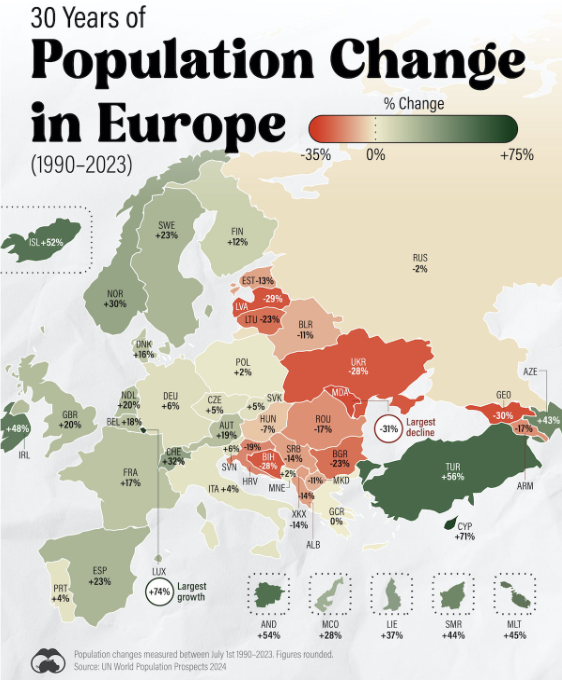
While India faces a growing exodus of talent, its overall population continues to increase, recently surpassing China as the world’s most populous country (Hertog et al. 2023). Other regions of the world are experiencing their own emigration problems paired with rapid population declines. The most severe declines currently reside in Eastern Europe. Since gaining independence from the USSR, Eastern European states have made significant strides towards incorporation in the Western sphere. After 45 years of Communist rule, the economic output of every state in Eastern Europe lagged behind those of Western Europe. In efforts to further integrate into the West, Eastern European states joined the European Union in waves in 2004 and 2007. While European integration has increased development and per capita GDP throughout each state , the freedom of movement and employment opportunities abroad have also accelerated Eastern Europe’s brain drain, such as in Romania: “Romania’s emigrant population increased from 1.3 million to 3.6 million, or even 4 million. In other words, almost 20% of the people born in Romania no longer live in the country” (Rapoza 2016; Hegedűs 2022; Tiut and Teacă 2023).
The Demographic Issue
An overall aging population is a common issue among developed and developing economies alike. With total fertility rates of less than 2.0, the minimum average number of children per family necessary to sustain a population, aging populations have contributed to strains on the workforce in many countries. France, one of the most developed nations economically, is facing a demographic crisis as their replacement rate sits at 1.79. This compelled the nation to raise the retirement age from 62 to 64 (The Associated Press 2023). With a growing percentage of elderly citizens granted social security and lower tax revenues from a decreasing workforce, aging populations are a detriment to economic growth. While this trend exists throughout most developed and developing economies, emigration of skilled workers from lower-income countries only compounds this process. Lower-income countries not experiencing population growth will feel the negative effects the most because a higher proportion of their jobs involve physical labor, which, unlike service or office jobs, is seldom performed by the elderly. If a majority of people become too old to work, a significant strain would be placed on those who can—either directly, as a greater percentage of the workforce would specialize in elderly care, or indirectly via higher taxes to cover the costs of maintaining an aging population.
Are There Any Solutions?
While EU accession causes state labor markets to open up, easing the process to go abroad for work, there is potential for curbing the impact of brain drain in the long term. An interesting case of a country appearing to surmount the crest of a brain drain lies with Lithuania. Since gaining independence from the USSR in 1990, its population has declined from 3.7 million to 2.7 million people (Turauskaitė 2024). Most emigrants since its independence have been of working age, contributing to a low fertility rate and an aging population domestically. Nonetheless, remittances have aided Lithuania’s economy and reduced competition in the job market has kept unemployment suppressed. According to the International Organization for Migration (IOM) Lithuania, long-term outcomes of emigration may be beneficial. In recent years, there has been an increase in returning emigrants. In 2022, Lithuania enjoyed “the highest net positive migration since the country’s independence, with more than 75,000 Lithuanians returning to Lithuania in the last four years—18,000 more than those who left” (Turauskaitė 2024). This observation is largely attributable to shifts in national spending meant to attract talent from Lithuanian expatriates, with initiatives such as Bring Together Lithuania.
Is Lithuania’s experience a fluke? Population growth in the nation is only a recent phenomenon, and it is the only country in the entirety of Eastern Europe experiencing a net increase in migrants. Is there any way to truly reverse brain drain? Or are developing economies today stuck below a glass ceiling?
It is, of course, everyone’s right to choose a better life. A brain drain cannot stop if the benefits of going abroad outweigh opportunities at home. It is the imperative of states with developing economies to create conditions that encourage citizens to stay. States need domestic talent to create economic opportunities, and despite losing much of their own, some developing economies have used their resources to attract foreign talent. The UAE, for example, has attracted foreign talent via grassroots development and economic opportunity (Al Maktoum 2014). Perhaps it is investing in people that can reverse brain drain. Ideas, innovations, and dreams are all future capital. If states can attract great minds today, then great things will happen tomorrow.

Hunter Loren is a Political Science/Economics major from Great Neck, NY. After his undergraduate years, he aims to pursue a masters degree in International Relations. Building on previous experience in IR tutoring, Hunter intends to shed light on happenings in more unknown parts of the world. When he was nine years old he had an email correspondence with the president of Lithuania and he enjoys motorsports, baseball, and guitar.
References
Associated Press. 2023. “Macron’s Pension Age Overhaul Sparks Unrest in France.” NPR, April 15. (https://www.npr.org/2023/04/14/1170238212/macrons-pension-age-france).
Badruddin, Asad. 2016. “Reverse the Brain Drain.” Stanford Social Innovation Review, October 3. (https://ssir.org/articles/entry/reverse_the_brain_drain#).
Corporate Finance Institute. 2024. “Developed Economy.” Corporate Finance Institute. (https://corporatefinanceinstitute.com/resources/economics/developed-economy/).
European Commission. 2024. “Population in European Neighbourhood East Countries.” Eurostat Statistics Explained. (https://ec.europa.eu/eurostat/statistics-explained/index.php?title=Population_in_European_Neighbourhood_East_countries#:~:text=This%20reflects%2C%20among%20other%20factors,65%20years%20in%20their%20populations).
Hegedűs, Eszter. 2022. “Brain Drain in Central and Eastern Europe.” Hype and Hyper, November 19. (https://hypeandhyper.com/brain-drain-in-central-and-eastern-europe/).
Hertog, Sara, Patrick Gerland, and John Wilmoth. 2023. “India Overtakes China as the World’s Most Populous Country.” UN Department of Economic and Social Affairs (DESA) Policy Briefs, June 15. (https://doi.org/10.18356/27081990-153).
Jonko, Anushree. 2025. “India Breaks Silence on the H-1B Visa Debate: Here’s What You Need to Know.” NDTV, January 4. (https://www.ndtv.com/world-news/india-breaks-silence-on-the-h-1b-visa-debate-heres-what-you-need-to-know-7398818).
Oxford Reference. 2024. “Entry Title.” Oxford Reference. (https://www.oxfordreference.com/display/10.1093/oi/authority.20110803095524120).
Quibria, M. G. 2002. “Growth and Poverty: Lessons from the East Asian Miracle Revisited.” ADB Institute Research Paper 33. February.
Rapoza, Kenneth. 2016. “Lithuania and the Euro: One Year Later, the Romance Continues.” Forbes, January 10. (https://www.forbes.com/sites/kenrapoza/2016/01/10/lithuania-and-the-euro-one-year-later-the-romance-continues/).
Saini, Pragya. 2024. “The Great Indian Brain Drain: Talent on the Move.” Indiatimes, January 31. (https://www.indiatimes.com/thought-starter/great-indian-brain-drain).
TimesPro. 2024. “Engineer Salary.” TimesPro, August 7. (https://timespro.com/blog/engineer-salary).
Tiut, Andrei, and Ana Maria Teacă. 2024. “Emigration from Romania: Impact and Legacy.” Österreichische Gesellschaft für Europapolitik, April 5. (https://www.oegfe.at/policy-briefs/emigration-from-romania-impact-and-legacy/?lang=en).
Turauskaitė, Barbora. 2024. “Lithuania Lost a Million Citizens to Emigration: How Did It Happen?” LRT.lt, April 5. (https://www.lrt.lt/en/news-in-english/19/2263911/lithuania-lost-a-million-citizens-to-emigration-how-did-it-happen).
U.S. Bureau of Labor Statistics. n.d. “Architecture and Engineering Occupations.” Occupational Outlook Handbook. https://www.bls.gov/ooh/architecture-and-engineering/
Visual Capitalist. 2023. “Mapped: How Europe’s Population Has Changed (1990-2023).” Visual Capitalist. (https://www.visualcapitalist.com/mapped-how-europes-population-has-changed-1990-2023/).
World Economic Forum. 2014. “Sheikh Mohammed bin Rashid Al Maktoum: How the UAE Is Combating Brain Drain.” World Economic Forum, October 6. (https://www.weforum.org/stories/2014/10/sheikh-mohammed-bin-rashid-al-maktoum-brain-drain-uae/).
-
H-2-Oh-No: How California is wasting its most important resource

By Hatim Husainy, Sustainability
Humans have routinely settled near water. It has been one of the most important ingredients for civilization from our earliest days, with entries about early human settlements along the Nile, Euphrates, Yellow, and Ganges rivers proudly opening almost all textbooks about human civilization. Water isn’t just for drinking — the flow of rivers is what made the Tigris and Euphrates river system so fertile, and the Nile’s cyclical floods were a crucial element in Egyptian prosperity. The inconsistent flooding and eventual complete shift of the Yellow River early in Chinese history killed millions between consequent natural disasters and ensuing famines — earning the river its nickname, China’s Sorrow (Omondi, 2019). Beyond farming, water was eventually harvested to feed the early stages of humanity’s harnessing of nature, turning wheels and powering everything from flour mills to textile factories.
The history of California can be traced along the axis of water as well: during the Mexican-American war, one month before Mexico’s surrender of the land that is today California, a man named James Marshall found gold on the banks of the American River. The leakage of this information ignited the famous California Gold Rush, sending “Forty-Niners”—named for their 1849 arrival—searching for gold throughout the river, with explorers arriving from as far as China, Europe, and South America. California’s population exploded, and even after the gold ran out, the rush’s influence lingered during California’s later bid for statehood and the founding of San Francisco (Brittania, 2025).
Today, California is the third-largest state in the United States and the largest economy, comprising 14% of US GDP (Bohn & Duan, 2025). Taken alone, it would be the world’s fifth largest economy. Nonetheless, the state is currently marooned in a 25-year megadrought, leaving it dryer than it has been in the past 1,200 years (Fountain, 2022).
California is also prone to extreme fires, a wave of which recently devastated the region. Thanks in part to the Santa Ana winds, southern California was recently engulfed in a wildfire expected to be the most expensive in American history (LA Almanac, 2002). This fire is distinct: after record-breaking rainfall last February, Los Angeles turned green as plants sprouted after a long period of drought. Then, within months, drought conditions returned and the region’s new plant life dried out into perfect kindling. California is naturally fire-prone in other ways. It receives little rainfall, even when it isn’t facing drought conditions, and most of the water in the region is provided by the rivers that flow through it, including the Colorado and American (California Department Of Fish And Wildlife, 2025).
These rivers are the primary source of water in an increasingly arid region, so strategic usage has been crucial. To this end, the state has devised, through a combination of historical and contemporary legislation, a complex “water rights” system to determine who can use California’s water, for what purpose, and how much. In its current iteration, it is built around the legal doctrine of “First in claim, first in right,” rather than a needs-based allocation approach (Williams, 2024). The system is headed up by the California Water Board, which approves new claims and manages water usage.
California has many vital uses for its water. In addition to “urban usage” — that is, residential consumption — the state uses river currents to create electricity, enough to power 2.5 million houses per year on hydropower alone. However, these applications pale in comparison to California’s thirstiest sector, agriculture (Richter, 2020).
Agriculture is today responsible for more than 80% of the American West’s total water usage. From corn and fruit to wheat and alfalfa, drought-struck states manage to allocate the lion’s share of their water towards crops, many of which are not eaten locally. Notably, 32% of the West’s water footprint goes to corn, grass hay, and alfalfa—crops grown exclusively to feed livestock. This is more than all commercial and residential use combined (14%) (Richter, 2020). More than 10% of this cattle feed, in turn, goes to the Middle East, China, or Japan to feed cattle. Many Middle Eastern countries, including Saudi Arabia, have banned growing alfalfa within their borders due to similar drought conditions (Tabuchi, 2023).The negative implications of western water use should be clear from the cuff: the most parched region of the United States is directing its water primarily toward animal feed production (some of which is not even used domestically), rather than conserving it for areas that desperately need to regrow after wildfire losses and build up resilience in anticipation of future fires (EPIC, 2025).
California is the first state in the US to enshrine a “right to water,” and with that in mind it should be especially unacceptable to allow archaic systems of law and power to worsen a historic drought and put millions at risk of losing consistent access to water. It is clear that drastic action is needed before a bad situation worsens even further; the good news is, there are a number of policy solutions worth considering. To start, programs that pay farmers to let certain fields rest (or fallow) during the growing season should be expanded, and can serve as a stopgap while California considers rewriting or, at minimum, reshaping its water rights laws to work better for its people (Skelton, 2023).
In the realm of legal reform, several key avenues should be pursued—one of the most critical being the inclusion of indigenous peoples in water rights laws. Currently, California’s water rights system largely sidelines Native communities that have stewarded natural resources for thousands of years, struggling to treat Native claims to water as they would other ancestral claims and limiting their usage of the water in a way they do not other rights holders. (Smith, 2003) Such an incorporation is essential not only for achieving justice and recognition for California’s indigenous communities, but also for leveraging millennia-old expertise that has improved water rights systems globally. A notable comparison can be drawn with Australia, where recent legal reforms have begun to acknowledge indigenous water rights, integrating traditional ecological knowledge with modern water management frameworks. Such a model demonstrates that embracing indigenous perspectives can lead to more equitable and effective water governance—a lesson that California could benefit from as it rethinks its own legal structures (Cho, 2024).

Hatim Husainy is a freshman from Smithtown, NY, studying political science. He is in the early phases of a research project on human rights in the Binghamton area. In addition to the Happy Medium, he participates in Moot Court, Model United Nations, and Citizens Climate Lobby. He plans to pursue law school after his undergraduate degree, and from there, he plans to save the world.
References:
Bohn, S., & Duan, J. (2025, February 3). California’s economy. Public Policy Institute of California. https://www.ppic.org/publication/californias-economy/#:~:text=California%20is%20an%20economic%20powerhouse,%25%20and%208%25%2C%20respectively
Britannica, T. Editors of Encyclopaedia (2025, February 3). California Gold Rush. Encyclopedia Britannica. https://www.britannica.com/topic/California-Gold-Rush
Cho, A. C. (2024, June). Cho_WaterLandPower. Google Docs. https://docs.google.com/document/d/1_6qNu39H1NArbKVNGTNKAxQ5smaoB3xM_ojl7ofmWsU/edit?tab=t.0
EPIC. (2025, February). Returning to a natural cycle of wildfire. EPIC Website. https://www.wildcalifornia.org/returning-to-a-natural-cycle-of-wil
Fountain, H. (2022, February 14). How bad is the western drought? worst in 12 centuries, study finds. The New York Times. https://www.nytimes.com/2022/02/14/climate/western-drought-megadrought.html
LA Almanac. (2002). What are the Santa Ana or Santana Winds?. What are the Santa Anas? https://www.laalmanac.com/weather/we23.php
Of Fish And Wildlife, C. D. (2025, February). Wildfire Resiliency Initiative. CDFW. https://wildlife.ca.gov/Lands/Wildfire#:~:text=Much%20of%20California%27s%20native%20vegetation,impact%20of%20high%20severity%20fires
Omondi, S. (2019, November 11). Which river is called “China’s sorrow” and why? WorldAtlas. https://www.worldatlas.com/articles/which-river-is-called-china-s-sorrow-and-why.html
Richter, B.D., Bartak, D., Caldwell, P. et al. Water scarcity and fish imperilment driven by beef production. Nat Sustain 3, 319–328 (2020). https://doi.org/10.1038/s41893-020-0483-z
Skelton, G. (2023, February 21). Column: Shrinking water supply will mean more fallow fields in the san joaquin valley. Los Angeles Times. https://www.latimes.com/california/story/2023-02-20/column-column-skelton-on-water-and-agriculture-in-the-san-joaquin-valley
Tabuchi, H. (2023, October 3). Water-stressed Arizona says state will end leases to Saudi-owned farm. The New York Times. https://www.nytimes.com/2023/10/03/climate/arizona-saudi-arabia-alfalfa-groundwater.html#:~:text=It%20is%20mainly%20used%20to,on%20the%20kingdom%27s%20water%20resources
Williams, R. (2024, August 14). Who’s Taking America’s Water? . YouTube. https://www.youtube.com/watch?v=XusyNT_k-1c
-
The Cost of Doing Business: How Does Gentrification Impact Crime In the Nation’s Capital?

By Travis Rayome, Political History
Photo: a katz, Shutterstock.com
Gentrification is a socioeconomic phenomenon spurred on by a growing investment bubble within urban centers. These areas are usually already suffering from a lack of public investment and have declined from a previous state of economic growth. Tax incentives, subsidies, and cheap land invite private developers to purchase real estate and begin operations in these neighborhoods due to the attractive business prospects. The main driver of economic growth under gentrification is private investment, which provides a flow of income into the area and increases property values. This growth attracts more actors in the real estate market to take advantage of the inflating investment bubble, including out-of-state owners and large firms. As this process occurs, businesses and new residents move in to take advantage of the local culture, proximity to desirable locations, economic opportunities, and urban infrastructure.
Gentrification is a pervasive topic within discussions of local economic development in US cities. As major cities such as New York City and Washington, D.C. employ market-driven revitalization efforts in previously neglected areas, they see increases in income and property values. Arguments arise about the adverse effects of this process, but local governments defend them by emphasizing its correlation to economic growth. For example, Muriel Bowser, mayor of Washington, D.C., promoted the controversial project to revitalize the Robert F. Kennedy Stadium Campus by highlighting the business it would bring to the area.
It is also often observed that public safety increases alongside gentrification–seen in the negative correlation between economic growth and crime (Barr and Zhang 2024). This added safety can attract even more higher-income residents and investors, which further drives growth and lowers crime. It is this perception that drives some local policymakers to attract private investment in order to make their cities safer. Within Washington D.C., which has been undergoing revitalization efforts for the past several decades, violent crime hit a 30-year low in 2024 and property crime saw a significant decrease from 2023. At the same time, some longtime D.C. residents purport their neighborhoods have improved (Lei et al. 2022). D.C.’s government prioritizes policies that contribute to gentrification, consistently allocating large portions of the annual budget to revitalization programs that encourage investment and increase economic activity in the District. Studies have even named Washington, D.C. as one of the most gentrified cities in the country (National Community Reinvestment Coalition 2020). But the idea that gentrification caused a decrease in crime is a misdiagnosis. D.C.’s crime went down in 2024, but there has been a significant overall surge from pre-pandemic numbers in the past few years. This has fueled a prevalent public perception of D.C. as being overrun with crime (Clement and Davies 2024), a sentiment repeated by even the House Budget Committee. Research into successful long-term crime deterrence efforts recommends adequately investing public funds in social services (Amaning and Bashir 2022; Partners for Justice 2022), something the District has historically struggled to do (Jenkins 2024). This means that crime being down in 2024 is not indicative of sustained improvement, and the issue remains a pressing concern for policy makers and residents.
Within D.C., conflicting approaches to and perceptions of crime complicate policy. D.C.’s government places heavy emphasis on expanding the powers, number, and budget of law enforcement as the most direct means of improving public safety. Mayor Bowser and the D.C. council explained their goal of deterring crime when discussing the large expansions of Metropolitan Police Department power through the 2024 Secure D.C. bill, citing significant public anxieties about crime and the need for punitive justice in keeping the city safe (Gelman 2024).
Long-term crime prevention in D.C. could potentially be hampered rather than ensured given the current trajectory of the local policy trends, though. The District’s 2025 budget prioritizes law enforcement and gentrification in revitalizing while cutting spending on measures crucial to improving conditions (Metzgar and Williams 2024; Washington Legal Clinic for the Homeless 2024). These measures were created to address D.C.’s inequality and unaffordability, but saw no substantial improvement in funding for 2025 while spending directed at encouraging private investment increased along with the police budget. Inequality and unaffordability caused by gentrification are problems which historically define the conditions that facilitate criminal activity and issues Mayor Muriel Bowser publicly recognizes as greatly impacting D.C. communities. Preventing poverty and homelessness prevents crime, yet the District’s government struggled to maintain living assistance programs, affordable housing initiatives, and other social services during an affordability crisis. Similarly, increased police funding is not shown to meaningfully lower crime without the proper community investment to go along with it (Austen 2024). Mayor Bowser defended her initial budget proposal, which contained even greater and more expansive cuts than the final approved version, as addressing the District’s budget deficit in public statements, but organizations such as the DC Fiscal Policy Institute and dissenting council members have since pointed out that the D.C. government is not pursuing all of the available avenues that would close the deficit without depriving communities of resources and potentially making the District’s existing struggles worse.
The socioeconomic factors most heavily correlated with crime are inequality and poverty (Fleming 2011); This is why investment in communities and social services is so important in preventing crime. This investment can include specialized policies like targeted anti-violence programs and welfare, but are most commonly found in the form of public institutions like education, transit, subsidies, and sanitation. These investments target needs; they help relieve poverty, improve infrastructure, and provide vital resources to residents. This also means they address conditions that foster crime: lack of education, poor health outcomes, unemployment, homelessness, food insecurity, etc. Two of the most harmful effects of gentrification are its capacity to strain social services and accelerate crime-fostering conditions among people already living within gentrifying areas. This is because gentrification is associated with rapid cost-of-living increases and unstable markets, not just in housing, but in other essential commodities such as insurance (Schneider 2024).
Gentrification can facilitate unstable housing markets as existing property values rise and newly-built developments become more expensive to cater to richer incoming residents. Three of the most gentrified neighborhoods of Washington, D.C. – Navy Yard, Eckington, and Shaw – saw rents increase by 55% in the previous decade (Erickson 2022), and the average home price across the district only continues to rise into the millions. Investor purchases of housing stock in gentrifying areas also dramatically increases the chances of an eviction spike, as was observed in Atlanta from 2000-2016 (Braun et al. 2021). These factors destabilize lower-income communities who cannot afford inflated prices and intensify crime-related conditions such as inequality, homelessness, and poverty.
The investment bubble created during gentrification can encourage exploitation and destabilize markets. As markets grow, private equity firms begin purchasing housing supply in the area and use their large size to drive up local housing prices, rapidly increasing asset values. This makes private equity a key driver of gentrification, and leads to practices like price gouging, cost cutting, collusion, and market consolidation becoming prevalent in gentrified cities. In November 2023, Washington, D.C. Attorney General Brian Schwalb filed a lawsuit against 14 of D.C.’s largest residential landlords and RealPage, a property management company owned by Chicago-based private equity firm Thoma Bravo. Schwalb alleges that RealPage encourages anticompetitive practices, as these firms illegally colluded to use the RealPage app to predatorily raise rental prices on over 50,000 apartments and monopolize the city’s housing market as a cartel (Office of the Attorney General for the District of Columbia 2023). According to the lawsuit, RealPage’s software is used to fix prices in over 30% of all multifamily apartments in D.C. and even more in the surrounding area, costing D.C. residents extra millions and raising prices across the area. The case is still pending as of January 2025, but the attorney general’s analysis highlights the dangers of gentrification: the attraction of private investment without public interest in mind can end up harming communities.
The increased cost of housing is not the only harmful financial impact on locals in gentrified cities, though. Prices across the board all shoot up as investors capitalize on the growing markets for all goods and services within the area. A notable example is in food prices. In gentrifying neighborhoods, local affordable grocers and restaurants either are priced out of the market, have their properties sold off to investors, or are forced to raise prices to remain competitive, not dissimilarly to local landlords. This can lead to what are referred to as “food mirages,” where food is seemingly readily available in an area, but the high prices and exclusivity of the vendors prevent many locals from having equal access to it and can hamper nutritional variety (Nevin 2018). Food insecurity is linked to crime (Caughron 2016), and gentrification can hide that insecurity in plain sight while making the problem worse. The phenomenon of food mirages shows how gentrification can indirectly make resources less accessible and put added financial strain on already struggling communities, and demonstrates that the line drawn from pro-gentrification policy to crime-fostering socioeconomic conditions has many different facets.
Gentrification is commonly correlated with major population displacements in affected neighborhoods as locals who cannot keep up with the increase in cost-of-living or who are evicted from their homes leave the area, which can give the impression that poverty has decreased. Police presence also increases in gentrified areas to bolster security. These two facts might explain why D.C. is choosing to invite private investment into the district and increasing police presence to lower crime instead of investing in poverty alleviation efforts; lower-income residents living in neglected and unsafe neighborhoods are being pushed out and replaced with wealthier arrivals as property values increase (Li et al. 2022). However, the assumption that displacement and increased security will improve conditions unilaterally is questionable. Displaced Washingtonians are mostly black and the richer new arrivals are mostly white, leading to increasingly racially segregated and unequal communities. Disrupting community cohesion in this way and increasing surveillance can make outreach efforts more difficult and lead to an alienating atmosphere for lower-income and black locals, both issues that could adversely affect crime rates.
On top of the problems posed within displaced populations, the population around a gentrified area may also see a rise in crime. A 2023 study published in the Journal of Economic Behavior & Organization found that in Philadelphia, PA in the 2010s, 8200 shootings (29% of Philadelphia shootings in that decade) were identified as resulting either directly or indirectly from gentrification within the city (Porreca 2023). The study explains that displacement of locals during gentrification relegates and concentrates criminal activity to nearby areas, sometimes even within the same neighborhood. This phenomenon is not specific to Philadelphia, either. The central area of Washington, D.C. saw the most crime in 2024 contains the neighborhoods that have experienced the highest turnover of black-to-white residents associated with gentrification (Lei et al. 2022; Rusk 2017) and massive increases in the cost of living, including the previously mentioned Navy Yard, Eckington, and Shaw (Erickson 2022). These neighborhoods were disadvantaged and unsafe before gentrification, but the ongoing increase in prices, concentration of criminal activity, disinvestment in communities, and displacement of locals combined with increased police presence since the 2000s is unlikely to sustainably improve the situation.
Above: maps detailing demographic change in D.C. (bottom and top left) along with prevalence of crime in 2024 (top right). Neighborhoods in central D.C. have seen the most extreme demographic shift and the highest number of crimes in the city.
So, if gentrification cannot meaningfully deter crime and can even make it worse in some aspects, how should cities like D.C. approach public safety? As mentioned before, investment in the city’s communities is a crucial first step. Cities should focus on preventing poverty, homelessness, food insecurity, and generally unstable conditions for locals, and properly support specialized measures to address specific factors. National Institute for Criminal Justice Reform officials attribute D.C.’s 30-year violent crime low in 2024 to the city’s robust violence prevention initiatives such as Cure the Streets and People of Promise, extensive outreach programs targeting individuals in unsafe situations (Kuo 2025). D.C.’s government, though, is struggling to decide between punitive and preventive approaches to crime.
The 2024 Secure D.C. bill increases penalties for existing sentences and implements pretrial detentions for people accused of violent crime. These types of policies are shown to have adverse effects on crime-fostering conditions in the long term even if they effectively scare criminals. The Council Office of Racial Equity argued in a letter to the D.C. Council that penalty increases would further harm the majority-black population, a group already disproportionately criminalized. Pretrial detention has disastrous effects; a New York Criminal Justice Agency report found that they are highly correlated with job loss, homelessness, and community instability. The Secure D.C. bill also increases police presence and reduces checks on their power (The Sentencing Project 2024), enabling further destabilization of primarily black lower-income communities and simply punishing criminals without addressing the economic environment that enables crime. As stated before, as well, increasing police budget and power does not contribute to reducing crime by itself. This makes Secure D.C. ineffective in preventing crime, as it enables harsher punishment while potentially worsening conditions for the District’s most vulnerable residents.
If cities wish to sustainably reduce crime and improve life for their residents, then the adverse effects of gentrification must be acknowledged and fought. Within D.C., allocating resources to communities to prevent crime-fostering conditions remains a priority for some council members and numerous advocacy organizations, but these parties clashed with the Mayor’s office and other council members who wished to cut investment in social services and focus on attracting private investment. Mayor Bowser’s proposed 2025 budget cut spending greatly on programs key to preventing crime, but under public pressure, the D.C. council revised the plan to undo many of the cuts and divert more funds to programs meant to resolve the District’s housing crisis, vast economic inequality, and strained social safety nets (DC Fiscal Policy Institute 2024). The council did not fully meet demands, though, and many of D.C.’s social services remain critically underfunded. This shows some promise for the future, demonstrating that the city’s government is willing to work with communities, but many top officials’ willingness to disinvest also indicates that achieving long-term public safety will likely remain an uphill battle for the foreseeable future. If Washington, D.C. provides any picture of the relationship between gentrification and crime, it is one that is complex and requires careful planning and meaningful investment from city governments, so that underserved communities can revitalize equitably and sustainably.
Travis Rayome is an English and Economics major from Alexandria, Virginia. He hopes to work for humanitarian NGOs around the Washington, DC area, continue writing on politics and economics, and play music. His areas of political interest are propaganda and information dissemination, structural violence and inequality, and power distribution within and between nation states.
References:
Amaning, Akua and Bashir, Hassen. 2022. “Community-Based Violence Interventions: Proven Strategies To Reduce Violent Crime.” Center for American Progress, June 15. https://www.americanprogress.org/article/community-based-violence-interventions-proven-strategies-to-reduce-violent-crime/.
Austen, Ian. 2024. “Spending More Money on Police Shows No Clear Link to Crime Levels.” The New York Times, January 27. https://www.nytimes.com/2024/01/27/world/canada/canada-letter-police-spending-crime.html.
Barr, Ashley, and Zhang, Zhe. 2024. “Gentrification and crime in Buffalo, New York.” PLoS ONE, June 20. https://doi.org/10.1371/journal.pone.0302832.
Bergin, Tiffany, Randolph, Imani, and Ropac, René. 2022. “The Initial Collateral Consequences of Pretrial Detention: Employment, Residential Stability, and Family Relationships.” New York City Criminal Justice Agency, September 27. https://www.nycja.org/assets/downloads/Collateral-Consequences-Results-Summary-Brief.pdf.
Braun, Jonathan, McKinney, Michaela, Miller, Ben, and Raymond, Elora Lee. 2021. Gentrifying Atlanta: Investor Purchases of Rental Housing, Evictions, and the Displacement of Black Residents.” Housing Policy Debate, April 15. https://nlihc.org/sites/default/files/Gentrifying-Atlanta-Investor-Purchases-of-Rental-Housing-Evictions-and-the-Displacement-of-Black-Residents.pdf.
Caughron, Jonathan Randel. 2016. “An Examination of Food Insecurity and Its Impact on Violent Crime in American Communities.” Clemson University, December. https://open.clemson.edu/all_theses/2565/.
Clement, Scott, and Davies, Emily. 2024. “Poll finds growing public concern over safety in DC despite drop in crime.” Washington Post, May 16. https://www.washingtonpost.com/dc-md-va/2024/05/16/dc-poll-fear-crime-rising/.
Cohen, Nevin. 2018. “Feeding or Starving Gentrification.” CUNY Urban Food Policy Institute, March. https://cunyurbanfoodpolicy.org/resources/report/feeding-or-starving-gentrification/.
Committee on the Judiciary and Public Safety. 2024. “Racial Equity Impact Assessment of the Secure DC Omnibus Amendment Act of 2024.” Council Office of Racial Equity, January 26.https://www.dropbox.com/scl/fi/9f8htxn0p2x1gn898y0s5/B25-0345-Secure-DC-Omnibus-REIA.pdf?rlkey=42ygjujf7orl1it1r3iwp23zj&e=4&dl=0.
DC Fiscal Policy Institute. 2024. “What’s in the Fiscal Year 2025 Budget?” July 1. https://www.dcfpi.org/all/whats-in-the-fiscal-year-2025-budget/.
Edlebi, Jad, Mitchell, Bruce, and Richardson, Jason. 2020. “Gentrification and Disinvestment: Do Opportunity Zones benefit or gentrify low-income neighborhoods?” National Community Reinvestment Coalition. https://ncrc.org/wp-content/uploads/dlm_uploads/2020/06/Gentrification-and-Opportunity-Zones-2020-v8.pdf.
Erickson, Andrew. 2022. “MetroCentered: Navigating Neighborhood Transition.” American University Magazine, December. https://www.american.edu/magazine/article/metrocentered-the-challenges-of-neighborhood-change.cfm
Executive Office of the Mayor of Washington, DC 2019. “Mayor Bowser to Highlight Investments to Combat Gentrification.” May 7. https://mayor.dc.gov/release/mayor-bowser-highlight-investments-combat-gentrification.
Executive Office of the Mayor of Washington, DC 2024. “Mayor Bowser Presents Fiscal Year 2025 Budget Proposal, A Fair Shot: Strategic Investments and Shared Sacrifice.” April 3. https://mayor.dc.gov/release/mayor-bowser-presents-fiscal-year-2025-budget-proposal-fair-shot-strategic-investments-and.
Fleming, Luke. 2011. “The Relationship Between Poverty and Crime: A Cross Section Analysis.” Bryant University. https://digitalcommons.bryant.edu/cgi/viewcontent.cgi?article=1052&context=eeb
Gelman, Scott. 2024. “DC’s mayor says crime is falling, as she signs sweeping anti-crime bill into law.” WTOP News, March 11. https://wtop.com/dc/2024/03/dcs-mayor-signs-sweeping-anti-crime-bill-into-law/.
House Budget Committee, 2024. “The Nation’s Capital is Suffering the Worst Crime Wave in 21st Century.” United States Congress, February 26. https://budget.house.gov/press-release/the-nations-capital-is-suffering-the-worst-crime-wave-in-21st-century.
Jenkins, Jen. 2024. “DC’s 2025 Budget: How Our Priority Programs Fared.” Legal Aid DC, July 8. https://www.legalaiddc.org/blogs/dc-2025-budget-programs.
Kuo, Chih-Rong. 2025. “Violent crime in DC dropped in 2024. What’s behind the decrease?” The Georgetown Voice, January 29. https://georgetownvoice.com/2025/01/29/violent-crime-in-d-c-dropped-in-2024-whats-behind-the-decrease/.
Li, Ming, O’Donnel, Katy, Overly, Steven, and Smith-Barrow, Delece. 2022. “Washington Was an Icon of Black Political Power. Then Came Gentrification.” Politico, April 15. https://www.politico.com/news/magazine/2022/04/15/washington-dc-gentrification-black-political-power-00024515.
Metropolitan Police Department. 2025. “DC Crime Cards.” https://crimecards.dc.gov/.
Metzgar, Nikki, and Williams, Erica. 2024. “DC Council Makes Progress but Fails to Raise Adequate Revenue for Critical Programs at First Budget Vote.” DC Fiscal Policy Institute, May 31. https://www.dcfpi.org/all/dc-council-makes-progress-but-fails-to-raise-adequate-revenue-for-critical-programs-at-first-budget-vote/.
Office of the Attorney General for the District of Columbia. 2023. “Attorney General Schwalb Sues RealPage & Residential Landlords for Rental Price-Fixing, Illegally Raising Thousands of District Residents’ Rents.” November 1. https://oag.dc.gov/release/attorney-general-schwalb-sues-realpage-residential.
The Office of the United States Attorney for the District of Columbia. 2025. “Violent Crime in DC Hits 30 Year Low.” U.S. Attorney’s Office, District of Columbia, January 3. https://www.justice.gov/usao-dc/pr/violent-crime-dc-hits-30-year-low .
Partners for Justice. 2022. “What Really Lowers Crime.” June. https://cdn.prod.website-files.com/6082d94f16ba7348d54d034d/62b475d4f5a5c07457935900_What%20Really%20Lowers%20Crime%20(1).pdf.
Porreca, Zachary. 2023. “Gentrification, gun violence, and drug markets.” Journal of Economic Behavior & Organization, vol. 207 (March). https://doi.org/10.1016/j.jebo.2023.01.017.
Rusk, David. 2017. “Goodbye to Chocolate City.” DC Policy Center, July 20. https://www.dcpolicycenter.org/publications/goodbye-to-chocolate-city/.
The Sentencing Project. 2024. “The Sentencing Project Condemns DC Council’s Passage of Secure DC Crime Bill.” March 5. https://www.sentencingproject.org/press-releases/the-sentencing-project-condemns-dc-councils-passage-of-secure-dc-crime-bill/.
Schneider, Franklin. 2024. “Soaring Property Insurance Rates Threaten Affordable Housing Development.” Shelterforce, March 26. https://shelterforce.org/2024/03/26/soaring-property-insurance-rates-threaten-affordable-housing-development/.
Smith, Jillian. 2025. “Biden signs bill giving DC control of RFK Stadium, Bowser says: ‘It’s officially law’.” Fox 5 Washington, January 6. https://www.fox5dc.com/news/biden-signs-bill-giving-dc-control-rfk-stadium-bowser-says-its-officially-law.
The Washington Legal Clinic for the Homeless. 2024. “The FY25 Budget: Disappointments and Disinvestments.” July 11. https://www.legalclinic.org/the-fy25-budget-disappointments-and-disinvestments/.Williams, Erica. 2024. “Claims that DC Spending is “Out of Control” are Wrong.” DC Fiscal Policy Institute, May 13. https://www.dcfpi.org/all/claims-that-dc-spending-is-out-of-control-are-wrong/.
-
The Rise of Minimum Wage in New York State and Its Implications

By James Kang, New York Politics
On December 17, 2024, Governor Kathy Hochul announced that as of January 1, 2025, the minimum wage for New Yorkers would increase by an additional $0.50 per hour. In other words, New York’s minimum wage increased to $16.50 per hour in New York City, Westchester, and Long Island, with the rest of the state earning $15.50 per hour (Hochul 2024). The adjustment fulfills Kathy Hochul and the New York State Legislature’s historic multi-year agreement to increase the minimum wage through 2026 and index to inflation beginning in 2027.
In addition to the increase in the minimum wage rate, tipped service employees must be paid at least a $13.75 cash wage per hour with a $2.75 tip credit, with tipped food service workers required to be paid at least an $11 cash wage per hour with a $5.50 tip credit in New York City. Other types of employees are required to be paid at least $16.50 per hour. With this in mind, the purpose of this article is to examine the economic influences and broader political and labor implications of this adjustment.
Economic Factors
Hochul’s announcement was part of the ongoing efforts of the New York State Department of Labor (NYSDOL) to educate people about economic changes and reducing potential wage theft. In terms of potential wage theft, the NYSDOL strives to emphasize that “as of September 2023, wage theft is larceny under New York State Penal Law section 155. Failure to pay wages may result in referral to a local District Attorney for consideration of criminal prosecution” (Department of Labor 2025). But more importantly, the NYSDOL addresses the need for New York employers and employees to be educated about businesses, especially on the hourly minimum wage rate. Additionally, “under the Wage Theft Prevention Act, private employers in New York State must provide all of their employees (both exempt and non-exempt) with a pay notice” (My City 2025). It is advised that the pay notice should include information such as pay rate–including overtime–how the employee is paid, when pay-day is, the Doing Business As (DBA) name of the employer, the contact information of the employer, and any allowances towards the minimum wage. Businesses are also advised to keep copies of all available pay notices.
Furthermore, there are contemporary influences that contributed to the necessary rise of the minimum wage in New York. One is the cost of living, with New York having a cost of living that is 26% higher than the national average in 2024. Housing, which includes buying and renting, is 75% higher compared to the national average. In addition, monthly utilities and food are both 3% higher compared to the national average. Plus, both healthcare and transportation costs are 7% higher compared to the national average, while goods and services are 9% higher (US Bureau of Labor Statistics 2025).
Another contemporary influence is inflation, where the Consumer Price Index for All Urban Consumers (CPI-U), which is a measurement of inflation, throughout the year 2024 advanced by 4.3 percent. In December, food prices rose by 0.5 percent while the energy index increased by 2.4 percent. According to the US Bureau of Labor Statistics, these are the prices that increased from December 2023 to December 2024:
- Food: 2.3%
- At-home food: 2.0%
- Away-from-home food: 2.7%
- Energy: 3.4%
- Household energy: 11.4%
- Electricity: 12.8%
- Natural Gas: 15.3%
- Household energy: 11.4%
The only price that declined was gasoline prices by 8.9%. As for items unrelated to food and energy, the index advanced by 4.7 percent throughout the year. A higher CPI in the state of New York indicates that higher levels of inflation were present, contributing to the push to raise the minimum wage.
Overall, both living costs and inflation are the most important factors that Governor Hochul and the New York State Department of Labor considered when increasing the minimum wage rate. As Governor Hochul noted, “Putting money back in your pockets has been the focus of my first three budgets, and that includes increasing minimum wage for the lowest earners across the state. With costs of living, this increase will help to lighten the burdens of inflation for New Yorkers while providing businesses with the time needed to adjust.” Moreover, New York State Department of Labor Commissioner Roberta Reardon stated, “In this current era of inflation and rising costs, every cent counts for all New Yorkers, especially workers who earn minimum wage. By gradually increasing wages for the lowest earners, we are ensuring businesses can adjust to the change while also helping more families make ends meet. I want to thank Governor Hochul and the Legislature for working together to strengthen the paychecks of New Yorkers statewide” (Hochul 2024).
Political Responses and Economic Implications
Most political responses to the minimum wage increase were positive. State Senator and Chair of the Senate Labor Committee Jessica Ramos demonstrated appreciation for Governor Hochul and the Department of Labor, stating, “Thanks to our efforts in the 2023 budget, New York’s minimum wage earners can expect to start every new year with a raise. More money in their pockets means more money circulating in our local economy. I urge New Yorkers to check their pay stubs closely to make sure they are taking home every penny they have earned. Together with the Governor and the Department of Labor, we are committed to fighting wage theft and making sure you can continue to afford to live in our great state” (Hochul 2025).
Assemblymember Harry Bronson and New York State AFL-CIO President Mario Cilento agreed with Ramos. Bronson argued that “our families and workers deserve a minimum wage that keeps pace with costs so they can afford life’s necessities . . . This was about doing right for New Yorkers and creating an economy that supports our businesses and our families.” Cilento applauded the Governor and Department of Labor’s efforts, stating that “the 2025 minimum wage increase is a much-needed boost for hardworking New Yorkers” (Hochul 2025).
But what about the economic implications of increasing the minimum wage? According to the Congressional Budget Office, increasing the minimum wage could contribute to negative effects. “In general, increasing the . . . minimum wage would raise the earnings and family income of most low-wage workers and thus lift some families out of poverty—but doing so would cause other low-wage workers to become jobless, and their family income would fall” (Congressional Budget Office 2024). In other words, by raising the minimum wage, some employers are inclined to employ fewer workers. While it can raise some families’ real income, the income of other families can fall, causing “a net reduction in average family income” (Congressional Budget Office 2024).
New Beginning?
In actuality, the increase of the minimum wage rate signifies a “new beginning” for labor standards and economic equity in the region. Despite having experienced increases in the minimum wage in previous years, these adjustments didn’t contribute to job losses as claimed by economists. In 2018, New York increased their minimum wage rate to $15, which conflicts with the textbook model of a perfectly competitive labor market. As aforementioned, “employers facing higher labor costs reduce their employee headcounts and hours and substitute technology for labor” (Center on Wage and Employment Dynamics 2023).
However, there are three different outcomes that New York either experienced or will observe because of the increase in minimum wage. First, businesses were able to transfer the cost increases to consumers. “Second, wage increases substantially reduce employee turnover and make it less costly for businesses to fill their vacant positions” (Center on Wage and Employment Dynamics 2023). After all, the number of job openings were much greater than the number of workers searching for jobs. Lastly, numerous low-wage employers hold the power to set their own wage and employment levels, signifying that our labor markets indeed follow a textbook model of a perfectly competitive labor market.
Conclusion
Besides the three different outcomes that New Yorkers can experience, Governor Kathy Hochul’s minimum wage adjustment offers a “new beginning” for labor standards and economic equity in the state of New York. After all, it is not the only local policy variation being implemented to support New Yorkers’ adaptability and resolve for economic predicaments. Other state legislatures include the Retail Workers Safety Act, Paid Parental Leave, and NYC Congestion Pricing. Overall, the introduction of these legislatures attempts to stimulate economic growth and development, signifying shifts in New York toward a more market-oriented economy. In other words, New York’s minimum wage increase essentially opens a new door for New York to try out different economic adjustment strategies.

James Kang is a junior from Queens, New York, majoring in political science. After graduation, James plans to go to law school. During high school and going into college, James wrote articles and worked with representatives, such as Congresswoman Grace Meng of New York’s 6th district. During this past summer, James worked as an intern in the office of United States Senator Lea Webb of the 52nd district and Josh Riley, who is the Democratic candidate for New York’s 19th Congressional district. Outside of politics, James enjoys playing the piano and basketball.References
Department of Labor. n.d. “Minimum Wage.” NY.gov. https://dol.ny.gov/minimum-wage-0.
Governor Kathy Hochul. n.d. “Money in Your Pocket: Governor Hochul Reminds New Yorkers of Minimum Wage Increase on January 1.” NY.gov. https://www.governor.ny.gov/news/money-your-pocket-governor-hochul-reminds-new-yorkers-minimum-wage-increase-january-1.
NYC MyCity. n.d. “Minimum Wage.” NYC.gov. https://nyc-business.nyc.gov/nycbusiness/description/wage-regulations-in-new-york-state#.
Reich, Michael. 2023. “The Economic Effects of a $21.25 Minimum Wage in New York by 2026.” Center on Wage and Employment Dynamics (March): 1-13. https://irle.berkeley.edu/wp-content/uploads/2023/02/The-Economic-Effects-of-a-21.25-Minimum-Wage-in-New-York-by-2026.pdf.
RentCafe. 2024. “Cost of Living in New York.” RentCafe, September. https://www.rentcafe.com/cost-of-living-calculator/us/ny/.
- Food: 2.3%
-
How the GOP Has Changed After the Rise of Donald Trump
By Moss Magnusson, Political Theory
The rise of Trump coincides not just with stark changes in political norms but also marked shifts in GOP policy. To analyze this change over time, I will compare and contrast the modern-day GOP platform with that of 2016 and the Reagan presidency. Stances on issues such as abortion, immigration, foreign policy, and education, will serve as reference points to see how much has changed within the party during the rise of Trump.
The evolution of GOP policies from the Reagan era to the Trump era is complex and influenced by numerous political, economic, and social factors. While this essay provides a broad comparison, it does not capture the full scope of nuanced policy shifts, ideological debates, and external influences that have shaped the party over time. The positions discussed here are meant to highlight general trends rather than provide an exhaustive analysis of every divergence and continuity.
Immigration
When Ronald Reagan took the stage in a 1980 GOP presidential debate, he demonstrated a more nuanced view on immigration than we see today. Throughout his presidency, he “praised the country’s immigrant past and hailed the entrepreneurial achievements of newcomers” (Tichenor 1994). In fact, during that 1980 debate—in Houston, Texas, of all places—he explicitly opposed “putting up a fence,” arguing instead that we ought to work on “recognition of our mutual problems” (Gonyea 2018). And, despite passing a strict immigration law focused on border security later in his presidency, he offered amnesty to millions of immigrants who entered illegally prior to 1982 (Gonyea 2018).
Trump’s thoughts on immigration during his campaign in 2015 read differently than Reagan’s did in 1980. He focused much of his energy on one thing that Reagan was explicitly against—“I would build a great wall…and I’ll have Mexico pay for that wall” (BBC Newsround 2019). Above this, the anti-immigration rhetoric of not just the Trump administration but much of the GOP in 2024 has taken a somewhat assertive turn. The immigration problem is instead often referred to as an “invasion,” and the 2024 Trump campaign promised mass deportations, in which Trump hopes to deport “millions of undocumented immigrants” (Sentner 2024).
This stance on immigration has gained significant traction among Republicans in recent years. According to a 2022 Pew Research Center poll, 91% of Republicans and Republican-leaning independents view strengthening security along the southern border as an “important” goal (Pew 2022). Similarly, 79% of the same group consider increasing deportations to be equally “important” (Pew 2022). The current GOP approach to immigration has galvanized support for more stringent measures than those advocated by the party in previous years, reflecting a shift toward harder-line policies.
Abortion
For as long as I can remember, the issue of abortion has been argued in one way—pro-life vs. pro-choice. The Republican party generally favored federal bans on abortion, opposed federal funding for abortions, and occasionally favored constitutional amendments to these ends (Granberg 1987). They rested this stance on the idea that they were protecting “the sanctity of human life” (Sentner 2024). This was certainly the case during the Reagan era, and it continued to be the precise rhetoric used by Trump and the GOP in 2016. The GOP platform of 2024 has steered far away from explicitly arguing for these principles—using the word abortion just once compared to 35 times in 2016 (Sentner 2024). Rather than framing the issue as a moral imperative to protect life, the party now emphasizes states’ rights, arguing that abortion policy should be determined on a state-by-state basis. This reflects a stark change in GOP policy and a strategic pivot toward decentralizing the issue and aligning it with broader conservative principles of local governance.
Foreign policy
The GOP has made a similar move on foreign policy, coinciding with the rise of Trump. The very first sentence of an article written by Ivo Daalder on the subject reads: “Ronald Reagan must be turning in his grave” (Daalder 2024). With respect to foreign policy, Reagan is defined as a “conservative internationalist” which, as defined by the Reagan Foundation, means support for the “expansion of freedom through the use of military force” (Continetti 2019). The policy translation of this stance is described by the Reagan Foundation here:
…the forward presence of U.S. forces; alliances based on security guarantees with NATO, Japan, South Korea, Australia, New Zealand, and the Philippines (as well as a commitment to aid in Taiwan’s defense); protection of the global commons of air, sea, space, and cyber; free trade; membership and leadership in international institutions such as the UN, World Trade Organization, and International Monetary Fund; foreign aid; large conventional and nuclear forces; promotion of democracy and human rights; and a willingness to intervene overseas if circumstances warrant (Continetti 2019).
The present-day ideas echoed by the Trump administration, the GOP, and the Republican party in general are growing further and further away from those of the Reagan era. Trump has repeatedly criticized the amount of aid going to Ukraine and has most commonly been associated with rhetoric embracing domestic issues first (Kakissis 2024; Chicago Council Surveys 2024). (Although generally speaking, skepticism over foreign aid has been a longstanding theme amongst the GOP.)
The Chicago Council on Global Affairs has been polling the support for an active U.S. role in world affairs for over 50 years now. Here is what their data looks like on this question:
The takeaway is that Republicans continually show decreasing support for U.S. involvement in world affairs (Chicago Council Surveys 2024). During the Reagan presidency, support peaked at around 71% amongst Republicans. In 2018, support remained high at around 70% and is now down to 54% in 2024 (Chicago Council Surveys 2024). Republican lawmakers are following their voters, falling in line with Trump (Daalder 2024), and expressing support for a less multilateral approach—favoring American interests first and foremost (Chicago Council Surveys 2024). Issues such as the Iraq War, where Republicans were previously hawkish, are now being denounced by the same party. It is worth noting, however, that Reagan was selective in his interventions—he withdrew U.S. forces from Lebanon after the 1983 Beirut barracks bombing and did not intervene in certain global conflicts where Cold War interests weren’t directly involved. However, broadly, differences in foreign policy stances between Trump and Reagan suggest a large shift in GOP foreign policy.
Education
While Trump has shown a significant departure from many Reagan-era ideas, education is not particularly one of them. Reagan shared the belief that the Department of Education needed to be brought to an end—an idea that Trump and many other Republicans have been outspoken about during the 2024 election. Reagan describes his position here: “I believed that federal educational programs could be administered effectively without a Cabinet-level agency” (L.A. Times 1985). “Believe” here is past tense because Reagan faced stiff opposition in Congress for this move (L.A. Times 1985). Trump, however, enjoys a Republican majority in the House and Senate, suggesting that with increasing support for ending the DOE in the Republican party, such a change could be possible. Still, whether such a move would pass is highly speculative.
Moss Magnusson is a senior at Binghamton University, double majoring in political science and PPL (politics, philosophy, and law). Originally from Rhinebeck, NY—a small upstate town in the Hudson Valley—Moss has gained valuable experience during his time interning on Capitol Hill, where he contributed to writing congressional records and other legislative materials. While deeply engaged in his political science studies, he also enjoys spending time with friends, playing tennis, and reading. After graduating this spring, Moss plans to work for a year while preparing for the LSAT, with the goal of attending law school the following fall.
References
BBC Newsround. 2019. “Why does Donald Trump want to build a border wall?” BBC, May 23. https://www.bbc.co.uk/newsround/46811167
Berry, Libby et al. 2024. “America’s foreign policy future: Public opinion and the 2024 election.” The Chicago Council on Global Affairs, November 1. https://globalaffairs.org/research/public-opinion-survey/americas-foreign-policy-future-public-opinion-and-2024-election
Cerda, Andy and J. Baxter Oliphant. 2022. “Republicans and Democrats have different top priorities for U.S. immigration policy.” Pew Research Center, September 8. https://www.pewresearch.org/short-reads/2022/09/08/republicans-and-democrats-have-different-top-priorities-for-u-s-immigration-policy/
Continetti, Matthew. 2019. “Internationalism and the American right.” Ronald Reagan Presidential Foundation & Institute, July. https://www.reaganfoundation.org/reagan-institute/publications/internationalism-and-the-american-right/
Daalder, Ivo. 2024 “The grand old party is no more.” America Abroad, February 18. https://ivodaalder.substack.com/p/the-grand-old-party-is-no-more
Gonyea, Don. 2018. “The GOP’s evolution on immigration.” NPR, January 25. https://www.npr.org/2018/01/25/580222116/the-gops-evolution-on-immigration
Granberg, Donald. 1987. “The abortion issue in the 1984 elections. Family Planning Perspectives, 19(2) (March-April): 59–62. https://doi.org/10.2307/2135050
Kakissis, Joanna. 2024. “What will Trump’s presidency mean for Russia’s war on Ukraine?” NPR, November 7. https://www.npr.org/2024/11/07/nx-s1-5181985/2024-election-trump-russia-ukraine-war
Los Angeles Times. 1985. “Why Reagan’s immigration reform failed”. Los Angeles Times, January 29. https://www.latimes.com/archives/la-xpm-1985-01-29-mn-13948-story.html
Sentner, Irie. 2024. “How has Trump transformed the Republican Party? Look at the platforms.” Politico, June 17. https://www.politico.com/interactives/2024/republican-platform-trump-changes/Tichenor, Daniel J. 1994. “The politics of immigration reform in the United States, 1981-1990.” Polity 26(3): 333–362. https://doi.org/10.2307/3235150
-
Declining Leaders and An Ascendant Political Right in Germany and Canada

By Kieran Grundfast, Elections
German and Canadian voters will go to the polls this year in national elections. At the latest, Canadian voters will vote in October, while a German snap election will be held on February 23. Both elections will take place in the context of ongoing political and economic turmoil in both countries and backlash directed at incumbent political parties observed in elections globally in 2024. However, Germany and Canada are unique in that their elections have been preceded by intense political crises sparked by intra-party and coalition infighting. Both parties had unique governing arrangements before these crises, which merit closer examination. In the case of Canada, Justin Trudeau’s decade-long stint as Prime Minister is coming to an anticlimactic close—he is now rejected by even his own party, which he helped bring into power at the beginning of his tenure and has led ever since. In Germany, Chancellor Olaf Scholz, the first chancellor from the Social Democratic Party (SPD) since 2005, failed to keep his historic three-party coalition government together, falling to third place in national polling behind the Christian Democratic Union (CDU) and Alternative for Germany (AfD). The result of the elections in both countries, following public polling, is likely to produce a remarkable shift to the political right, following global trends.
Germany’s three-party coalition included the SPD, the Free Democratic Party (FDP), and the German Green Party, forming after the 2021 elections in which the previously governing CDU lost first-party status to the SPD. Not wanting to rerun a “Grand Coalition” between the two parties that had governed the country since 2013, the CDU announced that it would remain the parliamentary opposition (Kinkartz 2024). Scholz and the SPD, lacking an outright majority in the German Bundestag, opted to form a coalition with the Greens, a party to their left that shares certain ideological proclivities and policy goals, and the FDP, a centrist liberal party that is mainly pro-business and prefers a smaller state government (Kinkartz 2024).
In 2021, the new coalition was introduced with much optimism and ambition, promising to host a government that straddled ideological divisions, would help modernize the German economy, lead it out of the COVID-induced economic malaise, and initiate a green shift in energy use and production (Associated Press 2024a). However, these assurances did not last long as policy disputes within the coalition—driven primarily by the ideological divisions between the coalition’s junior members, the FDP, and Greens—bled into the open, sometimes over already-agreed-upon policy plans. For example, the coalition had an intense period of public disagreement over the government’s 2025 budget. Internal debate was thought to have been settled in July of last year until, several weeks after the deadline, the FDP raised concerns over potential tax increases and budget shortfalls that would have violated German public deficit laws (Associated Press 2024b). Other points of contention have included the Ukraine crisis, where Scholz and the SPD have taken a cautious approach to supporting the Ukrainian government with weapons transfers while the FDP and Greens vigorously support further aid (Reuters 2025). Scholz’s coalition ultimately collapsed in November of last year when the Chancellor fired Finance Minister and FDP leader Christian Linder; the decision came after Linder publicly released a policy document and list of demands that denounced the government’s economic agenda and criticized it for failing to jumpstart Germany’s economy, which shrank in both 2023 and 2024 (Associated Press 2024c; Associated Press 2024d). Scholz made a brief attempt at running a minority government comprising the SPD and Greens until eventually acquiescing to opposition demands and holding a vote of no confidence in January. The vote passed, paving the way for snap elections on February 23.
As a result of the intense coalitional infighting, Scholz’s government is highly unpopular among Germans, with the SPD trailing the CDU in public polling since 2022. Beginning in 2023, the AfD overtook the SPD in polling, relegating them to third place (Politico 2025). Besides internal tensions, the downturn in the SPD’s polling has been driven by increasing concerns over immigration policy and national involvement in the Ukraine crisis, in addition to general dissatisfaction among German voters with mainstream political parties. The AfD has been consistently locked out of governing arrangements with other political parties due to policy positions widely regarded as far-right (especially on immigration issues) and controversial statements by its leaders, likely adding to the anti-establishment appeal it has gained among disillusioned voters. The result of all the discord is an increasingly fractured electoral landscape in which no party is likely to get more than 30% of the vote. This portends further political deadlock, an intense struggle between German political parties, and a grinding government formation process, no matter the upcoming election results. It also implies a shift toward the political right, with the center-right CDU expected to come in first place and the right-wing nationalist AfD likely to take a record 20% of the vote and second place. This forecast follows the global trend of electoral backlash against incumbent governments and mirrors a more significant shift toward the national populist right in Europe and the wider Western world.
Justin Trudeau has led Canada as Prime Minister (PM) since a decisive election victory in 2015 returned the Liberal Party to government. In the two elections in 2019 and 2021, Trudeau ushered his party to first-place finishes, but with lessening support. In 2019, the Liberals lost their majority in Parliament and formed a single-party minority government. In 2021, despite gaining a handful of seats, Trudeau established a confidence-and-supply agreement, an arrangement where one party supports the governing party without officially being a part of the government, with the social democratic New Democratic Party (NDP). Successfully preserving his incumbent position as PM and leader of the Liberal Party, he was relatively popular with Canadian voters until discontent began to rise in 2022. Much like Scholz, Trudeau and his party have become deeply unpopular due to economic issues stemming from COVID, immigration policies, and internal scandals within his Cabinet (Gillies 2024a). Canadians have reacted strongly to a cost-of-living crisis, which has seen the country’s food and housing prices soar. Carbon tax legislation by Trudeau’s government only added to voters’ discontent over economic issues and convinced many that Trudeau and his Liberal party were out of touch with their concerns (Al Mallees 2024). Voter discontent has been exacerbated by a recent surge in immigration, leading Trudeau to announce new restrictions last year—a deviation from the Liberal Party’s long-held position on the issue (Yousif and Murphy 2024). In September of 2024, due to his rising unpopularity, the NDP dissolved its legislative support agreement with the Liberals (Zimonjic 2024). Facing dismal personal approval numbers and a widening gap in election polling with the Conservative Party, Trudeau faced calls to resign from some Liberal members of Parliament in October of last year, yet resisted, determined to lead his party into the 2025 elections and continue his term (Gillies 2024b; Previl and Piper 2024).
Though it seemed he might retain his position as PM and Liberal Party leader, at least until the 2025 elections, Trudeau faced a crisis when, in late December, his Finance Minister Chrystia Freeland resigned from the Cabinet. Freeland stepped down due to disagreements with Trudeau over fiscal policy, potential trade disputes with the U.S., and, ultimately, a request from the PM that she take on a new, less influential role in the Cabinet (Gillies 2024c). Following this setback, two other Cabinet ministers resigned, sending the Liberal Party—already reeling from two losses in parliamentary by-elections in districts it had held for years just months prior—into further turmoil (The Economist 2024). Facing overwhelming internal pressure, Trudeau resigned on January 3, and the Liberal Party began the process of selecting a new leader (Gillies 2024d). The opposition parties in Parliament are likely to force a vote for early elections, which will probably be held sometime in the spring.
Trudeau’s resignation is yet another extension of the global backlash against incumbent governments and leaders in a time of widespread cost-of-living difficulties and voter dissatisfaction over immigration. It signals the end of political dominance for the Liberal Party, given their still-wide deficit in election polling against the Conservatives (CBC 2025). Much like Germany, the coming election promises a significant shift to the political right, though without the same degree of electoral fragmentation. The Canadian Conservative Party, led by Pierre Poilievre, seems poised to obtain at least a plurality in the Canadian Parliament and govern for the first time in a decade.
Scholz and Trudeau are both entries in a now long list of political leaders who have fallen victim to a global anti-incumbent backlash. The political and policy issues that produced their downfalls are remarkably similar, with both facing intense economic and cost-of-living issues and voter discontent with their handling of immigration, environmental, and foreign policy. The coming elections in both countries will likely produce strong, and in the case of Germany, historic shifts towards the political right. What sets these two leaders apart is the intense internal battles within their parties and coalitions that helped to produce the conditions for their downfalls, mirroring personal popularity’s role in President Biden’s exit from the presidential election last year. What remains to be seen is whether the political instability and anti-incumbent trend that characterized the inter-party politics of many nations last year will extend into the coming year. If this were the case, the volatility of national and global politics would surely increase, extending into political parties’ internal processes.
Kieran Grundfast is a Senior from Brookhaven, New York, majoring in Political Science. After finishing his undergraduate degree, he hopes to pursue a master’s in International Relations. He has prior experience volunteering on two campaigns for local offices back on Long Island, and he most recently completed an internship at the Library of Congress. He likes to work out and be in nature. His favorite sports team is the New York Rangers.
References:
“A By-Election Loss Puts Justin Trudeau on the Ropes.”. 2024. The Economist, September 19. https://www.economist.com/the-americas/2024/09/19/a-by-election-loss-puts-justin-trudeau-on-the-ropes.
Gillies, Robert. 2024. “Canada’s Finance Minister Resigns as Unpopular Trudeau Faces Biggest Test of His Political Career.”. AP News, December 17. https://apnews.com/article/finance-minister-chrystia-freeland-resigns-trudeau-a8355a62870edd962fee8138dc6bfc77.
Gillies, Robert. 2025. “Canada’s Liberal Party in Search of a New Leader While Dealing with Trump Threats, Pending Election.”. AP News, January 7. https://apnews.com/article/trudeau-canada-resignation-politics-election-84ff95a506d0c58226f0653447d8809b.
Gillies, Robert. 2024. “Canada’s Prime Minister Faces Calls to Resign. Here’s What Could Happen Next.”. AP News, December 17. https://apnews.com/article/trudeau-canada-resign-freeland-trump-f346160f062846bbbaac73dbdd597941.
Gillies, Robert. 2025. “Canada’s Trudeau Announces Resignation After Nearly a Decade as Prime Minister.”. AP News, January 6. https://apnews.com/article/trudeau-canada-politics-future-resignation-calls-03b27b55590bda7fb341065dd51fb873.
Gillies, Robert. 2024. “Canada’s Trudeau Reshuffles His Cabinet as Resignation Calls Mount and New Election Threat Looms.”. AP News, December 20. https://apnews.com/article/trudeau-canada-cabinet-1f222c037bbe7d1e8d68845f91d76417.
Mallees, Nojoud Al. 2024. “The Carbon Tax Has Plagued the Liberals Politically. Research Says That’s Not Surprising.”. CBC News, June 1. https://www.cbc.ca/news/politics/carbon-tax-political-popularity-research-1.7221908.
“Five Things to Know about Germany’s Government Crisis.”. 2024. AP News, November 13. https://apnews.com/article/germany-politics-government-collapse-new-elections-a316c7317ae47a3c6320c6902846f574.
Grieshaber, Kirsten. 2024. “Germany’s Coalition Collapses Dramatically. Scholz Plans to Lead with a Minority Government.”. AP News, November 7. https://apnews.com/article/germany-scholz-government-coalition-collapse-struggling-economy-ca3ebd538bc0e71af272aa7f65b12c19.
Kinkartz, Sabine. 2024. “Germany’s Coalition Government Falls Apart — How It Happened – DW – 11/06/2024.”. dw.com, November 6. https://www.dw.com/en/germanys-coalition-government-falls-apart-how-it-happened/a-70717066.
“Germany’s Economy Is on Track to Shrink for a Second Straight Year.”. 2024. AP News, October 9. https://apnews.com/article/germany-economy-gdp-recession-government-a4d30f2e398d12afbd793d69c5ac76de.
“Germany Election 2025: Parties, Polls and Key Issues.”. 2025. Reuters, January 29. https://www.reuters.com/world/europe/germanys-election-polls-parties-policy-debates-2025-01-29/.
Moulson, Geir. 2023. “Germany’s Scholz Pledges Less Infighting as His Government Works to Boost the Economy.”. AP News, August 30. https://apnews.com/article/germany-scholz-government-economy-d50cc116f2796776461352d5171e4a71.
Yousif, Nadine and Jessica Murphy. 2024. “How Canada Soured on Immigration.”. bbc.com, October 25. https://www.bbc.com/news/articles/cp9z5rpgkyeo.
Zimonjic, Peter. 2024. “The NDP Is Ending Its Governance Agreement with the Liberals.”. CBC News, September 4. https://www.cbc.ca/news/politics/jagmeet-singh-ndp-ending-agreement-1.7312910.
“POLITICO Poll of Polls — German Polls, Trends and Election News for Germany.”. 2025. POLITICO. https://www.politico.eu/europe-poll-of-polls/germany/.
“Poll Tracker.”. 2025. CBC News. https://newsinteractives.cbc.ca/elections/poll-tracker/canada/.
Gillies, Robert. 2024. “Some Liberal Lawmakers Ask Canadian Prime Minister Justin Trudeau Not to Run for a Fourth Term.”. 2024. AP News, October 23. https://apnews.com/article/trudeau-canada-revolt-election-d60161f9b6e83e97864e9d78623e2260.
Prevail, Sean and Jillian Piper. 2024. “Trudeau Says He’s Staying on as Liberal Leader after Caucus Revolt”. Global News, October 24. https://globalnews.ca/news/10828342/justin-trudeau-leadership-questions-will-stay-on/.


-
Subscribe
Subscribed
Already have a WordPress.com account? Log in now.
 Happy Medium
You must be logged in to post a comment.