-
Palestine, Settler Colonialism, and the National Question: Part II – Historical Backgrounds
Opinion by Colin Mangan
Editor’s note: This is the second installment of “Palestine, Settler Colonialism, and the National Question,” an opinion series by Colin Mangan.
In light of our previous exploration of settler colonialism as both the root cause and framework for analysis of the Palestine-Israel conflict, we must now examine the historical development of the settler colonial enterprise in Palestine in order to illustrate how the continued existence of the Israeli settler colonial project makes Palestinian self-determination historically, politically, and empirically impossible.
As Ilan Pappé notes, “the tale of Palestine from the beginning until today is a simple story of colonialism and dispossession, yet the world treats it as a multifaceted and complex story—hard to understand and even harder to solve” (Chomsky and Pappé 2015). Admittedly, the political history of the conflict is complicated (at least subjectively), owing largely to the maladies of uneven development and the historic role of great powers in shaping the political terrain of the region. But the principle contradiction between the colonizing class and the colonized people remains the same. The degree of imbalance of power is such that the term ‘conflict’ cannot adequately describe the course of events. But for the sake of familiarity, we will use the term ‘conflict’ hence forward.
The impetus of the conflict lay in the development of 19th-century bourgeois nationalism. As previously discussed, modern nationalism “reflects the will of the bourgeoisie to create the national bases for production” and develops according to the material conditions facing a given nation. According to Belgian-Jewish writer Abram Leon (1946), Zionism, in this vein, “appeared as a reaction of [a subsection of] the Jewish petty bourgeoisie…hard hit by the mounting anti-Semitic wave” amidst the destruction of feudalism in Eastern Europe and capitalist decay in the late 19th to early 20th centuries. From the outset, Zionism was conceived as an exclusionary ideology with the goal of colonizing historic Palestine and establishing ethno-national sovereignty over the territory (Pappé 2017; Khalidi 2020). Zionist leaders were very much conscious of the colonial nature of the project, as well as the native Arabs’ ambivalence to it, exemplified by Theodor Herzl’s respective correspondences with the British imperialist Cecil Rhodes and the then-Mayor of Jerusalem Yousef al-Khalidi. Herzl had already entertained the idea of expelling the native population as early as four years before his letter to al-Khalidi. As Benny Morris notes, particularly after 1936, all mainstream Zionist leaders supported expulsion as a means of achieving a demographic majority (Morris 1999).
At the time, the region of historic Palestine was a subject of the Ottoman Empire. The majority of the population was employed in the agricultural sector with foreign landlords owning vast swaths of land, and commercial activity was concentrated in the cities. Although imperfect, historic Palestine under Ottoman rule was a generally pluralistic society, with Jews, Muslims, and Christians alike living side by side. As historic Palestine at this time was a late feudal society, modern nationalism, although not totally absent, had not yet fully developed. At the time, socio-political identification was largely defined “in terms of family, religious affiliation, and city or village of origin” with localized feelings of patriotism and the use of the denonym ‘Palestinian’ appearing as early as 1898 (Khalidi 2020; Foster 2016).
The development of modern Palestinian nationalism was primarily caused by the regional development of capitalism, the breakup of the Ottoman Empire, and the subsequent demarcation of modern nation-state borders by European powers, a process accelerated by Zionist colonization. That being said “it is a serious mistake to suggest that Palestinian identity emerged mainly as a response to Zionism” (Khalidi 1997). The emergence of this nationalism corresponded to definite popular demands for state sovereignty, i.e. national self-determination as opposed to being subjects to British imperialism or settler colonialism (Finkelstein 2005). It must be said that although Palestinian nationalism arguably developed somewhat later than Zionism, the comparative development of this national consciousness does not change the principle class antagonism at play here, nor should it be used to delegitimize Palestinian identity and corresponding demands for self-determination.
The problem facing the Zionist movement was that it possessed neither the demographic majority nor the resources to establish control over Palestine. However, the movement would soon find its then most valuable benefactor in the form of the British Empire. With the collapse of the Ottoman Empire, the League of Nations put historic Palestine under the control of Great Britain, who subsequently worked to further the interests of the Zionist movement by establishing exclusive, political, and national privelages to them in seven of the Mandate’s twenty-eight articles. Under Article 4 of the British Mandate for Palestine, the Jewish Agency for Palestine was given “quasi-governmental status…with wide-ranging powers in economic and social spheres” (Khalidi 2017). Coupled with British training of Zionist military brigades, the Zionist movement was able to lay the foundations for a centralized state apparatus.
The development of Palestinian political structures faced several undo challenges, the first of which was the material development of the region itself. As stated in our previous article, the political and economic bifurcation of the land among ethno-national lines institutionalized the contradiction of uneven development. Politically, power remained concentrated within the hands of a few noble families, such as the al-Khalidi and al-Husayni clans. Moreover, “the Palestinians had not developed effective Arab allies or the apparatus of a modern state,” thus leaving Palestinians internationally isolated (Khalidi 2020). The establishment of the Arab Higher Committee (AHC) in 1936 was the first major attempt on part of the ruling political families to establish a centralized political apparatus.
With the post-World War II global realignment, the British sought to wash their hands of the matter in Palestine, and the task of solving the national question in Palestine was given to the United Nations. It’s important to remember that the end of the British Mandate did not negate Israel’s importance as a vital asset to Western imperialism, but rather affirmed it, as evidenced by the role of Western powers in supporting Israel’s conquests in 1956 and 1967.
The Ad Hoc Committee on the Palestine Question was assembled and two camps emerged. The minority camp, backed by the AHC called for an international court to address the Palestine question, namely whether or not it was legitimate to impose partition on a population which was decidedly against such proposals which would legitimize their colonization. Furthermore, this committee endorsed a proposal to establish one federal state in historic Palestine, with equal rights for all, including the European Zionist settlers presently living in the region. Both the U.N. and the Zionist leadership dismissed the subcommitte’s recommendations, and instead backed the subcommittee recommending partition, which enjoyed an electoral majority within the U.N. General Assembly.
By 1947, settlers constituted only 33% of the population of historic Palestine, and lacked any sort of demographic majority in any territory of Mandatory Palestine, save for what is today Northern Tel-Aviv. The disparity between settler colonial aspirations and the demographic realities of Palestine at that time are best illustrated by a September 1947 U.N. report; in the territories set aside for a Jewish state (comprised of 55% of historic Palestine), Palestinian Arabs would have comprised of 45% of the population, or even a narrow majority since the report excluded the Arab Bedouins living in the borders of the proposed state (Finkelstein 2005).
The U.N. proposal for partition was never actually implemented on the ground. As Benny Morris suggests, political upheaval in reaction to the partition vote and its consequences (i.e. civil war, the Nakba) was something of an inevitability. After all, the Palestinian leadership hadn’t even been consulted when the U.N. was drawing the prospective borders for the partitioning of the region. As far as Zionist support for partition went, the private writings of David Ben-Gurion make it clear that the Zionist leadership had every intention of territorial conquest in the whole of historic Palestine, with the accompying expulsion of large parts of the Arab population (Ben-Gurion 2013).
Thus began the Catastrophe, or ‘Nakba’ as it is called by Palestinians. In the immediate aftermath of the partition vote, civil war erupted within the mandate between Zionist paramilitary forces and Palestinian irregulars. With the expiration of the Mandate, the war evolved into one between the State of Israel and the Arab League, which had effectively taken the mantle of political leadership on behalf of the Palestinians.
During this period, 750,000 Palestinians (about 80% of the Palestinian population living in what became the borders of Israel) were forcefully expelled from their homes, and about 400 villages were depopulated and raized to the ground. This was not simply a consequence of the war, but was rather a highly coordinated campaign carried out with the expressed purpose of laying the groundwork for a demographic majority of settlers in historic Palestine. These plans are perhaps most damningly exemplified in paragraph four of Plan Dalet, a set of guidelines issued by the Haganah leadership in March 1948, which called for “[the] destruction of villages…especially those population centers which are difficult to control continuously…in the event of resistance, the armed force must be destroyed and the population must be expelled outside the borders of the state” (qtd. Pappé 2017). The Nakba was thus the midwife to Israel’s birth; without it, the Jewish state could not have been established. Even today, Israel’s reliance on population expulsion for territorial maximization continues, with Israel currently preparing to demolish the village of Masafer Yatta as of the writing of this article, with as many as 2,400 Palestinians facing imminent displacement (al-Jazeera 2022).
In the years following the 1948 war, Israel passed laws such as the Law of Return and Absentee Property Law in 1950, which prevent Palestinian refugees from returning to their homes and reclaiming the property that was taken from them. Today there are about 7.2 Palestinian refugees, 4.3 million of whom receive humanitarian assistance from the United Nations (al-Awda 2003).
The occupation of Palestine in its current form began in 1967 when Israel invaded the Sinai Peninsula, Gaza Strip, West Bank, East Jerusalem, and the Golan Heights under the knowingly false pretense of an imminent Egyptian invasion. Of course, the actual purpose of the war was territorial maximization, as multiple high-ranking Israeli military and political figures would admit in the years to come. The significance of the 1967 war is not only the solidification of Israeli control over the whole of historic Palestine, but also that Israel’s status as an invaluable imperial protectorate was reaffirmed.
The Palestinian Liberation Organization (PLO) was founded by the Arab League in 1964 in order to establish a viable form of political representation for the Palestinian people. Politically, the PLO was envisioned as an umbrella organization under which Palestinian political parties would operate. The next year, the political party Fatah was founded and has largely retained a monopoly on power within the PLO since then. From its 8th National Congress, the PLO sought “the establishment of ‘a democratic Palestinian state in which all who wish to do so can live in peace with the same rights and obligations’” (DiGeorgio-Lutz 1995). In 1974, both the Arab League and the United Nations recognized the PLO as the legitimate representative of the Palestinian people.
From the 1970s to late 1980s, the secular-nationalist PLO remained committed to utilizing armed struggle as means of liberating all of historic Palestine. But particularly in the wake of the First Intifada, divisions started to manifest within the Palestinian political leadership; divisions which Israel worked to exploit. From the 1980s, the Israeli military governorate began funding the Gazan branch of the Brotherhood as a means of factionalizing the Palestinian leadership (Hasan, Sayedahmed 2018). The leadership of the chapter eventually formed a new group, which would emerge as the primary opponents of the Oslo Accords in 1993. Today, this group is known as Hamas.
During this period of Israeli state violence and political factionalization, the PLO changed course, abandoning armed struggle in favor of diplomatic accommodationism. On November 15, 1988, the PLO declared the existence of an independent State of Palestine. A month later, in a pair of back-to-back speeches to the United Nations, Arafat renounced the use of terrorism and acknowledged Israel’s right to exist “in peace and security” (Arafat 1988). Thus, in 1993, the PLO opened a diplomatic backchannel with Israel, marking the beginning of the Washington peace process.
In reality, the Israeli-Palestinian peace process was “an instrument of Palestinian surrender, a Palestinian Versailles,” one adopted by an exhausted, but increasingly opportunistic PLO leadership, who felt its support in the Occupied Territories waning (Said 1993; Chomsky 1999). In practice, the Oslo Accords formalized the establishment of a Bantustan program in the West Bank and allowed Israel to “continue the occupation without paying any of the costs” (qtd. Dalloul 2017). Nor did Israel ever intend for the Accords to lead to the creation of a Palestinian state, a sentiment most clearly expressed by former Prime Minister Yitzhak Rabin in his final speech to the Knesset. The inevitable collapse of the peace process was crystallized at Camp David in 2000. The Palestinian leadership consistently sought a solution in line with “the terms of the international consensus, although in practice allowing for major concessions on East Jerusalem and the refugee question” (Finkelstein 2005). Then-Prime Minister Ehud Barak however, unilaterally suspended the talks “allegedly due to the impending Israeli election, which he lost,” with Ariel Sharon becoming Prime Minister of Israel (Finkelstein 2005). To this day, virtually all major Israeli political parties, as well as a plurality of Israeli citizens, remain vehemently opposed to the existence of an independent Palestinian state.
Israel’s failure to abide by the promises for Palestinian self-governance set forth by the Oslo Accords set the breeding ground for the Second Intifada. In the wake of the uprising, Israel stepped up the level of repression in the West Bank, constructing a network of barriers within the pre-1967 borders of the area, ghettoizing and segregating Palestinian communities. Coupled with the continuous expansion of Israeli colonies in the West Bank and Oslo’s formalization of apartheid, Palestinians in the West Bank today are subjected to brutal violence both by Israeli police forces and the settlers those forces protect.
Under the arrangement set forth by the Oslo Accords, Gaza was reaffirmed “as a separate geopolitical entity”, politically detached from the West Bank (Pappé 2017). The violence of the Second Intifada made it clear that an indefinite direct occupation of the territory was untenable, and thus, in 2005, Israel strategically withdrew both its military forces and settlers from the Gaza Strip. In the aftermath of the withdrawal of Israeli settlers from Gaza, Hamas was elected in what was a completely free and fair contest, according to international observers (CRS 2006). But in the immediate aftermath of Hamas’ electoral victory, Israeli and Western powers enacted devastating sanctions against the PNA and engineered a chain of events in which the PNA (controlled by Fatah) and Hamas were set against one another, destroying prospects for cooperation between the two. When Hamas gained control of the Gaza Strip, Israel unilaterally and without provocation imposed a devastating economic blockade by air, land, and sea. Today, roughly two million people, half of them under the age of 18, remain trapped in Gaza unable to leave, without sufficient access to power, water, adequate medical care, or employment, as a result of the Israeli blockade. Since the imposition of the blockade, Israel has conducted periodic massacres (also known as ‘military operations’) against Gaza, usually under manufactured pretext of a security threat from Gaza. In reality, these massacres are “designed to punish, humiliate and terrorize a civilian population, radically diminish its local economic capacity both to work and to provide for itself, and to force upon it an ever increasing sense of dependency and vulnerability” (United Nations 2009). Such is an apt description for Israel’s successive cullings in Gaza.
Through successive and overlapping modes of dispossession—in the form of ethnic cleansing, population expulsions, apartheid, partition, and colonization—the scale and severity of Israeli violence against the Palestinians have negated any possibility for the coexistence of Palestinian national self-determination alongside the settler colonial project. If what we call rights exist in any meaningful sense, then it is not the right of Israel or any country for that matter, to exist and defend itself against the very population it oppresses. It is the Palestinians who have every right to fight for their freedom by any means necessary. This right to resist—including by armed struggle if necessary—is enshrined in international law, most explicitly under U.N. General Assembly Resolution 37/43 which affirms “the legitimacy of the struggle of peoples for independence, territorial integrity, national unity and liberation from colonial and foreign domination and foreign occupation by all available means” (qtd. Cohen 2017) even if said means appear to be ‘violent’ or even counterintuitive. But the right to resist is not simply a matter of legal abstraction; it is a matter of survival, an assertion of human dignity in the face of the daily humiliation and pain inflicted by occupation. Nor should the supposed violence of resistance ever be used to imply mutual culpability for the suffering Palestinians have been subjected to.For this writer, the difficulty in writing this article was that for every instance of Israeli violence, there is also an even more important story of Palestinian resistance. Israel’s occupation of Palestine is indeed an all-too similar story of settler colonialism, and it’s one that has been complicated by the historic involvement of imperialist powers who have used Israeli occupation and Palestinian resistance to further their own geopolitical interests. Israel remains an invaluable protectorate for capitalist imperial powers (most visibly the United States). Hence, the fate of Palestine is invariably tied to the fate of capitalist imperialism. But in terms of what kind of political settlement is necessary for the national and political emancipation of Palestinians, it is clear upon examining the occupation of Palestine in its historical totality that, so long as the Israeli settler-colonial project continues to exist, Palestinians will never be free. Thus, if we truly understand this conflict as one of settler colonialism, decolonization—through the establishment of one indivisible, secular, and democratic state with a full right of return for Palestinian refugees—must become the framework for resolving it, until all of Palestine is free.

Colin Mangan is a rising senior sociology and philosophy major, and is currently enrolled in the philosophy 4+1 program, on track to graduate in Spring 2023 with a BA and an MA. He is currently the host of Straight Talk on WHRW Binghamton, on Thursdays at 5:30. His wide array of interests include the study of capitalism as a world-ecology, and he is also a passionate student of Marxist, Leninist, and anti-imperialist theory. After his master’s degree, Colin aspires to pursue a PhD in sociology, focused around historical capitalism and the world-ecology conversation. Colin also has a dual Irish citizenship.
References
Arafat, Yasser. 1988. “Yasser Arafat, Speech at UN General Assembly.” Le Monde diplomatique. https://web.archive.org/web/20120119053745/http://mondediplo.com/focus/mideast/arafat88-en (May 10, 2022).
Ben-Gurion, David. 2013. “Ben Gurion: Letter to His Son, October 5, 1937.” Jewish Voice for Peace, April 6. https://www.jewishvoiceforpeace.org/2013/04/the-ben-gurion-letter/ (May 24, 2022).
Carter, Chelsea J. 2014. “Ariel Sharon: Hero or Butcher? Five Things to Know.” CNN, January 11. https://www.cnn.com/2014/01/11/world/meast/ariel-sharon-5-things/index.html (April 21, 2022).
Chomsky, Noam. 2015. Fateful Triangle. London, UK: Pluto Press.
Chomsky, Noam and Ilan Pappe. 2015. On Palestine. London, UK: Penguin Books.
Cohen, Stanley L. 2017. “Palestinians Have a Legal Right to Armed Struggle.” Al Jazeera, July 20. https://www.aljazeera.com/opinions/2017/7/20/palestinians-have-a-legal-right-to-armed-struggle (May 26, 2022).
Dalloul, Motasem. 2017. “Oslo: 24 Years of Palestinian Losses.” Middle East Monitor, September 15. https://www.middleeastmonitor.com/20170915-oslo-24-years-of-palestinian-losses/ (April 21, 2022).
“Faqs about Palestinian Refugees.” 2014. al-Awda: The Palestine Right to Return Coalition. https://al-awda.org/learn-more/faqs-about-palestinian-refugees/ (May 10, 2022).
Finkelstein, Norman G. 2008. Beyond Chutzpah: On the Misuse of Anti-Semitism and the Abuse of History. Berkeley, CA: University of California Press.
Finkelstein, Norman G. 2021. Gaza: An Inquest into Its Martyrdom. Berkeley, CA: University of California Press.
Goldstone, Richard. “HRC: United Nations Fact Finding Mission on the Gaza Conflict.” OHCHR. https://www.ohchr.org/en/hr-bodies/hrc/special-sessions/session9/fact-finding-mission (May 10, 2022).
Hasan, Mehdi. 2017. “A 50-Year Occupation: Israel’s Six-Day War Started with a Lie.” The Intercept, June 15. https://theintercept.com/2017/06/05/a-50-year-occupation-israels-six-day-war-started-with-a-lie/ (April 21, 2022).
Hasan, Mehdi and Dina Sayedahmed. 2018. “Blowback: How Israel Went from Helping Create Hamas to Bombing It.” The Intercept, February 19. https://theintercept.com/2018/02/19/hamas-israel-palestine-conflict/ (April 21, 2022).
Khalidi, Rashid. 1997. Palestinian Identity. New York, NY: Columbia University Press.
Khalidi, Rashid. 2021. The Hundred Years’ War on Palestine: A History of Settler Colonialism and Resistance, 1917-2017. New York, NY: Picador.
Leon, Abram. 1970. The Jewish Question – a Marxist Interpretation. New York, NY: Pathfinder.
Morris, Benny. 2001. Righteous Victims: A History of the Zionist-Arab Conflict, 1881-1999. New York, NY: Vintage Books.
Pappe, Ilan. 2017. Ten Myths about Israel. London, UK: Verso Books.
Pina, Aaron D. 2006. “CRS Report for Congress: Palestinian Elections.” Congressional Research Service, February 9. https://sgp.fas.org/crs/mideast/RL33269.pdf (May 24, 2022).
“Rights groups slam Israeli ruling that allows razing of villages.” 2022. Al Jazeera, May 5. https://www.aljazeera.com/news/2022/5/5/rights-groups-slam-israeli-ruling-that-allows-razing-of-villages (May 11, 2022).
Said, Edward. 1993. “The Morning After.” London Review of Books, October 21. https://www.lrb.co.uk/the-paper/v15/n20/edward-said/the-morning-after (April 21, 2022).
Shlaim, Avi. 2013. “It’s Now Clear: The Oslo Peace Accords Were Wrecked by Netanyahu’s Bad Faith.” The Guardian, September 12. https://www.theguardian.com/commentisfree/2013/sep/12/oslo-israel-reneged-colonial-palestine (April 21, 2022).
“Who Was the First Palestinian in Modern History?” 2016. Institute for Palestine Studies, February 18. https://www.palestine-studies.org/en/node/232306 (May 10, 2022).
-
What is in the SCOTUS Leak? A Deep Dive into the Dobbs v. Jackson Draft Opinion
By Bryan Goodman, Political Director
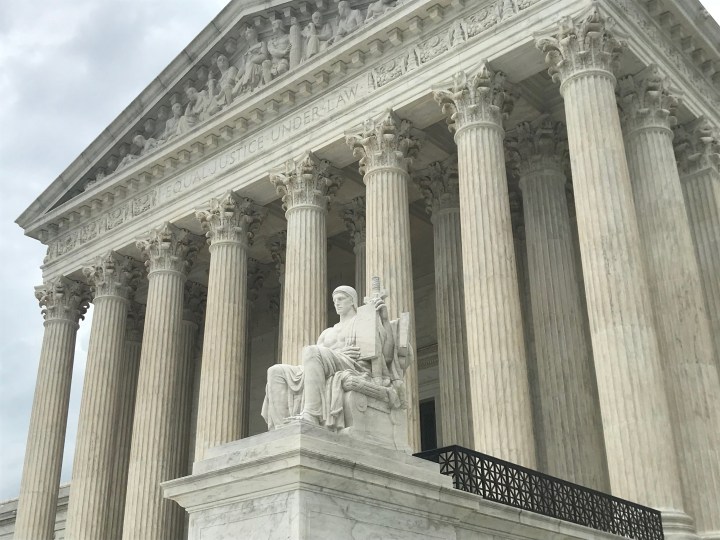
Photo: Staff, Happy MediumOn the evening of Monday, May 2, 2022, Politico reported a leaked draft copy of a majority opinion in which the United States Supreme Court would overturn Roe v. Wade 410 U.S. 113 (1973) and Planned Parenthood v. Casey 505 U.S. 833 (1992). It was written by Justice Samuel Alito, and circulated to the other Justices of the Court on February 10, 2022. This decision would come in the case of Dobbs v. Jackson Women’s Health Organization, which heard oral arguments at the end of 2021. The state of Mississippi passed a law in 2018 prohibiting abortions after 15 weeks with minimal provisions (“Dobbs v. Jackson”). The health organization and its doctors promptly filed suit and a district court in Mississippi found “… that the state had not provided evidence that a fetus would be viable at 15 weeks, and Supreme Court precedent prohibits states from banning abortions prior to viability” (“Dobbs v. Jackson”). This district court ruling was affirmed by a federal appellate court and was then granted cert by the Supreme Court for the case to be heard.
In the leaked opinion, Alito writes “We hold that Roe and Casey must be overruled” (5) and that “Roe was egregiously wrong from the start” (6). Alito continues on the same page by saying that the Fourteenth Amendment’s Due Process Clause does not implicitly protect abortion. This is in direct contrast to the opinion of the Court in its Roe decision that the Due Process Clause provides a right to privacy that includes abortion (“Roe v. Wade”). Alito follows this reversal with “That provision has been held to guarantee some rights that are not mentioned in the Constitution, but any such right must be ‘deeply rooted in this Nation’s history and tradition’ and ‘implicit in the concept of ordered liberty’” (5). Alito repeats this sentiment further in the draft, arguing “… a fundamental right must be ‘objectively, deeply rooted in this Nation’s history and tradition’” (13). It is quite interesting that Alito mentions that such rights to be protected by the Due Process Clause would have to be “‘deeply rooted in this Nation’s history and tradition’” (5) but does not provide examples of such cases. It is unclear whether or not Alito believes there are many such instances in which the Due Process Clause would provide such rights for individuals that are not explicitly protected.
There is a lot to unpack here, so let’s start with the implication that various rights which have been granted by the Court under the Due Process Clause of the Fourteenth Amendment will now be in danger of reversal if this opinion were to become official. Some of the landmark cases that could follow Roe and Casey to be overturned on these grounds include Obergefell v. Hodges 576 U.S. 644 (2015), which provided Due Process protections to same-sex couples looking to marry, and Lawrence v. Texas 539 U.S. 558 (2003), which deemed it a violation of the Due Process Clause for states to regulate intimate sexual conduct between same-sex couples.
These encroachments upon the privacy rights of millions of Americans present a danger that would allow for the government to implement more restrictive laws on personal conduct that is not the business of the state. Opening the door to taking away rights that have previously been Court precedent will create a dangerous precedent that may become more frequent. There would be nothing to stop a state from re-introducing and enforcing anti-sodomy laws or laws that prohibit same-sex marriage, which would immediately be challenged in court. However, this challenge in court is exactly what the policymakers would be hoping for, as they know they would likely have their case heard before the Supreme Court and as a result of the precedent that the Dobbs decision would establish, the Court could then reverse previous decisions in cases such as Lawrence or Obergefell.
Further, into the opinion, Alito begins a discussion on the two different categories of rights that the Due Process Clause protects. The first of these categories is the first eight amendments of the Bill of Rights which the Court ruled apply to the states as well as the federal government. The second category that Alito talks about “…comprises a select list of fundamental rights that are not mentioned anywhere in the Constitution” (11). This statement is quite interesting in that Alito recognizes that there are rights that are not specifically mentioned in the Constitution but are still protected under the Due Process Clause of the Fourteenth Amendment. If there are such rights that are protected under the Due Process Clause, which rights does Alito think should remain protected by it? Which ones should go? There would be nothing stopping future Courts with different makeups from flip-flopping on what are rights protected by the Fourteenth Amendment and which ones are not. This would create a legal instability that would likely continue on for eternity unless the near-impossible task of ratifying a constitutional amendment is achieved to codify and secure a certain right.
However, the Fourteenth Amendment is not the only amendment in the Constitution that recognizes that there are other rights that individuals have that are not expressly spelled out within the founding document. The Ninth Amendment states “The enumeration in this Constitution, of certain rights, shall not be construed to deny or disparage others retained by the people” (U.S. Const. amend. 9). Unfortunately, any case law surrounding the Ninth Amendment is extremely limited. There have only been a select number of opinions or dissents in which the Ninth Amendment has been used as justification for unenumerated rights. Griswold v. Connecticut 381 U.S. 479 (1965) is the case that gives the Ninth Amendment the most life. In their majority opinion, the Court ruled that there are several amendments that provide rights to privacy in marital relations (“Griswold v Connecticut”). The amendments that they cite for this decision include the First, Third, Fourth, and Ninth (“Griswold v Connecticut”). There were also multiple concurrences written by Justices in the majority position which further strengthen the argument that these rights to privacy are found in both the Ninth Amendment and the Fourteenth Amendment, and more specifically within the Due Process Clause of the Fourteenth Amendment in another concurrence (“Griswold v Connecticut”).
Upon his more in-depth analysis of the Fourteenth Amendment, Alito mentions
Instead, guided by the history and tradition that map the essential components of our Nation’s concept of ordered liberty, we must ask what the Fourteenth Amendment means by the term ‘liberty.’ When we engage in that inquiry in the present case, the clear answer is that the Fourteenth Amendment does not protect the right to an abortion (14).
Alito continues in his opinion down a rabbit hole of 13th and 17th Century treatises pertaining to abortion and goes on to mention how almost every state in the U.S. had criminalized abortion through the 19th and 20th Centuries. It is safe to assume that this is what Alito means by his earlier statements of “… fundamental right[s] must be ‘objectively, deeply rooted in this Nation’s history and tradition’” (13). If the Court were to rely on the history and traditions of the United States, would this not raise questions about more modern legal decisions and precedents, as well as legislative progress that has afforded unenumerated rights and/or protections given to the people? Alito also makes clear that the majority is not aware of any common law case that suggests a positive right to have an abortion at any stage of pregnancy (19). This lack of historical precedence for abortion protections does not necessarily signal that abortion should never be made legal in any form, but rather it can show that—like many other rights that have been attained—the progression of society more often than not leads to the demand for certain rights which become so politically unpopular to oppose, that they become statutorily enshrined by either act of Congress or through Constitutional amendments.
Alito rounds out his opinion by saying
We do not pretend to know how our political system or society will respond to today’s decision overruling Roe and Casey. And even if we could foresee what will happen, we would have know authority to let that knowledge influence our decision. We can only do our job, which is to interpret the law, apply long standing principles of stare decisis, and decide this case accordingly (65).
It is quite ironic for Alito to say that long-standing principles of stare decisis (precedent) must be applied in this decision while overturning a nearly 50-year precedent that was established in Roe and later strengthened by the decision in Casey. The notion of respecting precedent has always been a common question asked to nominees during their Supreme Court confirmation hearings before the Senate Judiciary Committee. In fact, all five of the Justices expected to sign on to the majority opinion have stated in one way or another that the precedents established in Roe and Casey were settled and established law. Justice Neil Gorsuch said in his confirmation hearing “… Roe v. Wade… is a precedent of the U.S. Supreme Court. It has been reaffirmed… It was reaffirmed by Casey in 1992 and in several other cases” (Lonas 2022). Justice Kavanaugh said this during his confirmation hearing “…it is settled as a precedent of the Supreme Court, entitled the respect under principles of stare decisis. And one of the important things to keep in mind about Roe v. Wade is that it has been reaffirmed many times over the past 45 years…” (Lonas 2022). Alito, during his 2006 confirmation hearing said that “I think when a decision is challenged and it is reaffirmed that strengthens its value as stare decisis” (Lonas 2022). It is clear now more than ever that at least these three Justices lied under oath to the Senate Judiciary Committee about Roe and/or Casey being settled law and established precedent of the United States Supreme Court.
Lastly, in the second to last paragraph, Alito proclaims
We end this opinion where we began. Abortion presents a profound moral question. The Constitution does not prohibit the citizens of each State from regulating or prohibiting abortion. Roe and Casey arrogated that authority. We now overrule those decisions and return that authority to the people and their elected representatives (67).
This delegation back to the states will instantaneously allow for over a dozen abortion restriction laws to go into effect all across the country. Restricting access to safe and legal abortions will not decrease the number of abortions that take place, it will only make it more dangerous for women to get abortions and increase the likelihood of death or serious bodily harm among women trying to receive one. As mentioned previously, the threat that this decision poses is not strictly limited to that of abortion rights. The precedent that this decision would establish surrounding non-explicitly enumerated rights within the Constitution would pose threats to Obergefell v. Hodges 576 U.S. 644 (2015), Lawrence v. Texas 539 U.S. 558 (2003), Griswold v. Connecticut 381 U.S. 479 (1965), along with plenty of criminal justice-related decisions that include Miranda v. Arizona 384 U.S. 436 (1966), Gideon v. Wainwright 372 U.S. 335 (1963), and Mapp v. Ohio 367 U.S. 643 (1961), and really any other decisions that some may believe are set in stone precedent. With the right-wing supermajority on the Court currently, anything is possible.

Bryan Goodman is a graduate student from Valhalla, Westchester County, NY. He attended Westchester Community College for two years before transferring to Binghamton University to complete his undergraduate studies in political science. Bryan is currently enrolled in the 4+1 Master of Public Administration program. Through various coursework in legislative and presidential politics, he has developed a strong understanding of the nuances of American institutions. Bryan is also passionate about judicial politics and a variety of social/economic issues. His future plans include earning a second Master’s Degree in public policy, as well as law school. Bryan hopes to one day be fortunate enough to positively impact as many lives as possible.
References
Dobbs v. Jackson Women’s Health Organization (Docket No. 19-1392, 2022). https://www.politico.com/f/?id=00000180-874f-dd36-a38c-c74f98520000 (May 3, 2022).
“Dobbs v. Jackson Women’s Health Organization.” Oyez. www.oyez.org/cases/2021/19-1392 (May 3, 2022).
“Lawrence v. Texas.” Oyez, www.oyez.org/cases/2002/02-102 (May 4, 2022).
Lonas, Lexi. 2022 “What the Conservative Justices Said About Roe v. Wade During Confirmation Hearings.” The Hill, May 3. https://thehill.com/regulation/court-battles/3475490-what-the-conservative-justices-said-about-roe-v-wade-during-confirmation-hearings/ (May 4, 2022).
Lydia, Saad. 2021. “Americans Still Oppose Overturning Roe v. Wade.” Gallup, June 9. https://news.gallup.com/poll/350804/americans-opposed-overturning-roe-wade.aspx (May 4, 2022).
“Obergefell v. Hodges.” Oyez. www.oyez.org/cases/2014/14-556 (May 4, 2022).
“Roe v. Wade.” Oyez. www.oyez.org/cases/1971/70-18 (May 3, 2022).
-
Federalism and the Battle Over Abortion Laws
Opinion by Emma Galletta
Photo: Staff, Happy MediumEditor’s note: This article was written before Justice Alito’s draft majority opinion for Dobbs v. Jackson Women’s Health Organization was obtained and published by Politico.
Since January 22, 1973, the landmark Supreme Court Case Roe v. Wade 410 U.S. 113 (1973) has been an established precedent for abortion access and regulation. Now, just under half a century later, what was once considered a legal right to bodily autonomy is being challenged by state governments throughout the nation. As an individual’s right to make private choices regarding their body becomes increasingly threatened, especially for the most vulnerable members of America’s population, the question remains: how did the Supreme Court become America’s self-proclaimed authority on abortion rights?
On July 14, 2020, the first amicus curiae brief was filed in the now-ongoing Supreme Court case Dobbs v. Jackson Women’s Health Organization (Dobbs). This brief, filed by the Roman Catholic Diocese of Jackson and the Roman Catholic Diocese of Biloxi (collectively “Amici”), was made in support of Petitioner Thomas E. Dobbs, the state health officer of the Mississippi Department of Health. As the sole two Roman Catholic Dioceses in Mississippi, they argued that they had “vested interests” in the matter of abortion; specifically, the “dignity and sanctity of all human life” (Dobbs). Less than one week later, the states of Alabama, Alaska, Arizona, Arkansas, Georgia, Idaho, Indiana, Kansas, Kentucky, Louisiana, Missouri, Nebraska, Ohio, Oklahoma, South Carolina, Tennessee, Texas, and West Virginia filed in support of Petitioners (Romoser). Jackson Women’s Health Organization et al. filed a brief in opposition on August 19, 2020, and oral arguments were finally heard by the Supreme Court over a year later on December 1, 2021.
What initially began as a challenge to the “Gestational Age Act” in Mississippi that forbade abortions after fifteen weeks (except in exceedingly extreme circumstances) has now become a striking example of government interference with reproductive rights. The aforementioned “extreme circumstances” do not acknowledge rape or incest as a valid reason to terminate a pregnancy, allowing exceptions exclusively for “a medical emergency, or in the case of a severe fetal abnormality” (Fausset). Additionally, the fifteen-week mark is a peculiar checkpoint; at this point, the fetus would not be viable outside of its mother’s womb for at least another two months, given that viability generally occurs at “about 24 to 26 weeks” (Fausset).
Possible support for the 15-week checkpoint could be driven by furtive gubernatorial desire. As Alice Miranda Ollstein and Megan Messerly of POLITICO note in an article from late February of this year, the legislators of “Arizona, Florida, West Virginia and several other states” pushing for the legalization of 15-week abortion bans after seeing Mississippi’s legislation believe they are taking a “politically and legally safer approach,” and that there is a certain “prudence” to the 15-week standard (Ollstein). As Jessica Arons, senior policy counsel with the ACLU, maintains: states such as Arizona and Florida purposefully introduced “Texas copycat bills” (i.e. bills attempting to ban abortion at six weeks) simultaneously with their proposed 15-week bans. This sets up the latter legislation to be viewed as “a reasonable compromise,” and “an acceptable center” (Ollstein). Governor Phil Bryant of Mississippi comments on his bill’s timeframe by arguing that he’s “saving the unborn” and is quoted as saying that there is no “better thing we could do” (Ollstein). This being said, regardless of Governor Bryant’s and the Republican-controlled Mississippi State Legislature’s personal views on the livelihood of fetuses, the 15-week mark offers a uniquely profound challenge to both Roe v. Wade and Planned Parenthood v. Casey.
More than simply demonstrating inconsistency within previously established abortion timelines, the illegitimacy of the currently proposed standards is highlighted through the neglect of precedent set by the Supreme Court. This problem of state and federal government interference with reproductive rights is showcased by the 1992 Supreme Court decision Planned Parenthood v. Casey 505 U.S. 833 (1992); in this case, not only was Roe v. Wade 410 U.S. 113 (1973) reaffirmed but an “undue burden” standard was established with the purpose of analyzing abortion restrictions. This paved the way for the transition from Roe’s trimester system to a new structure based on viability – crucially, both of these structures are challenged by Mississippi’s proposed 15-week ban. Under Casey, a pregnant individual’s right to seek and obtain an abortion before fetal viability without state interference was officially recognized by the court (Sorkin), with viability in this context reflecting the aforementioned standard of 24 to 26 weeks, or just before the third trimester begins. The interest of the state when the fetus was not yet viable was deemed “not strong enough” to justify abortion prohibition or the “imposition of substantial obstacles” to a pregnant person’s ability to choose if they wanted an abortion (Justia).
These “substantial obstacles” are further clarified within Casey’s establishment of TRAP laws, or Targeted Restrictions on Abortion Providers. As explained by Planned Parenthood, these laws are “costly, severe, and [impose] medically unnecessary requirements…on abortion providers and women’s health centers” (Planned Parenthood). Ultimately, they inhibit access to safe, accessible, and medically correct abortions. Within the context of TRAP laws came the emergence of the “undue burden” standard. This standard juxtaposed the aforementioned laws by ensuring that abortion restrictions did not produce any “substantial obstacle in the path of a woman seeking an abortion before the fetus attains viability” (Oyez). In other words, in Casey’s 5-to-4 decision, an individual’s right to choose an abortion procedure was not to be legally intervened with by the state throughout the first 24 weeks of their pregnancy. Furthermore, the opinion of the Court maintained that there would have been significant, inequitable repercussions on those that had come to rely on abortion services in the two decades between the cases if the justices had ruled in favor of increased Pennsylvania abortion restrictions and renounced the limitations on state power established under Roe v. Wade. Despite Casey’s somewhat unexpected reaffirmation of Roe, the ruling did increase ambiguity in terms of what exactly justifies the imposition of an abortion restriction. This ambiguity has allowed states to formulate their own restriction-based laws and inherent justifications, with the current state of affairs in Mississippi being a prime example. As long as a TRAP law can be proven to have been designed to accomplish something the state has a specific, legitimate interest in and does not violate the “undue burden” standard, these laws are Constitutional; thus making abortion increasingly difficult to access.
That being said, pre-viability prohibitions on elective abortions have become continuously more extreme. Some involve mandatory waiting periods for patients while others establish stricter licensing requirements to shut down clinics offering abortion. In the case of Dobbs v. Jackson Women’s Health Organization, Mississippi argues that prohibitions on abortion that begin at 15 weeks of pregnancy do not impose an undue burden given that this timeframe is sufficient for a pregnant person to access abortion care. As Maya Manian, a visiting professor at American University Washington College of Law, argues in a contribution to the SCOTUS blog, the Turnaway Study should be referenced to make note of the abundant harm faced by thousands of pregnant individuals that are unable to access abortion care (Manian). This study, completed by the ANSIRH (Advancing New Standards in Reproductive Health) program at The University of California San Francisco, “describe[s] the mental health, physical health, and socioeconomic consequences of receiving an abortion compared to carrying an unwanted pregnancy to term” (ANSIRH). Within ANSIRH’s findings is the conclusion that denial of abortion creates worse “financial, health and family outcomes” than would be the case if a pregnant person elected to have an abortion procedure (ANSIRH). Furthermore, it was made clear that receiving an abortion does not cause harm to the health and well-being of the pregnant person undergoing the procedure. Rather, denial of abortion can have grave financial implications; the Turnaway Study concluded that those forced to carry an unwanted pregnancy to term are four times as likely to live below the Federal Poverty Level (ANSIRH). The study also found that there are significant repercussions on the lives of those born out of unwanted pregnancy as well as children already present within the family of a person who was denied abortion access in addition to the health implications experienced by the carrier of the child during labor, birth and postpartum (ANSIRH). The gravity of this situation—if not already obvious—reveals itself in both the immediate and life-long consequences of abortion restrictions.
Dorothy E. Roberts, social justice advocate and professor of law, sociology, and civil rights at the University of Pennsylvania Carey Law School, has done work regarding policing, family regulation, science, medicine, bioethics, and more (Penn Law). Roberts is quoted in Manian’s article with an explanation of reproductive justice. She defines this concept as a framework that ensures a woman’s right “not to have a child” as well as the right to raise children with “dignity” in “safe, healthy, and supportive environments” (Manian). When a pregnant individual is denied abortion access through state and federal limitations or restrictions, there is a blatant and neglectful effect on reproductive justice.
The intersectionality of race, class, and gender within the context of reproductive justice is also extraordinarily obvious—and crucial to recognize through the lens of public policy—as access to abortion services grows increasingly limited. As Manian makes clear, abortion bans will, without a doubt, disproportionately affect vulnerable groups such as low-income individuals and pregnant people of color that already have minimal-to-no access to health care (Manian). Statistics show that 75% of pregnant people who have an abortion procedure live “at or near the federal poverty line,” and more than 50% are people of color; moreover, the risks of a person of color carrying their pregnancy to term are demonstrated within the preexisting maternal mortality crisis, which has a disproportional effect on Black women (Manian). In addition to the vast disparities in access to reproductive health care (such as access to abortion), the relationship between race and class must also be considered. The implementation of stricter abortion laws is a direct attack on all pregnant individuals with a greater impact on those that are Black.
Studies also show that further limitations on abortion access are likely to worsen the maternal mortality crisis, compounding the detriment to the Black community (Manian). As evidenced by recent research from the University of Colorado Boulder, a nationwide abortion ban would increase pregnancy-related deaths by 21%, with a “33% increase among Black women” (Marshall). These estimates do not include the inevitable rise in abortion-related deaths due to individuals experiencing “unsafe abortions” or likely self-induced “attempted abortions” (Marshall). This reaffirms with vast empirical data the notion that for many pregnant individuals, especially those already part of vulnerable communities with insufficient social safety nets and minimal access to much-needed resources, “staying pregnant is more dangerous…than having an abortion” (Marshall). As Amanda Stevenson, an assistant professor of sociology at the University of Colorado Boulder, maintains, the already-present public health crisis in the United States will be exacerbated by “increasing Black women’s exposure to the risk of pregnancy-related mortality by denying them access to abortion” (Marshall). It cannot be ignored that the mortality risk faced by non-Hispanic, pregnant Black individuals when forced to carry a pregnancy to term is over three times as high as the risk faced by non-Hispanic white women. When the current social and political structure of the nation denies Black folks equal access to “opportunities like housing, education, jobs and healthcare,” it should not come as any surprise that pregnant Black individuals seek abortions at higher rates than their white counterparts (Marshall). The denial of abortion is a direct, targeted attack on members of non-white racial groups, as well as members of lower socioeconomic classes. Access to safe abortions is not in nearly as grave jeopardy for pregnant, middle- and upper-class white individuals as it is for the rest of America’s pregnant population. Strengthening restrictions on abortion in such a tyrannical way is racial and class warfare. Fatima Goss Graves, president and CEO of the National Women’s Law Center, advocates for an individual’s right to elect to have an abortion on the grounds that Supreme Court precedent categorizes abortion as a right “firmly grounded… in personal autonomy, bodily integrity, and freedom from government intrusion” (Graves). In the Casey decision, abortion was described as an immeasurably “personal” and “intimate” decision, as well as one that has crucial implications on a pregnant individual’s ability to “participate equally in the economic and social life of the Nation” (Graves). Restrictive access to abortion and limitations on reproductive health care by state or federal authorities have considerably detrimental effects on a pregnant individual’s physical, economic, educational, and professional well-being. These effects are heightened within communities of color and in the lives of individuals who live in poverty and/or work low-income jobs. Some individuals who seek abortion may have become pregnant due to a lack of accurate, informative, or comprehensive sexual education and/or an inability to access adequate contraceptive care – effects of a system filled with discriminatory practices and barriers to the health care every individual deserves. The overall health and economic security experienced by pregnant people existing within marginalized groups are in peril. Pending a formal decision by the Supreme Court regarding abortion rights, it is impossible to separate the limitations to reproductive rights implemented by state and federal authority from their racist, classist, and broadly oppressive roots.

Emma Galletta is a double major from Fayetteville, New York who studies philosophy, politics, & law as well as Spanish. She is the Youth Engagement Coordinator for Binghamton University’s chapter of the American Cancer Society and the Vice President of NYPIRG. After graduating in Spring 2023, she plans to attend law school and dedicate her life to advocating for human rights and justice. Outside of school, she enjoys tutoring students pursuing their GEDs as well as doing yoga and experimenting with creative vegan meals in the kitchen.
References
Dobbs v. Jackson Women’s Health Organization (Docket No. 19-1392, 2022).
“Dorothy E. Roberts.” Penn Law. https://www.law.upenn.edu/faculty/roberts1 (April 3, 2022).
Fausset, Richard. 2018. “Mississippi Bans Abortions After 15 Weeks; Opponents Swiftly Sue.” The New York Times. https://www.nytimes.com/2018/03/19/us/mississippi-abortion-ban.html (May 4, 2022).
Graves, Fatima Goss. 2021. “Our equality and liberty are on the line.” SCOTUSblog. https://www.scotusblog.com/2021/11/our-equality-and-liberty-are-on-the-line/ (April 3, 2022).
Manian, Maya. 2021. “Dobbs and the undue burdens of pre-viability abortion bans.” SCOTUSblog. https://www.scotusblog.com/2021/11/dobbs-and-the-undue-burdens-of-pre-viability-abortion-bans/ (April 2, 2022).
Marshall, Lisa. 2021. “Study: Banning abortion would boost maternal mortality by double-digits.” University of Colorado Boulder. https://www.colorado.edu/today/2021/09/08/study-banning-abortion-would-boost-maternal-mortality-double-digits. (May 5, 2022).
Ollstein, Alice Miranda, et al. 2022. “States push 15-week abortion bans as the right argues over a post-Roe strategy.” POLITICO. https://www.politico.com/news/2022/02/23/states-push-15-week-abortion-bans-00010782. (May 4, 2022).
“Planned Parenthood of Southeastern PA. V. Casey, 505 U.S. 833 (1992).” Justia Law. https://supreme.justia.com/cases/federal/us/505/833/ (March 24, 2022).
“Planned Parenthood of Southeastern Pennsylvania v. Casey.” Oyez. https://www.oyez.org/cases/1991/91-744 (March 26, 2022).
Planned Parenthood. 2022. “What Are TRAP Laws?” Planned Parenthood Action Fund. https://www.plannedparenthoodaction.org/issues/abortion/types-attacks/trap-laws. (May 4, 2022).
Romoser, James, ed. “Dobbs v. Jackson Women’s Health Organization.” SCOTUSblog. https://www.scotusblog.com/case-files/cases/dobbs-v-jackson-womens-health-organization/
(March 25, 2022).
-
Viral Division: The Politicization of COVID-19 in America

Often referred to as “The Year from Hell,” 2020 showcased a menagerie of deeply troubling events. There were wildfires causing deaths and displacements in California and Australia, heightened racial tensions and major protests as a result of the death of George Floyd, and giant murder hornets that seemed to have escaped from the pages of The Book of Exodus. However, no event was as universally and pervasively impactful as the COVID-19 pandemic, which struck America beginning in January 2020 (Salo 2020).
By election day in 2020, despite the universal impact of COVID-19 and the subsequent regulations (i.e. mask mandates and lockdowns), perceptions of the pandemic differed wildly between Democrats and Republicans. According to a Civiqs poll, on Election Day, 44% of Republicans polled were not concerned at all about the outbreak of the coronavirus, while only 2% of Democrats were not concerned. Adversely, while a whopping 63% of polled Democrats were extremely concerned about the coronavirus outbreak, only a meager 6% of Republicans showed extreme concern (Civiqs 2020). What caused this particular division between party lines? How did such a universal problem as the COVID-19 pandemic become politicized?
In a 1980 publication titled “The Emergence and Transformation of Disputes: Naming, Blaming, Claiming,” socio-legal scholars William Felstiner, Richard Abel, and Austin Sarat argued that the process of politicization is defined by the three actions of naming, blaming, and claiming (Abel et al. 1980). Naming corresponds with the emergence phase, which is when the issue first enters the political sphere due to it impacting politics in some way. Blaming corresponds with the confrontation phase, where forces of polarization intensify as one side blames the other for action or inaction in the face of the issue, leading to strong political divide. Finally, claiming corresponds with the managing phase which often involves one side of the debate claiming that they have a solution that can solve the problem (Bobba and Hubé 2021).
Emergence Phase
We can match up events from the timeline of the COVID-19 pandemic to each of the three aforementioned phases. First, we need to identify the polarization of COVID-19’s emergence phase, starting at the beginning of the pandemic in America. The first documented case was in Washington state on January 20th. Less than ten days later, the White House established the Coronavirus Task Force (CDC Museum 2022). At this point in time, the coronavirus outbreak was treated simply as a matter of public health. It was treated with a high level of severity and concern, evident by subsequent emergency authorizations implemented to attempt to contain the outbreak. The first instance of COVID-19 being politicized is in the aftermath of a January 30th tweet from Republican senator Tom Cotton. The tweet implied that coronavirus may have been engineered in a lab in Wuhan, China. The official story until that point had been that the disease had most likely originated from unhygienic wet markets in Wuhan. Senator Cotton was the first prominent US politician to claim that the Chinese government intentionally engineered the disease as an intended bioweapon (Huang 2020). This is the beginning of the emergence phase, as it marks the point at which the pandemic became intertwined with political affairs. The prospect of a manufactured origin by another major world superpower—true or not—resulted in the matter becoming a topic of political discussion.
Confrontation Phase
In the aftermath of Senator Cotton’s tweet, alternative allegations accusing the United States of manufacturing and weaponizing the virus spread across Chinese social media. The allegations swiftly gained immense popularity among the Chinese population, but no one in the Chinese state government parroted the claims. On March 13th, a Chinese foreign ministry spokesperson posted a tweet promoting the allegations against the US. Previously, the Trump administration had been linking the virus to China; however, the March 13th tweet resulted in a much stronger campaign by the president. He began to refer to the disease only as the “Chinese virus” and called for the international community to hold China accountable (Huang 2020).
This still does not explain the partisan division that characterizes the confrontation phase, as the prospects of a hostile Chinese government would usually serve as a unifying force. Rather, the confrontation phase is the 2020 Presidential Election between Donald Trump and Joe Biden. The presidential race showcased the major disparity between candidates in their proposed methods of handling the pandemic. President Trump, who often emphasizes the importance of the functioning of the American economy, argued that lockdowns for the virus needed to end as quickly as possible to help Americans get back to work. In opposition, former Vice President Biden directly blamed the Trump administration for the deaths of hundreds of thousands of Americans (BBC News 2020). By using the coronavirus as a political tool in the presidential race, both candidates intensified the forces of polarization on the issue. Had the pandemic occurred in a non-election year, it may have served as a unifying force for Americans. Since it did coincide with the election, Americans expected their beliefs about the pandemic to be reflected by their candidates. Acts that should only be indications of philosophies about public health (e.g. social distancing, masking, and vaccinating) instead became directly conflated with political ideologies (Singal 2020). For example, take mask-wearing during the height of the pandemic. Prior to widespread vaccination, a person in public not wearing a mask might be conflated as a right-wing anti-masker. After vaccines had been distributed and mask mandates were lifted for vaccinated individuals, a person in public wearing a mask might be conflated as a right-wing anti-vaxxer. Oppositely, to those with polarized right-wing ideologies, a person wearing a mask in public may be seen as left-wing. In all of these cases, the fact that someone may believe that it is possible to discern evidence of political views from acts related only to reducing the spread of a virus demonstrates best how politicized the pandemic became.
Managing Phase
The managing phase of COVID-19’s politicization is the easiest to identify. After being elected, the Biden administration claimed to be able to solve the issue of how best to handle the pandemic. With their National COVID-19 Preparedness Plan, they mobilized thousands of vaccination locations and testing locations throughout the country. Perhaps ironically, they also made it a key point to try to prevent shutdowns as much as possible (The White House 2022). The Democrats held the majority of power in government, so they proceeded to manage the issue, maintaining their professed position as the party that could properly handle the pandemic.
The process of politicization of the COVID-19 pandemic that began with debates over a manufactured origin of the virus and later split among party lines due to the presidential election was complete. An issue that could have in other years had the potential to be a unifying force across the political spectrum was polarized and this topic of concern for national health instead became a political weapon and a facet of the political ideologies of the members of the two major political parties.

Skylar Yerdon is a sophomore-year economics major from Syracuse, NY. He plans to continue his education into graduate school. At Binghamton, Skylar is a member of the Scholars Program and WHRW, the university radio station. He loves long walks on the beach at sunset, the original version of Willy Wonka, and his dog.
References
Abel, Richard L., William L.F. Felstiner, and Austin Sarat. 1980. “The Emergence and Transformation of Disputes: Naming, Blaming, Claiming. . .” Law & Society Review www.jstor.org/stable/3053505 (April 21, 2022).
Bobba, Giuliano, and Nicolas Hubé. 2021. “1. COVID-19 and Populism: A Sui Generis Crisis.” Springer International Publishing, openarchive.tk.mta.hu/443/1/1_Chapter_1_Bobba_Hub%C3%A9.pdf (April 21, 2022).
“CDC Museum COVID-19 Timeline.” 2022. David J. Sencer CDC Museum, January 5. www.cdc.gov/museum/timeline/covid19.html. (April 23, 2022).
“Coronavirus: Outbreak concern.” 2020. Civiqs, November 11. civiqs.com/results/coronavirus_concern (April 19, 2022).
Huang, Y. 2020. “How the Origins of COVID-19 Became Politicized.” Think Global Health, August 14. www.thinkglobalhealth.org/article/how-origins-covid-19-became-politicized (April 23, 2022) .
“National COVID-19 Preparedness Plan.” 2022. The White House, March 3. www.whitehouse.gov/covidplan/ (April 25, 2022).
“Presidential debate: Trump and Biden row over Covid, climate and racism.” 2020. BBC News, October 23. www.bbc.com/news/world-us-canada-54654937 (April 25, 2022).
Salo, J. 2020. “2020 events: Yep, these things all happened in the year from hell.” New York Post, December 31. nypost.com/list/major-2020-events/ (April 19, 2022).
Singal, J. 2020. “The Theory That Explains the Politicization of Coronavirus.” New York Magazine, May 8. nymag.com/intelligencer/2020/05/the-theory-that-explains-the-politicization-of-coronavirus.html (April 22, 2022).
-
The Dead Political Parties of America

By Eric Wang
Photo: The Democratic-Republicans wore tricolor ribbons in support of the revolutionaries in France, and the Federalists wore similar black and white ribbons.Today there are two main parties that dominate United States politics: the Democratic Party and the Republican Party. However, there are also a few minor parties such as the Green Party and the Libertarian Party. As far as most people are concerned, this small handful of parties is all that’s relevant to US politics. But if we rewind the clock, we will see the rise and fall of several parties throughout American political history. Parties, such as the Federalist Party and the Whig Party, dominated periods of American history and majorly affected the course of our country and the world. By looking at failed American political parties, what they stood for, who made up their voter base, and why they fell, we can better understand our two-party system.
The Federalist Party
The Federalist Party was created alongside our fledgling nation in the late 18th century to oppose the Democratic-Republicans. Led by Alexander Hamilton, the Federalists supported protectionism, a strong national government, manufacturing, and, in terms of international affairs, Great Britain (“Federalist” 2021). As a result, many of the proponents of the party were businessmen who benefitted from protectionist and pro-manufacturing policies. Similarly, the party garnered support from those who preferred a strong overarching national government. This included a strong standing army and navy, as well as powerful federal institutions. The Federalists dominated the US government for about a decade but held influence until the 1820s (Federalist 2021). However, Federalist John Marshall (the 4th Chief Justice of the United States) handed down Federalist decisions long after the fall of the party and instilled many Federalist beliefs into our government with landmark cases such as McCulloch v. Maryland and Marbury v. Madison (Federalist 2021). Marbury v. Madison (1803) established the power of judicial review, which allowed the Supreme Court to declare laws unconstitutional (Marbury). Additionally, McCulloch v. Maryland (1819), where the state government of Maryland tried to impose a tax on a federal institution, was important as it concluded that the US Government and Constitution had supreme power over the states (McCulloch). Both of these decisions display Marshall’s Federalist beliefs as they strengthened the power of the national government and its entities.The Fall of the Federalist Party
A loss of support and popularity and a split within the Federalists’ ranks eventually crippled the party (“Federalist” 2021). Events such as Jay’s Treaty and the Whiskey Rebellion caused the party to lose public support. Jay’s Treaty was negotiated in 1794 by John Jay between the US and Great Britain to lower tensions between the two countries. The treaty met fierce opposition in Congress, especially from Democratic-Republicans Jefferson and Madison (“George” 2020). The Whiskey Rebellion of 1794 was the boiling point of years of tension between tax collectors and Pennsylvanian distillers. Those who opposed the tax unsurprisingly joined the Democratic-Republicans which weakened Federalist support (“Whiskey” 2019). In 1798, the Federalist Congress passed the Alien and Sedition Acts, which were widely disliked. These laws made it harder to become a US citizen, criminalized criticizing the government, and allowed the government to imprison or deport those deemed as “dangerous” (“Alien” 2020). The Alien and Sedition Acts led to increased opposition from the Democratic-Republicans, who claimed that the acts were unconstitutional and used to suppress those who disagreed with the Federalists (“Alien” 2020). The population largely agreed with the Democratic-Republicans, and support for the Federalists declined. The killing blow to the party came in 1799 when President Adams surprised the country by announcing a peace mission to France (“Federalist” 2021). This split the party in two: one faction supporting Adams and the other supporting Hamilton. This division allowed the Democratic-Republicans to easily win the presidential election of 1800. The Federalists would go on to make a small resurgence during the War of 1812, but they would never fully recover (“Federalist” 2021).The Democratic-Republican Party
Following the fall of the Federalist Party came the heyday of the Democratic-Republican Party. The Democratic-Republicans opposed all for which the Federalists stood. According to political scientist James A. Reichley, the point that divided the Federalists and the Democratic-Republicans the most was the issue of social equality (Reichley 1992). Led by Thomas Jefferson and James Madison, they supported agrarianism, expansionism, republicanism, and France, as opposed to the Federalists’ support of Great Britain (Murse 2018). Much of the support for the party was from the yeoman (a person who owns and cultivates a small plot of land) farmers of the era. Since most of the US was agrarian at this time, it is no surprise they took power after the Federalists.The Fall of the Democratic-Republican Party
The party’s downfall began during the presidential election of 1824. All the candidates were from the Democratic-Republican Party, and no one received a majority of electoral votes (Murse 2018). Thus, the House of Representatives held a vote to decide the president. One of the candidates, Henry Clay, was a former Speaker of the House and he decided to support John Quincy Adams over the other two candidates, William Crawford and Andrew Jackson. After Adams won, Clay was appointed Secretary of State. This led to Jackson and his supporters claiming that Clay and Adams had a “Corrupt Bargain” where Adams promised the Secretary of State position to Clay if Clay gave him his support (Murse 2018). As a result, there became two factions within the party, one behind Adams and one behind Jackson. Soon after, the Democratic-Republican Party dissolved into other factions and smaller parties (Murse 2018). The party lasted around 35 years from the mid-1790s to the late 1820s (Murse 2018).The Whig Party
The Whig Party would be the next big American political party to die out. This party was created to oppose Andrew Jackson and it consisted of people from factions of the Democratic-Republicans, the Anti-Masonic Party, and many more, small factions (“Whigs” 2021). The Whigs’ most influential figures were Henry Clay, William Henry Harrison, and Zachary Taylor. The Whigs opposed Jackson and his Democratic policies and supported a national bank and the American System (“Whigs” 2021). Pioneered by Clay, the American System was a plan that called for national infrastructural improvements to promote trade, increasing revenue through public land sales and tariffs, and a federal bank to strengthen the economy (Byrd 1994).The Fall of the Whig Party
The collapse of the Whig Party can be attributed to the Kansas-Nebraska Act and the issue of slavery. It divided northern and southern Whigs and led to a splintering of the Whig party into smaller parties and factions like the Know-Nothing Party and the Constitutional Union Party. The party was created in the mid-1830s and collapsed around the mid-1850s (“Whigs” 2021).The Reform Party
The Reform Party was formed in 1995 by Ross Perot (Hingston 2018). It never gained much of a foothold as the two-party system had been solidified by this point. However, Perot gained 19% of the popular vote in the presidential election of 1992, something no other third-party candidate has done since (Hingston 2018). The party called for a variety of reforms, such as a term limit for Congressmen and updating the electoral system. They also tried to keep social issues out of their platform, as the party’s goal was to bring people in from both sides of these issues (“About the Reform Party”).The Fall of the Reform Party
The party is still around today; however, its influence is negligible (Hingston 2018). The party’s support sharply decreased after their record-breaking year in the 1992 presidential election, partly due to infighting. Fun Fact: Donald Trump ran for the Reform Party’s presidential nomination in the presidential election of 2000 (Hingston 2018).Now what?
Just from these four dead parties of American history, a trend regarding the fall of each party is apparent. Each party fell due to fractures caused by ideological differences and other disputes within the party. Now the question is, could we see something like this happen to either of our two parties today?In the past few years, there seems to be increased radicalization in both parties (Dimock 2014). If polarization continues increasing, new parties could be created, or new factions could appear. Of the many ways this could happen, there are three that stand out. Either the fringes of the parties will break away, the moderate parts will join together, or a major politician will form their own party, bringing along their supporters.
Realistically, the most likely to occur would be a major politician breaking away from all their supporters and creating a new party. This was the case with the Progressive Party in the early 1900s which broke away from the Republican Party and rallied around Theodore Roosevelt. In a two-party system, candidates from break-away parties and their parent parties tend to perform poorly in elections because the voter base of the parent party is split, allowing the other dominant party’s candidate to win. This happened with the Progressive Party and the Republican Party in the presidential election of 1912. During this election, Theodore Roosevelt earned 27.4% of the popular vote with 88 electoral votes while William Howard Taft (the Republican presidential candidate) earned 23.2% of the popular vote with 8 electoral votes (“United” 2017). However, these numbers were not enough to defeat Woodrow Wilson and the Democrats, who received 41.8% of the popular vote and 81.9% of the electoral votes (“United” 2017). The next two methods are different sides of the same coin. If a radical branch emerges successfully from one of the two parties, we would be left with a group of more moderate individuals under the original party name. Alternatively, if the moderates of a party break away, then we would be left with a group of people with a more extreme agenda under the original party name. Since moderates favor stability, it is more likely for the fringes of a party to break away from the original party. If either type of split happens, it would not destroy the original parties—their supporter base and cultural influence are significant. But a new party, no matter their stance, would lead to increased competition for voters among all parties. As a result, parties would push for, and pass, popular and new legislation to please and enlarge their supporter base. This would help give more power to the people and it would support the democratic ideals that the United States was founded upon.

Eric Wang is a freshman mathematics major from Pittsford, New York. In the future, he hopes to go to graduate school to continue his studies in mathematics. In his free time, he enjoys fishing, playing soccer, and collecting coins. Eric is also an avid mathlete and helped Binghamton University place 54 out of 427 schools in the William Lowell Putnam Mathematical Competition.
References
“About the Reform Party.” Reform Party National Committee. https://reformparty.org/about-reform-party/ (March 31, 2022).
“Alien and Sedition Acts.” 2020. History.com, March 5. https://www.history.com/topics/early-us/alien-and-sedition-acts (March 31, 2022).
Byrd, Robert C. 1994. The Senate, 1789-1989: Classic Speeches, 1830-1993. Washington, DC: Government Printing Office.
Dimock, M., J. Kiley, S. Keeter, C. Doherty, J. Horowitz, K. McGeeney, A. Tyson et al. 2014. “Political Polarization in the American Public.” Pew Research Center, June 14. https://www.pewresearch.org/politics/2014/06/12/political-polarization-in-the-american-public/ (March 30, 2022).
“Federalist Party.” 2021. History.com, January 22. https://www.history.com/topics/early-us/federalist-party (March 30, 2022).
“George Washington signs Jay Treaty with Britain.” 2020. History.com, August 17. https://www.history.com/this-day-in-history/george-washington-signs-jay-treaty-with-britain (March 31, 2022).
Hingston, Sandy. 2018. “Eight U.S. Political Parties That Withered Away.“ Philadelphia, November 18. https://www.phillymag.com/news/2016/11/18/american-political-parties-died-whigs/ (March 30, 2022).
“Marbury v. Madison.” Oyez. https://www.oyez.org/cases/1789-1850/5us137 (March 31, 2022).
“McCulloch v. Maryland.” Oyez. https://www.oyez.org/cases/1789-1850/17us316 (March 31, 2022).
Murse, Tom. 2018. “History of the Democratic-Republican Party.“ ThoughtCo, April 20. https://www.thoughtco.com/democratic-republican-party-4135452 (March 30, 2022).
Reichley, James A. 1992. The Life of the Parties: A History of American Political Parties. New York: Free Press.
“United States Presidential Election Results.” 2017. Encyclopedia Britannica, February 3. https://www.britannica.com/topic/United-States-Presidential-Election-Results-1788863 (April 8, 2022).
“Whig Party.” 2021. History.com, January 22. https://www.history.com/topics/19th-century/whig-party (March 30, 2022).“Whiskey Rebellion.” 2019. History.com, September 13. https://www.history.com/topics/early-us/whiskey-rebellion (March 31, 2022).
-
Should The Electoral College Be Abolished?
Opinion by Katharine Stirber
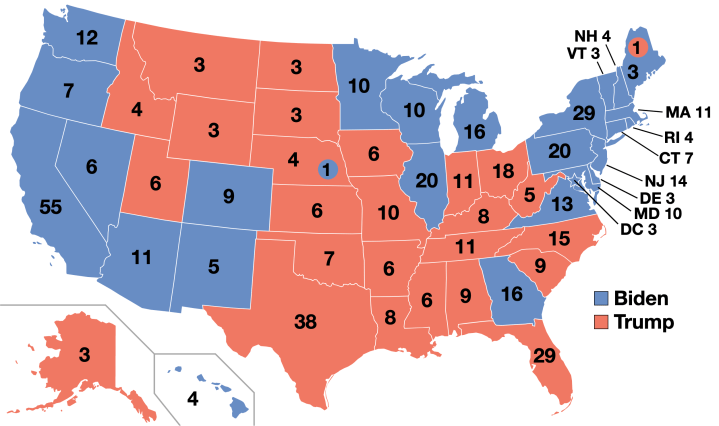
Photo: Electoral College results map, 2020When citizens of the United States cast their ballots for President in the popular vote, they elect a slate of electors called the United States Electoral College. The Electoral College consists of 538 presidential electors who come together every four years after election day to cast their official votes for President and Vice President of the United States. The ticket that wins a minimum of 270 electoral votes wins the election. The discussion of whether or not the Electoral College should be abolished is an ongoing argument among American citizens. The Electoral College should be abolished because it gives both people and states unequal representation in our democracy.
Slavery in the South played a big role in the creation of the Electoral College. The South had a lack of representation in votes because a large portion of the population were slaves who did not have the right to vote. However, the creation of the Electoral College allowed states to count slaves due to the Three-Fifths Clause: a compromise where three-fifths of the slave population would be counted for determining taxation and representation in Congress (Encyclopædia Britannica 2022). Wilfred Codrington III, a professor at Brooklyn Law School, stated in an article for The Atlantic that a consequence of the Three-fifths Compromise is that the South had an inside track in presidential elections; it gave states 33% more representatives and 33% more electoral votes (2019). Hence, the South won a disproportionate amount of the Electoral College votes compared to its eligible voting population, which gave them more say in presidential elections. It is no surprise that eight of the first nine presidential races were won by a Virginian. Virginia was the most populous state at the time, and it had a large slave population which inflated its electoral vote count. With this being said, the Electoral College should be abolished because it was made to empower Southern white voters and continues to do so (Codrington 2019). Today, Southern states have high concentrations of Black voters who vote Democratic. In 2008, eighty-three percent of African-American voters in the South identified with the Democratic Party (Mckee 2012). However, the Republican Party began its gradual rise in the South starting with presidential elections in the 1950s; Southern electors now vote overwhelmingly Republican (Mckee 2012). In the South, the Republican Party currently receives the majority of popular vote more often than the Democratic Party; this trend sways the way the Electoral College votes.
If the US is eager to see racial justice within society, there needs to be a change in the men and women chosen to lead the United States. For years, people of color have faced unfair and cruel treatment from authorities, and it is becoming more evident in our government and nationwide elections. The people of the United States have witnessed the impact of the Black Lives Matter movement, which started in July, 2013. It began with the use of the hashtag #BlackLivesMatter on social media platforms, which became very popular after the exoneration of George Zimmerman. Zimmerman fatally shot and killed an African-American teen named Trayvon Martin seventeen months earlier in February, 2012 (Isabella Mercado). Since then, there have been many violent murders of African-Americans that have yet to receive justice. Black Lives Matter became a wide-spread national and international movement in 2020 after the death of George Floyd. Derek Chauvin, a former Minneapolis police officer, was charged with second-degree murder after a video circulated that showed him kneeling on Floyd’s neck for nearly nine minutes while Floyd begged for his life. Such incidents motivate people to look for change, especially in presidential politics. A person’s race affects how they vote because there are long-standing racial and ethnic differences in partisan affiliation (Pew Research Center 2018). The Electoral College is a result of racism dating back to the founding of our nation. Abolishing it will allow the progressive movement of Black Lives Matter, along with other issues involving inequality, to become more influential on our citizens and the policies we live by. People want to be heard, and adopting a popular vote system for selecting presidents is a way to accomplish just that. The ongoing Black Lives Matter movement has made it clear that many people of color are unhappy with the representation they receive from the government. The Electoral College was made to be used against people of color and should be abolished to better represent all people of our country.
The Electoral College should be abolished because it also gives states less equal representation. Deep red and deep blue states are often ignored by presidential candidates who focus their attention on swing states. Swing states have populations that are closely divided politically. Candidates focus on these “battleground states” with campaign visits, advertising, and staffing to persuade citizens for their vote (U.S. Embassy, Consulate in Thailand 2020). Time Magazine found that presidential tickets spent 53% of their last two months of the 2016 election on the trail in Florida, Pennsylvania, North Carolina, and Ohio. As a result, presidential and vice-presidential candidates entirely ignored 27 states throughout the general election (Time 2016). Not only are more than half of the states completely ignored throughout the election, but less-populated states also weigh in disproportionately. By giving small states a guaranteed minimum of three Electoral College votes, some of the less-populated states are overrepresented and have more power when choosing the president.
The Electoral College is an outdated, undemocratic system which should be abolished. According to NPR, in the 2020 election, 16% of eligible Americans didn’t cast a ballot because they felt it wouldn’t make a difference (Montanaro 2020). Many eligible voters feel as though their vote isn’t worth much, so they ignore politics altogether and waste their vote. America praises the virtues of democracy and just representation, yet the Electoral College opposes those ideals. The Electoral College gives unequal representation to both people and states, making it seem less important to vote. Abolishing the Electoral College will honor the people of the United States and remind them that their vote counts just as much as that of their neighbors, giving a voice to all.

Katharine Stirber is a freshman from Mastic, NY, on the south shore of Long Island. She’s an environmental studies major with a concentration in sustainable systems. She plans on attending graduate school to complete a master’s degree in Public Administration, and she may continue on to study environmental law. Katharine developed writing techniques based on eco-friendly laws and policies while involved in Students 4 Climate Action in high school, a student-based organization that teaches about lobbying. Katharine plays in Binghamton’s Wind Symphony and is involved in spirit squads and the outdoors club. Katharine hopes to educate others on enduring political issues and create change through her writing.
References
Codrington III, Wilfred. 2020. “The Electoral College’s Racist Origins.” The Atlantic, June 16. www.theatlantic.com/ideas/archive/2019/11/electoral-college-racist-origins/601918/.
“Three-Fifths Compromise.” 2022. Encyclopædia Britannica, February 7. www.britannica.com/topic/three-fifths-compromise.
Mckee, Seth. (2012). “The Past, Present, and Future of Southern Politics.” Southern Cultures, 18(3) 95-117. 10.1353/scu.2012.0027.
Montanaro, Domenico. 2020. “Poll: Despite Record Turnout, 80 Million Americans Didn’t Vote. Here’s Why.” NPR, December 15. www.npr.org/2020/12/15/945031391/poll-despite-record-turnout-80-million-americans-didnt-vote-heres-why.
“These 3 Common Arguments For Preserving the Electoral College Are Wrong.” 2016. Time, November 15. www.time.com/4571626/electoral-college-wrong-arguments/.
Isabella Mercado. “The Black Lives Matter Movement: An Origin Story.” 2020. Underground Railroad Education Center, August 6. www.undergroundrailroadhistory.org/the-black-lives-matter-movement-an-origin-story/.
“What Swing States Are and Why They’re Important.” 2020. U.S. Embassy, Consulate in Thailand, August 18. th.usembassy.gov/swing-states-importance/.
“Trends in Party Affiliation among Demographic Groups.” 2020. Pew Research Center, August 28. www.pewresearch.org/politics/2018/03/20/1-trends-in-party-affiliation-among-demographic-groups/.
-
Should Corporations Care about Us?

Essay by Trevor Fornara, Editor in Chief
Photo: Petr KratochvilCorporations often boast new initiatives to reduce their pollution, plastic use, reliance on non-renewable energy, or whatever else is topical in the public discourse. These corporations try to sell these initiatives to the public as corporate social responsibility—companies taking it upon themselves to help their communities and society as a whole. However, the primary motive behind these actions is likely financial. Shifts in regulations and consumer behavior have made it easier for corporations to benefit financially from doing the “right thing.” The underlying issue here can be evaluated through the context of shareholder theory and stakeholder theory—whom do corporations aim to benefit? Changes in the way laws are written and how the public consumes have allowed corporations to adopt more environmental practices because there is financial incentive to do so; and, although there is no movement toward stakeholder theory or real corporate social responsibility, corporations are still making positive changes that have real effects on their communities and society.
The debate between shareholder theory and stakeholder theory is ongoing in the world of business. These two ideas pivot on whether or not corporations hold responsibility for anything besides increasing profit for themselves. Shareholder theory accepts the idea that a company’s primary goal is to generate profits for its owners: the shareholders (Friedman 1970). In a C Corporation, the shareholders buy into the company, receive voting rights, and often a dividend (Chron.com 2010). The shareholders do not have the time to run the corporation themselves, so they elect a board of directors who hire executives trained in running a corporation (Chron.com 2010). These executives are the decision-makers that are tasked with generating profit for the shareholders (Friedman 1970).
One of the issues with shareholder theory in practice is that the shareholders’ best interest is often taken to mean increased profit, when this may not always be the case. For example, if a corporation could maximize profits by legally disposing of waste into a nearby river, then shareholder theory in practice would likely advocate for that option. However, individual shareholders may be members of the community who are affected by the pollution. Shareholder theory would contend that they have every right to use their corporate dividend to clean up the river. This logic is flawed because it would probably cost the shareholders more money to clean up the river than to pay for proper waste disposal in the first place.
Stakeholder theory views this relationship much differently. While executives are working on behalf of shareholders, stakeholder theory adds that they must also work toward society’s betterment. This adds many more groups into the equation, including employees, customers, and the broader community. This concept is called corporate social responsibility, and it is the main point of contention between the two theories. In a 1970 article for The New York Times Magazine, economist Milton Friedman gave examples of what a corporate executive could do to help society and explained why he believed corporations should not be responsible for society’s well-being. For example, an executive could give jobs to the unemployed instead of better-qualified individuals working at other jobs to help fight poverty. This decision would be to the detriment of the company, as their employees are less trained (Friedman 1970). Friedman argued for shareholder theory because an executive acting on behalf of all stakeholders is spending money that is not theirs to spend. Friedman would say that, if the shareholders cared about fighting poverty, then they can do so with the dividend they receive from the corporation (1970). This is similar to the shareholders using their dividends to clean the river. This part of shareholder theory makes sense when talking about charitable acts. However, it fails when applied to more material examples, such as the polluted river. Friedman was being a bit dramatic when he claimed that corporate social responsibility makes the corporate executive into “simultaneously legislator, executive and jurist” (1970). An executive deciding against polluting a local river is not a tyrannical tax that robs the shareholder, employee, and customer of their money, as Friedman suggests. It is within the executive’s right to sacrifice some profit in the name of preserving the local environment because they have a responsibility as representatives of their corporation to look out for their stakeholders’ well-being.
There is no doubt that stakeholder theory makes for good public relations. We’ll make the assumption that customers like to support businesses that appear to support them back. Therefore, there is an incentive for companies to project an image of stakeholder theory to the public. It is often difficult to see the difference between a company acting in the name of profit and an honest attempt at helping their community. A common way that corporations project a good public image is through “sustainable practices.” This term is a political buzzword with very little meaning behind it. In 2020, renewable energy became cheaper than using fossil fuels (Evans 2020). It would be easy for a corporation to switch over to using renewable energy and boast to the public that they are “climate-conscious,” while the real decision-maker is the bottom line. It is becoming harder and harder to determine corporations’ true intentions regarding social responsibility.
Cap-and-trade is a climate policy that has been sweeping the globe over the past 20 years (Plumer and Popovich 2019). The legislation puts a cap on the total amount of carbon dioxide emitted into the atmosphere (Environmental Defense Fund). Emission permits are then distributed to corporations who may trade them amongst themselves. The profit to be made from selling climate permits is significant enough for corporations to limit their carbon emissions. The cap falls over time, which forces corporations to innovate, or invest in renewable options (Environmental Defense Fund). A direct tax on carbon emissions also works; this system was adopted by Canada in 2019 (Plumer and Popovich 2019).
The United States has yet to adopt a national cap-and-trade program or a direct carbon emissions tax, although many states have done so. Several states in the Northeast have put cap-and-trade systems in place for the energy industry (Plumer and Popovich 2019). The energy industries in these states make up about 18 percent of total emissions and the policy charges corporations about five dollars per metric ton of carbon dioxide (Plumer and Popovich 2019). These policies are weak compared to California’s, which covers 85 percent of the market and costs corporations 15 dollars per metric ton. Canada’s tax covers 47 percent of the market and also costs corporations 15 dollars per metric ton (these are the statistics for the nationally-imposed tax; some provinces have stricter policies that cover up to 90 percent of emissions and charge twice as much per metric ton) (Plumer and Popovich 2019). Anti-emissions policies can vary widely in method and scope, but they all have one thing in common: they provide a financial incentive for corporations to limit their carbon emissions.
When a company says they are taking a stand against climate change and are vowing to decrease emissions for the sake of the environment, how do we know if they are genuine in their reasons? As it becomes more profitable to go green, corporate promises will sound more disingenuous. Cap-and-trade does not promote stakeholder theory; it is an admission that the vast majority of corporations have only their shareholders’ profits in mind. From a political perspective, cap-and-trade is an “if you can’t beat them, join them” policy. Lawmakers are forced to play by the rules of shareholder theory to make harming the environment bad for business.
It is becoming increasingly difficult to ascertain the true intentions of corporations. This shift is likely due to a change in how policy is written and in consumer consciousness. Consumers are increasingly willing to pay more for products that they can feel good about buying. For example, the organic foods market has nearly doubled in the last 10 years (Nunes). Government policies and consumer pressure are working to make companies better their practices. Although corporations are using these opportunities to feign corporate social responsibility, at least they are actually reducing emissions, ethically sourcing products, using less harmful preservatives, et cetera. These financial incentives do not take the place of corporate social responsibility, but they are a good start toward corporations taking action for the greater good.
Stakeholder theory is the ideal way to run a society. The goal of a corporation should be to benefit its shareholders while simultaneously benefiting its community and society. Friedman (1970) argued that it was not the place of corporations to be benefiting society because that is the job of government, and any profit lost in doing so is unjust taxation on all parties involved. However, it is not the job of government to spend billions cleaning up messes caused by corporations caring only about their bottom line. Additionally, shareholder theory in practice usually assumes that the sole interest of shareholders is profit (Friedman 1970). This is problematic because corporate executives may try to maximize profit through means that are disagreeable to the shareholders, ignoring any of their non-fiscal interests. The current corporate system is undoubtedly shareholder-centric, and any change will have to come from within corporations themselves. Until that happens, lawmakers must write policy that works within this system. Cap-and-trade is a prime example of how policy can create financial incentives for corporations to act in ways that are favorable to society (Environmental Defense Fund). Financial incentives can also be made through shifts in how the public consumes. If people are willing to pay more for items that they feel good about purchasing (ethically sourced, organic, et cetera), companies will adapt their practices to fill that demand. Corporations pretend that these ethical changes display their corporate social responsibility even though they are often financial-based. This is to be expected, though, and at least the changes these corporations are making are real and have real effects. Today’s corporations often make unethical decisions, and they care little about social responsibility; but, it is reassuring to know that government has ways to channel corporate actions that will benefit society at-large.

Trevor Fornara is a senior from Mystic, Connecticut, majoring in philosophy, politics, and law. Trevor is a research fellow with the Undergraduate Research Center’s Summer Scholars and Artists Program, and works as a communications intern on the Leslie Danks Burke for State Senate campaign. He served as treasurer on the founding e-board of the Interdisciplinary Research Club last year, before leaving to focus on Happy Medium. During his first year at Binghamton, Trevor participated in the Source Project where he researched the affects of the university on the city’s housing market. Trevor also wrote for the Jewish Leader, a regional Jewish newspaper in CT, for 3 years.
References
Evans, Simone. 2020. “Solar Is Now ‘Cheapest Electricity in History’, Confirms IEA.” Carbon Brief, October 13. http://www.carbonbrief.org/solar-is-now-cheapest-electricity-in-history-confirms-iea.
Friedman, Milton. 1970. “The Social Responsibility Of Business Is to Increase Its Profits.” New York Times Magazine, September 13. https://www.nytimes.com/1970/09/13/archives/a-friedman-doctrine-the-social-responsibility-of-business-is-to.html.
“How Cap and Trade Works.” Environmental Defense Fund. www.edf.org/climate/how-cap-and-trade-works.
Nunes, Keith. 2020. “Organic Food Sales Reach $50 Billion in 2019.” Food Business News, June 10. http://www.foodbusinessnews.net/articles/16202-organic-food-sales-reach-50-billion-in-2019.
Plumer, Brad, and Nadja Popovich. 2019. “These Countries Have Prices on Carbon. Are They Working?” The New York Times, April 2. http://www.nytimes.com/interactive/2019/04/02/climate/pricing-carbon-emissions.html.
“What Does Incorporate a Business Mean?” 2010. Chron.com Small Business. https://smallbusiness.chron.com/c-corporation-work-4767.html.
-
The Last Republic: How the Soviet Union Lives on in Transnistria

By Matthew Beylinson
Photo: Flag of Pridnestrovian Moldavian RepublicIt’s a cold winter night in Moscow, 1991. Although it’s the day after Christmas, the mood in the Red Square and the rest of the country is far from cheerful. It’s now 7:32 p.m, and as a crowd looks on, the flag of the Soviet Union is lowered for the final time over the Kremlin. A few short moments later the flag of the Russian Federation is raised and begins to flutter in the night sky. The Soviet Union has collapsed, not with a bang but with a whimper. It is an accepted fact that the USSR is gone and that the state had ceased to exist in any form after December 26th, 1991. That is unless you were to travel to a small strip of Eastern Moldova that hugs the Ukrainian border. There lies a little country that seems to be frozen in time called Transnistria. In this strange place, it looks as though the USSR never fell.
If you have never heard of the nation of Transnistria, I can hardly blame you. Transnistria, or the Pridnestrovian Moldavian Republic (PMR), is a tiny nation of about half a million people that sits between the Dniester River and the Moldavian-Ukrainian border. In addition to its small size, the reason why you may have never heard of this place is that it is not recognized as a nation by most of the world. The nation declared independence from Moldova in 1990 and fought a bloody war in 1992 to secure its independence. However, Transnistria is still not recognized in the United Nations (Reid 2020).
Despite their lack of recognition, the PMR is very distinct from the rest of Moldova. It has its own currency, passports, national anthem, government, and flag (Encyclopedia Britannica). Mostly its uniqueness is expressed through the soviet aesthetic of the small nation. The streets retain the names of legendary communists, the flag of the country includes a hammer and a sickle (despite the country no longer being communist), portraits of Stalin line the walls of various government offices, officials still wear the same uniforms that they wore during the late Soviet period, and a massive statue of Lenin still stands outside the brutalist-style parliament building. Yet there is no soviet relic more fascinating in Transnistria than the KGB (yes, that KGB), which continues to keep a close watch on any foreigners who wish to meet government officials. If one were to be dropped on the streets of the capital city, Tiraspol, they would have a difficult time discerning whether the year was 1989 or 2022. One would eventually figure out that they were in the modern era from the smartphones and computers which juxtapose the country’s cold-war aesthetic.
The people and culture of the PMR are as unique as the outdated communist paraphernalia which decorates the nation. Unlike Moldova, which continues to claim control over Transnistria, the Transnistrian people are thoroughly Slavic. The nation is 29.1% Russian, 22.9% Ukrainian, 28.6% Moldovan, and the dominant language in both law and vernacular is Russian (PMR Population Census 2015). You might be wondering, ‘considering the significant Moldovan population, why would the PMR be considered thoroughly Slavic?’ First, the PMR is the only place on earth where the Moldovan language is written in the Cyrillic alphabet (Constitution of the Pridnestrovskaia Moldavskaia Respublica 2016). Second, Transnistrian identity, while being Russo-centric (as the USSR was), is mostly a multicultural soviet identity. This means that the Moldovans who live in the PMR connect with their Soviet identity more than their regional Maldovan identity (Wagemakers 2014).
In most Transnistrian cities and towns it is common to see the flag of the Russian federation waving alongside that of the PMR. Anatolii Dirun, Scientific Director of the Tiraspol School of Political Studies, told BBC in 2021 that “Transnistria has historically considered itself a part of the Russian cultural space” (Reid 2020). The Russia-centric culture of Transnistria further adds to the feeling that this slice of Moldova is still in the Soviet Union. While the rest of Moldova has embraced its Moldovan cultural heritage since the fall of the USSR, Transnistria continues to look east for its cultural identity.
It is clear that the PMR is culturally, linguistically, and aesthetically unique, but how did this odd region of the Eastern European, Post-Communist world come into existence? Our story begins in 1989 as the Soviet Union was in its twilight years. The inhabitants of the region of Transnistria were closely tied to the Soviet Union both culturally and economically. Transnistria was a large steel producer for the Soviet world and the population, especially the elites, were largely Russophone (King 2001). As the USSR was loosening its grip on its republics, Moldova’s government used the opportunity to establish Maldovan and Romanian as the official languages. They also started to culturally and politically align themselves with Romania (Dembinska 2019). Transnistria and Moldova entered into an intense ideological disagreement in which Moldova strove to solidify its own cultural identity while Transnistria wanted to stick to its Russocentric, Soviet roots.
This disagreement intensified when Moldova formally left the Soviet Union in 1991. After Moldova left, Transnistrian separatist movements began to be violently suppressed. By this point, the USSR had fallen, but Transnistria hoped to remain a part of the greater Russian world and retain its Soviet identity, even if the state behind the identity had ceased to exist (King 2001). Eventually, Transnistria formally declared independence and revolution broke out. The armed forces of the newly minted Russian Federation came to the assistance of the PMR and in July of 1992, a ceasefire was declared until a decision regarding Transnistrian independence could be reached (Miarka 2020). Even to this day, a decision has yet to be reached, and Russia continues to station soldiers in the PMR in support of their independence. The PMR continues to remain in a state of ‘frozen conflict’—analogous to that of the Korean War.
The ethnography of the Transnistrian people and their fairly recent history means that the nation still has close ties to Russia. These ties extend far beyond just the garrison of Russian soldiers and their shared language. Russia is incredibly important to Transnistria economically, with 29% of all trade in Transnistria being done with Russia (Pridnestrovian Republican Bank 2019). There is also a significant amount of Transnistrian workers in Russia who are there for higher wages and send money back home. In fact, almost 63% of all electronic money transfers made by the Transnistrian Republic Bank have been sent from Russia (Pridnestrovian Republican Bank 2019). Russia has also been providing gas subsidies, paying pensions, and supporting both healthcare and education in this small parastate (Miarka 2020).
This has made Transnistria almost completely dependent on Russia, and as a result, Transnistrian political elites are strongly aligned with Moscow. This is concerning news considering the ongoing Russian invasion of Ukraine. While no military actions have been staged from Transnistria; because it borders Ukraine and its ties to Russia (along with the sizable detachment of Russian soldiers stationed in the PMR), future Transnistrian involvement in the invasion cannot be discounted. Already there has been some fighting near the Transnistrian border between Russian and Ukrainian forces, and there are fears that conflict will spill over (Kingsley 2022). For now, despite Russia’s inflammatory and imperialistic actions, Transnistria remains peaceful. But considering the fighting that has been going on near what is considered a frozen conflict zone, war may once again break out in this part of Eastern Moldova. While it is still relatively unheard of, and widely unrecognized, this little slice of the Soviet Union will be an important actor in Eastern European politics.

Matthew Beylinson is a political science and classical civilizations double major from Staten Island, NY. He is in his sophomore year and hopes to attend law school and eventually work in international law or government. Outside of Happy Medium, Matthew is a member of the History Club, Rowing Club, and works as a bus driver for OCCT. He is fluent in Russian and specializes in Post-Soviet politics and the analysis of autocratic and totalitarian regimes.
References
Reid, Sarah. 2020. “Celebrating a Nation That Doesn’t Exist.” BBC Travel, February 6. https://www.bbc.com/travel/article/20200205-celebrating-a-nation-that-doesnt-exist (March 7, 2022).
“Constitution of the Pridnestrovskaia Moldavskaia Respublica.” 2016. Ministry of Foreign Affairs of PMR, August 20. http://mfa-pmr.org/en/constitution.
Dembińska, Magdalena. 2018. “Carving out the Nation with the Enemy’s Kin: Double Strategy of Boundary‐Making in Transnistria and Abkhazia.” Nations and Nationalism 25(1): 298–317. doi: 10.1111/nana.12386.
“Dinamika denezhnykh perevodov v/iz PMR v marte 2019 goda [Dynamics of Money Transfers to/from PMR in March 2019],” Pridnestrovian Republican Bank, http://www.cbpmr.net/data/ddp_28_04_2019.pdf.
King, C. 2001. ‘The benefits of ethnic war’, World Politics 53, 4: 524–552. (March 10, 2022)
Kingsley, Patrick. 2022. “On Ukraine’s Border, Moldovans Wonder: Where Will Putin Stop?” The New York Times, March 6. https://www.nytimes.com/2022/03/06/world/europe/ukraine-russia-moldova-transnistria.html (March 7, 2022).
Miarka, Agnieszka Aleksandra. 2020. “Para-States as an Instrument for Strengthening Russia’s Position – the Case of Transnistria.” Journal of Strategic Security 13(2): 1–18. doi: 10.5038/1944-0472.13.2.1750.
Tynyaev, Ivan. 2015. “Population census of the PMR.” NewsPMR.com, March 9. http://newspmr.com/novosti-pmr/obshhestvo/15927 (March 9, 2022).
Wagemaker, Joris. 2014. “National Identity in Transnistria: A Global Historical Perspective on the Formation and Evolution of a Resistance Identity.” Journal of Eurasian Affairs 2(1).
-
Palestine, Settler Colonialism, and the National Question: Part I
Opinion by Colin Mangan
On Tuesday, February 1, Amnesty International published a report titled “Israel’s Apartheid Against Palestinians: Cruel System of Domination and Crime Against Humanity”—officially joining B’Tselem, Human Rights Watch, and the United Nations Economic and Social Commission for Western Asia in condemning Israel’s systematic oppression of Palestinians as a criminal act of apartheid (Amnesty 2022). Under the 2002 Rome Statute of the International Criminal Court and the 1973 International Convention on the Suppression and Punishment of the Crime of Apartheid, apartheid is a crime against humanity.
Superficially, the report appears to be a progressive development in fostering international recognition of the systematic oppression of Palestinians. However, it fails to condemn the Israeli occupation itself. In fact, within hours of the report, Amnesty International released a statement outright refusing to do so. Instead, it emphasized “the Israeli government’s obligations, as the occupying power, under international law” as the framework of their analysis (Amnesty 2022). In other words, Amnesty International has accepted the indefinite occupation of Palestine and the oppression of the Palestinian people.
On page 38 of the report, Amnesty explicitly rejects applying the concept of the right to self-determination to the question of Palestine, while at the same time “[engaging] with the reality of the existence of the State of Israel” (qtd. Within Our Lifetime 2022), effectively recognizing the ‘right to self-determination’ for Israelis while refusing to extend that same ‘right’ to Palestinians. Although Israel and its supporters have vehemently rejected the report’s findings, Amnesty has legitimized Israel’s occupying project by limiting its inquiry to the strictly legal framework in which apartheid is understood by international law. This has provided a framework in which the inequalities between Israelis and Palestinians may be perpetuated.
Therefore, our analysis must go further; we must analyze the ends that apartheid serves. In the context of settler colonialism, apartheid is merely the rational-legal framework that one ethnic group, or rather the colonizing class, uses as a means of “[institutionalizing a] regime of systematic oppression and domination by one racial group over any other racial group or groups and committed with the intention of maintaining that regime” (qtd. Shakir 2021). We must remember that national oppression never exists in a vacuum; rather, we plan to show that national oppression is a form of class struggle. In the case of Palestine and Israel, the principal contradiction exists not between the internal class antagonisms in Israeli and Palestinian societies but rather between the colonizing power (Israel) and the colonized subject (Palestine).
This article is intended as the first in a two-part series exploring the ‘right to self-determination’ in the context of Palestine. The purpose of this first article is to explain the fundamental concepts of ‘self-determination,’ nationality, statehood, and settler colonialism. An understanding of these concepts in their material and historical context is the prerequisite for any meaningful discussion on the struggle for national liberation in Palestine. In the next installment of this series, we hope to specifically address what Palestinian self-determination requires politically and how it may be realized.
In the context of historic Palestine, the processes of nation-state building and class formation “was deeply bifurcated along ethnonational lines” (Locker-Biletzki 2018). Of course, this is the distinguishing characteristic of settler colonialism. Whereas colonialism in the classical sense of the term aims at the extraction of surplus value from colonies, settler colonialism’s long-term goal is the direct control of land, which requires the dispossession and disenfranchisement of the colonized population. Consequently, settler colonialism results in “the creation of a sovereign settler nation and the construction of a settler consciousness and narrative” (Locker-Biletzki 2018). In Palestine, this resulted in the systematic proletarianization of the Palestinian peasantry. Thus, our analysis of the ‘right of self-determination’ must be based on the “socio-economic development, by [the] material class interests” at play in the struggle for national self-determination (Luxemburg 1909). This is not simply a matter of abstract theorization. Rather, it is a vital question for praxis: what does self-determination look like in practice?
When one speaks of the right of nations to self-determination, we mustn’t fool ourselves. We shouldn’t speak of ‘rights’ as a metaphysic that descends from Heaven to Earth, nor are we here interested in developing a metanormative ethical basis for national ‘rights.’ What we call ‘rights’ are historically constituted rational-legal abstractions used to further the interests of one class over another. Rather, we are here interested in clarifying what self-determination means (or perhaps more accurately what we should take it to mean) and how Palestinian self-determination can be achieved? Before we may speak to what the supposed right to self-determination is and what self-determination looks like politically, it is necessary for us to define the ontological context of ‘self-determination’ and differentiate between who or what self-determination applies to and how self-determination is expressed politically. For us, this requires a brief exposition of two central concepts: nationality and statehood.
Fundamentally, a nation is “a historically constituted, stable community of people, formed on the basis of a common language, territory, economic life, and psychological make-up manifested in a common culture” (qtd. Nimni 1985). These criteria for what constitutes a nation are not exhaustive or exclusive, nor must a group of people possess all of the aforementioned characteristics to be considered a nation. The question as to how nations are or should be expressed politically has long been a question in Marxian discourse, in the debate known as the ‘national question.’ Conversely, the state is not a group of individuals, nor would it be correct to assume that the state is simply the political expression of a nation. The state may be defined by its two functions: the monopoly on the use of legitimate violence and the administration of a juridico-political structure.
While ‘nations’ have existed throughout history, nationalism (which is the assumption of and advocacy for the socio-political congruence between the nation and the state) is a product of modernity and corresponds with definite periods of class formation. We cannot here go into the historical development of the modern nation-state as such because no such thing exists. Since the formation of nation-states is a historical process, subject to different material and conditions, the developmental experiences of nation-states follow from those conditions. In the course of modernity, “the nation has formed within the boundaries of the state, and those who lived outside those boundaries did not belong to the nation” (Finkelstein 1987). We must remember that neither nationality nor statehood ever stands above class power. Rather, the emergence of modern nationalism corresponds with a definite period of class formation, and the modern state and its apparatuses always work to maintain the interests of the ruling power base.
Given these premises—our understanding of nationality, statehood, and the intersection between them—we may make several observations. Since we understand the chief characteristics of nationality as the historical unity of a group of people through culture and politico-economic life, it follows that for a nation to ‘determine’ itself in these matters, it must have some degree of socio-political autonomy. This obviously prompts the question of who truly represents a nation. But such a question is outside the scope of our discussion at the moment. Suffice to say that in terms of praxis, we can identify two main principles to which any political solution to a given national question must adhere: allowing for the cultural, socio-economic, and political development of a given nation; and ensuring said nation is free from coercion and chauvinism. It follows from these propositions that the self-determination of nations requires ensuring the full equality of all nationalities in every respect.
That being said, the ‘self-determination’ of nations is absolutely not synonymous with the establishment of statehood along ethnic lines (especially since ‘nations’ are not necessarily based on ethnic heritage). Such proposals which ensure the socio-political domination of one group in a particular territory violate the very principle of self-determination. Furthermore, we must reject the reactionary proposition that any nation-state has a ‘right to exist.’ All nation-states, without exception, come into being through violence, and their political legitimacy is merely a rational-legal abstraction produced through their historically constituted processes. Particularly within the context of settler colonialism, the demand that the colonized group (the Palestinians) recognize the political legitimacy of Israel’s ethnonational regime is nothing more than a bad-faith demand calling for Palestinians to “legitimize their own dispossession” (Hill and Plitnick 2021). Such is the logic of elimination.
The State of Israel has indeed imposed a regime of apartheid and persecution upon the Palestinian population, and this system of apartheid serves to maintain a demographic majority and system of the ethnic supremacy of settlers in the land between the river and the sea (Shakir 2021; B’Tselem 2021). The regime serves to ensure that Palestinians within Israel remain second-class citizens; Palestinians in East Jerusalem and the West Bank continue living under indefinite occupation and colonization; Gaza continues suffocating under a primeval siege; and to prevent seven million Palestinian refugees around the world from returning to the homes that were taken from them (Ghanem 2016; Amnesty 2017; B’Tselem 2017; AFSC 2021). Settler colonialism and ethnic nationalism run counter to any possibility for national liberation. Therefore, for Palestinians to be free, settler colonialism, apartheid, and the ethnic nationalism which underlies both must be rejected and dismantled.

Colin Mangan is a junior sociology and philosophy major, and is currently enrolled in the philosophy 4+1 program, on track to graduate in Spring 2023 with a BA and an MA. He is currently the host of Straight Talk on WHRW Binghamton, on Thursdays at 5:30. His wide array of interests include the study of capitalism as a world-ecology, and he is also a passionate student of Marxist, Leninist, and anti-imperialist theory. After his master’s degree, Colin aspires to pursue a PhD in sociology, focused around historical capitalism and the world-ecology conversation. Colin also has a dual Irish citizenship.
References“A Regime of Jewish Supremacy from the Jordan River to the Mediterranean Sea: This Is Apartheid.” 2021. B’Tselem. January 12 https://www.btselem.org/publications/fulltext/202101_this_is_apartheid (March 10, 2022).
American Friends Service Committee. 2021. “Palestinian refugees and the right of return.” AFSC, January 14. https://www.afsc.org/resource/palestinian-refugees-and-right-return (March 7, 2022).
Amnesty International. 2017. “Israel’s Occupation: 50 Years of Dispossession.” Amnesty International, June. https://www.amnesty.org/en/latest/campaigns/2017/06/israel-occupation-50-years-of-dispossession/ (March 10, 2022).
Amnesty International. 2022. “Israel’s apartheid against Palestinians: a cruel system of domination and a crime against humanity.” Amnesty International, February 1. https://www.amnesty.org/en/latest/news/2022/02/israels-apartheid-against-palestinians-a-cruel-system-of-domination-and-a-crime-against-humanity/.
Amnesty International USA. 2022. “Does Amnesty Oppose Israel’s Military Occupation of Palestine? Amnesty Hasn’t Taken a Position on Occupation. Our Focus Has Been on the Israeli Government’s Obligations, as the Occupying Power, under International Law, but Amnesty Has Taken No Position on the Occupation Itself.” Twitter, February 1. https://twitter.com/amnestyusa/status/1488519451976810499?s=20&t=3BOelzgmeYQCqJCK1wnotw (March 10, 2022).
B’Tselem. 2017. “The Gaza Strip.” B’Tselem, November 11. https://www.btselem.org/gaza_strip (March 7, 2022).
Finkelstein, Norman G. 1987. “From the Jewish Question to the Jewish State: An Essay on the Theory of Zionism.” thesis. Princeton University.
Ghanem, As’ad. 2016. Israel’s second-class citizens: Arabs in Israel and the struggle for equal rights. Council on Foreign Relations, 95(4), 37–42. http://www.jstor.org/stable/43946930.
Hill, Marc L. and Mitchell Plitnick. 2021. Except for Palestine: The limits of progressive politics. New York, NY: The New Press.
Locker-Biletzki, Amir. 2018. “Rethinking settler colonialism: A Marxist critique of Gershon Shafir.” Rethinking Marxism, 30(3), 441–461. https://doi.org/10.1080/08935696.2018.1525969.
Luxemburg, Rosa. 1909. “The National Question.” Marxists Internet Archive. https://www.marxists.org/archive/luxemburg/1909/national-question/index.htm (March 10, 2022).
Nimni, Ephraim. 1985. “Great historical failure: marxist theories of nationalism.” Capital & Class, 9(1), 58–83. https://doi.org/10.1177/030981688502500103.
Shakir, Omar. 2021. “A Threshold Crossed.” Human Rights Watch, April 27. https://www.hrw.org/report/2021/04/27/threshold-crossed/israeli-authorities-and-crimes-apartheid-and-persecution.Within Our Lifetime. 2022. Beyond apartheid: A critique of Amnesty International’s latest report and the apartheid framework. Within Our Lifetime, February 2 https://wolpalestine.com/statements/beyond-apartheid/.
-
A Democratic Concept of Representation: An Analysis of the Ideal Concept of Representation in Democratic Institutions
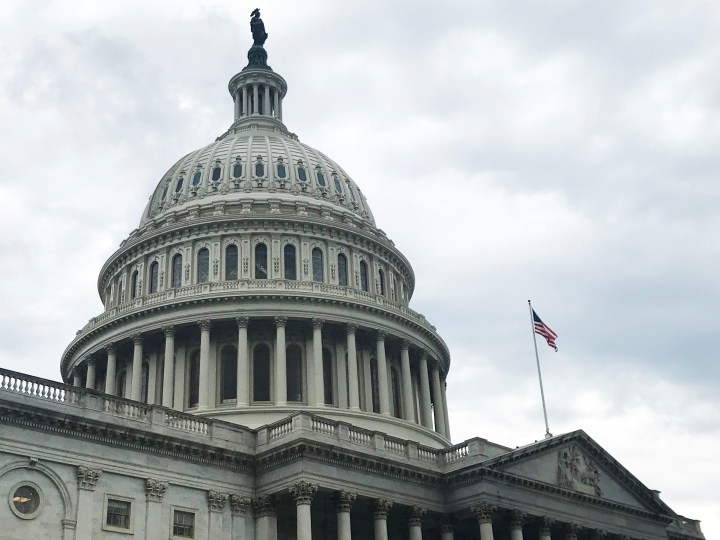
Essay by Samuel Marks
Photo: Staff, Happy MediumRepresentation, at its core, is defined as “a making present again” or “the making present in some sense of something which is nevertheless not present literally or in fact” (Pitkin 1967). However, in a democratic sense, representation goes beyond the simplistically unrefined definition above. Seminal political scientist Hanna Pitkin’s analysis and conclusions are arguably the most cogent in encapsulating the democratic concept of representation, with additional qualifiers. Therefore, the most defensible concept of democratic representation is representing as a means of acting in the interest of the represented, in a manner responsive to them, where the representative acts independently (using discretion and judgment), but should not be in constant conflict with the represented and have explanations for the necessary times they occur. Furthermore, there should be the formalistic aspects of authorization and accountability through elections, as well as the possibility for descriptive representation, but only on the grounds that substantive representation is the most prominent feature (Pitkin 1967).
Before defending the aforementioned argument, the more rational solution is to illustrate the failures of other definitions. The first definition of representation, both historically and as Pitkin presents it, is the Hobbesian formalistic concept of representation, centered on authorization (Pitkin 1967). In philosopher Thomas Hobbes’ definition, there are two groups of people in society: natural people whose words and actions are their own, and artificial/feigned people whose words and actions are those of someone else. This creates a paradigm in which natural people become represented and an artificial person(s) becomes the representative, or to Hobbes’ concept, the Levithan (Pitkin 1967). The representative has been granted all the rights, through transfer or renouncement, of the represented, who authorized the representative into their position of power. However, the represented bear all the burden and responsibility for the actions of the representative, as they are the true owner of the representative’s actions. Therefore, the representative could do whatever they pleased, even levying a 100% tax, and for the represented to interfere would be unjust. Once the power and rights have been transferred to a representative, all decisions made by the representative are binding; there is no recourse for the represented if they dislike what the representative is doing (Pitkin 1967). This is the main issue with Hobbes’ idea of representation, also known as the formalistic authorization view. The only focus of this view of representation is the ceding of authority to act; there are no standards or expectations to which the representative must conform. It lacks any responsiveness to the represented. In fact, they are not truly being represented, as the “representative” can do as they please, even if such an action is in direct conflict with the interests of the represented (Pitkin 1967). This concept would allow figures such as kings and dictators to be titled as “representatives,” regardless of how they actually represent the people, if at all. This is what renowned political scientist Nadia Urbanati called “indirect despotism,” as the people are not actually being represented in a manner that is acceptable, let alone to democratic standards of representation (Urbaniti 2006).
Even if one traverses to the opposite side of the formalistic spectrum to accountability views, it is equally lacking. Although accountability to the governed is critical in defining democratic representation, as is authorization, only acknowledging the beginning and end of a representative’s period while serving, neglects their responsibilities while in office. This concept is equally flawed, as it is really just the inverse of the authorization view. The focus is too heavily reliant on the initiation (in both cases) and termination (only in accountability views) of authority, not what the actual representative does (Pitkin 1967). Both of these elements are important to a democratic concept of representation, but alone, without the substantive “acting for” base of representation, they are horribly faulty.
The next version or concept of representation Pitkin addresses is descriptive representation, which focuses on a representative’s characteristics and the correspondence/connection between the representative and represented (Pitkin 1967). This version of representation is where Pitkin and the definition presented in the introduction differ. This is because she holds the practice of descriptive representation in very low regard, in all cases. However, in reality, it can enhance democratic representation, with some qualifications. Pitkin does present some legitimate criticism of descriptive representation in her assessment. The first of which is the notion that people tend to prefer an “ideal-type” of representative, rather than someone that looks or acts like them. This makes rational sense, as representatives tend to be better educated, from a higher socioeconomic class, and overall better looking than those they represent. Furthermore, representatives’ characteristics do not necessarily have any indication of their preferences or how they will act once elected (Pitkin 1967). Pitkin’s criticism of the version of descriptive representation presented is fair, largely because she only addresses microcosmic descriptive representation, which seeks to perfectly mirror society to the legislature. In this system, a pure lottery would serve as a better means of selecting representatives than elections. Furthermore, such a plan would not be feasible to introduce realistically, but also produce worse representation as a whole (Mansbridge 1999; Pitkin 1967).
The kind of descriptive representation that Pitkin ignored or overlooked is where a better concept can be presented. The superior version is known as selective descriptive representation. This concept allows for institutional designs to be created that give select groups better representation in proportion to their descriptions, in cases where there are factors unnaturally reducing the proportion of certain groups (Mandbridge 1999). However, I still draw criticisms of this version of descriptive representation. This is because the greatest cost in this practice is fomenting essentialism, which is “the assumption that members of a certain group have an essential identity that all members of the group have and which none other can partake” (Mandbridge 1999; Phillips 2020). Such practice fails to recognize legitimate cleavages among groups that would be treated as monoliths in this system. This would inherently marginalize some of the population within certain groups that are overall meant to be uplifted. Furthermore, it encourages citizens to self-divide, hampering cross-cutting cleavages, political parties, political unity, and compromise (Mandbridge 1999; Phillips 2020).
However, even with all the criticism presented against descriptive representation, there is still a critical role it can play in democratic concepts of representation. The key mechanism is that it can serve to enhance the deliberative functions of a legislative body, on the grounds that substantive representation comes first and forms the base of representation. The opprobrium presented against descriptive representation is not in the practice itself, but the practice acting alone, without the substantive base. Political scientist Katherine Tate masterfully presents a case whereby, if the substantive representation is primarily accounted for, then descriptive representation can act as a positive addendum to the deliberate purpose of the legislature (Tate 2003).
Symbolic representation is the most complex of the ideas presented, but the easiest to dismiss. Symbolic representation lacks a cogent definition but is roughly viewed as representation as a form of symbolization so that political representatives are to be understood on the model of a flag representing a nation (Pitkin 1967). It either exists or it does not; if someone believes it does, then it does, if not, then it does not. The concept rests on emotional/irrational psychological responses, rather than on rationally justifiable criteria. This means that keeping the represented content is the only thing that matters (Pitkin 1967). This is inherently problematic, as it really does not matter what substantive representation representatives provide, so long as the people are content. Therefore, the need for elections becomes irrelevant, as parades, propaganda, and coercion would function more successfully. Furthermore, kings and dictators would be “better” representatives than elected officials, since being a representative has nothing to do with the accurate reflections of the popular will or enacting good laws; as long as enough people are content, the representative could do whatever they pleased (Pitkin 1967).
Now that the competing definitions of the democratic concept of representation have been successfully analyzed and relatively discredited, the defense of substantive (“acting for”) representation must be presented. The key role of a good democratic representative is the substance of what they do, for the represented, while in office. The promotion of the represented’s interests, and ensuring they are met, is crucial to the raw definition of representation by “making present in some sense of something which is nevertheless not present literally or in fact” (Pitkin 1967). It defines the actions of the representative, not just their initiation and termination, what they look like, or what they stand for; it is about the responsiveness of the representative. Within this concept, however, there are distinctions to be made. Some believe that representatives should act solely as delegates, acting on explicit instruction. Others believe that they should be trustees and act in the interests of represented, with some discretion. The latter is preferable in normative terms of democratic concepts of representation. This is because, as philosopher Edmund Burke noted, a representative’s goal is to act in the interests of the represented, not their desires and wishes, which are fickle and ever-changing (Pitkin 1967). Furthermore, representatives are seasoned political operatives and have spent long periods of time honing their judgment, virtue, and wisdom, through experience, to provide the best for the represented. If a representative simply followed the orders of represented, the quality of representation would not only be lower, but it would cease to be representation, as they devolve to becoming a mere surrogate of ideas (Pitkin 1967). However, this does not rationalize a case whereby the representative is at constant odds with the represented. Such a case would indicate that the representative’s independence to act in the interests of the represented has swayed too far. Despite this, there are times where the true interests of the represented, and what they vocally desire, do not align. This is why the representative should be granted some autonomy, yet have a rational explanation and good reasoning for why the wishes of the represented and their interests might be misaligned (Pitkin 1967).
In conclusion, the initial definition and concept of democratic representation has been illustrated as superior. By comparing the definition against others that fail, and then defending and rationalizing the proposed concept, the veracity of the claims bolstered its legitimacy. In the end, a relatively independent, substantive representation, with the additional features of the formalistic authorization and accountability, with the possibility for descriptive representation, is the best means of democratic representation.

Samuel Marks is a junior political science major from Poughkeepsie, NY. He is planning to get his Master’s in Public Administration and a Juris Doctor degree. Sam has previously written on politics in the past and has had papers published. He likes to run, watch the Mets and Jets, and anime. Sam also has a unique upbringing, as he grew up in Asia for 13 years, which gives him a unique insight into the global political sphere.
References
Mansbridge, Jane. 1999. “Should Blacks Represent Blacks and Women Represent Women? A contingent ‘Yes.’” Journal of Politics 61(3): 628-57.
Phillips, Anne. 2020. “Descriptive Representation Revisited.” The Oxford Handbook of Representation in Liberal Democracies, August.
Pitkin, Hanna. 1967. The Concept of Representation. Berkeley, CA: University of California Press.
Tate, Katherine. 2004. Chapters 1-3. In Black Faces in the Mirror: African Americans and Their Representatives in the U.S. Congress. Princeton, NJ: Princeton University Press.
Urbinati, Nadia. 2006. Introduction and Chapter 1. Representative Democracy: Principles and Genealogy. Chicago, IL: University of Chicago Press.
-
Subscribe
Subscribed
Already have a WordPress.com account? Log in now.
 Happy Medium
You must be logged in to post a comment.