-
(Dis)information Maximalism: A New Age of Politics
By Mihaela Pranjkovic-Kovac, Science and Technology
Photo: Haley Keener
In just the past few years, we have witnessed leaps and bounds in the realm of technological ability; it has advanced in ways many of us could never have imagined. One of these innovations has been the introduction of artificial intelligence (AI). It has become especially noteworthy with its increased presence on social media. AI is considered to have gone mainstream just two years ago (Associated Press 2023). This technology has become so proficient that when scrolling through social media one may no longer be able to discern whether or not a given piece of content was AI-generated. Such videos may now include a slew of comments trying to figure out whether what they just watched was real—it has gotten that good. This is bound to affect politics given that many people use social media: about 54% of American adults say that they at least sometimes consume the news through social media (Pew Research Center 2024).
Politicians are not oblivious to this fact; I’m sure that many received the same social media ads of politicians seeking donations that I did this past election season. Social media has the ability to reach and catch the attention of many people, especially those who rely on it for their daily news. Politicians have found a new haven on social media as it has given them the ability to make use of new tools such as virality and accessibility to increase the outreach of their political platforms. AI has changed the nature of the same social media platforms that politicians are utilizing in a crucial way. It has changed the manner of politics and the political presence on social media by facilitating a surge of information and disinformation. This shift, in turn, has intensified social divisions and increased polarization, leaving both general masses and political actors to navigate a new political world.
Firstly, it is vital to outline how social media itself has led to an increase in political polarization before analyzing how AI has escalated the issue. In a report conducted by Brookings, the primary conclusion—drawn from more than 50 social science studies and over 40 interviews with a variety of academics, activists, experts on policy, and industry members—is that while social media platforms are not the sole catalyst for political polarization, they broaden the issue. The method through which social media intensifies polarization is by acting as a platform for political debate, “…intensifying political sectarianism” (Barrett et al. 2021). Importantly, social media algorithms tend to work on a popularity basis—this includes interacting with either posts positively because you agree with them or negatively because it aggravates you, fostering political sectors. In short, you see more of the people you agree with the most and more of the people you agree with the least. This alters the perceptions of politics and creates a new reality on social media that tends to be more extreme and polarized than in the real world. These implications are supported by a study which found that subjects who stopped using Facebook for a month reduced polarization of views on policy issues by a significant amount (Barrett et al. 2021).
Now, what role does AI play in further facilitating this issue? The problem is that AI has the ability to produce mass amounts of content, quicker than any person could come up with, that takes over the modern social media landscape used by so many people. Importantly, the content produced and posted on social media is not required to be true—platforms can spread as much disinformation and misinformation as users want to churn out. This undermines the principle of democratic representation because voters on social media platforms have a harder time deciphering whether what they are hearing about elected officials is correct, making it harder to hold them accountable in their next vote when constituents are unsure what is real and what is fake. On the other hand, social media is making it harder for elected officials to discern what their constituents truly want as it is also altering their perception (Kreps and Kriner 2023). Seeing misinformation or disinformation may also contribute to seeing the subjective “other” side in a manipulated, and more extreme, light; it is easy to see how this might contribute to polarization. Moreover, it is not just limited to the internal mechanism of a country. As a Senate Intelligence Committee report showed, Russian AI operatives posed as Americans and deliberately targeted social media tools to deceive millions of users in the United States—millions of potential voters. The goal of this disinformation campaign was to polarize Americans on a variety of social divisions and build covert support for Russia’s favored candidate for the 2016 United States election (Kreps and Kriner 2023). This is a clear exemplification of politics being affected by AI.
Just as AI in social media can be used to spread mass amounts of disinformation and deceive voters to sway the ebb and flow of politics, it can also be used to spread mass amounts of information and educate voters to enhance the ebb and flow of politics. It truly comes down to the manner in which it is wielded. This dilemma presents a variety of questions, yet to be definitively answered, for political actors of all sorts. For the voter, it raises questions of the best way to navigate the new political and social media sphere. It’s not enough to be simply aware of the disinformation and how AI propagates it; one needs to understand how to spot disinformation and develop the habit of fact-checking on their own. This poses a challenge. As the average person likely may not have the time nor energy to check on their own, it may be easier to simply accept the disinformation as true. For the politician, it has become of the utmost importance to check the information they are spreading and make it clear what they stand for, monitor what is being spread about their personal or public life, and direct voters to official pages and studies. Being aware of the influence of AI and its ability to spread disinformation will be crucial for quick response times. For the government, adapting to the rapid advancements in AI and amplifying official voices may prove to be necessary. All in all, in this new era of politics—being influenced by the integrated presence of AI on heavily used social media platforms and facts becoming indistinguishable from disinformation—it is time to react actively to protect politics. With political changes having the ability to affect the lives of millions, we cannot afford fiction produced by AI to tear us further apart.

Mihaela Pranjkovic-Kovac is a political science major on the pre-law path from Liverpool, New York. She plans on attending law school after graduating from Binghamton in 2025, and her dream is to pursue International Human Rights Law. She is extremely passionate about politics and the power it has to shape lives- for better or worse. She interned at the Human Rights Quarterly over the summer as well as the Volunteer Lawyers Project of CNY. She enjoys reading in her free time and finding new music to listen to.
References
Associated Press. 2023. “2023 was the year AI went mainstream. It was also the year we started to panic about it.” EuroNews, December 27. https://www.euronews.com/next/2023/12/27/2023-was-the-year-ai-went-mainstream-it-was-also-the-year-we-started-to-panic-about-it.
Barrett, Paul. Hendrix, Justin. Sims, Grant. 2021. “How tech platforms fuel U.S. political polarization and what government can do about it.” Brookings, September 27. https://www.brookings.edu/articles/how-tech-platforms-fuel-u-s-political-polarization-and-what-government-can-do-about-it/.
Kreps, Sarah. Kriner, Doug. 2023. “How AI Threatens Democracy.” Journal of Democracy, October. https://www.journalofdemocracy.org/articles/how-ai-threatens-democracy/. Liedke, Jacob and Christopher St. Aubin. 2024. “Social Media and News Fact Sheet.” Pew Research Center, September 17. https://www.pewresearch.org/journalism/fact-sheet/social-media-and-news-fact-sheet/.
-
War and Peace Reimagined: The Role of Nuclear Weapons

By Mihaela Pranjkovic-Kovac, Science and Technology
The past century has seen a rapid increase in scientific developments; included among these is the development of weapons. In 1915, the development of the tank was adamantly supported by Winston Churchill and in less than thirty years, in 1942, J. Robert Oppenheimer was put in charge of the Manhattan Project, which would eventually result in one of the most jarring scientific developments in modern history—the atomic bomb (Oxford Reference 2012). Just three years later, on August 6th, 1945, the first atomic bomb was dropped during warfare by the United States on Japan. Killing 70,000 people instantly, it was clear that not just warfare but all political relations across the world had changed (The Editors of Encyclopaedia 2024). This jarring number of casualties, however, is not the only role that nuclear weapons play in international conflict. By looking at historical examples, it’s made apparent that nuclear weapons have become a double-edged sword that simultaneously encourages and threatens peace in the international arena.
An apt place to start is by analyzing the cases in which nuclear weapons have threatened peace. The reason why these weapons are regarded as such a threat is their ability to enact such a large amount of indiscriminate damage and destruction in a short matter of time. Such an ability renders nuclear weapons a grave threat to peace, even if they aren’t even used—just the threat of their effects is chilling enough. Consider how India and Pakistan nearly initiated nuclear warfare in 2019. This escalation was part of a larger historical context. The two countries have fought multiple wars against each other in the Kashmir region, which they have both claimed belongs to them since their independence in 1947 from Great Britain. The nations became nuclear powers at different times, India in 1974 and Pakistan twenty-four years later in 1998 (The Arms Control Center 2024). In just a little over twenty years after Pakistan’s acquisition of nuclear arms, the two countries would teeter on the edge of nuclear war. Former U.S. Secretary of State Mike Pompeo would recall in his memoir that the public was not adequately aware of how large the threat of nuclear war was during this time. India had launched air raids inside of Pakistan in 2019 because it blamed Pakistan for the death of forty-one Indian soldiers in the Kashmir region. Pakistan would retaliate by shooting down and capturing the pilot of an Indian warplane. Soon, both sides of the conflict became convinced that the other was preparing to deploy their nuclear weapons. The United States would later intervene and persuade both countries that the other was not engaged in such preparation, which eventually led to the de-escalation of the situation (Al Jazeera 2023). Jarringly, even a small nuclear exchange between the countries has the potential to kill twenty million in just a week, potentially triggering a nuclear winter that would put the lives of nearly two billion people at risk from starvation (The Arms Control Center 2024).
A better-known example of when nuclear weapons threatened international peace would be the Cuban Missile Crisis, which occurred at the height of the Cold War. The Cuban Missile Crisis is in fact regarded as the closest moment the United States and the Soviet Union came to nuclear warfare. Beginning when the United States failed to overthrow the Cuban Castro regime during the blunderous Bay of Pigs invasion, Soviet premier Nikita Khrushchev made a deal with Cuban premier Fidel Castro to put nuclear missiles on the island as a form of deterrence from another invasion. The U.S. regarded the decision as a severe threat to its security upon discovery because of Cuba’s geographic proximity, which resulted in the ordering of a naval “quarantine” of Cuba. President Kennedy wrote to Khrushchev ordering the missile bases to be taken down and all weapons to be returned to the Soviet Union; Khruschev’s response was to label the quarantine an aggressive act. This correspondence would continue until Khrushchev demanded the removal of U.S. missiles from Turkey as a condition for any deal. Despite a number of hostile exchanges, the missile crisis would eventually de-escalate (The Office of The Historian).
The Cold War created many precedents when it came to nuclear warfare. The course of events would flow naturally into the Treaty on the Non-Proliferation of Nuclear Weapons. It is a multilateral treaty with the objective “to prevent the spread of nuclear weapons…to promote cooperation in peaceful uses of nuclear energy and to further the goal of achieving nuclear disarmament and general and complete disarmament,” it was put into force in 1970. A total of 191 states that have joined the Treaty (The Office for Disarmament Affairs). The objective of the Treaty suggests the interesting idea that there can indeed be a sense of peace connected to nuclear weapons. There does in fact appear to be instances in which nuclear weapons specifically have promoted peace, though perhaps not in the manner originally envisioned by the treaty.
The manner in which nuclear weapons can directly promote peace is deterrence. When a country is aware of the damage its and retaliatory countries’ nuclear arsenals can cause, it often deters a country from the use of nuclear weapons, and instead urges the search for a diplomatic means of addressing international issues. This observation is best exemplified by the Treaty on the Non-Proliferation of Nuclear Weapons, but this is not the only example. In 1972, President Nixon and General Secretary of the Soviet Union Leonid Brezhnev would sign a historic treaty that would limit the nuclear arsenals of both countries (The Guardian Archive 2013). Given that nuclear stockpiling is what triggered the tensions of the Cold War in the first place, the treaty’s significance cannot be overstated. It proved to be an example of when nuclear weapons contribute to peace, putting both countries in a position to resolve their mutual tensions and better their diplomatic relations.
The role of nuclear weapons in the international political landscape proves to be a shield and scourge simultaneously. These weapons have at various points threatened global peace and the lives of billions. Contrarily, they harbor the potential to incentivize countries to seek and practice peaceful diplomatic alternatives to nuclear warfare. It is precisely this dual role that makes nuclear weapons so important; harnessing the power they have to promote peace begins with the awareness of their ability to do so.

Mihaela Pranjkovic-Kovac is a political science major on the pre-law path from Liverpool, New York. She plans on attending law school after graduating from Binghamton in 2025, and her dream is to pursue International Human Rights Law. She is extremely passionate about politics and the power it has to shape lives- for better or worse. She interned at the Human Rights Quarterly over the summer as well as the Volunteer Lawyers Project of CNY. She enjoys reading in her free time and finding new music to listen to.
References
Al Jazeera. 2023. “India, Pakistan Came Close to a Nuclear War in 2019: Pompeo.” Al Jazeera, January 25. https://www.aljazeera.com/news/2023/1/25/india-pakistan-came-close-to-a-nuclear-war-in-2019-pompeo.
The Arms Control Center. 2024. “India and Pakistan.” The Center for Arms Control and Non-Proliferation, https://armscontrolcenter.org/countries/india-and-pakistan/
The Editors of Encyclopaedia. 2024. “atomic bomb.” Encyclopedia Britannica, October 30. https://www.britannica.com/technology/atomic-bomb/Development-and-proliferation-of-atomic-bombs.
The Guardian Archive. 2013. “From the archive, May 27, 1972: Nixon and Brezhnev sign historic arms treaty.” The Guardian, May 27. https://www.theguardian.com/theguardian/2013/may/27/nuclear-arms-pact-russia-usa-1972.
The Office for Disarmament Affairs. “Treaty on the Non-Proliferation of Nuclear Weapons (NPT).” The United Nations, https://disarmament.unoda.org/wmd/nuclear/npt/
The Office of The Historian. “The Cuban Missile Crisis, October 1962.” Department of State,
https://history.state.gov/milestones/1961-1968/cuban-missile-crisis.
Oxford Reference. 2012. “Weapons.” HistoryWorld, https://www.oxfordreference.com/display/10.1093/acref/9780191737930.timeline.0001.
-
Location, Location…Mediation: The United Nations’ Headquarters

By James Kang, New York Politics
The United Nations (UN) is an international organization that concerns itself with five major objectives. These are the maintenance of international peace and security, the protection of human rights, humanitarian aid, sustainable development and climate action, and the upholding of international law (United Nations 2024). There are four main UN offices, one of them in New York. However, the role of the New York location isn’t limited to being one of the four offices; it is also the headquarters of the UN. What political and historical contexts caused the UN to establish their headquarters in New York?
Historical Background
World War II was one of the major reasons the United Nations was established. By June 1941, the Axis Powers dominated most of Europe, causing representatives from various Allied Powers to meet in London and sign the Declaration of St. James Palace. This declaration, which was signed on June 12, 1941, was a pledge to “continue the struggle against German or Italian oppression until victory is won; and [to] mutually assist each other in this struggle to the utmost of [the Allies’] respective capacities” (United Nations 2024). However, in August 1941, the Axis Powers still had an advantage over the Allies, especially because the United States had yet to enter the war.
Soon after, US President Franklin D. Roosevelt and British Prime Minister Winston Churchil established the Atlantic Charter, a joint declaration addressing “certain common principles in the national policies of their respective countries on which they based their hopes for a better future for the world” (United Nations 2024). This charter became the foundation for another document, the Declaration by United Nations. Representatives from twenty-two other nations added their signatures, pledging to accept the Atlantic Charter and abstain from negotiating a separate peace with any member of the Axis Powers. The document marks the first official use of the term “United Nations,” which the Allied Powers used to refer to their alliance. By 1943, the Allied nations were committed to establishing a world in which “men in all lands may live out their lives in freedom from fear and want” (United Nations 2024). In pursuit of this objective, representatives from the United Kingdom, the United States, China, and the USSR met in Moscow in October 1943. On October 30, the representatives signed the Moscow Declaration, which addressed “the necessity of establishing at the earliest practicable date a general international organization . . . for the maintenance of international peace and security” (United Nations 2024).
By 1944, with the war coming to a close, representatives from the same four countries met at Dumbarton Oaks, a private mansion in Washington, D.C. The four nations submitted a proposal for the structure of the new organization, which stated that it would consist of four principal bodies. (United Nations 2024) These bodies would include a general assembly composed of all member states, a security council of eleven members, an International Court of Justice, and a United Nations secretariat. These proposals were voted on by the Allied countries at the Yalta Conference, during which it was decided that a UN conference would be held in San Francisco on April 25, 1945. (United Nations 2024)
Thus, there was the San Francisco Conference in 1945, more commonly known as the United Nations Conference on International Organization (UNCIO). (United Nations 2024) Delegates from fifty countries gathered in San Francisco, representing over eighty percent of the world’s population. The conference lasted for two months, from April to June 1945. Among its biggest challenges was addressing the authority which the permanent members of the Security Council held over smaller member states. However, the former, consisting of the United States, the United Kingdom, the USSR, France, and China, insisted that they were the most responsible for maintaining world peace. Delegates unanimously passed and signed the UN Charter on the last official day of the conference. (United Nations 2024)
The signing of the charter did not mean that the United Nations would immediately be established. Regardless of its passage by the permanent members, the document had to be approved by each country’s respective government. By October 24, 1945, this condition was fulfilled, and the United Nations officially came into existence in the wake of the Axis’ surrender and the dropping of the atomic bombs on Japan. (United Nations 2024) After four years of planning, an international organization, which had the objective of ending wars and promoting the concepts of peace, justice, and the wellbeing of all humankind, was designed and realized. Still, the United Nations had yet to decide on a location for its headquarters, where its main bodies would carry out their work (United Nations 2024).
Headquarters in New York City
On December 10, 1945, the United States Congress unanimously decided to invite the United Nations to establish its permanent headquarters in the country. (United Nations 2024) As a result, the General Assembly considered a proposal to locate the United Nations headquarters in New York City during their first session, which was held in London.
During this conference, the UN site committee considered other possible locations, such as Philadelphia, Boston, San Francisco, and even areas north of New York City; Manhattan wasn’t an obvious option. However, the General Assembly eventually decided on accepting the offer after John D. Rockefeller, Jr. donated $8.5 million on December 14, 1946. (United Nations 2024) New York City completed this offer with additional gifts of property. The specific area chosen was home to slaughterhouses and other light industry, along with a railroad barge landing.
Once the location of headquarters was agreed upon, the next major task was to design and construct the headquarters building. Delegates started a joint project of selecting leading architects from all over the world, with Wallace K. Harrison of the United States being appointed as the chief architect, or Director of Planning. (United Nations 2024) There was a board of design consultants selected to assist him, consisting of ten architects nominated by each government. Construction completed in 1952, and the United States became bound by an agreement as the host country; no American federal, state, or local officer could enter the UN Headquarters building unless consent was given by the Secretary-General. Moreover, the Headquarters was protected from use as a refuge for people attempting to avoid arrest under any US law (United Nations 2024).
Mediation
Despite being considered international territory, the New York location does have an impact on the role and responsibilities of the UN. To illustrate, New York City is also the host of the Permanent Missions and Observers to the UN, which helps establish permanent missions in coordination with the UN’s work and provides relevant documentation for non-member states. (NYC Mayor’s Office of International Affairs 2024) In other words, the heavy presence of the missions and observers elevates New York’s status as a global hub. After all, the UN leads the quest for global mediation development, especially in the economic, social, and cultural spheres.
Since one of the UN offices is located in NYC, both the UN and NYC recognize that they share commitments to certain forms of mediation. As a result, the NYC Mayor’s Office for International Affairs established the digital campaign “We are the City of United Nations” in 2016 to commemorate the unique relationship between the UN and NYC (NYC Mayor’s Office of International Affairs 2024).
For instance, one of the partnerships between the UN and NYC highlights the protection of the rights of people around the world. The program enforces policies that empower all people, including the LGBT community. Both the UN, through its UN LGBT Core Group, and NYC highlight that people should live free from harassment and violence, “including the right for all New Yorkers to use the bathroom consistent with their gender identity.” (NYC Mayor’s Office of International Affairs 2024) Another example was when NYC signed an agreement with the UN to work together to improve the safety and security of women and girls, making them the first US city to join the Safe Cities Global Initiative. Another historic partnership between the UN and NYC involves the Paris Agreement, with governments around the world committing to limit global carbon emissions. In NYC, the UN plans to initiate a bold plan to reduce greenhouse gas emissions in 2050 by eighty percent from 2005, making NYC the most sustainable big city in the world. (NYC Mayor’s Office of International Affairs 2024)Overall, many initiatives and policies are established with the UN-NYC partnership. Thus, the UN tests most of their mediation efforts in NYC to determine if they are feasible for international contexts.
However, most of the important mediation efforts by the UN are not impacted by the headquarters’ location. This includes the mediation of “inter- and intra-State conflicts at all stages: before they escalate into armed conflict, after the outbreak of violence, and during implementation of peace agreements.” (United Nations 2024)
At the request of parties involved in a dispute, the Secretary-General and his representatives carry out mediation efforts. Established in 1992, the Department of Political Affairs (DPA) assisted the work of the Secretary-General, but later reconstructed itself into the Department of Political and Peacebuilding Affairs (DPPA) by joining forces with the Peacebuilding Support Unit (PBSO) in 2019. With the establishment of the DPPA, the United Nations acknowledged that “successful conflict mediation requires an adequate support system to provide envoys with the proper staff assistance and advice, and to ensure that talks have the needed logistical and financial resources” (United Nations 2024). The DPPA tends to lead United Nations mediation efforts, and has collaborated with other partner organizations in those efforts. Likewise, the DPPA’s Mediation Support Unit (MSU) works closely with the DPPA’s regional divisions in order to coordinate mediation efforts. MSU “provides advisory, financial, and logistical support to peace processes; works to strengthen the mediation capacity of regional and sub-regional organizations; and serves as a repository of meditation knowledge, policy and guidance, lessons learned and best practices” (United Nations 2024).
The DPPA has control over the United Nations Standby Team of Mediation Experts, created in 2008, providing a last-resort effort for mediation. These team members have proved to be effective in providing support in negotiations, utilizing their expertise to resolve issues such as power-sharing, natural resources, and conflict. The Standby Team of Mediation Experts is expected to have flexibility given that its members are deployed on short notice. Since 2020, the team has expanded to practice virtual mediation and to meet the evolving needs of mediation actors. This includes the development of an online mediation tool known as UN Peacemaker. This tool allows individuals the opportunity to access an extensive database of approximately 800 peace agreements and materials on the UN’s mediation services. (United Nations 2024)
Lastly, the DPPA provides support for the High-Level Advisory Board (HLAB) on Mediation, which was created by Secretary-General Antonio Guterres in September 2017. There are eighteen members in HLAB, consisting of “current and former global leaders, senior officials, and renowned experts [who can] back specific mediation efforts around the world with their unparalleled range of experience, skills, knowledge, and contracts” (United Nations 2024). The creation of the DPPA and other subsequent programs demonstrates the United Nations’ vision for effective mediation.
Conclusion
In conclusion, the UN headquarters was established upon the importance of having a reliable anchor for peacekeeping operations, and the United States promised to provide this foundation. In addition, the role of NYC is to provide the UN with opportunities to explore what mediation policies are effective to incorporate on an international level.

James Kang is a junior from Queens, New York, majoring in political science. After graduation, James plans to go to law school. During high school and going into college, James wrote articles and worked with representatives, such as Congresswoman Grace Meng of New York’s 6th district. During this past summer, James worked as an intern in the office of United States Senator Lea Webb of the 52nd district and Josh Riley, who is the Democratic candidate for New York’s 19th Congressional district. Outside of politics, James enjoys playing the piano and basketball.
References
“History of the United Nations.” United Nations. https://www.un.org/en/about-us/history-of-the-un (November 5, 2024a).
History of United Nations Headquarters. https://www.un.org/sites/un2.un.org/files/headquarters.pdf (November 5, 2024).
“The New Yorkness of the UN.” The New Yorkness of the UN – Mayor’s Office of International Affairs. https://www.nyc.gov/site/international/programs/the-new-yorkness-of-the-un.page (November 4, 2024).
NYC. “We are the city of United Nations,” NYC: Mayor’s Office for International Affairs. https://cityofunitednations.tumblr.com/ (November 4, 2024).
“Peace, Dignity and Equality on a Healthy Planet.” United Nations. https://www.un.org/en/ (November 4, 2024b).
-
From Language To Action: A Conversation with a Common Ground Expert
By Halina de Jong-Lambert, Interviews
Soon after we sat down to speak, James Coan said, “There’s often been a statement: we need to find common ground. Well, cool, but if we already have hundreds of examples when we’ve found it, why don’t we just use what’s already there and just share that it exists?” This idea is part of what propelled James Coan, who formerly worked in energy research and consulted for S&P Global, to co-found More Like US, an organization dedicated to correcting the political misperceptions that abound in America today. A few mere minutes on the organization’s website leads to some surprising revelations – notably among them that Americans share the same views far more than one may think. This is an increasingly difficult thing to convince the average American of, especially in the wake of the presidential election, which James and I touched on as a flash point for polarization.
But More Like US makes a strong attempt to do just that with a “multi-pronged approach.” One part of this is recognizing the growing role of social media and TV in providing political news and shaping how we perceive information. A fan of mnemonics, Coan uses ‘CAST’ to explain what his organization does in this area. “So, casting the other side in a better light, which is showing them as more complex, admirable, similar, and worthy of togetherness than what we otherwise think.” While More Like US’s website doesn’t focus solely on the perceived yawning gap between the two main political parties, Coan acknowledged their role in our tendency to oversimplify of each other: “Instead of seeing people as stereotypical, all the same, I see people as unique individuals, [I] see a big party of tens of millions of people as actually having lots of subgroups and not being all the same.”
To translate this goal into action, More Like US has formulated lesson plans and presentations about the perception gap, hoping they are flexible enough to be presented to people across age groups. Coan emphasized that these lesson plans try “to reach people where they are.” He continues,“There will be a few who want to go into a workshop, who want to spend quite a bit of time learning skills and engaging in conversations that may be difficult. But a lot of people don’t have the time, interest, energy, or confidence to do that. And so we try to reach this category that we would say the vast majority of people fit into.” The organization prefers for people to come across their materials naturally: in classes, training programs for organizations like Americorps, or onboarding materials for jobs.
Yet, the organization also hopes that people use their aggregated data in their own individual ways to inform people about collective similarities. This is what the Similarity Hub portion of their website is intended for. The Similarity Hub shares some surprising statistics concerning what Republicans and Democrats agree on. Agreement can be found even with volatile political issues; 94% of people are stated to be in favor of “preventing certain people, such as convicted felons or people with mental health problems, from owning guns.” Hearteningly, 96% of us agree that “it is at least somewhat important to have mutual respect and compassion for each other despite our differences.” Coan told me he hopes these numbers can have some impact on our information environment, whether they are shared by those in more traditionally political professions such as journalists, or those less so, like preachers.
“Dethreatening.” – crafting new words like this is one example of the unique approach Coan is taking towards eliminating the political perception gap. Dethreatening essentially “reducing the amount of fear people have about the other side.” Unfortunately, with many of today’s prominent political issues being interpreted as profoundly personal and intimate – transgender health care and abortion comes to mind – lowering people’s sense of fear and danger in politics becomes a tall order. When I questioned Coan on this, he highlighted reduction over complete elimination: “So when it comes to these fears, it’s reducing a sense of threat, but not eliminating it. Like if there’s a lion, I’m not going to tell people, ‘no, it’s a friendly lion,’ right? There are threats but it’s about rightsizing them, reducing the overblown.” He introduced research that, if widely publicized, could go far in making people feel safer. “There’s data about the share of people in each party who condone political violence, which is very low, at least when certain questions are asked. There is also a much lower condoning of breaking democratic norms than expected.” Why, then, do we not see the media, politicians, and even nonprofits doing more to share this kind of positive data, and attempting to “dethreaten” or encourage some common ground? Coan cites a “negative incentive.” He elaborates, “If they want to get people’s attention and money, typically it makes sense to get people emotionally activated through anger, outrage, and fear, and these data points don’t lend themselves to that.”
For Coan, the mission of More Like US goes to the core of the question of identity, which may present an interesting future direction for the organization. As he described, the identities we ascribe to others and ourselves greatly shape how we see each other, and whether we can see the other side over the perception gap. What if these identities were less surface level? “Martin Luther King [Jr.] –, [his] “I Have a Dream” speech, he doesn’t want his daughter judged on the color of her skin but the content of her character. Can you actually have a virtue-status society, where people are judged on the contents of their character? How hardworking they are, how trustworthy they are?” He believes that there is a niche role for More Like US to play in reducing post-election divisions, and that re-evaluating identity could be especially important now in the wake of the presidential election.Concerning some terms that have been thrown around since, he said: “There are some predispositions to these authoritarian and illiberal tendencies, but they have to be activated by threat. So what More Like US does is trying to reduce at least the overblown parts of this threat, which should hopefully reduce the attractiveness of authoritarianism or illiberalism.” Whether this threat turns out to be as real as some predict or not, Coan sees correcting our political misperceptions of each other and emphasizing our collective similarities to be a crucial goal that supersedes political changes. As he puts it, “The North Star is trust.”

Halina de Jong-Lambert is a sophomore double majoring in economics and political science and minoring in music from Manhattan, NY. She is part of the Student Association and Treble Chorus on campus and is an intern for the NYC Department of Health. She wrote a research article last year on the aftermath of a Universal Basic Income study in Otjivero, Namibia as part of the Source Project, interviewing the heads of the study to get an accurate picture of its complex effects. This project gave her the strong belief that economic opportunity is central to quality of life and must be a top priority globally. She enjoys running, baking, and watching horror movies with her roommates, and hopes to one day be a development economist for an international organization like the IMF or World Bank. -
The Mechanics, Impact, and Future of Labor Negotiations
By Travis Rayome, Political History
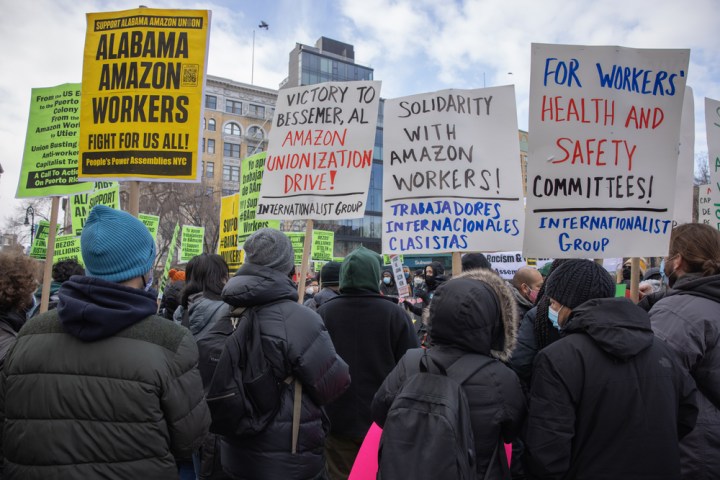
For a majority of Americans, no policy has had more of an impact on livelihood than employment contracts. Employment contracts lay out all terms and conditions regarding workers filling a certain position at a given firm, such as wages, job responsibilities, and terms of employment. Employers set these terms and conditions, and workers may either agree to the contract and accept the position, or reject the contract and lose the opportunity, as employers move on to hire someone more agreeable. This means that, alone, workers are at the behest of employers, who are the sole authors of the contracts and require workers to either accept them as-is or seek employment elsewhere. The primary way workers maintain security in their positions while influencing their contracts is through labor unions. Labor unions are collective organizations of workers in a given firm, industry, or profession, and are formed to negotiate contracts with employers for all workers in the union’s sphere of influence, even if they are not members. Unions leverage their bargaining power through the threat of collective labor action, which can slow, damage, or halt a firm or industry’s operations until a settlement is reached. Such action includes overtime bans (refusing to work overtime hours), workplace occupation (refusing to leave the workplace), slowdowns (minimizing productivity), and strikes (refusing to work outright). The process of labor negotiations determines whether labor action takes place. Representatives from both management and the union each put forth proposals for contract changes and negotiations. Once the representative teams have agreed on new terms, they verify with their respective groups whether to move ahead with ratifying the settled contract. If a settlement is not reached before a given deadline, a mediator can be employed or the union may take labor action. At the time of writing, SAG-AFTRA, the union representing actors in home entertainment media, is striking against the Hollywood video game industry after major developers and publishers refused their contract proposals. These would have guaranteed protections against exploitation through AI technology, which would allow studios to replace performers with “digital replicas.”
Labor unions–the foundation of labor negotiations–benefit all workers in proximity to them, even in unrelated fields. Among the seventeen states with the highest density of unions, the average minimum wage is 19% higher than the average minimum wage across the entire country. Likewise, the median annual income is over $6,000 higher than the national average (Banerjee et al. 2021). There is a significant correlation between labor union density and pro-labor public legislation in the same area, meaning states with a larger union presence are more likely to pass laws that guarantee protections for all workers (Galvin 2020). Labor unions have historically advocated for increasing the minimum wage, allowing for more family leave, and fighting workplace discrimination (Galvin 2020). Those states with the highest density of unions have elected to expand Medicaid coverage for their citizens and have passed more paid leave laws than other states (Banerjee et al. 2021).
Labor negotiations can come up against numerous obstacles on the path to reaching a fair resolution. Corporations have a history of utilizing their massive wealth and influence to push anti-union policies. In March 2024, several multinational corporations infamous for their vigorous union-busting efforts and abuse of workers–such as Amazon, Starbucks, and SpaceX–directly challenged the National Labor Relations Act, which established the National Labor Relations Board, the agency responsible for enforcing labor regulations and protecting unions. These corporations argue the legislation is unconstitutional, therefore suing for its repeal. Similarly, corporations lobby with, compose, and donate money to anti-worker groups like ALEC and the National Right to Work Committee, which in turn utilize PACs and lobbying groups to encourage anti-worker legislation. Such legislation often include right-to-work policies, which prohibit union security agreements, and contractual requirements delineating the affiliation workers can or must have with their workplace union. Prohibiting these agreements would undermine unions’ influence over contracts and exclude new hires from membership, thereby preventing labor action. Additionally, employers have a history of directly interfering with negotiation efforts through making unofficial contract promises, turning workers against the union, harassing union members outside of the workplace, delaying negotiations, or disrupting the negotiations schedule. Since workers labeled ‘gig workers’ and independent contractors have fewer legal protections, earn lower wages, receive no benefits, and can more easily be replaced, employers will classify workers as such in order to circumvent labor regulations and prevent unionization and potential negotiations. Labor negotiations can often become long and arduous due to employer pushback. Starbucks Workers United, the union representing Starbucks stores based in Ithaca, New York, was targeted by the corporation while organizing in 2022 and 2023. Ithaca Starbucks locations began unionizing in April of 2022, only for negotiations to be halted, sometimes for months at a time, as the corporation began to shut down Ithaca locations that June. The union sued in response, and so the NLRB took on the Starbucks case in November 2023. A verdict was reached indicting Starbucks for union-busting in July of 2023, and judges ordered the reopening of the closed Ithaca locations in September of 2024–meaning that despite ultimately failing to union-bust, Starbucks’ efforts delayed negotiations by at least two years. Starbucks has claimed it both adheres to labor laws and respects unions, but the more than ninety unsettled workers’ claims of labor rights violations in 2023 indicate otherwise (Muñoz and Senzon 2023). These tactics–halting negotiations, antagonizing workers, stalling legal action indefinitely–are common strategies among anti-union employers. With President-elect Donald Trump’s intentions to dismantle regulatory bodies, they could become even more routine for labor negotiations–leading to reduced wages, benefits, and protections across the country.
The troubling future for labor unions reflects an existing trend of labor struggle. The number of unions has already declined significantly over the past forty years. The share of American workers in unions has decreased from 20.8% in 1983 to just 10% in 2023 (Pew Research 2024). In recent years, however, public opinion has shifted in favor of unions. Since 2008, the proportion of Americans who approve of unions has risen from 48% to 70% (Gallup Polls 2024). This change demonstrates that Americans increasingly favor unions regardless of federal administration, and could reflect an increased concern for their workers’ welfare, given the benefits that they provide. A Pew Research poll conducted in March 2024 echoes a similar sentiment, showing that 54% of Americans see the decline of union membership as bad for the country, and around 60% see the decline as bad for working people in particular. Younger generations are more likely to support unions as well, with millennials and Generation Z viewing the decline of unions less favorably than older generations (Pew Research 2024).
The conflict between labor unions and employers has persisted long before our living memory. The Harlan County War, for example, was a prolonged conflict between unionized coal miners and mine owners in Kentucky. In the early 1930s, armed struggle between striking workers and the mine operators’ cohort of hired muscle, police, politicians, and the United States Military erupted over concerns regarding poor conditions and low wages. The War was prolonged when the mine operators and local officials enacted what the governor of Kentucky called a “reign of terror” over the entirety of the decade, which entailed the bombing, shooting, and beating of their disgruntled workers.
Labor unions are of chief importance to the future of America, as the leverage they maintain in negotiating contracts is the largest advantage that the vast majority of workers have in achieving better conditions, wages, and benefits. However, employers can always be expected to undermine the presence and influence of unions for their own self-interest. This means that the agenda the new Trump administration has for labor is not a new one; it is the same agenda that business owners have always had, as seen in the Harlan County War. At the same time, the benefits provided by union presence are being increasingly recognized and, while slow, public perception is shifting more to favor unions. Only time will tell how labor negotiations will be impacted by the coming administration, but if current trends are any prediction of the future, the current economic conditions facing workers will continue to cause the American people to become increasingly pro-labor.

Travis Rayome is an English and Economics major from Alexandria, Virginia. He hopes to work for humanitarian NGOs around the Washington, DC area, continue writing on politics and economics, and play music. His areas of political interest are propaganda and information dissemination, structural violence and inequality, and power distribution within and between nation states.
References
American Federation of Labor and Congress of Industrial Organizations. 2024. “What Unions Do.” https://aflcio.org/what-unions-do
Banerjee, Asha. 2021. “Unions Are Not Only Good for Workers, They’re Good for Communities
and for Democracy.” Economic Policy Institute, December 15.
https://www.epi.org/publication/unions-and-well-being/.
Berry, Aurora. 2024. “Judge Orders Reopening of 2 Unionized Starbucks Stores in Ithaca That Closed.” WSKG, September 16. https://www.wskg.org/2024-09-16/judge-orders-reopening-of-2-unionized-starbucks-stores-in-ithaca-that-closed.
Gallup Polls. 2024. “Labor Unions.” https://news.gallup.com/poll/12751/labor-unions.aspx.
Galvin, Daniel J. 2021. “Labor’s Legacy: The Construction of Subnational Work Regulation.” ILR Review, October. https://journals.sagepub.com/doi/10.1177/0019793920943831.
Greenhouse, Steven. 2024. “Major US Corporations Threaten to Return Labor to ‘Law of the Jungle’.” The Guardian, March 10. https://www.theguardian.com/us-news/2024/mar/10/starbucks-trader-joes-spacex-challenge-labor-board.
Husak, Corey. 2019. “How US Companies Harm Workers by Making Them Independent Contractors.” Equitable Growth, July 31. https://equitablegrowth.org/how-u-s-companies-harm-workers-by-making-them-independent-contractors/.
Muñoz, Gabriel and Senzon, Julia. 2023. “Starbucks Found Guilty of Violating Labor Laws in Ithaca Closure.” The Cornell Daily Sun, July 7. https://cornellsun.com/2023/07/07/starbucks-found-guilty-of-violating-labor-laws-in-ithaca-closure/.
National Education Association. 2024. “How Does Collective Bargaining Work? A Step-by-Step Guide.” https://www.nea.org/sites/default/files/2022-07/How%20Does%20Collective%20Bargaining%20Work%3F%20A%20Step-by-Step%20Guide.pdf (accessed 14 November 2024).
SAG-AFTRA, 2024. “We’re Fighting for the Survival of Video Game Performers.” August 19. https://www.sagaftra.org/were-fighting-survival-video-game-performers.
Union Busting Playbook. 2024. “Union Busting Playbook.” Communications Workers of America. https://unionbustingplaybook.com/.
United Steel Workers. 2024. “Who is Behind These Anti-Worker Bills?” https://m.usw.org/act/campaigns/rtw/resources/who-is-behind-these-anti-worker-bills.Van Green, Ted. 2024. “Majorities of Adults See Decline of Union Membership as Bad for the U.S. and Working People.” Pew Research Center, March 12. https://www.pewresearch.org/short-reads/2024/03/12/majorities-of-adults-see-decline-of-union-membership-as-bad-for-the-us-and-working-people/.
-
Trust in the Media and a Path Forward
By Moss Magnusson, Political Theory
It’s a worrying paradox—information used to evaluate trust in the media is itself vulnerable to distrust.
If you ever try writing on a topic such as trust in media, you might find yourself in an infinite regression, similar in difficulty to answering “What came before the Big Bang?” Read one report, check the “AllSides” media bias score, and then wonder: “What’s the AllSides media bias score for AllSides?” For the sake of sidelining this regression, and for the sake of transparency, I’m going to be using AllSides (a media bias evaluator) as a baseline. Sites like these are key players in regaining the public trust in mainstream media. However, this dilemma highlights a deeper issue within media literacy—without a universally trusted standard, assessments of media trustworthiness can become circular or self-defeating. For Americans, amongst whom trust in the media is at an all-time low, this circularity is exactly what makes trusting the media so difficult. In this article, I will evaluate the current state of trust in mainstream media, investigate how we got here, and consider a path forward.
What are the statistics on media trust?
Partisanship has made this task a little easier by indicating that there is a consensus in the numbers across the political divide—Americans’ trust in the media is at an all-time low. A poll from Gallup (AllSides bias score: 0) that was covered by both Fox News (AllSides bias score: 3.88/6), and The New Yorker (AllSides bias score: -4.2/-6) indicated that “Americans continue to register record-low trust in the mass media” (Gallup 2022); (Allsides, n.d.). (A negative AllSides score indicates a left-leaning bias and a positive score indicates a right-leaning bias.) The poll, released in mid-October, shows a decline in trust among all Americans but particularly, across three groups: self-identified Democrats, Republicans, and independents. Below are the respective charts from Gallup, who started polling these questions in the early ‘70s and returned to them in the mid-’90s:
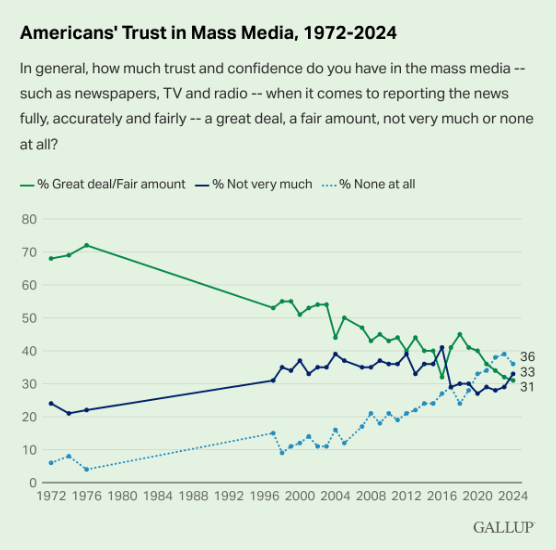
Image Credit: GALLUP 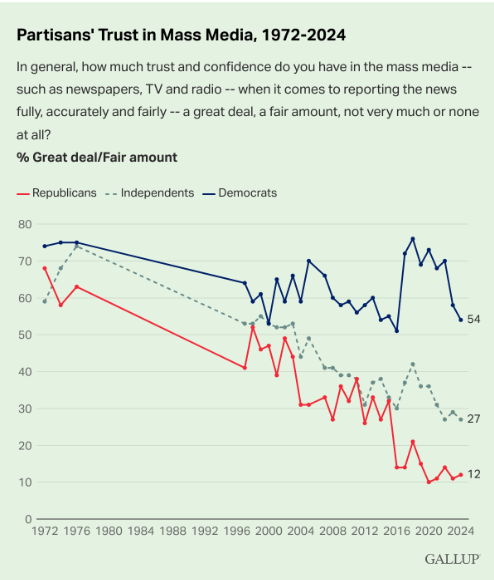
Image Credit: GALLUP Besides an ominously persistent decline in trust overall, the first graph shows that U.S. adults have reversed the trends we’d hope to see concerning trust in mass media: 36% reported having no trust at all, 33% reported having not very much trust, and 31% reported having a great deal of trust (Gallup 2022). As Gallup noted, this is “the third consecutive year [that] more U.S. adults have no trust at all in the media…than trust it a great deal or fair amount” (Gallup 2022). The second graph illustrates that, despite the widely differing levels of trust across partisan groups, they have all been trending downward over the last six years.
With trust dwindling, mainstream media faces weighty challenges, the most concerning of which involves a shift to alternative forms of media. These forms of media are concerning because, to be used effectively, these sources—Facebook, X (formerly Twitter), podcasts, and the like—must be approached by consumers with an added level of caution. Deriving news from these sources can sometimes mean simply viewing a popular yet unresearched post that, on many occasions, is not subject to any form of fact-checking. Such is the case on platforms like X, which, in recent years, has seemingly done a very poor job of blocking misinformation.
With added levels of uncertainty, consumers should be more weary of these forms of media. But a recent poll conducted by the Pew Research Center (AllSides bias score: 0) indicates that this isn’t necessarily so (Allsides, n.d.). An October 16th poll indicated that Republicans are now almost as likely to trust information from social media as they are from national news outlets (Pew Research Center 2024). Although their trust in social media aligns closely with that of Democrats, Republicans’ trust in national news has dropped by thirty percentage points since 2016. Trust in local news remains relatively high for both groups, though Republicans consistently express less trust than Democrats.
This trend is not solely partisan—age also plays a significant role in influencing trust in media sources.
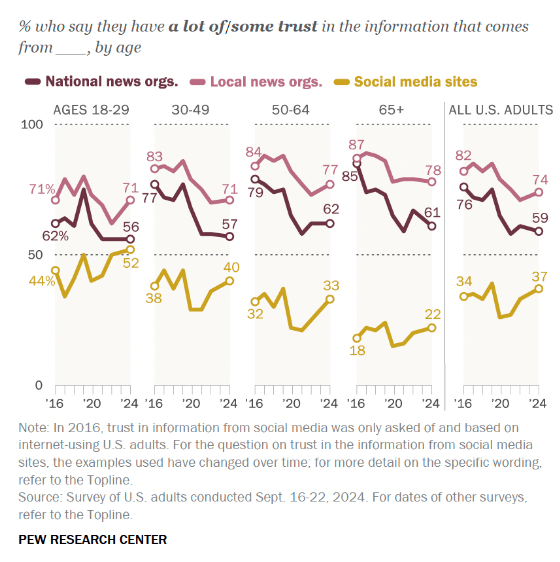
Image Credit: Pew Research Center The perceived interchangeability between national news organizations and social media is also seemingly true for adults under thirty (Pew Research Center 2024). Here, young adults have almost equal trust in national news outlets as they do in social media, at 56% and 52% respectively.
How did we get here?
Jesse Halcomb, writing for the Pew Research Center, says that when investigating the cause of these trust issues, “we ought to be cautious about oversimplifying a decades-long phenomenon” (Pew Charitable Trusts 2024). He considers the problem to have three broad and intertwining causes: increased political polarization, heaps of new media platforms, and economic difficulties faced by the news industry (Pew Charitable Trusts 2024). It is not unreasonable to claim that recent Trumpian rhetoric has likely accelerated mistrust in mainstream media and that this is a likely explanation for Republicans’ diminished trust compared to other groups. (“Donald Trump has called journalists and news outlets ‘fake news’ nearly 2,000 times since the beginning of his presidency, averaging more than one daily broadside against the press over the last four years”) (Woodward 2020). But trust in the media is diminishing across partisan lines and the essential question still remains: are these grievances legitimate? Journalists are far more likely to be Democrats than they are Republicans. A 2022 poll from Syracuse University found that the number of journalists who identified as Republican was only around 3.4% compared to 36.4%, 51.7%, and 8.5% for Democrats, Independents, and ‘Other,’ respectively (Willnat et al. 2022). Other studies have found similarly small numbers of Republicans in journalism. This may help explain lopsided trust in mass media.
As for the heaps of new media platforms, more does not equal better. Media outlets took advantage of a quickly realized exploit: attacking the credibility of the mass media was an easy way to grow their brand (Pew Charitable Trusts 2024). When the news began to diversify in this way, and Americans were no longer relying on one of three major news outlets, as they were in the ‘70s, a partisan sort began to emerge. Overtly biased news stations grew in numbers and became more acceptable. This diversification, coupled with the arrival of the internet, put an economic strain on the once-booming news industry (Pew Charitable Trusts 2024). This squeeze necessitated a large reduction in the number of journalists working for newspaper companies. With the loss of journalists came less diverse reporting and competition with the web for advertising revenue (Pew Charitable Trusts 2024). What followed was simply a worse news product that left readers disinterested in the quality of the journalism and skeptical of the business’ motivations (Pew Charitable Trusts 2024).
What is the path forward?
Outlets such as the Washington Post have begun trying to take back the reins on the trust issue. Most recently, they abstained from a long-established tradition of endorsing a presidential candidate. In an opinion piece entitled “The hard truth: Americans don’t trust the news media,” Washington Post owner Jeff Bezos writes this about the decision: “By itself, declining to endorse presidential candidates is not enough to move us very far up the trust scale, but it’s a meaningful step in the right direction” (Washington Post Editorial Board 2024). This decision was a contentious one, leading three editorial board members to step down in the wake of over 200,000 canceled Post subscriptions (NPR 2024). Whether you agree with the endorsement decision or not, it demonstrates that both people and media companies are ready and willing to take large steps to rectify this trust issue.
James Coan, co-founder and Executive Director of “More Like US”—an organization focused on bridging the partisan divide—has explored the relationship between increasing partisanship and declining trust while mapping out potential solutions. Coan writes mostly on his efforts to reduce polarization—described above as a direct contributor to the erosion of trust. He has proposed numerous solutions to polarization that, in my view, would have the effect of increasing trust in the media, namely, his idea of a “unifying news,” which “would provide informative and newsworthy content, but also other data or context that facilitates greater social cohesion” (The Fulcrum 2024b). This type of content would specifically showcase bipartisan victories, shared goals, and other stories of collaboration (The Fulcrum 2024b).
Furthermore, Coan notes that it’s possible to take direct steps to increase trust (The Fulcrum 2024a). This can be achieved by showcasing cross-partisan similarities (as is done by AllSides’ Similarity Hub and More Like US), portraying people across the political spectrum positively (an approach taken by Bridge Entertainment Labs), and encouraging civil discourse, as many groups in the #ListenFirst Coalition do (The Fulcrum 2024a). Through these methods, Coan aims to present a pathway toward reducing polarization. The potential solutions to this multi-decade issue can sometimes be expressed simply. For James Coan, it’s about “adding more trust” and “reducing polarizing rhetoric and behavior” (The Fulcrum 2024a). However, he acknowledges that while the vision may be straightforward, the path is far from easy. Achieving this kind of change demands a unified effort, one that encourages a critical and constructive approach to media, grounded in compassion and thoughtfulness.
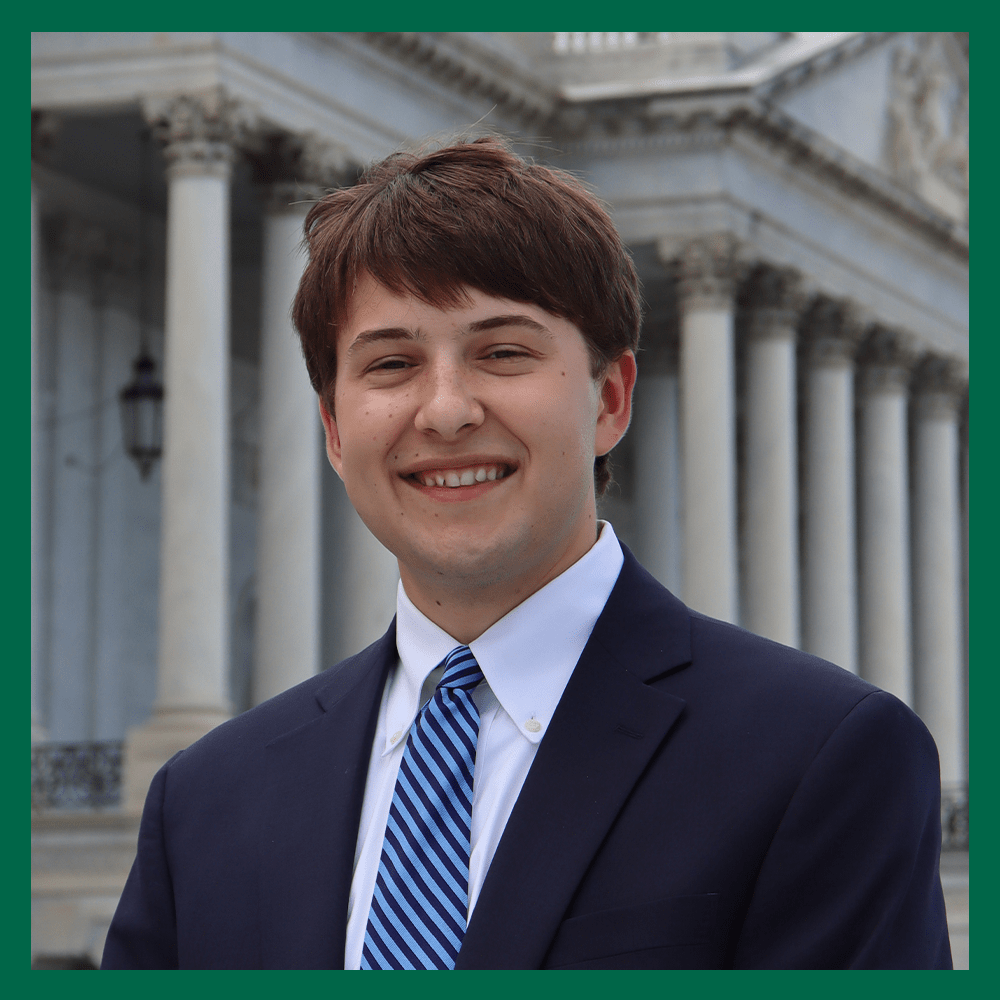
Moss Magnusson is a senior at Binghamton University, double majoring in political science and PPL (politics, philosophy, and law). Originally from Rhinebeck, NY—a small upstate town in the Hudson Valley—Moss has gained valuable experience during his time interning on Capitol Hill, where he contributed to writing congressional records and other legislative materials. While deeply engaged in his political science studies, he also enjoys spending time with friends, playing tennis, and reading. After graduating this spring, Moss plans to work for a year while preparing for the LSAT, with the goal of attending law school the following fall.
References
AllSides. n.d. “Fox News Media Bias.” AllSides. https://www.allsides.com/news-source/fox-news-media-bias (November 22, 2024).
AllSides. n.d. “New Yorker Media Bias.” AllSides. https://www.allsides.com/news-source/new-yorker (November 22, 2024).
AllSides. n.d. “Pew Research Media Bias.” AllSides. https://www.allsides.com/news-source/pew-research (November 22, 2024).
Gallup. 2022. “Americans’ Trust in Media Remains Near Record Low.” https://news.gallup.com/poll/651977/americans-trust-media-remains-trend-low.aspx (November 22, 2024).
National Public Radio (NPR). 2024. “Washington Post Faces Internal Turmoil over Bezos’ Endorsement of President.” October 28. https://www.npr.org/2024/10/28/nx-s1-5168416/washington-post-bezos-endorsement-president-cancellations-resignations (November 22, 2024).
Pew Charitable Trusts. 2024. “Media Mistrust Has Been Growing for Decades. Does It Matter?” Trend Magazine, Fall 2024. https://www.pewtrusts.org/en/trend/archive/fall-2024/media-mistrust-has-been-growing-for-decades-does-it-matter (November 22, 2024).
Pew Research Center. 2024. “Republicans, Young Adults Now Nearly as Likely to Trust Info from Social Media as from National News Outlets.” Pew Research Center Short Reads. https://www.pewresearch.org/short-reads/2024/10/16/republicans-young-adults-now-nearly-as-likely-to-trust-info-from-social-media-as-from-national-news-outlets/ (November 22, 2024).
The Fulcrum. 2024a. “Building Trust among Americans.” The Fulcrum. https://thefulcrum.us/bridging-common-ground/building-trust-among-americans (November 22, 2024).
The Fulcrum. 2024b. “The Importance of Non-Partisan News.” The Fulcrum. https://thefulcrum.us/civic-engagement-education/non-partisan-news (November 22, 2024).
Washington Post Editorial Board. 2024. “Jeff Bezos’ Leadership at the Washington Post Sparks Debate about Trust.” The Washington Post, October 28. https://www.washingtonpost.com/opinions/2024/10/28/jeff-bezos-washington-post-trust/ (November 22, 2024).
Willnat, Lars, David H. Weaver, and Cleve Wilhoit. 2022. The American Journalist Under Attack: Key Findings 2022. Syracuse, NY: S.I. Newhouse School of Public Communications, Syracuse University.
Woodward, Alex. 2020. “‘Fake News’: A Guide to Trump’s Favourite Phrase – and the Dangers It Obscures.” The Independent, October 2. https://www.the-independent.com/news/world/americas/us-election/trump-fake-news-counter-history-b732873.html (November 22, 2024).
-
Why Do Neutral States Mediate Conflicts?

By Hunter Loren, Current Affairs
The international system is rooted in nation states and the competition that occurs among them. In the midst of the powers vying for influence lie politically neutral states. Often, a country not involved in a given conflict will act as a third-party mediator in peace processes. An example of this phenomenon includes the Oslo Accords, which, as their name suggests, were held in Norway to negotiate recognition of the Palestinian Authority in the West Bank (US Department of State, 2009). Another is when Kenya acted as mediator for negotiations in the South Sudanese Civil War (Akech 2024),. Likewise, the majority of UN peacekeeping missions around the world employ neutral states; the top three contributors as of August, 2024 are Nepal, Bangladesh, and Rwanda (United Nations Peacekeeping 2024). This phenomenon has also been observed throughout history–the Spanish-American War ended with a treaty signed in France, a noncombatant state (Craemer, 1946). Such a trend begs the question–why do neutral states bother to mediate conflicts they aren’t involved in?
Certain states, particularly Norway and Switzerland, have built legacies as peace-brokers, positioning themselves as essential players in international affairs. For example, since severing relations with Tehran after the Islamic Revolution in 1980, the United States has frequently used what it refers to as “The Swiss Channel” to indirectly communicate with Iran via Switzerland (Agence France Presse, 2024). The Swiss embassy in Tehran handles all consular affairs between the United States and Iran, including passport requests, civil status changes, and consular protection for US citizens in Iran. The Swiss Channel has been vital in recent years, most notably due to recent soaring tensions in the Middle East, and has played a key role in mediating hostility after Iran’s missile strikes on Israel. Since 2000, Switzerland has been engaged in approximately twenty processes in fifteen different countries and regions (Lanz and Mason 2012).
The motives behind mediating various state conflicts are disputed, and are not unique to Swiss foreign policy. Realists in International Relations would view third-party mediation as an opportunity to advance national interests. Should a state happen to bring about peace between others, it may generate stability for trade and investment, bringing prestige along with it. From the same perspective, the international system is anarchic: an international institution is only upheld when a state actor’s interests align with its principles. The roots of mediation lay in the same kind of international system. Mediation enables states to resolve their respective conflicts, making contributions to territorial integrity a part of the realist world (Boke, 2019).
There are many examples of third-party conflict resolution being utilized as a tool for political gain. In 2023, the UN authorized the deployment of international peacekeeping forces, led by Kenyan police, to Haiti, a state where gangs hold more power than the national military in almost every respect (UN News, 2024). Kenya’s foreign minister claimed on the social media platform X that the motivation for this maneuver was to rebuild Haiti. However, analysts claim that Kenya stands to gain from sending its forces to Port-au-Prince, asserting that the initiative “gives Kenya a very serious political capital. In the eyes of the world, Kenya becomes a dependable ally who is willing to help other countries” (Mohamed 2023).
Additionally, Kenya partakes in diplomatic talks in East Africa. Apart from the prestige earned by states willing to mediate conflicts in which they have no interests, conflicts closer to home present genuine threats to national interests far more important than reputations. Kenya has been a key player in pushing for ceasefires and negotiations in the South Sudanese Civil War, which began almost immediately after South Sudan gained independence in 2011 (Akech 2024). Hosting over 750,000 refugees from surrounding countries, a stable South Sudan is crucial for alleviating Kenya’s refugee crisis and easing the resulting financial burden, which is posed on one of the only politically stable states in the horn of Africa.
It may seem grim to claim that the primary motive behind smaller neutral states engaging in mediation efforts is one of reputational benefit. At the same time, it is possible that other motives may arise simply out of moral conviction. Certain countries’ efforts coincide with their foreign policy goals. Costa Rica, for example, has an established policy dedicated to disarmament in Central America (André 2023). Proving that this policy isn’t just performative, Costa Rica is one of the few countries in the world with no standing military, which has been the case since 1949. Other countries reflect their ideological commitments to seeking peace through their institutions. Neutral states are often home to influential humanitarian organizations, such as the International Committee of the Red Cross (ICRC) in Switzerland. The presence of these organizations fosters a national humanitarian focus that aligns with the state’s mediation efforts, reinforcing a commitment to peace and the protection of human rights. Morals may also manifest in diplomatic soft power. Soft power is both an outcome and a motivation, as it strengthens states’ ability to influence others without relying on military or economic posturing (Council on Foreign Relations, 2023).
The unique political position neutral states fill on an international scale enables them to adopt a niche diplomatic role. States not engaged in war or significant diplomatic disputes are often seen as the primary choices for nonpartisan peacemakers. Decisions to act in such a capacity largely advance the reputation of the state, and consequently give it greater influence; yet overall motivations can be mixed. Neutrality is strategic, yet at the same time shares many connotations with moral and ethical values that are attached to peace, human rights, and global stability. By mediating conflicts, neutral countries enforce self-assigned moral imperatives, enhance their reputations as responsible agents of peace, and strengthen their national identities.

Hunter Loren is a Political Science/Economics major from Great Neck, NY. After his undergraduate years, he aims to pursue a masters degree in International Relations. Building on previous experience in IR tutoring, Hunter intends to shed light on happenings in more unknown parts of the world. When he was nine years old he had an email correspondence with the president of Lithuania and he enjoys motorsports, baseball, and guitar.
References
Lanz, David, and Simon J. A. Mason. 2012 “Switzerland’s Experiences in Peace Mediation.” University of Basel. https://edoc.unibas.ch/47984/1/20121125113738_50b1f4f2e8fed.pdf.
Wakhungu, Juma 2011. “KENYA’S MEDIATION IN THE SUDAN PEACE PROCESS.” http://erepository.uonbi.ac.ke/bitstream/handle/11295/60179/Wakhungu_Kenya
Goetschel, L. (2020), “Neutral States as Peace Mediators: Favoured or Restrained by Norms?” Swiss Polit Sci Rev, 26: 527-534. https://doi.org/10.1111/spsr.12427
United Nations. n.d. 2024. “Troop and Police Contributors.” United Nations Peacekeeping, 31 August. https://peacekeeping.un.org/en/troop-and-police-contributors.
Mohamed, Hamza 2023. “Why Kenya volunteered to lead UN-approved forces to Haiti.” Al Jazeera, 3 Oct. https://www.aljazeera.com/news/2023/10/3/why-kenya-volunteered-to-lead-un-mission-to-haiti
Agence France Presse. 2024. “Vital Swiss Role as US-Iran Go-Between as Tensions Soar.” Barron’s. https://www.barrons.com/news/vital-swiss-role-as-us-iran-go-between-as-tensions-soar-222d51e1.
International Crisis Group 2024. “High-Stakes South Sudan Talks in Kenya.” Crisis Group. 11 September. https://www.crisisgroup.org/africa/horn-africa/south-sudan-kenya/high-stakes-south-sudan-talks-kenya.
Costa Rican Ministry of Foreign Affairs and Worship. n.d. “Costa Rican Foreign Policy.” https://www.rree.go.cr/?sec=servicios&cat=prensa&cont=593&id=7158.
Craemer, Alice R. “PEACE—1898.” Current History 10, no. 53 (1946): 31–35. http://www.jstor.org/stable/45306836.
Cem Boke 2019. “Third-Party Intervention to Civil Wars: Realist, Liberalist and English School Theoretical Perspectives.” Beyond the Horizon International Strategic Studies Group. https://behorizon.org/third-party-intervention-to-civil-wars-realist-liberalist-and-english-school-theoretical-perspectives/.
UN News. 2024. “Haiti: Gangs Have ‘More Firepower than the Police.’” United Nations News, April 4. https://news.un.org/en/story/2024/04/1148231.
U.S. Department of State 2009 “The Oslo Accords, 1993” Office of the Historian. https://2001-2009.state.gov/r/pa/ho/time/pcw/97181.htm.
Council on Foreign Relations 2024. “What Is Soft Power?” Foreign Policy. https://education.cfr.org/learn/reading/what-soft-power.
Image Credit: Marko Kafé, CC BY-SA 4.0 https://creativecommons.org/licenses/by-sa/4.0, via Wikimedia Commons
-
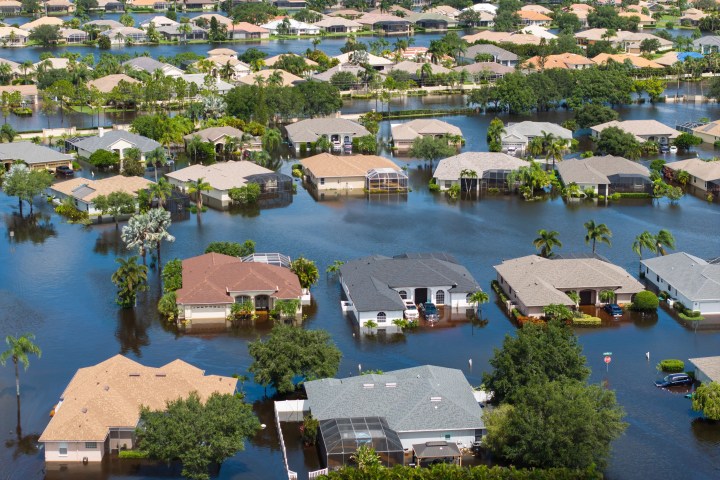
Life in the Shadow of the Storm: Hurricane Preparation on a Warming Planet
By Hatim Husainy, Sustainability
In 2011, Binghamton experienced one of the worst floods in the city’s recorded history. Tropical Storm Lee had stalled in the area, fusing with the dying hurricane Katia. These two storm systems combined to release a deluge into the Susquehanna River basin, causing a devastating flood as the river broke its banks and submerged much of the city (NOAA 2024). Today, remnants of the storm’s path can be seen simply by walking through Binghamton. The Macarthur Elementary School had to be entirely rebuilt after the flood’s devastation and now sits on stilts designed to “co-exist [with the river] based on long-term flood projections.” (Welliver 2023) according to the firm hired to rebuild the school. The flood may be over, but its impact has lasted since it persisted.
Hurricanes, their behavior, and the legacies they leave act in much the same way. The devastating Hurricane Katrina reshaped the city of New Orleans and its surrounding areas, even the parts that didn’t flood entirely (Ambrose 2021). The Lower 9th Ward is still struggling to rebuild – in the Ninth Ward, the failure of a floodwall caused much of the section to be flooded, and the Ninth was also the last part of the city to be cleared of water and debris. In contrast, some parts of the New Orleans region have completely reinvented themselves. Katrina almost destroyed Saint Bernard’s Parish, but it is now the fastest-growing economic zone in the state. Much of the post-Katrina rebuilding parallels Long Island’s recovery from Superstorm Sandy. In 2013, Sandy reshaped the shorelines of New York and New Jersey. In one of the most expansive shoreline protection projects in the history of New York, the US Army Corp of Engineers built out shoreline protection and restoration efforts from Long Island to New Jersey. (Parker, 2024)
Worryingly, hurricanes aren’t expected to get any weaker. In fact, Hurricane season is expected to become more intense as the amount of rain hurricanes bring with them increases, and storm surge swings become more dangerous due to higher water levels (Gramling 2021), making adequate preparation all the more critical. It is expected that, among other factors, warming seas and the El Niño cycle have been strengthening the most recent hurricane season, increasing not just the amount of damage inflicted on infrastructure but the threat to human life posed by hurricanes. (Waldholz et al. 2024). Luckily, these threats have not gone unnoticed. The Inflation Reduction Act invested in strengthening hurricane prediction and prevention technology and developing new approaches to fighting extreme weather. (Vaidyanthan 2022). Similarly, communities build strong mutual aid networks in the direct aftermath of hurricanes that fuel survival and recovery and enable communities to recover. (Advocate For Justice 2024). Increasingly extreme weather is also changing the way we build cities. In the wake of the 2011 floods in Binghamton, the city released new plans to begin building storm drainage systems and increasing the amount of water the city can absorb, which would protect from future flooding (Maneshni 2023). These plans mirror similar developments elsewhere in the world – the “sponge city” movement that began in China, aiming to lower flood casualties in China’s rapidly growing and industrialized cities, has shown promise and laid out a blueprint that has since gained international recognition (Ruwitch 2023).
Moving towards greener and more absorbent cities has numerous benefits beyond merely less flooding (Simon, 2022) – they are walkable, calm, and sustainable. Recent research on using fungi in land purification has suggested that these strategies could yield several auxiliary benefits, such as purifying soil of everything from heavy metals to pesticides. (Akhtar et al. 2020). Hurricane Helene recently tested these ideas. When the storm rampaged through Florida, one community explicitly designed for flood resilience and energy efficiency weathered it with few problems (Ramirez, 2024).
The climate crisis is an issue with many angles. It forces us to examine how we live our lives, not just in terms of energy but how we build our cities, transport ourselves, and what we eat. As we are forced to deal with the consequences of unchecked climate change, it is not enough to focus on lowering emissions. We must also prepare ourselves for an exceedingly hot world — and, as a result, more hurricanes, tornados, and droughts. These are problems that would be difficult to deal with in the most ideal circumstances, and we must leverage the potential of civil engineering and urban design to face these challenges and turn them into opportunities.

Hatim Husainy is a freshman from Smithtown, NY, studying political science. He is in the early phases of a research project on human rights in the Binghamton area. In addition to the Happy Medium, he participates in Moot Court, Model United Nations, and Citizens Climate Lobby. He plans to pursue law school after his undergraduate degree, and from there, he plans to save the world.
References
Advocates for Disaster Justice. https://www.advocatesfordisasterjustice.org/ (November 16, 2024).
Akhtar, Nahid, and M Amin-Ul Mannan. 2020. “Mycoremediation: Expunging Environmental Pollutants.” Biotechnology Reports. https://www.sciencedirect.com/science/article/pii/S2215017X19307003 (November 2024).
Ambrose, Kevin. “Sixteen Years after Katrina, New Orleans Has Strengthened Its Flood Barriers – The Washington Post.” Washington Post. https://www.washingtonpost.com/weather/2021/08/28/hurricane-katrina-orleans-rebuilt-photos/ (November 18, 2024).
“Binghamton City School District – MacArthur Elementary School.” 2023. Welliver. https://www.buildwelliver.com/projects/binghamton-city-school-district-macarthur-elementary-school/ (November 16, 2024).
Gramling, Carolyn. 2021. “Hurricanes Are Getting More Dangerous, but May Not Be More Frequent.” Science News. https://www.sciencenews.org/article/hurricanes-frequency-danger-climate-change-atlantic (November 16, 2024).
Maneshni, Autriya. 2023. “Binghamton Reveals 1st Climate Action Plan in a Decade.” https://www.wbng.com. https://www.wbng.com/2023/06/27/binghamton-reveals-1st-climate-action-plan-decade/ (November 16, 2024).
Parker, Lisa. 2024. “Looking Back: Twelve Years of Coastal Restoration & Resilience since Hurricane Sandy.” DredgeWire. https://dredgewire.com/looking-back-twelve-years-of-coastal-restoration-resilience-since-hurricane-sandy/ (November 17, 2024).
Ramirez, Rachel. 2024. “Helene and Milton Put This Net-Zero, Hurricane-Proof Community to the Test. the Lights Stayed on as Everything Else Went Dark.” CNN. https://www.cnn.com/2024/10/12/climate/hurricane-milton-helene-florida-homes/index.html (November 16, 2024).
Ruwitch, John. 2023. “Making Cities ‘spongy’ Could Help Fight Flooding – by Steering the Water Underground.” NPR. https://www.npr.org/2023/10/03/1202252103/china-floods-sponge-cities-climate-change (November 16, 2024).
Simon, Matt. 2022. “If You Don’t Already Live in a Sponge City, You Will Soon.” Wired. https://www.wired.com/story/if-you-dont-already-live-in-a-sponge-city-you-will-soon/ (November 16, 2024).
US Department of Commerce, NOAA. 2024. “Flood of September 07-08, 2011 Lee.” National Weather Service. https://www.weather.gov/bgm/pastFloodSeptember072011 (November 16, 2024).
Vaidyanathan, Gayathri. 2022. “Scientists Welcome ‘enormous’ Us Climate Bill – but Call for Stronger Action.” Nature News. https://www.nature.com/articles/d41586-022-02223-8 (November 16, 2024).Waldholz, Rachel, and Alyson Hurt. 2024. “Are Hurricanes Getting Worse? Here’s What You Need to Know.” NPR. https://www.npr.org/2024/10/08/nx-s1-5143320/hurricanes-climate-change (November 2024).
-
Electoral Cooperation Across Borders?: Political Internationals and Electoral Coordination

By Kieran Grundfast, Elections
An often neglected aspect of political parties is their broader participation in transnational political organizations, referred to as political internationals. A political international is a transnational organization comprising parties with a common ideology or political outlook (Wood 2015). These organizations serve as forums where political parties can share experiences, electoral strategies, and policy ideas. Some organize training and workshops for party activists and operatives to learn from each other to better their electoral performance. The first political internationals formed in the 19th century. These organizations were standard among the political left and what were then newly formed socialist and communist political parties in Europe. Since then, these organizations have expanded in popularity to encompass various ideologies, especially after the Second World War and the beginning of the ideologically charged Cold War. Why do political parties join these organizations, and how do they assist member parties electorally? Ultimately, The primary benefit and way these organizations serve to benefit their members electorally is by providing a discussion forum in which parties can exchange information and strategies, while the more resource-intensive tasks are, naturally, handled by the member parties themselves.
Political internationals can provide various resources and avenues for parties to coordinate with other members and enhance their electoral performance. Straightforwardly, political internationals serve as forums for electoral strategy sharing. Parties learn from each other’s successes and failures in campaign organization and voter outreach (IDU 2024; Progressive International 2024). Political internationals may also set up training programs, where the organization offers workshops and training sessions to educate party operatives on effective messaging and campaigning strategies. An example is the Sao Paulo Forum, a forum for left-leaning political parties in Latin America, which organizes political training schools where party operatives and strategists learn from each other. This forum was also crucial for convincing member groups that electoral competition was the best means for achieving power, given that it originally included several armed groups (Caldero 2022). The International Democracy Union, a center-right political international formed during the Cold War, provides a similar forum for exchanging messaging and electoral strategies. However, unlike the Sao Paulo Forum, it does not organize training programs for the member parties (IDU 2024).
Political internationals also support member parties by helping to ensure the validity and security of the elections in which member parties participate. For example, Progressive International, which brings together left-leaning political parties, activists, and pressure groups, established its electoral observatory to support member parties where democratic processes are either not consolidated or deteriorating (Progressive International 2024). They help aligned groups develop messaging strategies to promote their message and combat disinformation (ibid.). Like the Sao Paulo Forum, this organization also organizes informational and training workshops for activists and individuals from member organizations to help them build the relevant human capital and expertise needed to compete in elections successfully (ibid.).
It should be noted that not all political internationals engage in the same level of cooperation. The activities of those with high levels of coordination, such as the Sao Paulo Forum and the Progressive International, still do not outweigh each member party’s efforts on their behalf electorally (Day 2006). This is because political parties ultimately have limited resources. It is only rational that they would focus on their own electoral needs first (ibid.). Indeed, unlike other international organizations, no current political international places resource obligations upon its members. Therefore, their coordination and cooperation in elections is entirely voluntary.
Political internationals formed out of a desire for transnational cooperation among like-minded parties and the firm international ideological tensions that underpinned the Cold War. Political parties join these organizations to advocate for shared beliefs and capture the benefits of having a forum of similar organizations to learn from. Political internationals allow political parties worldwide to share electoral and messaging strategies, organize and participate in training programs and workshops to enhance the expertise of their political staff and operatives, assist member parties with electoral observation and security, and generally share resources. Ultimately, however, these organizations have a minor impact on the outcome of any given election, and the actual resources organized and invested by these organizations into helping members electorally are dwarfed by the same of any single member party.

Kieran Grundfast is a Senior from Brookhaven, New York, majoring in Political Science. After finishing his undergraduate degree, he hopes to pursue a master’s in International Relations. He has prior experience volunteering on two campaigns for local offices back on Long Island, and he most recently completed an internship at the Library of Congress. He likes to work out and be in nature. His favorite sports team is the New York Rangers.
References
IDU. 2018. “History | International Democracy Union.” https://www.idu.org/about/history/.
Caldero, Rocco. 2022. “Lula Da Silva Says São Paulo Forum Was Created to Moderate the Left.” The Rio Times. https://www.riotimesonline.com/brazil-news/brazil/lula-da-silva-says-sao-paulo-forum-was-created-to-moderate-the-left/.
Progressive International. “Observatory | Progressive International.” https://progressive.international/observatory/
Wood, Tim. 2015. “Reinforcing Participatory Governance through International Human Rights Obligations of Political Parties.” Harvard Human Rights Journal 28: 147–204. https://heinonline.org/HOL/P?h=hein.journals/hhrj28&i=151 (November 12, 2024).
Day, Stephen. 2006. “Transnational Party Political Actors: The Difficulties of Seeking a Role and Significance.” EU Studies in Japan 2006 (26): 63-83. doi:10.5135/eusj1997.2006.63.
-
Isolating Taiwan: Johannesburg or Bust?

By Max Drucker, Foreign Affairs
On October 7th, South Africa formally requested the Taiwanese government to move its unofficial embassy out of the administrative capital of Pretoria to Johannesburg. This move has been largely interpreted as South Africa conceding to China by subverting relations with Taiwan to strengthen relations with the former. South Africa officially cut ties with Taiwan in 1997 after it officially recognized the Communist Chinese Party as China’s legitimate governing authority. The nation has maintained an unofficial Taiwanese liaison office in the capital. South Africa wishes to continue the informal relationship with Taiwan, but nevertheless describes its embassy as a ‘trade office.’ South Africa’s request to move the Taiwanese embassy reflects the non-political and non-diplomatic relationship South Africa has with Taiwan. This demonstrates the international norm that capitals are reserved for official foreign embassies and high commissions (Barlett 2024). However, Taiwan has moved to reject South Africa’s embassy exchange, seeing it as a breach of a bilateral agreement made between the two countries in 1997 following South Africa’s withdrawal of Taiwanese recognition. The clash has forced South Africa to decide whether or not it is worth pandering to the Chinese at the cost of an economic relationship with Taiwan.
Understanding BRICS
South Africa’s appeasement of China can be attributed to China’s integral role as South Africa’s largest trading partner and their shared membership in the organization known as “BRICS”. BRICS began as an international forum between Brazil, Russia, India, China, and South Africa (forming an acronym for its name), and has since grown to include members such as Egypt, Ethiopia, the UAE, and Iran. The constituent states of BRICS represent an organized challenge to international organizations such as the European Union, NATO, and the G7. The BRICS states challenge Western institutions such as the World Bank and the United Nations, as they believe they are disadvantaged by the Western-oriented international order (Ferragamo 2024). However, BRICS is more an international symbol than a functional organization. Their goal of challenging the US dollar has made little to no progress, and there have been very few gains toward reforming institutions such as the World Bank and the IMF, and it suffers from internal discord through contested geopolitical confrontations between the constituent members (O’Neill 2024). Relations between member states such as India, China, and Russia have been strained by historical and contemporary conflict, which greatly complicates concrete multilateralism. BRICS represents a symbolic challenge to the Western-built world order but is often misconstrued as something more than just a platform for contentious and isolated states.
South Africa’s Relationship with Taiwan
It is important to frame the dissonance between South Africa and Taiwan as a conflict manufactured by China that has nothing to do with their shared membership in BRICS. China’s policy toward Taiwan is centered around depleting international recognition of the state. It has been employing this strategy by implementing economic and developmental investment projects in impoverished states across Africa and Asia, with the caveat that these states sever ties with Taiwan. Given that South Africa has already recognized China, ceasing Taiwanese recognition nearly thirty years ago, South Africa is consolidating its partnership with China by further alienating Taiwan. South Africa has warned of drastic measures if the unofficial Taiwanese embassy is not moved. The Taiwanese foreign minister Lin Chia-Long stated Taiwan was considering closing South Africa’s own liaison office in Taipei in response to South Africa’s demand. The initial threat South Africa presented to Taiwan–that Taiwan relocates the office to Pretoria or risk its shutdown–poses a major loss in trade, travel, and educational exchange to both states (AP News 2024).
In an eerie sense of déjà vu, Taiwan was posed with the same ultimatum by the Nigerian government in 2017, following the reveal of a $40 billion Chinese investment plan into Nigeria. The Nigerian government used the same rationalization that South Africa used for their relocation–namely, that relations between the two states haven’t changed given Nigeria’s recognition of China in 1971, and that acknowledging the unofficial embassy as a trade office was simply a clearer distinction of relations (CNBC 2017). Similarly, Taiwan protested Nigeria’s request but decided the best choice was to move from the Nigerian capital Abuja to Lagos, Nigeria’s commercial hub. This poses the question of whether Taiwan would concede to South Africa as they did with Nigeria. This form of isolation is not new to the Taiwanese government; however, as international recognition and cooperation dwindle, China’s threat of annexation looms greater.
The Bigger Picture
Given Taiwan’s geographic and historical proximity to the mainland, China is simultaneously Taiwan’s largest trading partner and biggest threat. The Chinese government adamantly views Taiwan as a historic province of China and dismisses any claims of Taiwanese sovereignty. The United States policy toward China and Taiwan supports the People’s Republic of China as the sole Chinese nation but also maintains a guarantee of Taiwanese sovereignty. The United States’ partnership with Taiwan was founded on the Cold War narrative of communism against capitalism and has since grown into the contemporary issue of authoritarianism against democracy. United States Republican senator Marsha Blackburn outlined this idea in a recent statement in which she condemned the actions of the South African government and called on the Biden administration to take a harsher stance toward South Africa (Yu-Chen 2024). The implications of a Taiwanese concession to the South African government enable Chinese attempts to undermine Taiwanese sovereignty, which only places China closer to realizing its territorial ambitions.

Max Drucker is a senior-year student from Brooklyn, NY. He’s majoring in Political Science with a double minor in Religious Studies and Genocide and Mass Atrocity Prevention (GMAP). He mostly concentrates on the global affairs facet of Political Science. He was fortunate enough to spend a semester in Vienna, Austria studying International Relations. In his free time, he enjoys listening to music, hanging out with his cats, and playing the guitar and bass.
References
AP News. 2024. “South Africa asks Taiwan to move its unofficial embassy out of the capital” AP News. https://apnews.com/article/south-africa-taiwan-office-china-971930e1d381d44f7d63170aefdf12bd
Bartlett, Kate. 2024. “South Africa bows to Chinese pressure to move Taiwan office, analysts say” Voices of America. https://www.voanews.com/a/south-africa-bows-to-chinese-pressure-to-move-taiwan-office-analysts-say/7830219.html
CNBC. 2017. “Nigeria trims ties with Taiwan as it courts China” CNBC. https://www.cnbc.com/2017/01/13/nigeria-gets-40-billion-from-china-tells-taiwan-to-move-out-of-capital.html
Ferragamo, Mariel. 2024. “What Is the BRICS Group and Why Is It Expanding?” Council on Foreign Relations. https://www.cfr.org/backgrounder/what-brics-group-and-why-it-expanding
O’Neill, Jim. 2024. “The BRICS Still Don’t Matter” Project Syndicate. https://www.project-syndicate.org/commentary/moscow-brics-summit-expanded-bloc-still-rudderless-and-ineffective-by-jim-o-neill-2024-10
Yu-Chen, Chung. 2024. “U.S. urges ‘engagement’ with Taiwan amid South Africa office dispute” Focus Taiwan. https://focustaiwan.tw/politics/202410240008
Image Credit: Palácio do Planalto, CC BY 2.0 https://creativecommons.org/licenses/by/2.0, via Wikimedia Commons
-
Subscribe
Subscribed
Already have a WordPress.com account? Log in now.
 Happy Medium
You must be logged in to post a comment.