-
WANTED: Affordable Bedrooms in the City that Never Sleeps

By Aidan Klarman, US Policy Reporter
New York City’s housing crisis is a complex tapestry of challenges that affects every corner of the Metropolitan Area. While migration, bureaucratic hurdles, and slow construction are often cited as the primary culprits, the underlying issue lies in exclusionary zoning laws and local land use restrictions. These regulations have become the invisible architects of our neighborhoods, often with unintended consequences (Thomas 2023). For example, housing prices in the NY Metropolitan Area jumped 20% in 2021. At the same time, 70% of residential areas in small and big cities alike restricted or banned apartment construction in some way, illustrating how affordability decreases when availability doesn’t meet demand (Hanley 2023).
The New York urban-suburban landscape is one where minorities and low-to-moderate-income families struggle to find affordable housing, and urban development is not just inefficient but historically segregated. This reality calls for urgent action – a comprehensive state policy to reform zoning restrictions, streamline processes, and remove unnecessary obstacles to high-density, affordable housing (Gray 2022).
The Zoning Conundrum: A Developer’s Challenge
Developers and those looking for housing in New York face a triad of legal-political obstacles in local government that zoning policy experts call blunt tools, subtle tools, and arbitrary requirements (Harvard Law Review 2022). Blunt tools are zoning and land-use laws explicitly limiting or banning denser housing construction in certain municipalities. In contrast, subtle tools are procedural constraints that increase costs for developers, intentionally disincentivizing development projects. These include prolonged public and site-plan review processes and restrictive zoning around historic sites (Kazis 2022). The most challenging are arbitrary requirements – unreasonable mandatory criteria for land development set by local governments. These include compulsory parking spaces, minimum lot size requirements, height and density limits, and architectural guidelines that often serve no practical purpose beyond complicating the construction process.
The Ripple Effect: Beyond Housing
The impact of these zoning practices extends far beyond the housing market, reshaping New York’s economy and society:
- Housing prices have escalated dramatically. As construction rates plummet, especially for affordable multifamily housing, demand outpaces production, turning the housing market into a high-stakes competition.
- Economic productivity is suffering. New York’s financial power stems from its diverse mix of professionals and workers. However, as high-density development gives way to suburban sprawl, we’re witnessing a disruption of economic accumulation and diversification.
- Wealth distribution is becoming increasingly skewed. Restrictive zoning often reinforces a racial or wealth-based status quo, relegating minorities and low-income workers to underdeveloped communities lacking resources and opportunities.
- Environmental impact is significant. Bans on multifamily units and ADUs promote car-centric living, increasing carbon emissions and traffic. Urban sprawl, induced by a lack of housing density, is taking its toll on our environment.
- Freedom of mobility is being constrained. With limited options, residents are forced to choose between unaffordable city apartments or impractically distant suburban houses (Kazis 2022).
A Call for Change: Reimagining New York’s Housing Landscape
The solution to the housing policy issue requires state intervention to level the playing field. Reforms are needed to restrain local authorities from arbitrarily restricting development, formalizing criteria for new projects, and ending the case-by-case review process that impedes construction. One promising approach is to emulate Massachusetts’ Chapter 40B law (Barret 2017). This would provide a streamlined approval and state appeals process for qualifying new projects in zones with under 10% affordable housing stock. Since its implementation in the 1970s, 40B has allowed for flexible urban development that meets the needs of Massachusetts residents without causing a decrease in existing property values, a prospect commonly used to argue for zoning restrictions, especially in wealthy communities. Reports on the effects of 40B since its inception show an increase in affordable housing construction and diversification of specialized developments, all while market incentives replaced large state subsidies. Thus, 40B has the potential to increase the housing stock and reduce taxpayer spending through guided regulation (CHPA 2003).
Another potential solution is SB162, proposed by NYS Senator Brad Holyman-Segal (Holyman-Segal 2024). This bill aims to eliminate parking requirements, modify mandatory minimum lot sizes, and legalize dense, affordable housing by limiting municipal authority to impose questionable restrictions. By removing arbitrary requirements like minimum parking spaces or minimum lot sizes, SB162 would make affordable housing projects easier to approve and faster to construct. Additionally, the bill would appropriate funds for the construction of duplexes and fourplexes to promote housing density. Even still, more comprehensive reforms are necessary. These would include liberalizing ADU regulations, eliminating single-family zoning, and removing off-site parking requirements. It is time to increase density in our suburbs, invest in public transportation, and create a New York that is accessible to all its residents.
The Stakes: More Than Just Housing
The implications of these zoning practices are far-reaching. When implemented incorrectly, they can perpetuate racial and income segregation, create inefficient suburban layouts that waste space and energy, and impact public health and economic productivity leading to even more housing scarcity. For example, immigrants make up 44.3% of the New York City labor force and add hundreds of billions in economic value, yet they also make up a staggering 18.6% of the city’s homeless population (DiNapoli 2024). Similarly, redlining and exclusionary zoning policies (among broader systemic inequities) have led African Americans to represent over 50% of NYC’s homeless, despite only being 24% of the population and 23.1% of the labor force (Wasow-Park 2024). Migrants, minorities, and low-income workers are essential labor in the service, food, public, and entertainment sectors. Diversity is one of New York’s economic strengths therefore unequal housing outcomes are not only unethical but counterintuitive to New York’s economic-demographic balance. When housing scarcity and the stresses of poverty take their toll, the delicate balance is disrupted, threatening the very essence of New York’s economic ecosystem.
While some may view zoning reform as government overreach, they fail to consider the need for oversight in local governance. It is the duty of the government to correct systemic imbalances that disrupt socio-economic growth and stability. If providing affordable and livable housing is among these duties, then overruling unjust local obstructions is paramount to fostering healthier, more equitable, and productive communities.
The Path Forward: A Blueprint for Change
As it stands, the need for comprehensive reform is clear; a policy that addresses all aspects of the issue is paramount. Drawing inspiration from Massachusetts’ Chapter 40B, streamlining the review process, and mandating affordable housing quotas would be a significant step forward. Likewise, the passage of SB162 would eliminate arbitrary requirements that unnecessarily complicate construction. Furthermore, it is crucial to deregulate ADUs, permit renovations to increase housing density and phase out single-family zoning. Combined with renewed investment in public transportation, these measures can reduce sprawl and pollution while consolidating population density.
The blueprint for a New York with sustainable, efficient, and affordable housing exists, and with the right reforms, it is well within reach. Now is the time for action – time to construct a future where housing is not merely a dream, but instead a reality for all New Yorkers.

Aidan Klarman, born in 2003, is a senior at Binghamton University pursuing a B.A. in Political Science and a Master’s in Public Administration. Raised in East Hampton, New York, he developed an interest in politics during high school, writing for the school newspaper and co-organizing a peaceful demonstration against police violence. He has been involved with organizations like TurnUp Youth Network and the Nancy Goroff congressional campaign. He enjoys outdoor activities, reading news, painting, and writing. Aidan aspires to intern with the New York State Assembly and aims to serve the public at various levels of government.
References
Featured Image: Justin Brown, flickr. https://www.flickr.com/photos/justininsd/8650903114
Edsall, Thomas B. 2022. “Why Aren’t You Voting in Your Financial Self-Interest?” The New York times. https://www.nytimes.com/2022/09/14/opinion/elites-populists-political-beliefs.html (November 24, 2024).
Hanley, Allison. 2023. “Rethinking Zoning to Increase Affordable Housing.” The National Association of Housing and Redevelopment Officials (NAHRO). https://www.nahro.org/journal_article/rethinking-zoning-to-increase-affordable-housing/ (November 24, 2024).
Heudorfer, Bonnie. 2003. The Record on 40B: The Effectiveness of the Massachusetts Affordable Housing Zoning Law. https://www.chapa.org/sites/default/files/qwert_3.pdf (November 24, 2024).
Kazis, Noah. 1/2022. “The Case Against Restrictive Zoning.” NYU Furman Center. https://furmancenter.org/research/publication/the-case-against-restrictive-land-use-and-zoning (November 24, 2024).
Nolan Gray, M. 2022. “Cancel Zoning.” Atlantic monthly (Boston, Mass.: 1993). https://www.theatlantic.com/ideas/archive/2022/06/zoning-housing-affordability-nimby-parking-houston/661289/ (November 24, 2024).
“NY State Senate Bill 2023-S162.” NY Senate. https://www.nysenate.gov/legislation/bills/2023/S162 (November 24, 2024).
Park, Molly Wasow, and Joslyn Carter. 2023. Focus On Equity. https://www.nyc.gov/assets/operations/downloads/pdf/pmmr2024/dhs.pdf (November 24, 2024).
-
From blue to red and back again: Fracking across the administrations, a brief explanation of fracking policy during Obama, Trump and Biden administrations.

By Hatim Husainy, Sustainability
A single, undeniable fact looms large in the political sphere—the world is warming. Each passing year pushes the planet closer to a potential climate catastrophe, the threat of which has grown to dominate the past four presidential terms and now demands immediate action. The differing approaches of presidential administrations and their subsequent consequences are quite complex. To better understand broader climate policy, we can look at the changes in U.S policy on a specific issue.
We can analyze fracking policy’s relationship to broader environmental policy to see how different administrations approach the complicated balance of energy independence and carbon emissions reduction. Hydraulic fracturing, or fracking, is a method of extracting oil and natural gas by digging deep wells and injecting liquid into them at high pressure. This process is particularly productive when combined with horizontal drilling and has been used to extract an abundance of natural gas from shale deposits across the United States. The extraction of natural gas and oil are controversial because the burning of fossil fuels is largely responsible for climate change (Nelsen 2024). Fracking is itself controversial for a variety of reasons. One being that the pressurized liquid can leak into the nearby groundwater. Additionally, an investigation by Environmental Health News uncovered a range of negative health externalities: “researchers found that babies born near frequent flaring—the burning off of excess natural gas from fracking wells—are 50 percent more likely to be premature. In Colorado, … people living near fracking sites face an elevated risk of nosebleeds, headaches, breathing trouble, and dizziness. In Pennsylvania, … people living near fracking face increased rates of infant mortality, depression, and hospitalizations for skin and urinary issues”(Marusic 2021).
The US government’s regulatory structures can dramatically increase or decrease our country’s carbon footprint. The way policies have changed over time can demonstrate the effectiveness of different techniques, and show us the path forward.
Former President Barack Obama’s administration was one of the first in which climate change became an important part of a president’s agenda, and is when the government took some of its first significant steps to slow the warming. He was critical in getting the United States to sign the Paris Climate Agreement (Somnader 2016). This international framework placed the responsibility on countries to cut their emissions in half by 2030 and implement a series of new agencies to assist in the transition (United Nations 2016). His Clean Power Plan was projected to move the country more than halfway to its climate goals before Former President Trump repealed it. Notably, the law was set to go into its enforcement phase in 2022, indicating the speed at which the Obama administration intended to address this issue (NRDC 2017). His rules and regulations on new fracking technology were mainly about transparency concerning the extraction liquid, which environmental groups condemned for being too weak, and energy companies for being too strong (Plumer 2015).
In most policy arenas, Trump’s presidency can be understood as a reaction to and a reversal of the Obama administration. His fracking policy was one aggressively in favor of the practice– he dismantled all of the transparency policies put in place by President Obama and by the end of his presidency, the Trump Administration proudly proclaimed that the US was “the world’s leading producer of both oil and natural gas.” Much of his justification for this hinged on the incredible profitability of natural gas—“[Trump’s] Council of Economic Advisers estimated that fracking and other innovations had reduced energy prices and saved Americans $203 billion per year, or $2,500 each year for a family of four” (Trump White House 2020). Notably, Trump-era deregulation within and outside of fracking led to an estimated 1.8 billion cubic tons more in carbon dioxide emissions throughout his administration, despite many states establishing strong climate policies within their jurisdictions (Pitt et al. 2020).
The Biden Administration, in contrast, was one of the first-ever successful presidential campaigns to center climate policy in its campaign, which later became realized through targeted measures. The Inflation Reduction Act constituted a massive investment in achieving climate goals and is considered the most significant investment in fighting climate change by the United States thus far (Lashof 2024). In other ways, the Biden administration failed to counteract substantial drivers of local emissions—much of the promised regulation of drilling either struggled to pass or was shot down in the courts, and one of the most significant oil projects on federal land was approved (Nilsen 2023). The Biden administration has pursued a “neutral” stance on fracking – not approving any new infrastructure or fracking on federal land nor seeking a curtailment or ban (Egan 2021).
Since the Obama administration, there has been a dramatic increase in focus on climate change, and thus a massive improvement in approaching climate emissions and climate remediation. The cost of solar and offshore wind have decreased dramatically, while wind and solar capacities have soared (Crimmens et al. 2024). As the country becomes more exposed to the climate disaster, it becomes more clear that these efforts can’t come quickly enough.
Fracking is a serious problem, and a good example of the monumental difficulties facing climate legislators. The infrastructure related to fracking and the natural gas it extracts is largely permanent and privately built—this permanence means that the natural gas infrastructure can never be re-positioned towards forms of renewable energy, and privatization means that corporations will be very resistant to the removal or phasing out of that infrastructure before its lifespan is up. Dismantling it will be a formidable and probably decades-long task: but an extremely necessary one (Kemfert et al. 2022).

Hatim Husainy is a freshman from Smithtown, NY, studying political science. He is in the early phases of a research project on human rights in the Binghamton area. In addition to the Happy Medium, he participates in Moot Court, Model United Nations, and Citizens Climate Lobby. He plans to pursue law school after his undergraduate degree, and from there, he plans to save the world.
References:
Photo credit: Figure 1. Mount Whitney: Albert Bierstadt circa 1877. Exhibited in The Rockwell Museum, Corning, New York. Alterations by the Happy Medium.
Crimmins, Allison R. 2023. “Fifth National Climate Assessment.” Fifth National Climate Assessment, November 14. https://nca2023.globalchange.gov/.
Egan, Matt. 2021. “No, Joe Biden Didn’t Just Ban Fracking.” CNN, January 27. https://www.cnn.com/2021/01/27/business/fracking-ban-biden-federal-leasing/index.html.
Kemfert, Claudia, Fabian Präger, Isabell Braunger, Franziska M. Hoffart and Hanna Brauers. 2022. “The Expansion of Natural Gas Infrastructure Puts Energy Transitions at Risk.” Nature Energy 7: 582–87, July 4. https://doi.org/10.1038/s41560-022-01060-3.
Lashof, Dan. 2024. “Tracking Progress: Climate Action under the Biden Administration.” World Resources Institute, July 30. https://www.wri.org/insights/biden-administration-tracking-climate-action-progress.
Marusic, Kristina. 2020. “Babies born near natural gas flaring are 50 percent more likely to be premature: Study” Environmental Health News, July 16.
Marusic, Kristina. 2021. “Fractured: Harmful Chemicals and Unknowns Haunt Pennsylvanians Surrounded by Fracking.” Environmental Health News, April 15. https://www.ehn.org/fractured-harmful-chemicals-fracking-2650428324.html.
Nelsen, Matt. 2024. “Natural Gas Is Scamming America.” YouTube, March 27. https://www.youtube.com/watch?v=K2oL4SFwkkw.
Nilsen, Ella. 2023. “The Willow Project Has Been Approved. Here’s What to Know about the Controversial Oil-Drilling Venture.” CNN, March 14. https://www.cnn.com/2023/03/14/politics/willow-project-oil-alaska-explained-climate/index.html.
Pitt, Hannah, Kate Larsen and Maggie Young. 2020. “The Undoing of US Climate Policy: The Emissions Impact of Trump-Era Rollbacks.” Rhodium Group, September 17. https://rhg.com/research/the-rollback-of-us-climate-policy/.
Plumer, Brad. 2015. “Obama’s Controversial New Fracking Rules, Explained.” Vox, March 20. https://www.vox.com/2015/3/20/8265507/federal-fracking-standards.
“The Paris Agreement.” 2015. United Nations Framework Convention on Climate Change. https://unfccc.int/process-and-meetings/the-paris-agreement.
Trump White House. 2020. “President Donald J. Trump Is Supporting Hydraulic Fracturing and Other Technologies to Protect Our Jobs, Economic Opportunity, and National Security.” National Archives and Records Administration, October 31. https://trumpwhitehouse.archives.gov/briefings-statements/president-donald-j-trump-supporting-hydraulic-fracturing-technologies-protect-jobs-economic-opportunity-national-security/.
Somanader, Tanya. 2016. “President Obama: The United States Formally Enters the Paris Agreement.” National Archives and Records Administration, September 3. https://obamawhitehouse.archives.gov/blog/2016/09/03/president-Obama-United-states-formally-enters-Paris-agreement.“What Is the Clean Power Plan?” 2017. NRDC, September 29. https://www.nrdc.org/stories/what-clean-power-plan.
-
Our Decision: New Yorkers could decide house control
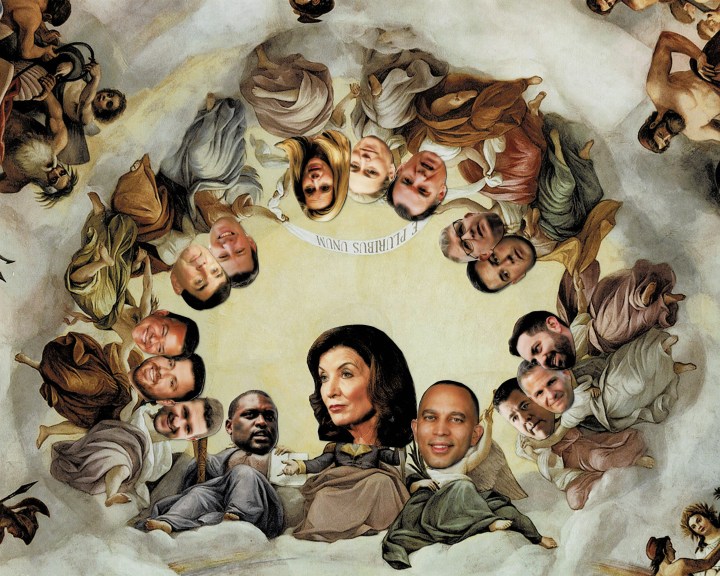
By James Kang, New York Politics
The last congressional election in New York in 2022 may have helped the Republican Party maintain its slight majority in the House, as they successfully flipped four districts. Two years later, the 2024 congressional elections are being held alongside the 2024 United States presidential election, and the outcome of New York’s congressional races will determine if there will be a power shift in Congress in 2025.
Contested Seats in the House
Of the 26 districts in New York, seven appear to be heavily contested for the 2024 elections. One of these districts is the 1st Congressional District, a district known for voting Republican. As of October 1, the polls claim that the Republican candidate, Nick LaLota, has a ten percentage net advantage over the Democratic candidate, John Avlon (FiveThirtyEight 2024). Regardless, the Democratic Congressional Campaign Committee established a strong belief that Avlon has a chance of winning the congressional race as they added him to the list of candidates part of the Democratic Congressional Campaign Committee’s (DCCC 2024) “Red to Blue” program. The “Red to Blue” program is a “highly competitive and tested program at the DCCC that equips top-tier candidates with organizational and fundraising support to help them continue to run strong campaigns. Come November, these candidates and others will take on Republicans across the country—and fight to help us win back our majority.” (Democratic Congressional Campaign Committee 2024).
Another contested seat in the House is the 3rd Congressional District, with polls stating that this district could be likely Democratic (FiveThirtyEight 2024; New York Times 2024). The candidates are incumbent Tom Suozzi and Republican Michael LiPetri Jr. Although a Democratic victory is likely, the polls have been close for the first few months of 2024. The deciding factor of this election appears to be the candidates’ positions on housing, as noted in their televised debate (Ballotpedia 2024).
Another contested seat in the House is the 4th Congressional District, with the polls stating that this district could be a dead-heat toss-up (City and State New York 2024; New York Times 2024). The candidates are Anthony D’Esposito for the Republican Party and Laura Gillen for the Democratic Party. While incumbent D’Esposito helped Republicans flip this seat in 2022, he is now vulnerable because he allegedly put his fiancee’s daughter and a woman he was having an affair with on his payroll (New York Times 2024). There are more active registered Democratic voters in this district than Republicans, but more importantly, this will be the second time that these two candidates face off against each other. The 4th Congressional district experienced minimal changes in regard to the redistricting process, and in 2022, D’Esposito won the district by a slight margin of 4 points (Ballotpedia 2024; FiveThirtyEight 2024). Overall, polls claim that this congressional district can be flipped back to the Democratic side, but the race is still a toss-up (FiveThirtyEight 2024; New York Times 2024).
Another contested seat in the House is the 17th Congressional District, with the polls stating that this district is another toss-up (New York Times 2024). The candidates are Mike Lawler of the Republican Party and Mondaire Jones of the Democratic Party. In terms of voter registration, there are more registered Democratic voters than Republican voters. This will be the first time these two candidates face off against each other, but Jones has had experience before, being previously elected as the representative for the 17th Congressional District in 2020. Similar to aforementioned candidates, Jones is also part of the “Red to Blue” program, as the Democratic party believes that he is a strong candidate that can help “lower costs for everyday people, defend democracy, improve public safety, and stop Republicans from banning abortion.” (DCCC 2024). The outcome of the election is still relatively unknown. Jones has experienced attacks from New York media that he lied about his reason for leaving the district, in addition to his loss in the Working Families Party primary to Anthony Frascone. Lawler has tried to strengthen his campaign by vocalizing his support for Israel to appeal to the large Jewish population in the district (City and State New York 2024). So while polls perceive a seat-flip for the Democrats, this race is far from over (FiveThirtyEight 2024; New York Times 2024).
In the 18th Congressional District, incumbent Pat Ryan faces Republican Alison Esposito. The polls have suggested that the election is close, as Ryan and Esposito were even on August 1-3. As the months went on, Ryan gained a slight advantage of four percentage points.. The most significant factor of this election appears to be the candidates’ positions on abortion rights. Ryan’s campaign has criticized the Supreme Court’s overturning of Roe v. Wade and promotes abortion rights, while Esposito’s campaign claimed that the Supreme Court was right to return the issue back to the states (City and State New York 2024).
Furthermore, another heavily contested election is taking place in the 19th Congressional District, which includes Binghamton. Republican incumbent Marc Molinaro and Democrat Josh Riley are fighting for the seat in a rematch (Ballotpedia 2024). Josh Riley has the support of the Democratic Congressional Campaign Committee with their “Red to Blue” program, as well as having more registered, Democratic registered voters in his district.. This will be a tight race, as Molinaro had only won the 2022 election by approximately 4500 votes (City and State New York 2024).
Last but not least, the contested race of the 22nd Congressional District. According to the polls, Democrat John Mannion currently holds a slight advantage over his opponent, incumbent Brandon Williams. Also supported by the “Red to Blue” program, Mannion may flip the congressional seat. Historically, the 22nd Congressional District has tended to flip between Democrat and Republican representation, as Williams managed to win the 2022 election by just 1 percentage point (City and State New York 2024).
To conclude, the Democratic Party’s electoral strategy is to direct and establish a coordinated effort. According to New York Democratic Senator Kirsten Gillibrand, one of the reasons why the Democratic Party lost to the Republicans in 2022 was because “There were no big rallies. There was no organized canvassing, there was no coordination at all amongst local candidates and House candidates,” Gillibrand said to NPR News. As a result, the Democrats are using the “Red to Blue” program to unify their efforts, and link state and local party operations. On the other hand, New York Republicans are striving to maintain their congressional seats by utilizing similar strategies from 2022. Similar to their “formula in 2022, [which] was a barrage of ads and attacks on Democrats on crime, immigration, and border security,” Republicans’ 2024 electoral strategy is to re-highlight these issues to the Republican voters (NPR 2024).
2022 New York Congressional Race
When examining the relationship between a hypothetical power shift in Congress in 2025 and the outcome of congressional races in New York, it is important to examine the 2022 New York Congressional races. These races can provide valuable insight into the key factors that contributed to the current balance of power in Congress and what can influence future elections.
New York is traditionally perceived as a “blue” state, indicating Democratic Party dominance (270towin 2024). This was especially the case for its congressional delegation, as the Democratic Party has held a significant majority in the House. When the 2020 House elections were held on November 3, 2020, the Democratic Party maintained 19 of their 21 held congressional districts, with two being flipped to the Republican Party (Politico 2021).
However, it was announced on April 2, 2021, that New York was one of seven states that lost seats in the House of Representatives. Since US state population totals determine how many seats each state receives in the House of Representatives, New York lost one congressional seat; only 89 residents short (AP News 2021).
New York also had another change implemented in 2014: a constitutional amendment known as Proposition 1. This piece of legislation preaches a fair and transparent redistribution process of the state legislative and congressional districts. This would be achieved by ending prison gerrymandering and eliminating party legislative control over voting procedures and map approval mechanisms. Briefly, prison gerrymandering is “the practice of counting individuals where they are incarcerated, rather than where they call home – [which] actively works against the notion of equal representation that is foundational to our democracy” (Democracy Docket 2021). Through the amendment, “New Yorkers voted to establish an advisory commission for redistricting, composed of ten members. Each of the majority and minority leaders in the New York legislature appoints two commissioners, and those eight commissioners, in turn, choose the remaining two members, who cannot be registered members of either of the state’s two largest political parties (i.e., must be members of third parties or independents)” (Brennan Center for Justice 2020).
Having this in mind, the New York Independent Redistricting Commission submitted its initial redistricting proposals to the public on September 15, 2021. After two sets of maps were passed on February 2, 2022, New York Democratic Governor Kathy Hochul signed the new congressional and state legislative map proposals into law the next day. Democrats in New York submitted these maps in hopes of maintaining their power while decreasing Republican power in the state (Princeton 2023). On the contrary, after back-and-forth reviews by different levels of New York state courts, the maps were rejected because they were perceived to be gerrymandered. Eventually, New York Judge Patrick McAllister approved a new congressional map published by a special master under the New York Court of Appeals. Through this newly approved congressional map, voting power was shifted in the state, but political scientists perceived that Democrats would keep their political advantage regardless (New York State Independent Redistricting Commission 2021; Ballotpedia 2024).
Democrats eventually learned that this wasn’t the case. After the House elections were held on November 8, 2022, the Democratic Party has only won 15 of New York’s House seats. In other words, having won 11 of New York’s 26 districts, the Republican Party was successful in flipping 4 of the districts. Not only was this a shock to the Democratic Party, but political scientists began considering if New York was slowly transitioning into a “purple” state.
So what exactly happened? One of the arguments political scientists propose is that New York’s loss of a congressional seat and the new redistribution of the congressional districts was to blame. On the other hand, others argue that seats were flipped from Democrat to Republican because of issues with turning out their core supporters. The numbers show that fewer New Yorkers cast ballots in the 2022 elections compared to previous years, with the steepest declines occurring in the New York City boroughs. To put it in perspective, since the 2020 election is when the presidential election occurs, it is better to examine the 2018 midterm election, being in the same category as the 2022 election. After all, voter turnout typically decreases during midterm election years compared to presidential election years (New York City Campaign Finance Board 2019).
In 2018, voter turnout was significantly higher than it was in previous midterms, at a rate of 39% in New York City, including over 250,000 new voter registrations. However, in 2022, voter turnout in New York City decreased to 38.3%, with only approximately 154,000 voters to be newly registered. Therefore, the drop in voter turnout was approximately 500,000 votes in 2022 compared to 2018, despite the 2022 election having more than 5.7 million votes cast. Moreover, Brooklyn, being one of the most important boroughs for Democratic votes, saw 109,815 fewer votes cast than in 2018. Manhattan also witnessed a decline in voter turnout, with 114,171 fewer votes than in 2018. Staten Island, which is prominently known for its Republican status, experienced an increase in voter turnout, with approximately 1400 additional votes (Brookings 2023; New York City Campaign Finance Board 2023).
Furthermore, when examining voter turnout by age group, there are evident large distinctions for the younger and middle age groups. In 2018, there was a 39.3% turnout for the age group 18-29, while there was a 26.6% turnout in the 2022 general election. In 2018, there was a 42.6% turnout rate for the age group of 30-39, while it decreased to 32.9% in 2022. In 2018, there was a 46% turnout rate for the 40-49 age group, which decreased to 37.4% in the 2022 general election. As for the 50-59 age group, the turnout rate decreased from 51.2% to 43.8%. While older age groups also experienced turnout rate decreases, they weren’t as substantial and only decreased by a small percentage (Brookings 2023; New York City Campaign Finance Board 2019; New York City Campaign Finance Board 2023).
When analyzing the turnout rate by race, it is noticeable that Black and Latino or Hispanic Americans had lower turnout rates in 2022 compared to 2018, with the turnout rate for Black Americans experiencing a 5.7% decrease and the turnout rate for Latino or Hispanic Americans decreasing by 2.5%. As for sex, the turnout rate for females experienced a 1.9% decrease, a larger decrease than the male group with a 0.5% decrease. Thus, it is evident that certain demographics of Democrats have failed to turn out, particularly residents of New York City, causing Democrats to lose the congressional elections in 2022 (Brookings 2023; New York City Campaign Finance Board 2019; New York City Campaign Finance Board 2023).
Conclusion
The outcome of New York’s congressional races in New York has the potential to cause a power shift in Congress in 2025. Regarding 2022, however, there is one more aspect of elections to be examined: the red wave. In 2022, polls predicted that there would be a red wave, meaning that the Republican Party would experience significant gains in the elections. The red wave was a concept not applicable to the House, as Republicans only increased from 212 seats in the House to 222, with the Democrats decreasing only from 220 to 213. The number of flipped seats in 2022 was noticeably less than in the 2018 midterm elections, where the Democratic Party won 41 more seats, with the Republican Party losing 42.

James Kang is a junior from Queens, New York, majoring in political science. After graduation, James plans to go to law school. During high school and going into college, James wrote articles and worked with representatives, such as Congresswoman Grace Meng of New York’s 6th district. During this past summer, James worked as an intern in the office of United States Senator Lea Webb of the 52nd district and Josh Riley, who is the Democratic candidate for New York’s 19th Congressional district. Outside of politics, James enjoys playing the piano and basketball.
References:
Boyce, Lily, Lazaro Gamio, Eli Murray, and Alicia Parlapiano. 2024. “Tracking the House’s Most Competitive Races.” The New York Times, October 16. https://www.nytimes.com/interactive/2024/us/elections/house-election-swing-districts.html.
“DCCC Announces First Round of Candidates Named to Coveted 2024 ‘Red to Blue’ Program.” 2024. DCCC, January 29. https://dccc.org/dccc-announces-first-round-of-candidates-named-to-coveted-2024-red-to-blue-program/.
Democracy Docket. 2021. “Prison Gerrymandering, Explained.” Democracy Docket, October 4. https://www.democracydocket.com/analysis/prison-gerrymandering-explained/
Force, Eliot. 2024. “2024 New York Congressional Races to Watch.” City & State NY, July 17. https://www.cityandstateny.com/politics/2024/07/2024-new-york-congressional-races-watch/397861/.
Frey, William H., Gabriel R. Sanchez Rashawn Ray, Elaine Kamarck, and Morley Winograd Michael Hais. 2023. “New Voter Turnout Data from 2022 Shows Some Surprises, Including Lower Turnout for Youth, Women, and Black Americans in Some States.” Brookings, May 18. https://www.brookings.edu/articles/new-voter-turnout-data-from-2022-shows-some-surprises-including-lower-turnout-for-youth-women-and-black-americans-in-some-states/.
New York presidential election voting history – 270towin. 270toWin.com. (n.d.). https://www.270towin.com/states/New_York
“New York’s 4th Congressional District Election, 2024.” Ballotpedia. https://ballotpedia.org/New_York%27s_4th_Congressional_District_election,_2024.
“New York’s 17th Congressional District Election, 2024.” Ballotpedia. https://ballotpedia.org/New_York%27s_17th_Congressional_District_election,_2024.
“New York’s 19th Congressional District Election, 2024 (June 25 Democratic Primary).” Ballotpedia. https://ballotpedia.org/New_York%27s_19th_Congressional_District_election,_2024_(June_25_Democratic_primary).
“New York | Gerrymandering Project.” Princeton University. https://gerrymander.princeton.edu/reforms/NY.
“NYC Votes Releases the 2018-2019 Voter Analysis Report.” New York City Campaign Finance Board. https://nyccfb.info/media/press-releases/nyc-votes-releases-the-2018-2019-voter-analysis-report/.
Ryan Best, Aaron Bycoffe. 2024. “Latest Polls.” FiveThirtyEight, October 8. https://projects.fivethirtyeight.com/polls/.
Walsh, Deirdre. 2024. “How Democrats Are Targeting Red Seats in Blue New York to Help Win Back the House.” NPR, October 3. https://www.npr.org/2024/10/03/nx-s1-5119744/democrats-flip-new-york-house-races.
Walter, Amy. 2024. “2024 CPR House Race Ratings | Cook Political Report.” Cook Political Report, October 18. https://www.cookpolitical.com/ratings/house-race-ratings.
-
How the Framers Created the Debate on Constitutional Interpretation
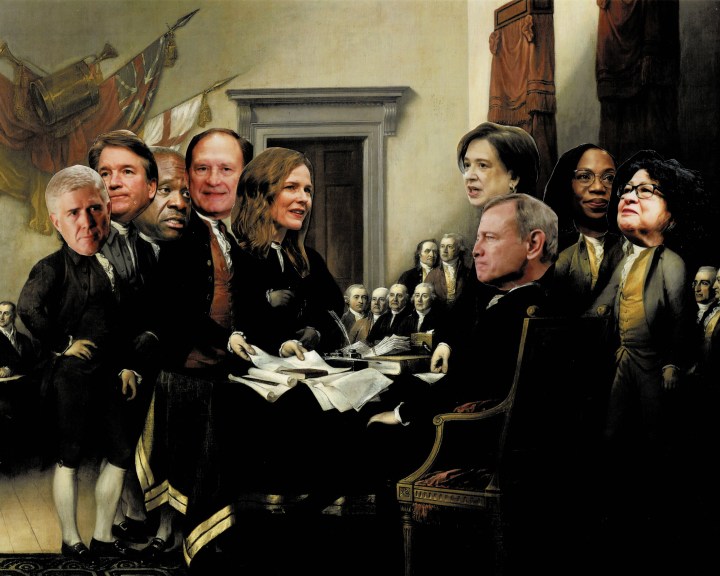
Moss Magnusson, Political Theory
The Constitution says very little about the Supreme Court – its role is outlined in just a few sections. The document truly does not delve deeply into the size, structure, or detailed operation of our nation’s highest Court. Despite knowing the difficulties of constitutional interpretation, the framers deliberately chose not to prescribe a specific method of interpretation. Instead, much of the Constitution utilizes broad language designed to withstand the test of time and ensure its applicability even in changing circumstances (Supreme Court of the United States n.d.). While they could have tried to dictate the proper method of interpretation – originalism, living constitutionalism, Thayerism, and so on –they did not (these specific terms were developed long after the drafting of the Constitution). This strategic decision made by the framers has allowed justices expansive freedom in deciding constitutional questions and spawned a seemingly permanent divide on the question of constitutional interpretation.
To explore the connection between the framers’ choices in drafting the Constitution and the interpretive decisions made by Supreme Court justices, this article will analyze the Constitution’s language, the insights on interpretation found in the Federalist Papers, and the reasons behind the inevitable divide in constitutional interpretation.
A Broad Constitution
The Constitution was written in 1787 and ratified the following year when the ninth state, New Hampshire, ratified it. It is “the world’s longest surviving written charter of government” (U.S. Senate n.d.). Though there are many nuanced reasons for its longevity, this success is generally attributed to its wisdom in employing separation of powers, checks and balances between the branches of government, allowance for amendments, and general flexibility. Relevant to our focus, flexibility is the factor to which we should pay attention. Specifically, flexibility regarding its application. In the Supreme Court ruling of McCulloch v. Maryland, Chief Justice Marshall wrote:
“A constitution, to contain an accurate detail of all the subdivisions of which its great powers will admit, and of all the means by which they may be carried into execution, would partake of the prolixity of a legal code, and could scarcely be embraced by the human mind.” (17 U.S. 316, 407, 1819)
When Marshall says “all the means by which they may be carried into execution,” he is directly addressing interpretation. His point is that to dictate the methods of interpretation, the framers would have been embarking on an overly verbose mission that, in the end, could hardly be interpreted by the human mind. Although Marshall was not a framer of the Constitution, he provided valuable insight into the impossibility of instructing interpretation.
Pursuing a narrow wording of the Constitution would not only have been a futile mission, but broader language comes with its own advantages. First and foremost, broadness allows for applicability in changing circumstances. For example, when the First Amendment declares, “Congress shall make no law… abridging the freedom of speech,” (U.S. Const. amend. I) it allows this principle to adapt to modern contexts, such as speech on social media. Had the framers been more specific, enumerating all forms of protected speech, many contemporary examples could have been left ambiguous or unprotected. Building on this, broadness can protect even those rights that are not listed. This concept was raised by James Madison when he explained that “the enumeration in the Constitution, of certain rights, shall not be construed to deny or disparage others retained by the people” (U.S. Const. amend. IX), this idea was later codified in the form of the Ninth Amendment. While broadness has the defect of leaving interpretation up in the air, it also serves a very important role in creating a functional constitution.
A Look into the Federalist Papers
The U.S. Constitution’s broad and flexible nature has placed much of its interpretation in the hands of the judiciary, an outcome that key figures in its creation foresaw and debated. When we examine how the leading proponents of the Constitution addressed the issue of interpretation, we see a mix of trust in judicial discretion balanced with an expectation that the Constitution should remain supreme – not susceptible to judicial activism.
In many regards, it is this debate on trust that underlies the ambiguousness surrounding methods of interpretation. It has become evident that granting the courts the freedom to interpret the Constitution was necessary to ensure they could properly check and balance the other branches of our government. Without this freedom, judicial review could not have been invented and legitimized by way of Marbury v. Madison (5 U.S. 137, 1803). Through all of this, one thing remains clear – the framers believed some degree of interpretive freedom is necessary for the courts to function properly. We see this in Federalist No. 78, where Alexander Hamilton writes:
“The interpretation of the laws is the proper and peculiar province of the courts. A constitution is, in fact, and must be regarded by the judges, as a fundamental law. It therefore belongs to them to ascertain its meaning, as well as the meaning of any particular act proceeding from the legislative body.” (Hamilton 1788)
Here, Hamilton highlights the intention to leave interpretation up to the courts. The idea is that through the mechanism of judicial review, the Court can ensure “that the will of the whole people, as expressed in their Constitution, would be supreme over the will of a legislature, whose statutes might express only the temporary will of part of the people” (Supreme Court of the United States n.d.). In other words, judicial review allows courts to invalidate laws that conflict with the Constitution, ensuring that the fundamental law remains the ultimate guiding principle of governance. Thus, leaving interpretation to the judiciary was a necessary step in establishing a crucial check on the legislative and executive branches. Without this authority, the courts would lack the power to enforce constitutional limits, undermining the balance of power and the protections embedded in the Constitution.
To this point, James Madison had generally feared that leaving interpretation up to the legislature, rather than the judiciary, would have left constitutional questions subject to political bargaining, and the “Constitution would be reduced to a battleground of competing factions, political passion, and partisan spirit” (Supreme Court of the United States n.d.). For this reason, it was decidedly not the place for the framers to have given extensive guidance as to which method of interpretation is preferred.
What does this mean for preferred methods of interpretation?
The flexibility in the Constitution’s wording and the ambiguity in its application seems to have been largely an intentional strategic decision on the part of the framers. This approach has allowed for applicability in changing circumstances and ensured that the Court could serve its duty as a check on the other branches of government. But how has this approach manifested in actual Supreme Court rulings? And what methods of interpretation have justices favored as a result?
The answer is rather anticlimactic: Justices must determine for themselves how to interpret the Constitution within the framework of precedents, legal norms, and constitutional text. Historically, they have adopted a wide variety of interpretive approaches. The framers’ strategic decisions have directly led to a system where no single method has risen to the top as the categorically correct approach. This is not to say that proponents of each method do not have compelling reasons as to why their preferred method is best or correct. Rather, the result of the framers’ choices has produced an enduring and seemingly irreconcilable battleground over constitutional interpretation. This battleground has shaped landmark cases where justices, divided by their interpretive philosophies, have delivered conflicting opinions – often with lasting consequences for American law and society.

Moss Magnusson is a senior at Binghamton University, double majoring in political science and PPL (politics, philosophy, and law). Originally from Rhinebeck, NY—a small upstate town in the Hudson Valley—Moss has gained valuable experience during his time interning on Capitol Hill, where he contributed to writing congressional records and other legislative materials. While deeply engaged in his political science studies, he also enjoys spending time with friends, playing tennis, and reading. After graduating this spring, Moss plans to work for a year while preparing for the LSAT, with the goal of attending law school the following fall.
References:
Hamilton, Alexander. 1788. “Federalist No. 78.” In The Federalist Papers. Avalon Project, Yale Law School. https://avalon.law.yale.edu/18th_century/fed78.asp.
Marbury v. Madison, 5 U.S. 137 (1803)
McCulloch v. Maryland, 17 U.S. 316 (1819)
Supreme Court of the United States. n.d. “Constitutional Interpretation.” Supreme Court of the United States. https://www.supremecourt.gov/about/constitutional.aspx.
U.S. Senate. “The Constitution of the United States: A Transcription.” U.S. Senate. https://www.senate.gov/about/origins-foundations/senate-and-constitution/constitution.htm.
-
Who Does High Turnout Benefit in the Trump Era?
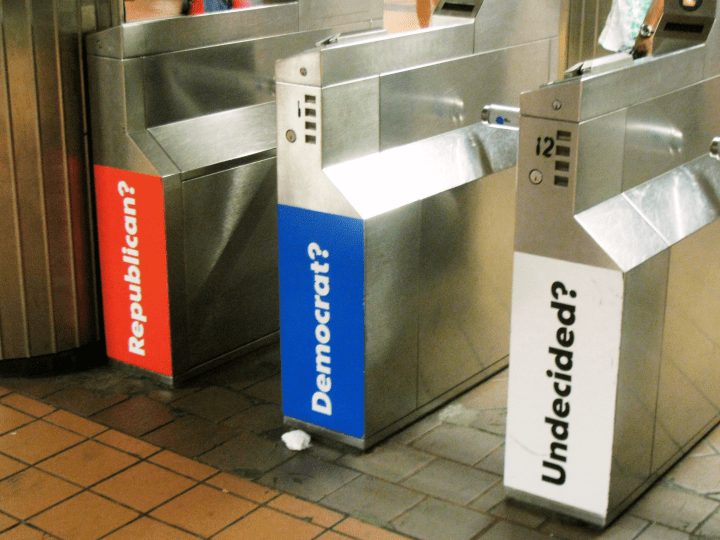
By Kieran Grundfast, Elections
The 2024 presidential election campaign, characterized by a quick succession of unexpected and shocking twists and turns, is likely to result in an incredibly close election. Most polls show Vice President Kamala Harris and former President Donald Trump in a dead heat in the seven battleground states. Vice President Harris has a slight lead in national polls but is well within the margin of error. In elections as close as this, barring systematic polling errors, the outcome will be highly dependent on which campaign can turn out the most voters and persuade the remaining, but minor, proportion of voters that have yet to make up their minds. In this context, infrequent voters, often called low-propensity voters, can have a highly significant but uncertain impact on the election outcome. Indeed, as will become apparent, these voters have driven a large part of the narrative of this election and are a focus of both campaigns.
Put simply, low-propensity voters participate in elections irregularly, or in some cases not at all, despite being eligible to vote. Several major pollsters active in this election identify low-propensity voters by asking survey respondents whether they voted in the last three or four nationwide elections (Hopkins 2024; Brownstein 2024). Those eligible to vote but who voted in none or only one of these elections are considered low-propensity voters. They compare against high-propensity voters who participated in all or most of the last few national elections. Demographic data of identified irregular voters in pollster surveys show that low-propensity voters are from traditionally Democratic-leaning constituencies. That is, taken as a group, they tend to be younger, poorer, and racial or ethnic minorities.
Additionally, they are more likely to be registered Democrats or identify as Democratic-leaning independents. However, low-propensity voters span the partisan-ID spectrum (Cohn 2024). These voters also tend to take a grim view of American politics and report disenchantment with the political process, the two major parties, and often the candidates themselves, a possible explanation for their non-participation compared to frequent voters (Thomson-Deveaux et al. 2020; Montanaro 2020).
In the context of this election, some unusual and significant patterns related to these voters have emerged in the polling data. Before dropping out of the race, President Biden was underwater with low-propensity voters who responded to pollster surveys. Aggregated survey results from polls conducted by NBC in May showed President Biden leading by four points with respondents who said they voted in 2020 and 2022; among those who voted in 2020 but not 2022, Former President Trump led by 12 points. This lead swelled to 20 points among those who said they did not vote in 2020 or 2022 (Brownstein 2024). Of this latter group, 65% disapproved of Biden’s performance in office when asked. Similar patterns emerged in polling by ABC and the NYT/Siena College (Cohn 2023; Cohn 2024; Hopkins 2024). These patterns were also consistent when measured across several other respondent variables, such as race and age, meaning the level of political engagement or participation has predictive value when determining how a person may vote.
Essentially, the lead in national and battleground state polling that Trump opened over Biden before his exit from the race was driven by gains in support among low-propensity voters, and as Nate Cohn, an NYT polls and elections analyst, puts it, “To the extent that has not been true in New York Times/Siena College polling in the last eight years, disengaged voters are driving the overall polling results and the storyline about the election” (Cohn 2024).
This is significant not just because these voters, on average, are part of traditionally Democratic-leaning constituencies such as young, non-white, and lower-income voters but also because it contradicts conventional knowledge and observed electoral patterns in American politics. In this scenario, higher turnout would almost certainly benefit Trump, contradicting decades of observations that Democratic candidates, especially those for president, perform better when turnout is higher; this is precisely because in prior decades, holding other variables constant, low-propensity voters were more likely to support Democrats when they did turn out (Fowler 2024; Hopkins 2024). The inverse is also significant, as the GOP in recent decades performed better when turnout was lower—for example, in the 2014 midterm elections—precisely because higher-propensity voters leaned Republican.
Of course, it is difficult to tell whether these voters will turn out in significant enough numbers in November to have a measurable impact on the race’s outcome. Indeed, the pitfalls of this trend for Trump and the GOP appeared two years ago when Democrats overperformed expectations in the 2022 midterm elections, in part because high-propensity voters shifted toward them in an election where turnout tends to be lower than in general elections (Cohn 2023; Hopkins 2024). Some relevant experts have also predicted that turnout this November will not match that seen in 2020. One expert predicts 15–20 million fewer voters will participate in the November election compared to 2020 and notes that the total number of registered voters in May 2024 is down significantly from the same point in 2020 (Brownstein 2024). The Trump Campaign is well aware of the role turnout, both of infrequent voters and in general, will play in the outcome of the race, given the statistical tie between the former President and current Vice President, and has made turning out low-propensity voters a central part of their campaign strategy (Fowler 2024; Roarty & Swartz 2024). Although their turnout will be hard to predict, the stark gap in survey results that opened up along the lines of voter participation likely means that the outcome of this election will be highly sensitive to the makeup of the electorate (Cohn 2024).
It is essential to ask ourselves what could have prompted such an unexpected and potentially transformative shift among low-propensity voters and the opening of the “participation gap” in presidential race polling. Analysis from the NYT shows that these voters have distinctive views compared to high-propensity Democratic or independent voters. They get their news in unique ways, with an outsized proportion receiving it primarily through social media (Cohn et al. 2024). Compared to their regular or high-frequency counterparts, infrequent voters are likelier to report the economy as their top issue, as opposed to democracy and abortion for frequent Democratic-leaning voters or immigration for frequent-Republican voters, and have a poorer view of the economy under President Biden (ibid.). They are also more likely to state that they want “fundamental change” in the US and report a dislike for the President based on age and performance concerns while maintaining a preference for down-ballot Democratic candidates (ibid.). All in all, it seems that the disapproval of President Biden – particularly the economy’s performance during his administration – and concerns around his age drove infrequent voters, including many Democratic-leaning ones, to vote for Trump.
However, President Biden dropped out of the race in July. Do the patterns in the relevant polling data described above persist now that Vice President Harris is the Democratic nominee? By the time Biden exited the race, he was trailing Trump by about three percentage points in the Real Clear Politics (RCP) national polling average. He also was behind Trump in virtually every battleground state (RealClearPolitics 2024). Harris has improved on these numbers, maintaining a small but persistent two-point lead in the national polling average. She is in a statistical tie with Trump in battlegrounds (RealClearPolitics 2024). Harris has improved over Biden with the electorate at large. She has made up ground with Democratic and Democratic-leaning voters who were either defecting from Biden or, at the very least, not enthusiastic about his candidacy. However, as shown by the continued closeness of the race in the polls, Trump’s newfound support with low-propensity voters and those from traditionally Democratic-leaning constituencies is only muted, not erased, perhaps indicating that their shift toward Trump cannot be attributed solely to their view of the Biden Administration. Recent polls that show continued strength for Trump among young Hispanic men speak to this fact (Morin 2024). The Trump Campaign continues to center them in their overall electoral strategy, especially in battleground states. The Harris campaign, meanwhile, is actively seeking to make up ground lost under Biden with these same constituencies.
If the patterns that have emerged in this election’s polling data do play out among the electorate on Election Day, it would represent a significant change in the dynamics of American politics. It would have long-term implications for both major parties’ electoral strategies. The common belief that higher voter turnout almost always benefits Democrats and, by extension, that lower turnout benefits Republicans would no longer be true. The Democratic and Republican parties need to rethink how they connect and energize voters and the exact voters they should appeal to. Democratic voter turnout strategies based on maximizing turnout among younger, lower-income, and non-white voters will need to be revised. Likewise, Republicans would need to build a long-term strategy to connect with more irregular voters from communities they have not commonly focused on reaching in prior elections, particularly younger, non-white, and lower-income voters if they wish to capitalize on the potential electoral benefits of these recent trends. Moreover, if political participation becomes another cleavage along which partisan polarization develops, and election outcomes become even more sensitive to voter turnout dynamics, electoral politics in the United States will become even more volatile.

Kieran Grundfast is a Senior from Brookhaven, New York, majoring in Political Science. After finishing his undergraduate degree, he hopes to pursue a master’s in International Relations. He has prior experience volunteering on two campaigns for local offices back on Long Island, and he most recently completed an internship at the Library of Congress. He likes to work out and be in nature. His favorite sports team is the New York Rangers.
References:
Photo credit: Eden, Janine and Jim from New York City, CC BY 2.0 https://creativecommons.org/licenses/by/2.0, via Wikimedia Commons
Brownstein, Ronald. 2024. “Analysis: The Unusual Turnout Dynamic That Could Decide the 2024 Election | CNN Politics.” CNN, May 29. https://www.cnn.com/2024/05/29/politics/turnout-2024-election-analysis/index.html.
Cohn, Nate. 2023. “Why Less Engaged Voters Are Biden’s Biggest Problem.” The New York Times, October 30. https://www.nytimes.com/2023/10/30/upshot/biden-voters-midterms-2024.html.
Cohn, Nate. 2024. “The Shaky Foundation of Trump’s Lead: Disengaged Voters.” The New York Times, May 24. https://www.nytimes.com/2024/05/24/upshot/trump-biden-polls-voters.html.
Cohn, Nate, Charlie Smart, and Ethan Singer. 2024. “If Everyone Voted, Would Biden Benefit? Not Anymore.” The New York Times, June 15. https://www.nytimes.com/2024/06/15/upshot/election-democrats-republicans-turnout-trump.html.
Fowler, Stephen. 2024. “Donald Trump’s Big Get-out-the-Vote Strategy in Arizona and Georgia? Donald Trump.” NPR, July 12. https://www.npr.org/2024/07/12/nx-s1-5032965/trump-force-47-maga-organizing-georgia-arizona.
Hopkins, Dan. 2024. “The Less You Vote, the More You Back Trump.” ABC News, April 10. https://abcnews.go.com/538/vote-back-trump/story?id=109090626.
Morin, Rebecca. 2024. “Harris Losing Ground with Young Latino Men, Exclusive USA-TODAY Polls Find.” USA TODAY, October 7. https://www.usatoday.com/story/news/politics/elections/2024/10/07/harris-trump-latino-voters-nevada-arizona/75530730007/.
Montanaro, Domenico. 2020. “Poll: Despite Record Turnout, 80 Million Americans Didn’t Vote. Here’s Why.” NPR, December 15. https://www.npr.org/2020/12/15/945031391/poll-despite-record-turnout-80-million-americans-didnt-vote-heres-why.
Roarty, Alex and Katherine Swartz. 2024. “Trump Is Trying to Make Up Ground by Reaching Out to Voters Who Hate Politics.” NOTUS, October 4. https://www.notus.org/trump-2024/trump-voters-who-hate-politics.Thomson-DeVeaux, Amelia, Jasmine Mithani and Laura Bronner. 2020. “Why Millions Of Americans Don’t Vote.” FiveThirtyEight, October 26. https://projects.fivethirtyeight.com/non-voters-poll-2020-election/.
-
Socialist Presidential Candidate Visits Binghamton: An Exclusive Interview

By Halina de Jong-Lambert, Interviews
In this high-stakes presidential election, with the Democratic and Republican tickets grabbing the majority of headlines, we are prone to forget about third-party candidates.
Claudia De la Cruz, the candidate for the Party for Socialism and Liberation, has a revolutionary agenda and a piercing gaze that demands you not disregard her. She acknowledges that many would consider components of her plan to end capitalism (as well as the plan itself) “radical:” notably, seizing the 100 most prominent corporations in the United States and subjecting them to collective ownership, as well as disbanding the United States Senate, Supreme Court, and Federal Reserve. But to De la Cruz, these are necessary steps for a long-overdue reformation of a profoundly unequal country.
When I asked her about her agenda for corporation nationalization, De la Cruz asserted, “Take into consideration a corporation—like Amazon for example—[it] wouldn’t be Amazon, and it wouldn’t accumulate the amount of profit it does, if it were not because of the workers that work there.” For De la Cruz, the robber barons of the Gilded Age are alive and well in today’s America. She asked me, “Why is it that the United States ruling class is so brutal and so criminal towards the majority of people in this country; why is it that they don’t care about humanity or the planet?”
The biggest shift required by a socialist revolution, according to De la Cruz, is a mental one. She says of her “revolution,”—“It is possible, but we need to disassociate ourselves from a capitalist object that tells us that the only reality is this.” I proceeded to mention the troubled history of socialism as a possible factor that might deter potential supporters, notably the failure and collapse of the USSR. She quickly responded with one of the most surprising statements of our conversation: that the USSR was “sold out,” and that “the person in power, Gorbachev, was very friendly with the United States and gave up the revolution.”
According to De la Cruz, the United States played a role in the downfall or economic failure of many socialist nations, considering them a threat to US hegemony. Regarding Cuba, she cited the US’s long-standing economic sanctions against them which have restricted possible revenue: “What can a country do with $15 million? It’s a whole lot a country could do.” In the case of Venezuela, she said, “see what Venezuelans can do with having their gold given back to them, with giving them back their petroleum and oil companies,” (referring to oil sanctions against Venezuela). De la Cruz’s argument that socialism has never really gotten a fair trial due to “US imperialism” rested on another assumption, one which those who have lived under a socialist socio-economic structure might challenge. She told me, “If their people didn’t want them, they wouldn’t be there.”
Much of De la Cruz’s cynicism about the US’s international influence seems to come from the same place as her disdain for the nation’s governmental and economic structure: that is, its history of suppressing activist groups. She noted to me, “If you’re principled and you fight for those things, the United States government administrations will guarantee that you die.” Many leftist activists have voiced variations on this opinion throughout American history, and one might expect that a candidate who places herself on the side of activists would consider herself closer to the Democratic party than the Republican Party, or at least able to share common ground with them. When I asked De la Cruz about this, a gleam appeared in her eye. De la Cruz sees the Democratic party as “the most undemocratic element in American society.” She may even have a preference for the Republican Party over Democrats. She told me, “The Republican Party—we know exactly what it is. The Democratic Party is like a fox in so many ways that they’ll smile at you, but their intention is still to bite into your flesh and eat you. They’re not there to move the country towards progressive policies.” This Little Red Riding Hood-esque Democratic Party is, in fact, one of her main justifications for a socialist revolution, as she reiterated many times that the Democrats are simply an ”obstacle” to real change.
So where did this hardening against America’s political, social, and economic structure come from? De la Cruz pinpoints much of her disillusionment with the American dream to her upbringing in the South Bronx. As she described to me, “this is the poorest congressional district in the United States, and it has been the poorest congressional district for a long time. This is a neglected community, an abandoned community with high levels of healthcare issues from asthma to diabetes.” Growing up, she experienced what she saw as “a huge gap between what your reality is and what they show you is possible,” perpetuated by Jay Z and other cultural icons who lived “a lavish life” that appeared diametrically opposed to her own experience. She spoke with special passion about her family’s struggles under a system that seemed stacked against them. “My mom has worked religiously in the Department of Education for the city. So why is it that she’s barely making it and she also needs to buy supplies to take to her school? Why is it that my father doesn’t only work construction, but he’s also working as a porter on Fifth Avenue; why is it that they have to struggle so much?” Her thoughts about potential solutions were solidified when she visited Cuba at seventeen and was surprised by the clean tap water, health care system, and lack of student debt under the socialist government. To De la Cruz, “they have so little and they’re doing so much for their people. What could happen if the United States would take everything it has and put it into the people’s needs?”
It is hard not to notice the hypocrisy in some of De la Cruz’s hardest stances. I attended her lecture hosted by Binghamton University’s Democratic Socialists Club (in conjunction with other student organizations), where she jokingly said of the presidential debate between Donald Trump and Kamala Harris, “They’ll say that ‘I have a plan!’ and spend the two minutes that they have to be able to share the plan just saying ‘I have a plan.’ Right.” On her campaign website, there are no more specific steps to her agenda, which would entail massive changes to systems fundamental to the United States, than only two general ones: taking money away from the wealthy and redistributing it to the general populace. Under an “Our Program” header, even the most disruptive ideas (a 90% cut to the military budget) had little more than a few paragraphs to justify them, notably lacking concrete statistical and logistical planning that would properly address how massively complex a “socialist revolution” would be. There may have been a lot of fluffy language thrown around in the presidential debate (as often happens), but voters tend to trust that there is a detailed and sound, statistic-backed plan behind it.
Despite a lack of popularity and shaky prospects in the upcoming election, De la Cruz may represent something more important, something that presents a contrast to her call for revolution: a test of the strength of both our democracy and voting systems. The Declaration of Independence says, “We not only have the right but we also have the duty to alter or abolish any government that does not secure our unalienable rights.” Claudia De la Cruz is attempting to exercise this constitutional right, and the extent to which she can continue to do so will be proof of our collective strengths and weaknesses as a representative democracy. She has already been disqualified from the ballot in both Pennsylvania and Georgia for “failing to file the proper paperwork” (AP News). Her representative alleges it was “sabotage” by the Democratic Party.

Halina de Jong-Lambert is a sophomore double majoring in economics and political science and minoring in music from Manhattan, NY. She is part of the Student Association and Treble Chorus on campus and is an intern for the NYC Department of Health. She wrote a research article last year on the aftermath of a Universal Basic Income study in Otjivero, Namibia as part of the Source Project, interviewing the heads of the study to get an accurate picture of its complex effects. This project gave her the strong belief that economic opportunity is central to quality of life and must be a top priority globally. She enjoys running, baking, and watching horror movies with her roommates, and hopes to one day be a development economist for an international organization like the IMF or World Bank.
References:
Amy, Jeff. 2024. “Judge disqualifies Cornel West and Claudia De La Cruz for running for President in Georgia.” AP News, September 11. https://apnews.com/article/georgia-presidential-election-ballot-cornel-west-cruz-cdcf0229fca52bd13f97384e53d0f638.
-
Tariffs, Taxes, and Trust: Economic Policy and Public Opinion in the Upcoming Election
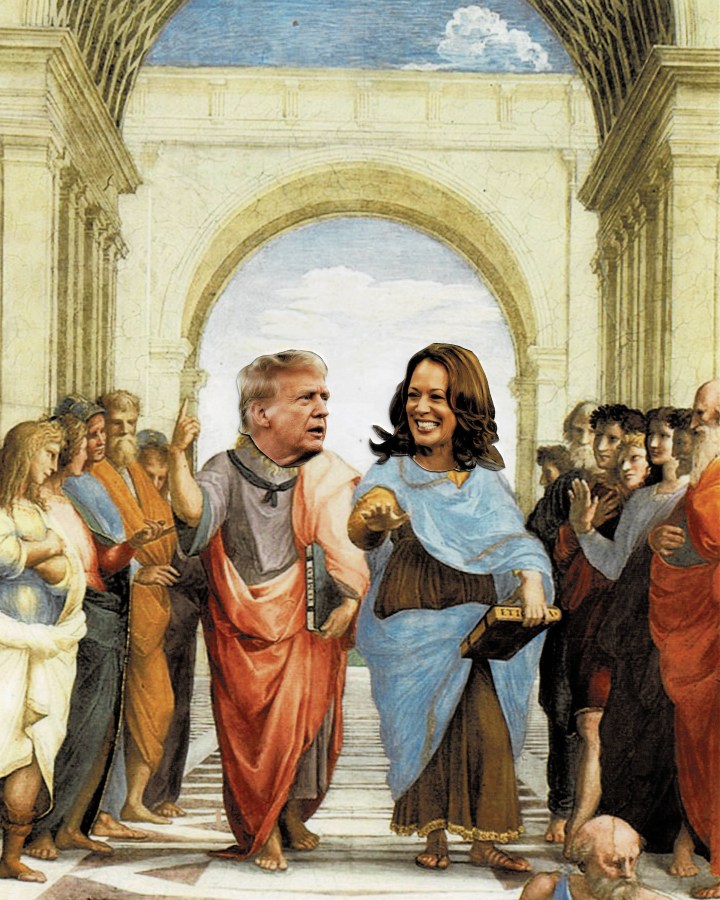
By Aidan Klarman, US Policy
The economy is one of, if not the most, salient points of presidential elections in the United States. A voter evaluates an incumbent president regarding his/her material circumstances to form opinions about the candidate. Similarly, candidates propose policies based on popular economic conceptions that are most likely to attract voters. In this sense, the relationship between candidate approval ratings and their economic plans is one of rational self-interest—the economic policies that candidates release form the basis for voters to engage with their ideas and decide which candidate is best for them.
Still, it is not always so simple to determine the impact of economic plans on voting behavior, as externalities like framing, misinformation, social stratification, and selective bias in the presence of certain terminology or information may skew a voter’s perception of a candidate’s plan. Alternatively, some voters lack a fundamental understanding of government operations, overlooking candidates’ ability to tangibly affect the economic area they illustrate in their campaign. While the current election is politically polarizing, the economic woes Americans face every day don’t discriminate on partisan lines. It is important, therefore, to understand how candidate approval ratings reflect public perception of the economy, as this has significant implications for voting behavior. This article summarizes a handful of polls to assess public perception of Kamala Harris’ and Donald Trump’s economic and tax policies, the macroeconomic implications of each plan, and how they influence public opinion in terms of approval ratings.
The first question we must address is the “why:” Why do voters care about the economy? It may seem obvious, but there are myriad material and cultural cleavages that distinguish one voter’s rational self-interests from another. Industry of employment, age, ethnicity, and personal moral, religious, and political philosophies, influence the frameworks through which voters approach the question: which candidate is better for the economy? For billionaire CEOs, the candidate proposing tax cuts for capital gains and corporate revenues represents an obvious choice to pursue economic self-interest. Conversely, unionized workers, those on Medicare, Social Security, or some form of welfare program, are economically incentivized to oppose tax cuts because they reduce federal funds, consequently disrupting the provision of essential state services. For other voters, cultural and ideological cleavages can determine voter behavior and approval regardless of, or even despite, personal material conditions. Issues like immigration, crime, and religion, compel voters to favor one candidate over the other based on a perceived moral imperative.
Emotions like fear are often employed to convince voters of an existential threat to their way of life and/or material success, imploring them to vote as a matter of necessity instead of rationality. Recently, the rhetoric used in the debate by former President Trump about Haitian immigrants in Springfield Ohio suggested that these immigrants are eating the pets of residents, a demonstrably false statement (Hutzler 2024). The functional objective of this kind of rhetoric is to stoke fear of immigrants committing violence. This fear is a rallying point that compels some to vote out of a perceived necessity. For others, fear is a foot in the door for the Trump campaign to frame a popular issue in a way that fits the solution they are offering, a border wall. This kind of rhetoric may be overlooked by loyal voters and popular with more radical voters. However, it can also scare away the moderate voters who, though concerned about immigration, find Trump’s statements to be too radical, or voters of migrant background or descent that are offended by these statements (Suter 2024).
Religious faith can also produce a moral imperative in voters if a candidate professes favoritism for a particular religion or frames it as being under attack, or conversely, as a threat. Still, the rational self-interest model of voting behavior remains the largest indicator of candidate approval, especially in the absence of a particular moral impetus (such as a perceived threat to democracy). When applied to economic plans, rational self-interest is demonstrated by voter support for policies that reflect and address the daily struggles that individuals face such as wealth inequality, unemployment, food insecurity, housing affordability, and more. Thus, the economy is and will likely remain the defining characteristic of any candidate’s campaign.
The first study I reviewed was a blind survey by The Guardian which polled 2,124 likely voters on their thoughts about twelve economic policies, six proposed by each candidate. The poll asked respondents to rank the twelve economic policies from most favorable to least favorable. To control for confirmation bias, the poll didn’t associate any policies with the respective candidates. This increases the likelihood of impartial nonpartisan responses.
A recurring result was that four of the five most favored policies on the list were the proposals from the Harris campaign while only one of the five was a Trump campaign proposal. The most popular proposal was a federal ban on price gouging for food and groceries, a proposal by the Harris campaign which 44% of respondents viewed favorably. This is not surprising for two reasons: food prices have surged in recent years due to inflation and deregulation, which has raised the cost of living and eroded public trust in large corporations, especially food producers, real estate firms, and the energy sector. This is especially salient for young people and those entering the workforce who are struggling with food and housing insecurity due to stagnant wages, high education costs, and a general lack of consumer protection. Another aspect of this poll to note is that the findings suggest voters may be more likely to favor particular economic policies when those proposals are not immediately associated with a particular candidate or party. In other words, removing social pressure and confirmation bias to tow the party line decreases the chances for personal biases to muddle answers.
The blind survey demonstrated that Harris’ policy plans such as tax breaks for small businesses, an expanded child tax credit, and raising the long-term capital gains tax enjoy a plurality of popular support amongst respondents. Policies originating from the Trump campaign such as universal import tariffs, a 60% tariff on Chinese imports, and lowering the corporate tax rate are significantly less popular. However, it should be noted that Trump’s proposal to eliminate the Social Security benefits tax ranked as one of the five most favored policies with a 42% support rate (Aratani 2024). This particular policy reflects the salience of social security benefits to America’s 68 million current recipients. Additionally, the popularity of this policy demonstrates the importance of capturing older voters, a historically active and reliable voter base. Finally, this policy along with Harris’ small-business tax cut proposal exemplifies how economic austerity measures can be popular when they are perceived to be beneficial.
Returning to tariffs—a major issue for the Trump campaign as they are in line with his extremely popular “America first” rhetoric about making our international trading partners pay up and ‘taking a stand against China’—they are demonstrably proven to raise costs for American consumers as foreign firms simply raise their prices to recoup the profits lost to tariff fees (York 2024). Trump has framed his tariff policy as a long-term plan to stop American manufacturers from shipping jobs overseas while reducing the federal deficit through new import tax revenues, however, the supporting evidence is flimsy (York 2024). This framing places tariffs at the crossroads of economics and foreign policy, challenging voters to decide whether reducing the federal deficit and confronting China, a competitor and threat to American economic hegemony, is worth enduring the price hikes on consumer goods.
The next study is a survey from Data For Progress which raises an important question on the issue of candidate trust and its advantage in approval ratings. This analysis surveyed 1,211 likely voters on who they trust more to properly manage or address important economic issues, with the basic question format being: “Who do you trust more to handle… .” The results indicate a massive trust advantage for Harris as respondents expressed more confidence in her ability to support small businesses, revive the middle class, increase wages, lower housing costs, handle labor union policy, improve infrastructure, create jobs, lower food costs, and protect manufacturing.
On the other hand, respondents trust Trump more when addressing inflation, lowering gas prices, and managing trade policy. Notably, Trump and Harris are trusted equally (44%) to reduce the national debt, possibly implying that voters lack trust in both candidates to handle the debt or that voters do not emphasize the national debt due to a misunderstanding of debt politics or just disinterest. And that distrust or disinterest is understandable considering that both candidate’s plans are expected to add between $3.5 trillion (Harris) and $7.5 trillion (Trump) to the national debt. Ultimately, this poll underpins the importance of trust in spanning the knowledge gap between policymakers and the average citizen (Aratani 2024).
Finally, voters in the Data for Progress survey ranked inflation as the most prominent issue in deciding who to vote for. This is interesting considering the president has little to no power over monetary policy outside of appointing a chairman of the Federal Reserve. This contradiction underscores an important aspect of public opinion regarding presidential elections, in that the issues on which voters base their decisions don’t require a linear rationale of cause and effect. In other words, the input (candidate choice) does not produce the output (lower inflation) but still affects the election and is represented by approval ratings. This shows how public perceptions of economic policy issues, and not the material reality of those issues, can influence public opinion and electoral success regardless of whether or not there exists a causal relationship between the input and output.
So what are the approval ratings? As of late, Harris enjoys an aggregate 50% approval rating with Trump not far behind at 44%, though their disapproval ratings show a different story. 39% of respondents view Kamala as very unfavorable while 9% see her as somewhat unfavorable, an aggregate 48% disapproval rating. 46% of respondents viewed Trump as very unfavorable, with an additional 10% seeing him as somewhat unfavorable, producing an aggregate disapproval rating of 56%, or in other words, a majority (Taylor 2024).
Though exceptions exist, the rational self-interest model endures as the prevailing model for predicting voting behavior and explaining approval ratings even in situations of spurious correlation because ultimately, what matters isn’t the concrete reality of whether a policy does or will best represent a voter interest, such conclusions are hard to draw. After all, where there are winners, there are losers, and everyone cannot win realistically. What matters is whether or not a voter believes a policy will serve their best interests. That belief is based on many external and internal inputs, including financial circumstances, social status, ethnic or racial identity, religious doctrine, and more. While much of the political discourse surrounding this election reflects a deeply polarized and skeptical electorate, the blind survey and approval ratings show us that Americans generally agree on the common economic problems our country faces, and the policies needed to address them.

Aidan Klarman, born in 2003, is a senior at Binghamton University pursuing a B.A. in Political Science and a Master’s in Public Administration. Raised in East Hampton, New York, he developed an interest in politics during high school, writing for the school newspaper and co-organizing a peaceful demonstration against police violence. He has been involved with organizations like TurnUp Youth Network and the Nancy Goroff congressional campaign. He enjoys outdoor activities, reading news, painting, and writing. Aidan aspires to intern with the New York State Assembly and aims to serve the public at various levels of government.
References:
Aratani, Lauren. 2024. “Kamala Harris’s Economic Policy Slate More Popular than Trump’s – Poll.” The Guardian, September 30. https://www.theguardian.com/us-news/2024/sep/30/harris-trump-economic-proposals-poll.
Edsall, Thomas B. 2022. “Why Aren’t You Voting in Your Financial Self-Interest?” The New York Times, September 14. https://www.nytimes.com/2022/09/14/opinion/elites-populists-political-beliefs.html.
“Harris Tax Plan vs. Trump Tax Plan.” 2023. Tax Foundation. https://taxfoundation.org/research/federal-tax/2024-tax-plans/.
Hutzler, Alexandra. 2024. “Fact-Checking JD Vance’s Claims about Haitian Migrants in Springfield, Ohio.” ABC News, September 19. https://abcnews.go.com/Politics/fact-checking-jd-vances-claims-haitian-migrants-springfield/story?id=113844705.
Springs, Abby. 2024. “Harris Leads Trump by 3, Improves Standing on Economic Issues.” Data For Progress, October 4. https://www.dataforprogress.org/blog/2024/10/4/harris-leads-trump-by-3-improves-standing-on-economic-issues.
Suter, Tara. 2024. “Most in Ohio Survey Say Baseless Trump Claim That Immigrants Are Eating Pets Is False.” The Hill, October 10. https://thehill.com/homenews/campaign/4926432-ohio-survey-trump-claims-immigrants/.
Taylor, Kelley R. 2024. “Harris or Trump: Whose Tax Plans Are More Popular with Voters?” Kiplinger, October 5. https://www.kiplinger.com/taxes/harris-or-trump-whose-tax-policies-are-more-popular-with-voters.York, Erica. 2024. Trump Tariffs & Biden Tariffs: Economic Impact of the Trade War. https://taxfoundation.org/research/all/federal/trump-tariffs-biden-tariffs/.
-
Life after Brexit: Prime Minister Starmer’s Vision

Max Drucker, Foreign Affairs
The 2024 British General Election resulted in a landslide victory for the Labour Party, a historic development for the United Kingdom. The Labour victory marked the end of uninterrupted Conservative domination in the British House of Commons since 2007. The United Kingdom’s Conservative Party has undergone a tumultuous past few years, largely stemming from Boris Johnson’s actions as Prime Minister. Boris Johnson most famously instigated the Brexit movement, the UK’s withdrawal from the European Union. The aftereffect of Brexit plunged the UK into immediate economic decline, a contentious issue left unresolved by the last two prime ministers Liz Truss and Rishi Sunak. Keir Starmer, the new Labour Prime Minister, has inherited a country in recession and in dire need of economic and political reform. Given Boris Johnson’s actions at removing the UK from Europe, Keir Starmer must balance reintegration with Europe while persevering with Brexit.
On Brexit
Of the various pledges made by Keir Starmer toward British rejuvenation, growing relations with Europe are high on the agenda. Labour has made it clear they intend to negotiate a veterinary agreement with the EU to foment smoother trade, a clear attempt to reverse Britain’s disappearance from the European economy (Webber 2024). The absence of Britain from a codependent European market had catastrophic consequences on the British economy and the average Briton. The Mayor of London, Sadiq Khan, published a report citing Cambridge Econometrics on the effects of Brexit on the United Kingdom. The report declares that due to Brexit, the average Briton was down nearly £2,000 in 2023. The report further emphasizes that due to Brexit there have been 3 million jobs lost across the UK, with 500,000 jobs lost in London alone (Patel 2024). Khan notes that if the government wishes to remedy the swift economic decline the UK is facing, relations with the European Union must be rebuilt (Khan 2024). This report directly attributes the decline in the British economy to the lack of connection to the greater European market, accomplished by Brexit. The obvious solution to reverse Brexit’s effects would be to rejoin the European Union.
However, Keir Starmer’s promises to the British people have not been to reverse Brexit, but to implement countermeasures to ensure the revitalization of the British economy. This entails the nullification of decadent trade barriers, the prevention of unnecessary border checks, and the reduction of inflation toward food prices (Labour 2024). As Brexit was a multi-faceted concept not entirely based on yielding economic benefits, it is interesting to see the Labour Party refrain from bashing it. The Labour Party’s manifesto intentionally lacks an emphasis on Brexit’s effects on the British economy while proposing numerous ways to revise the direct economic ramifications of Brexit. Instead, the Labour Party attributes the economic decline brought on by the Conservatives to the “lack of acceptance regarding a benefit of the community” and a failure to acknowledge the need for government cooperation with British Business (Labour 2024). The Labour Manifesto regarding the reconstruction of relations states that “With Labour, Britain will stay outside of the EU. But to seize the opportunities ahead, we must make Brexit work. We will reset the relationship and seek to deepen ties with our European friends, neighbors and allies. That does not mean reopening the divisions of the past” (Labour 2024). Labour regarding Britain’s time in the EU as ‘divisions of the past’ indicates they harbored discontent, further corroborating a narrative that Britain can economically suffice independently.
Many Britons found Brexit promising, aside from the economic thought, because of the prospect of reclaiming Britain for the British. A nationalistic fervor centered around migration left an indelible impression on Britons who felt as though the culmination of displaced refugees and the EU’s Schengen area were altering the ethnic makeup of the UK. The slogan “take back control” became commonly affiliated with the Brexit movement, indicative of the revanchism toward Britain’s imperial past and fall from grace (BPP 2016). This form of populism has been on the rise in many Western countries, such as the United States, France, and Germany (Gavel 2024). Conservative politicians, such as David Frost, maintain a Euro-skeptic narrative that returning to Europe would continue to chip away at the country’s national independence (Stone 24).
A Domestic and International Outlook Toward Change
Many abroad are wary of Britain’s prospective European resurgence, given their initial aptitude for leaving. The Deputy Prime Minister of Ireland, Micheál Martin, provided a rather cynical take on Starmer’s European policy. Martin stated there would be no ‘à la carte’ for the United Kingdom simply because a pro-European government is in power. While many politicians share Martin’s concerns, many heads of state have readily announced their support for Starmer. Ursula von der Leyen, President of the European Commission, declared that the European Union would look forward to discussing possible means of cooperation between the two entities. However, many EU politicians agree more with Martin and wish to see the British government agree to EU trade conformity before anything else. The return to an EU single market ruling is a concern of the British government, as aspects of the EU such as these initially brought contempt regarding the British economy and economic independence.
On the home front, Britons are having a change of heart toward the European Union and the likeliness of rejoining. Keir Starmer has explicitly stated that he has no interest in rejoining the bloc on behalf of the UK. However, the British people have expressed great interest in a return to the EU. Recent polling revealed that 59% of Britons would vote to rejoin the European Union if a referendum was held, with 41% voting to remain out. (Smith 2024).
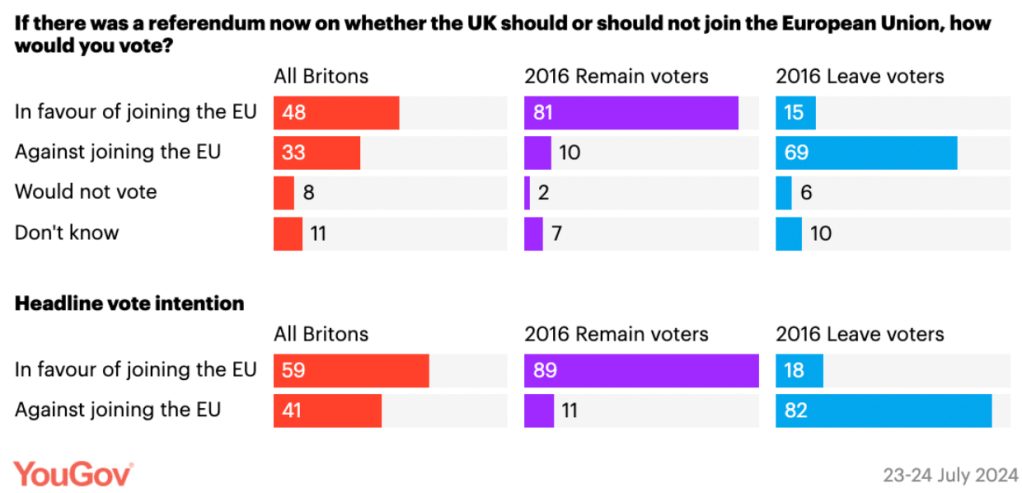
Image Credit: YouGov While Starmer remains adamant on maintaining nominal British independence, he must contend with European demands concerning a British reprisal and growing pro-European fervor at home. Starmer intends to accomplish this feat by bolstering economic ties between the UK and the EU while simultaneously tending to domestic growth, such as increasing taxes on the elites, defending the National Healthcare System (NHS), and working with trade unions.
Populism was a driving force, perhaps the most important force, in the execution of Brexit. However, the Conservative British politicians have fallen out of favor with the people due to the immense economic decline brought about by Brexit. Keir Starmer is aware that much of his voter base does not completely loathe Brexit and still identifies with aspects of the movement. Starmer has made it clear that he intends to reconvene with Europe increasingly more so than previous Conservative politicians had, while leaving EU membership off the table. Given populism was the force that drove Brexit into reality, could populism be the force to drive Britain back into Europe?

Max Drucker is a senior-year student from Brooklyn, NY. He’s majoring in Political Science with a double minor in Religious Studies and Genocide and Mass Atrocity Prevention (GMAP). He mostly concentrates on the global affairs facet of Political Science. He was fortunate enough to spend a semester in Vienna, Austria studying International Relations. In his free time, he enjoys listening to music, hanging out with his cats, and playing the guitar and bass.
References:
Bui, Ha. 2024. “London’s economy after Brexit: Impact and implications” Cambridge Economics, September 28. https://www.camecon.com/what/our-work/londons-economy-after-brexit-impact-and-implications/
BPP, LSE. 2016. “How Brexiteers appealed to voters’ nostalgia” The London School of Economics and Political Science, September 28. https://blogs.lse.ac.uk/politicsandpolicy/how-brexiteers-appealed-to-voters-nostalgia/
Gavel, Doug. 2024. “Why is support for populism rising in the West?” Harvard Kennedy School, September 28. https://www.hks.harvard.edu/faculty-research/policy-topics/politics/why-support-populism-rising-west
Ridley, Hollie. 2024. “Kickstart Economic Growth” The Labour Party, September 28. https://labour.org.uk/change/kickstart-economic-growth/
Sadiq, Khan. 2024. “New report reveals UK economy is almost £140 billion smaller because of Brexit” Mayor of London, September 28.https://www.london.gov.uk/new-report-reveals-uk-economy-almost-ps140billion-smaller-because-brexit#:~:text=The%20new%20report%2C%20by%20Cambridge,of%20Brexit%2C%20the%20report%20reveals.
Starmer, Keir. 2024. “My Pledges to You” Keir Starmer, September 28. https://www.clpd.org.uk/wp-content/uploads/2020/10/Keir-Starmers-10-Pledges.pdf
Statista. 2024, “In hindsight, do you think Britain was right or wrong to vote to leave the European Union?” Statista, September 28. https://www.statista.com/statistics/987347/brexit-opinion-poll/
Stone, Jon. 2024. “Irish prime minister: EU open to Keir Starmer’s Brexit plan” Politico, September 28. https://www.politico.eu/article/europe-brexit-ireland-united-kingdom-keir-starmer-simon-harris/
Smith, Matthew. 2024. “Labour does not have a mandate to take Britain back into the EU, says public” YouGov, September 28.https://yougov.co.uk/politics/articles/50317-labour-does-not-have-a-mandate-to-take-britain-back-into-the-eu-says-public.
Webber, Esther. 2024. “6 things UK Prime Minister Keir Starmer wants to fix in his first month” Politico, September 28. https://www.politico.eu/article/uk-prime-minister-keir-starmer-speech-win-jobs-immigration-government-reform/
-
From Mercantilism to Hegemony: How European Economics Changed Diplomacy
By Travis Rayome, Political History
Diplomacy between nations is guided by complex and implicit variables. How a government chooses to negotiate and interact with foreign governments is determined by how they govern themselves – this is statecraft. Statecraft is governance as a project; it is how nation-states choose to build their national identity, what sort of larger goals they pursue and rules of conduct they hold themselves to, and how they choose to perform universal functions (economics, culture, fiscal policy, law, etc.). Statecraft influences diplomacy because diplomacy is a reaction to statecraft; the diplomatic actions taken by a government are a reflection of and contribution to the ever-evolving project of their state. To demonstrate this relationship, one can point to the history of European diplomacy. In the past three centuries, European states (primarily led by the empires of Western Europe) have completely changed standard diplomatic conduct. As European states evolved into their modern forms, the developments made in statecraft shifted diplomacy away from monopoly-based imperial competition towards the maintenance of a shared hegemony over globe-spanning colonial holdings.
The primary element of statecraft that guided European politics starting in the 16th Century was colonialism. Colonialism spawned from mercantilism, an economic system that prioritized giving the colonizing state as much of an export advantage as possible to maximize the flow of valuable resources, capital, and precious metal-backed currency into the country to bring about prosperity. Thus, capitalization on unclaimed resources and monopolization of supply chains was an economic imperative for countries, leading to aggressive colonial territorial acquisition and protectionism becoming a common goal among European states. A key element of mercantile colonialism was the charter company, which were companies that had a monopoly on trade within a designated territory, such as the British East India Company, which operated on behalf of the British Empire in Asia. These companies were chartered by state governments, granted a region to operate in, and handed over to non-state actors to run the company in the name of that government. This made the state the primary benefactor and driver of economic activity internationally. This aspect of European statecraft, then, fostered an environment of fierce competition between nations who had a direct incentive to control as much of the trade in colonized regions as possible. As a result, wars over territorial disputes were common in the Americas.
As the mercantile system developed and more of the world came under the control of one of a few European empires, though, the trade monopolies held by chartered companies began to wane. First, the advent of the joint-stock company created alternate ways for companies to maximize profits, such as stock price fixing, inflating demand for stocks without increasing output, and driving investment by issuing bank notes and shares without gold and silver backing (Boardman-Weston et al. 46-7). This meant much more rapid but also unsustainable growth in revenue based on returns in the financial market, also known as an investment bubble. Second, unincorporated joint-stock companies began popping up all over Europe and receiving heavy investment from investors and the newly developing middle class. These companies, existing outside legal jurisdiction and thus being almost entirely unregulated, challenged the charter company monopolies and market bubbles they facilitated. The illegality of these companies also encouraged more unstable bubbles, made contractual obligations and accountability meaningless, and increasingly threatened to take control of the economy away from the state (55-7). This meant that the mercantile trade monopoly and domestic prosperity European statecraft had been directed towards was now in danger of wide-scale collapse, as was seen in France’s 1719 economic crisis, when the investment bubble popped and the chartered monopoly collapsed as they were unable to pay back investors, leaving millions of French people destitute (47). This led governments to begin changing the policy and goals surrounding economic activity, which led to a shift in their diplomacy.
The British Parliament passed the Joint Stock Companies Act of 1844 and Limited Liability Act of 1855 to address the rising prominence of unincorporated companies, which made it easier for private companies to be incorporated and made the corporation into an entity legally distinct from its owners (Boardman-Weston 58). These acts indicated a larger shift in how European states began to contend with the emergence of the free market: by changing the role of the state in the economy from corporate monopoly to universal mediator and benefactor of economic activity. This period also saw the increasing financialization of the market, growing number, scale, and complexity of corporations, and massively widened trade networks as more lands were claimed by European empires in the 19th century. These factors gave less of an incentive for European governments to wage territorial wars abroad and crush the competition and caused them to instead focus primarily on encouraging as much economic activity as possible within the empire to increase national wealth. Additionally, it was apparent that conflict was hurting potential economic gains, as British diplomat John Kasson wrote: “[productive labor] can only be arrived at through the permanent establishment of a peaceful regime” (Kasson 163, as cited in Shepperson, 41). Alongside the shift in the nature of the market was the reduction of protectionist policies. These policies restricted international trade by adding barriers to importing goods. Protectionism grew out of favor as trade networks became more solidified and the free-market system was given room to grow. Britain famously repealed its rigid Corn Laws in 1846, which to that point had prevented cheaper foreign corn from being sold in Britain. The repeal of these laws signaled commitment from European empires to move away from mercantilism.
Another large change in European statecraft came from changing attitudes surrounding the method of imperial expansion. European-American colonies were settler colonies, meaning that the home country brought in civilians to live on and cultivate the land, turning the colonized area into an extension of the state both politically and demographically. However, as these colonies grew and developed and the political stability of Europe was shaken by the Napoleonic Wars, the flaws of settler colonialism as a method of imperial expansion made the system unsustainable for Europe’s new economic priorities. The Spanish crown was left with less means to enforce loyalty from its colonies, who had no interest or obligation to continue Spanish rule in its colonies once the monarchy had collapsed by 1809, and so Latin American states revolted and gained independence across the continent in the following decades (Humphreys 227). A similar situation occurred in North America with the American Revolution, where Britain’s 13 colonies along the Atlantic coast of North America grew self-sufficient and distant enough from the home country that they sought independence.
In tandem with the decline in favorability of settler colonies and expansion of the free-market global economy was the emerging imperial front in Africa and Asia. Africa and Asia were vast regions already known to be rich in resources and population. Imperial charter companies had also already laid claim to numerous parts of these regions, such as the British East India Company. Due to the decreasing emphasis on settler-colonial projects in imperial pursuits and the decreased drive for monopoly, European empires did not need to settle in and populate the region to colonize. Instead, a military garrison could just station itself there, establish relations with the local power, occupy the land, and create the right conditions for private companies to set up operations. These private companies could extract resources from the land using the existing population as cheap or free labor to generate profits, build wealth, and strengthen the influence of the empire. Facilitated by the rise of the free-market capitalist economic system in the 19th Century, imperial land acquisitions in Africa and Asia furthered the new economic interests of European empires by prioritizing maximal market activity over direct and complete monopolistic domination.
The diplomatic shift away from mercantile monopolization, expansion of the free market, and changes in imperial practices culminated in the Scramble for Africa, which was a joint European imperial effort to divide the entire African continent amongst themselves. Unlike the rapid and competitive colonization of the Americas, the Scramble for Africa was a coordinated effort that began with the Berlin Conference, which ran from 1884 to 1885. The Conference was held to prevent friction among the empires and establish rules of engagement when claiming Africa. The changing economic needs of the nations and shared white identity are central reasons given for the conference, with the General Act framing imperialism as “furthering the moral and material wellbeing of the native populations” (General Act of the Berlin Conference of West Africa, 1885) and “regulat[ing] the conditions most favorable to the development of trade and civilization in certain regions of Africa” (General Act, 1885). The rules of engagement laid out in the Conference reflected the new focus in European statecraft on making economic activity as smooth as possible: free trade and travel, qualifications for the legitimacy of a territorial claim, and communication between empires on developments in imperial expansion. At this point, the elements of European statecraft– the priority of facilitating economic activity, the justification of white supremacy and humanitarianism to collaborate and expand influence, and the evolving methods of imperialism– made it so that collaboration between European states in managing a shared global hegemony was now a chief focus of diplomacy.
Statecraft in Europe before the 20th century was guided by the changes in economic priorities brought on by imperialist pursuits. From this, diplomacy changed in response to suit the goals of the state. As mercantilism transformed into free-market capitalism, diplomatic incentives trended towards a Europe united in national wealth-building through facilitating as much free-market activity as possible in the regions and peoples they dominated. This is because previous European diplomacy, which spawned from mercantilist economics and was centered around warfare and outcompeting adversarial empires, was harming the priorities of the emerging capitalist system. That system spawned from the statecraft of European empires as well, as the popularity of the financial market and new economic opportunities presented by imperialism pushed the mercantile system away from state-chartered monopolies and towards private ventures whose activities were sanctioned by the state. The environment fostered by European statecraft is what created the grounds for diplomacy.

Travis Rayome is an English and Economics major from Alexandria, Virginia. He hopes to work for humanitarian NGOs around the Washington, DC area, continue writing on politics and economics, and play music. His areas of political interest are propaganda and information dissemination, structural violence and inequality, and power distribution within and between nation states.
References:
Photo credit: Claude Lorrain, Public domain, via Wikimedia Commons. https://commons.wikimedia.org/wiki/File:F0087_Louvre_Gellee_port_au_soleil_couchant-_INV4715_rwk.jpg
Boardman-Weston, et al. 2012. “The Rise and Fall of the Chartered Corporation: A Historical Analysis: The Development of the Charter up to 1500, the Rise of the Chartered Corporation post-1500, the Decline and Fall of the Charter as a Method of Incorporation in the 19th Century and the Potential for a Resurgence in the 21st Century.” Durham University, November 8. https://etheses.dur.ac.uk/5572/.
Cao, Yahin. 2014. “Comparison Between the African Colonialism and American Colonialism.” Pennsylvania State University, December 11. https://sites.psu.edu/afr110/2014/12/11/comparison-between-the-african-colonialism-and-american-colonialism/.
Coleman, D.C. 1980. “Mercantilism Revisited.” The Historical Journal, November 4. http://www.jstor.org/stable/2638725.
General Act of the Berlin Conference on West Africa, 1885, February 26. https://loveman.sdsu.edu/docs/1885GeneralActBerlinConference.pdf
Humphreys, R.A. 1952. “The Fall of the Spanish American Empire.” History, October. https://www.jstor.org/stable/24403077.
Kasson, John. Protocols and General Act of the West African Conference. 1885. United Kingdom National Accounts (Blue Books), as cited in: Shepperson, George. 1985. “The Centennial of the West African Conference of Berlin, 1884-1885.” Clark Atlanta University. https://www.jstor.org/stable/274944.
LaHaye, Laura. “Mercantilism.” Library of Economics and Liberty. https://www.econlib.org/library/Enc/Mercantilism.html.
Thomas, J.A. 1929. “The Repeal of the Corn Laws, 1846.” Economica, April. https://www.jstor.org/stable/2548518.
-
Is History Truly Happening Faster?

By Hunter Loren
Since the popularization of social media, a perceived feeling that history is essentially happening “faster” today compared to previous eras has been prevalent. After all, modern humans have existed for roughly 100,000 years. By 10,000 BCE, 90,000 years later, the Neolithic revolution began. Afterward, mankind progressed towards industrialism by the early 1800s: roughly 10,000 years later. It took only another 150 years to progress towards atomic power, and the information age was reached 50 years later. Indeed humanity is progressing faster than ever before, and this trend is likely to continue. Given such rapid progress, has the frequency of major world events truly accelerated in tandem with our transition to modernity? Or is the notion of history going faster simply an artifact of memory?
On August 7, 1945, American newspapers mostly featured two large headlines. One was the bombing of Hiroshima, and the other was the death of Major Dick Bong; a 24-year-old fighter pilot, and highest-scoring U.S. fighter ace of World War II. Most people have probably heard of one of these events, and consider it to be important. The other event is probably so obscure that one might for a moment think I am making up the name “Major Dick Bong” and saying that it was treated with co-equal importance to Hiroshima. And to be sure, even in its immediate aftermath, the death of Major Bong was in a somewhat smaller typeface than Hiroshima — but it was still a relatively big announcement – it was important news of the day according to the people. Read any old newspaper, and you’ll find many “major events” neglected today because they didn’t add up to much later. Hiroshima maintains its status as a major event because it is a symbol of an entirely changed world. Major Bong’s death did not. A similar story applies to most of human history. Every part of the world has had its fair share of major events in every century, every decade, and every year. To the average person, however, a time period such as the Medieval Era, for example, may only conjure thoughts of the Crusades or knights in shining armor, making such a complex time period seem like a blur with only a few major happenings. Other major events of the time such as the Treaty of Verdun, which foreshadowed the formation of the modern countries of Western Europe, or the Abbasid Revolution which shifted the Islamic world’s foci towards Baghdad are an afterthought, if a thought at all. Many major events in history are today relegated to the minds of historians, which inherently begs the question, “what about major events today?” After all, it’s not unlikely that hundreds of years in the future, major events which shook today’s world such as the women-led regime protests in Iran won’t be common knowledge among the average person, regardless of the impact they made on the world in 2022. Could this perceived increased frequency be a case of recency bias?
Of course, “major world events” have many variables. For the sake of simplicity, this brief analysis will consider a major world event as something that is genuinely counted as international news, having a ripple effect in its occurrence beyond a small region. Examples include wars, pandemics, natural disasters, economic crises, political revolutions, etc. Modern examples include the COVID-19 pandemic, the 9/11 attacks, and the climate change crises. I will also be focusing on 1900 onward, as newspapers, telegrams, and radio enabled worldwide communication and news about various events.
Of the many innovations that define the early twentieth century, the most notable is the sheer speed in which communication took place. In 1900, though knowledge of major world events was surely widespread, one’s information of events of the time such as the Boxer Rebellion was largely limited to coverage of local newspapers or word of mouth. In contrast, nearly all events in our modern world are considered “news”, with widespread media coverage not just through television programs but also social media. This means that the average person consumes news articles and sees some sort of notification about some sort of event whether they actively seek to do so or not. Because we don’t actively seek information, but can easily stumble across it regardless, it creates a seeming acceleration of events which can alter our perception of history (Rosa 2003). This amplification of news to the average person may also in turn lead to amplification of reactions to such events. In 1982, an upward estimate of 10,000 marched across Britain protesting the Falklands War (Peace Pledge Union 2012). Pushing for a ceasefire and negotiations, such marches were almost entirely limited to Great Britain. During the Breakup of Yugoslavia from 1992-1995, anti-war demonstrations were for the most part limited to the boundaries of what was once Yugoslavia, even as Western States directly intervened with NATO bombing campaigns or after news of the Srebrenica Massacre came to light. These wars directly involving major powers went down in history as primarily a regional issue. Decades later, the murder of George Floyd sparked outrage across the United States which almost immediately spread across the world and prompted Black Lives Matter demonstrations to be seen in every continent. What may have been an isolated incident just a few decades ago became a major world event through its coverage. If social media existed during the Falklands War or the Yugoslav wars, it’s certainly possible that these regional conflicts would have engendered a much broader reaction. Along with media prevalence enhancing knowledge of world news, the phenomenon of globalization within the last few decades has created vastly different dynamics in which the world operates. Economies and trade are more intertwined than ever before, and global interdependence creates a ripple effect in state economic downturns, amplified much more than in previous eras (Haldane and May 2011).
Perhaps the phenomenon is an artifact of memory or perhaps it’s simply a matter of exposure. Wars happen just as they did a century ago, as have religious conflicts and societal change. With increased exposure to major world events, a perception that more things are happening in the world is understandable. However, these kinds of events were still happening a hundred years ago. In describing how technology, mainly social media, is a primary culprit for amplifying worldwide events, I showed how it can morph what would otherwise be a regional issue into a much larger phenomenon. In a way, that means that it essentially makes new history. The transition to modernity has meant that as the world becomes more interconnected, so does the news. History may not be happening more often in terms of how many events actually happen, but technology has more so made new ways for history to happen and for news to reach all parts of the world.

Hunter Loren is a Political Science/Economics major from Great Neck, NY. After his undergraduate years, he aims to pursue a masters degree in International Relations. Building on previous experience in IR tutoring, Hunter intends to shed light on happenings in more unknown parts of the world. When he was nine years old he had an email correspondence with the president of Lithuania and he enjoys motorsports, baseball, and guitar.
References:
Photo credit: Photograph of the Newspapers & Current Periodicals Reading Room, Library of Congress. , 1900. Photograph. https://www.loc.gov/item/2002716645/.
Haldane, Andrew G., and Robert May. 2011. “Globalization and Systemic Risk.” Nature 469 (7330): 351–355, January 19. https://doi.org/10.1038/nature09659.
Peace Pledge Union. 2022. “Falklands War: 40th Anniversary.” Peace Pledge Union. https://www.ppu.org.uk/falklands40.
Prosic-Dvornic, Mirjana. “Enough! Student Protest ’92: The Youth of Belgrade in Quest of ‘Another Serbia’.” University of Belgrade. https://scholarworks.iu.edu/journals/index.php/aeer/article/download/596/698/0
Rosa, Hartmut. 2003. Social Acceleration: Ethical and Political Consequences of a Desynchronized High–Speed Society. Constellations 10 (1):3-33. https://acceleratedclassroom.wordpress.com/wp-content/uploads/2011/03/social-acceleration.pdf
Wellerstein, Alex. 2013. “Major Bong’s Last Flight.” Nuclear Secrecy Blog, August 6. https://blog.nuclearsecrecy.com/2013/08/06/major-bongs-last-flight/.
-
Subscribe
Subscribed
Already have a WordPress.com account? Log in now.
 Happy Medium

You must be logged in to post a comment.