-
Culture War: Americans are Redefining What it Means to Disagree

By Ashley Pickus, National Politics Reporter
Read this article and more in our Spring 2023 Innovation edition, on campus now!
The term ‘culture war’ was made popular by James Davison Hunter in 1991 with his book Culture Wars: The Struggle to Define America. The book focused on contemporary issues at the time that are still relevant today, such as religion in schools, abortion, and LGBTQ rights (Stanton 2021). However, in the 30 years since, new issues arose that now defined the American culture war. The main difference is that, at the time, the debate almost entirely revolved around secularism versus theology. Today, while religion plays a role in some issues, Hunter says the positions some people hold are “mainly rooted in fear of extinction” (qtd. Stanton 2021). Thirty years ago, a political issue and a culture war issue were distinguishable. For example, how much the government should subsidize healthcare was a distinctively political area of debate, and the discourse about transgender people was a culture war issue. Now, the same debate gets conflated; if more people are eligible for Medicare, then what if a transgender person on it gets hormone replacement therapy? Should citizens whose taxes were raised to pay for their treatment have the ability to object? On the other hand, is it any of their business? Simply put, a compromise can be found on a political issue, but for a culture war issue, each side sees its position as morally correct, and thus concessions are rarely made.
Education
One aspect of the modern culture war is its ability to transform topics that were previously apolitical into hot-button issues. A primary example of this is the array of debates around education. In recent years, there have been several controversies surrounding how children should be taught, including Critical Race Theory, social-emotional learning, sexual orientations, and gender identities.
The teaching of Critical Race Theory (CRT) has always been contentious, but recently state governments have begun placing restrictions on it. Several states, including Arkansas, Florida, Idaho, Iowa, New Hampshire, Oklahoma, and Tennessee, have banned CRT, and over a dozen more states have pending legislation aimed at accomplishing this goal (“States that Have Banned” 2023). CRT has been used as a buzzword during these debates, so it’s important to know what it is. CRT teaches about systemic racism, which means that, as opposed to individual prejudice, racism is “embedded in legal systems and policies” (Sawchuk 2021). The division has mostly been split down party lines, with Republican governors such as Ron DeSantis advocating for banning CRT in all schools. The main argument against CRT is that some claim it encourages discrimination against white students and is a form of indoctrination; DeSantis has said, “We believe in education, not indoctrination” (qtd. Papaycik and Saunders 2022). Conversely, House Minority Leader and Binghamton University alumnus Hakeem Jeffries (D-NY) argues that “It is our moral imperative to tell the truth about our past to finally reconcile with this nation’s history of racism and white nationalism” (Camera 2022). However, CRT has not been the only point of contention in children’s education. In some states like Arizona, parents and legislators have shifted focus to a new target: social-emotional learning.
Social-emotional learning, or SEL, has long been a part of elementary school curriculums throughout the country. It teaches children important tools for “developing the self-awareness, self-control, and interpersonal skills that are vital for school, work, and life success” (Committee for Children 2022) and is backed up by research showing that it increases academic performance and decreases bullying. However, SEL has been called “woke nonsense” (qtd. O’Brien 2022) by critics such as Karol Markowicz, a Fox News Contributor, who argue that it does not belong in classrooms and that schools should stick to strictly teaching academic subjects like math and reading (O’Brien 2022). “Parents need to understand that woke nonsense is creeping into their kids’ education in a variety of ways” (qtd. O’Brien 2022).
Another significant culture war issue in terms of education stems from Florida’s Parental Rights in Education law, or as critics of the bill have called the “Don’t Say Gay” statute. The law prohibits discussions of sexual orientation and gender identity in classrooms from kindergarten to third grade and says parents of children of all ages must be notified if there “is a change in the student’s services or monitoring related to the student’s mental, emotional, or physical health or well-being” (“Parental Rights” 2022). Supporters of the law maintain that these topics are inappropriate for young children and are a distraction from what children should be learning. Conservative Political Action Conference Chairman Matt Schlapp spoke out in support of the law, saying, “Instead of being force fed the left’s points on gender and sex, young students in Florida can focus on learning how to read and write” (Migdon 2022). Critics assert that it opens the door to further discrimination against an already marginalized community and could potentially force school faculty to out LGBTQ students to their parents, creating a possibly dangerous home-life situation. Pete Buttigieg, the first openly gay Cabinet secretary, said, “It tells youth who are different, whose families are different, that there’s something wrong with them out of the gate and I do think that contributes to the shocking levels of suicidal thoughts and suicide attempts among LGBTQ youth” (qtd. CNN Newsroom 2022). Other states have also begun introducing similar policies, which critics argue have dangerous implications for queer students throughout the country.
Transgender Rights
The topic of transgender people can elicit strong reactions. Between the discourse around the release of Hogwarts Legacy and the declaration that “transgenderism must be eradicated” (qtd. Wade and Reis 2023), some people feel like they are acting in accordance with God, while others believe their very existence is under attack.
At the most recent Conservative Political Action Conference, Daily Wire host Michael Knowles stated, “For the good of society … transgenderism must be eradicated from public life entirely—the whole preposterous ideology, at every level” (qtd. Wade and Reis 2023). After “Nazi Germany” started trending on Twitter, Knowles later attempted to defend himself, saying, “Nobody is calling to exterminate anybody, because the other problem with that statement is that transgender people is not a real ontological category—it’s not a legitimate category of being” (qtd. Wade and Reis 2023). Knowles represents one—albeit more extreme—side of this particular culture war issue.
On the same side are significant figures such as former President Donald Trump. A contentious issue within the topic of transgender rights is access to gender-affirming care, which includes hormone replacement therapy and surgical procedures. In a campaign video for the upcoming 2024 primary elections, Trump announced that, if re-elected, he would ban gender-affirming care to minors, declaring that it was tantamount to “child abuse” and “child sexual mutilation,” and he would prohibit federal agencies from promoting “the concept of sex and gender transition at any age” (qtd. Narea and Cineas 2023). While supporters of these efforts believe that minors should not have access to permanently change their bodies with surgery, critics point out that puberty blockers that many transgender minors take are reversible (Kassel 2022).
Implications
The implications of the modern-day culture war cannot be understated. Education, which has previously been a local and state issue, is now at the forefront of national politics. The introduction of a bill by House Republicans to nationalize policies similar to Florida’s Parental Rights in Education law would change how children across the country are educated (although the bill is extremely unlikely to come close to passing with a Democrat-controlled Senate and White House) (Wamsley 2022). Still, the influence of the law is seen in several states, such as in Alabama, where Gov. Kay Ivey signed into law bans on teaching about sexual orientation and gender identity in kindergarten through fifth grade and transgender healthcare for minors.
Teachers have also expressed their frustration with the increased focus on how they should run their classrooms. Arguing that these laws undermine the role of public schools, some educators have considered leaving the profession (Walker 2023). On the other hand, parents that support these restrictions deem them necessary to protect their children (Wolf 2023).
The ramifications of the culture war are even heavier on the issue of transgender rights. With a growing number of states passing legislation prohibiting gender-affirming care and increasingly aggressive rhetoric being used in opposition to “transgenderism,” there have been reports of escalating mental health issues among transgender individuals, including up to 86 percent of trans or nonbinary minors (The Trevor Project 2023). Moreover, states like Idaho have introduced legislation “to ensure that counselors and therapists will not be required to take on clients when it would conflict with their ‘sincerely held principles’” (Narea and Cineas 2023). Those who are already at an increased risk of poor mental health may see restricted options for mental health services. A similar situation can be seen with the Parental Rights in Education Act; because teachers and guidance counselors are required to inform parents of any mental health concerns, students may feel like it is no longer safe to discuss any issues they may be having.
While there may be some less serious issues involved in the culture war, including Tucker Carlson’s war against the packaging of M&Ms (Radde and Folkenflik 2023), James Davison Hunter warned that if the culture war continues to grow and each side becomes more belligerent, there could be grave consequences.
“Culture wars always precede shooting wars,” Hunter said in a 2021 interview. “They don’t necessarily lead to a shooting war, but you never have a shooting war without a culture war prior to it, because culture provides the justifications for violence” (Stanton 2021).

Ashley Pickus is a junior from Plainview, New York. She is double-majoring in political science and English rhetoric and minoring in writing studies. Ashley spends most of her free time following the current pop culture trends, watching television shows, or listening to music. If asked, she can explain the meaning of any Taylor Swift song and its significance. After graduation, Ashley hopes to find a job in the media industry.
References
CNN Newsroom. 2022. “‘Absolutely’: Pete Buttigieg on whether ‘Don’t Say Gay’ bill is dangerous.” CNN, February 9. www.cnn.com/videos/politics/2022/02/09/pete-buttigieg-florida-dont-say-gay-bill-lgbtq-youth-impact-nr-vpx.cnn.
Camera, Lauren. 2022. “Congressional Democrats take aim at efforts to ban critical race theory.” US News, February 2. www.usnews.com/news/education-news/articles/2022-02-02/congressional-democrats-take-aim-at-efforts-to-ban-critical-race-theory.
Committee for Children. 2022. “What is social-emotional learning?” Committee for Children, December 15. www.cfchildren.org/what-is-social-emotional-learning/.
Good, Owen S. 2023. “Why is Hogwarts Legacy, a Harry Potter video game, so controversial?” Polygon, February 4. www.polygon.com/23584328/hogwarts-legacy-controversy-jk-rowling-explainer-transphobia-release-boycott.
Kassel, Gabrielle. 2022. “The effects of puberty blockers are reversible: 14 FAQs.” Healthline, November 9. www.healthline.com/health/are-puberty-blockers-reversible.
Migdon, Brooke. 2022. “Florida’s ‘don’t say gay’ bill signed into law.” The Hill, October 24. thehill.com/changing-america/respect/equality/598999-floridas-dont-say-gay-bill-signed-into-law/.
Narea, Nicole and Fabiola Cineas. 2023. “The GOP’s coordinated National Campaign Against Trans Rights, explained.” Vox, March 10. www.vox.com/politics/23631262/trans-bills-republican-state-legislatures.
O’Brien, Cortney. 2022. “Controversial Florida math textbook ignites social-emotional learning debate.” Fox News, July 18. www.foxnews.com/media/controversial-florida-math-textbook-ignites-social-emotional-learning-debate.
Papaycik, Matt and Forrest Saunders. 2022. “Florida’s governor signs controversial bill banning critical race theory in schools.” WPTV News Channel 5 West Palm, April 22. www.wptv.com/news/education/floridas-governor-to-sign-critical-race-theory-education-bill-into-law.
Parental Rights in Education Act of 2022, H.B. 1557, Fla. State Senate. (2022). www.flsenate.gov/Session/Bill/2022/1557.
Radde, Kaitlyn and David Folkenflik. 2023.“M&M’s replaces its spokescandies with Maya Rudolph after Tucker Carlson’s rants.” NPR, January 24. www.npr.org/2023/01/24/1150984597/m-ms-backlash-spokescandies-candy-tucker-carlson-fox-news-culture-war.
Sawchuck, Stephen. 2021. “What Is Critical Race Theory, and Why Is It Under Attack?” Education Week, May 18. www.edweek.org/leadership/what-is-critical-race-theory-and-why-is-it-under-attack/2021/05.
Stanton, Zack. 2021. “How the ‘Culture War’ could break democracy.” Politico, May 20. www.politico.com/news/magazine/2021/05/20/culture-war-politics-2021-democracy-analysis-489900.
“States that Have Banned Critical Race Theory.” 2023. World Population Review. worldpopulationreview.com/state-rankings/states-that-have-banned-critical-race-theory.
The Trevor Project. 2023. “Issues Impacting LGBTQ Youth” The Trevor Project, January. www.thetrevorproject.org/wp-content/uploads/2023/01/Issues-Impacting-LGBTQ-Youth_Morning-Consult-Poll_Jan-2023_Public.pdf.
Wade, Peter and Patrick Reis. 2023. “CPAC speaker calls for eradication of ‘transgenderism’ — and somehow claims he’s not calling for elimination of transgender people.” Rolling Stone, March 6. www.rollingstone.com/politics/politics-news/cpac-speaker-transgender-people-eradicated-1234690924/.
Walker, Tim. 2023. “The culture war’s impact on public schools.” NEA, February 17. www.nea.org/advocating-for-change/new-from-nea/culture-wars-impact-public-schools.
Wamsley, Laurel. 2022. “What’s in the so-called don’t say gay bill that could impact the whole country.” NPR, October 21. www.npr.org/2022/10/21/1130297123/national-dont-say-gay-stop-children-sexualization-bill.
Wolf, Zachary B. 2023. “The growing movement to protect children from their government.” CNN, March 10. www.cnn.com/2023/03/09/politics/education-government-role-what-matters/index.html.
-
Enlarging the House
By Joseph Brugellis, Legal Reporter
Read this article and more in our Spring 2023 Innovation edition, on campus now!
Every two years, Americans head to the polls to select the candidate whom they wish to represent them in the US House of Representatives. The House consists of 435 voting members tasked with representing the constituents in their respective districts (“What is a Representative?”). This magic number of House seats was not chosen because of any specific modern necessity; rather, the House of Representatives is legally mandated to contain 435 seats pursuant to the Permanent Apportionment Act of 1929 (“How Your State Gets Its Seats”). This mandate on the number of congressional districts has remained stagnant despite the fact that the average population in each congressional district has nearly tripled from 280,675 persons in 1930 to more than 760,000 persons today (“Historical Apportionment Data”).
This phenomenon poses problems for our system of democracy. With so many Americans concentrated in one district, a congressperson will find greater difficulty in making meaningful connections with all of their constituents and facilitating effective service (Drutman et al. 2021). This creates incentives for representatives to listen exclusively to the most powerful or outspoken members of the district and simultaneously ignore the interests of everyone else (Kane et al. 2020). Some have argued that lifting the arbitrary cap on the number of congressional seats and thus expanding the House of Representatives is necessary to promote effective congressional representation and return the voice back to the people.
A brief historical background of the apportionment process will help illuminate the present dilemma. The US Constitution mandates that congressional reapportionment happen every decade following the census (U.S. Const. art. I, §2). Apart from mandating that each state be allocated at least one representative and that the population size for each district consists of 30,000 persons at minimum (U.S. Const. art. I, §2), the Constitution remains silent as to what apportionment formula must be adopted and how many total districts should exist. James Madison did originally propose an additional amendment to the Bill of Rights enshrining a House apportionment formula into the Constitution contingent upon national population growth, but the initiative came one state short of ratification (Kane et al. 2020).
For the first fifty years of the nation’s existence, congressional apportionment took place without prior selection of a fixed number of House seats (“Apportionment Historical Perspective”). Congress first utilized the so-called “Jefferson method” to allocate seats. Congress would first select a predetermined population-to-representative ratio (ex: 45,000:1) and then plug the individual state’s population into this ratio, which results in the number of representatives or seats in that state (Kane et al. 2020). Plugging a state population of 830,000 persons into this Jefferson formula would yield 18 House seats for this state after rounding from 18.44 to the nearest whole number that is lower than the quotient (Kane et al. 2020). In 1840, the House reapportioned using the Jefferson formula, but instead rounded the quotient upward if the decimal fraction is greater than one-half (“Apportionment Historical Perspective”). The first-ever cap on districts was set at 233 House seats in 1850, but it was ignored by Congress and thus the House grew to 386 seats by the dawn of the 20th century (Kane et al. 2020).
As the House grew to 435 seats after 1911, many in Congress began to question the merits of allowing the enlargement of the House to continue (“Apportionment Historical Perspective”). After the House failed to reapportion itself following the 1920 census thanks to contentious debate between rural and urban members over the size of Congress (“How Your State Gets Its Seats”), Congress eventually passed the Permanent Reapportionment Act of 1929 which sets a statutory cap of 435 seats in the House. This statutory cap is still in effect more than ninety years later.
Capping the House of Representatives at 435 seats even as the nation’s population has significantly increased over the past decades inadvertently grants residents of certain states disproportionate overrepresentation in Congress compared with others. While districts within a state are legally required to have a roughly equal population size (“Wesberry v. Sanders”), the same principle does not apply when comparing districts from separate states. This can lead to residents of a state having greater individual congressional representation than those in another state. For example, the state of Delaware contains only one at-large congressional district encompassing approximately one million residents (“Delaware Population Facts”). The state of Wyoming also has an at-large congressional district, but it represents a population of only 580,000 residents (Skelley 2021). Even though both states have one district, each individual Wyoming resident is disproportionately overrepresented in the House compared with each individual in Delaware under the current apportionment system.
Many political scientists and others have increasingly advocated for the lifting of the cap on the House to alleviate this overrepresentation problem. Taking a global perspective, the average population per representative district in the United States as of 2020–761,169 persons– is abnormally large compared with other similar representative districts in nations like the UK and Japan (Skelley 2021). Increasing the number of seats in the House of Representatives allows for a decrease in the average number of residents per congressional district, thereby affording the opportunity for representatives to build closer connections with each individual constituent he or she is tasked with representing in Congress.
But what would such an expansion actually look like? Several different methods and theories have been proposed to effectuate a possible enlargement of the House.
One such proposal is known as the Wyoming Rule. The Wyoming Rule would allow for the addition of new House seats so that the ratio between a representative and the number of individual constituents within any given district would be equivalent to “that of the least populous state”, which is currently Wyoming (Drutman et al. 2021). Since Wyoming’s at-large congressional district contains around 576,000 constituents per the 2020 census (“Wyoming Population Facts”), congressional seats would be added to the House of Representatives to ensure each congressional district would consist of a roughly equivalent number. The House would increase to around 574 seats to accommodate this rule (Drutman et al. 2021). Critics of the Wyoming Rule point out that such a rule can lead to chaos if the number of House seats changes dramatically every decade due to a rapid increase or decrease in the population of the smallest state (Drutman et al. 2021).
Another possible blueprint for House expansion is the Cube Root Rule. The Cube Root Rule is based on the observation that the size of the representative body of a country is roughly equivalent to the cube root of the country’s population at large (Kane et al. 2020). The population of the US is around 331 million people; therefore, the cube root is approximately 692. The House would therefore be expanded to 692 seats. Those opposed to the adoption of this rule point out that the number of constituents assigned per congressional district will invariably increase as the nation’s population grows, which seemingly defeats the purpose of expanding the House to make representation more efficient.
Members of Congress have also begun to take an interest in possibly expanding their own workplace. Representative Earl Blumenauer of Oregon recently introduced the REAL House Act in January 2023. The REAL House Act would increase the size of the House from 435 to 585 seats after the 2030 census (“REAL House Act Fact Sheet”). This 149-seat increase represents the 149 times that states were forced to lose a congressional seat due to population shifts between 1929 and the present day. As compensation for this loss, the bill chooses to expand the House as a whole by adding 149 new seats (“REAL House Act Fact Sheet”). This proposed bill, however, is not perfect. What happens when the nation eventually grows so large that 585 House seats become ineffective at ensuring proper representation? Once the Nation’s population eventually grows to such a size, Congress would have to again step in and propose another solution.
Expanding the House by lifting the 1929 artificial cap on congressional seats represents an innovative attempt to correct the increasingly undemocratic relationship between the representative and their constituents. The proposals above all share the same problem: they lack any mechanism designed to prevent any future complications that could occur after the hypothetical implementation of the expansion proposal. If Congress eventually chooses to welcome an enlargement of the representative body, it must fashion an apportionment scheme that will actually promote the benefits of democratic representation in the long term.

Joseph Brugellis is a freshman from New Hyde Park, NY, on Long Island who intends to double-major in history and philosophy, politics, and law. After graduation, Joseph plans to go onto law school and hopes to one day be appointed as a federal judge. Joseph is passionate about the American judicial branch and is deeply interested in how different interpretative philosophies held by judges shape constitutional law. During summer 2022, Joseph worked as an intern in the office of state Senator Anna M. Kaplan. In his free time, Joseph enjoys reading, listening to music, and exploring nature.
References
“Apportionment Historical Perspective.” 2021. United States Census Bureau, November 22. www.census.gov/topics/public-sector/congressional-apportionment/about/historical-perspective.html.
“Delaware Population Facts.” QuickFacts, United States Census Bureau. www.census.gov/quickfacts/DE.
Drutman, Lee et al. 2021. “The Case for Enlarging the House of Representatives.” American Academy of Arts and Sciences. www.amacad.org/sites/default/files/publication/downloads/2021_Enlarging-the-House.pdf.
“Historical Apportionment Data (1910-2020).” 2021. United States Census Bureau, April 26. www.census.gov/data/tables/time-series/dec/apportionment-data-text.html.
“How Your State Gets Its Seats.” U.S. Capitol Visitor Center. www.visitthecapitol.gov/sites/default/files/documents/resources-and-activities/CVC_HS_ActivitySheets_CongApportionment.pdf.
Kane, Caroline et al. 2020. “Why the House of Representatives Must Be Expanded and How Today’s Congress Can Make It Happen.” Democracy and the Constitution Clinic, Fordham University School of Law, January. www.fordham.edu/download/downloads/id/14402/Why_the_House_Must_Be_Expanded___Democracy_Clinic.pdf.
“REAL House Act Fact Sheet.” 2023. Congressman Earl Blumenauer, Third District of Oregon, United States House of Representatives. blumenauer.house.gov/sites/evo-subsites/blumenauer.house.gov/files/evo-media-document/real-house-act-one-pager.pdf.
Skelley, Geoffrey. 2021. “How The House Got Stuck At 435 Seats.” FiveThirtyEight, August 12. fivethirtyeight.com/features/how-the-house-got-stuck-at-435-seats/.
“Wesberry v. Sanders.” Oyez. www.oyez.org/cases/1963/22.
“What is a Representative?” United States House of Representatives. www.house.gov/the-house-explained.
“Wyoming Population Facts.” QuickFacts, United States Census Bureau. www.census.gov/quickfacts/WY.
-
Minting the Coin: A Debt-Ceiling Panacea or a Trillion-Dollar Boondoggle?

By Joseph Brugellis, Legal Reporter
Photo: one design for the trillion-dollar coin by artist DonkeyHoteyA sovereign state possesses a national deficit when the amount of government spending in a given fiscal year exceeds that which the state collects through revenue-generating mechanisms like income taxes. Since the end of fiscal year (FY) 2001, the United States Federal Government has consistently run a deficit that has recently grown to $1.38 trillion (“What is the National Deficit?”). To make up this deficit gap, The US Treasury Department borrows money by issuing securities to investors; the amount of money borrowed combined with any interest owed on these securities comprises the national debt (“What is the National Debt?”).
While national debt has been held by the US since the Founding Era, the process by which such debt is accumulated has undergone significant changes. For most of the country’s history, Congress assumed the role of issuing bonds and other securities to finance a specific project or purpose (DeSilver 2023). As an example, Congress directly issued three different types of fifty-year bonds to help finance the construction of the Panama Canal at the turn of the 20th century (“The Panama Canal Loan”). The role of Congress in this borrowing process shifted dramatically during WWI. To fund all necessary wartime provisions, Congress needed to borrow unprecedented sums of money. As the management of the Nation’s finances became increasingly complex, Congress passed the Second Liberty Bond Act of 1917, giving the Treasury Department wide discretion to borrow money as necessary (“The Debt Limit Through the Years”).
In 1939, Congress imposed the first cap on the maximum amount of money the Treasury may borrow to pay bills and finance its obligations (“The Debt Limit Through the Years”). Known as the debt ceiling, this maximum limit prevents the government from further accruing debt once X dollars has been reached, even though this debt accumulation is critical to funding statutorily mandated programs and paying the country’s bills (“What is the National Debt?”). Since 1960, Congress has voted to raise the debt ceiling a total of 78 times under both Democratic and Republican administrations (Neuman et al. 2023). While this had long been considered a routine procedure, raising the debt ceiling in recent years has embroiled both Congress and the President in a game of political brinkmanship over larger disputes on issues like deficit spending.
Perhaps the most infamous historical example of a debt ceiling brawl occurred during the Obama administration. After the 2010 midterm elections ushered in a wave of populist so-called “Tea Party” Republicans who advocated for a significant reduction in the size of the federal government, a new Republican majority in the House of Representatives sought to flex its newfound influence over policy matters. In January 2011, Treasury Secretary Timothy Geithner called on Congress to increase the debt ceiling before the Treasury Department would be forced to take “extraordinary measures” to avoid a debt default on May 16 of that year (“Timeline of 2011 Debt Ceiling Crisis”). House Republicans in March announced their refusal to raise the debt ceiling unless a budget plan to fund the government contained certain unnamed provisions designed to control long-term spending. After much jockeying that saw the defeat of both President Obama and House Republicans’ respective deficit reduction proposals, Geithner was forced on May 16 to deploy certain “extraordinary measures” to allow the federal government to pay its bills until August 2. On July 31, two days before this absolute deadline, House Republicans agreed to raise the debt ceiling in exchange for a complex web of deficit reduction measures. The 2011 debt ceiling crisis roiled financial markets and even led to a downgrade in the US credit rating for the first time (Neuman et al. 2023).
Today, Congress is seemingly gearing up for another debt ceiling clash that is eerily similar to the 2011 showdown. Shortly after a new Republican House majority was inaugurated at the beginning of this year, current Treasury Secretary Janet Yellen notified Speaker Kevin McCarthy of the Treasury Department’s intention to deploy extraordinary measures beginning on January 19 to temporarily preserve the ability of the US to continue paying its bills (Yellen 2023). The Republican-controlled House, however, refuses to pass a clean debt ceiling increase advocated for by President Biden. Instead, Republicans are hoping to extract concessions from the administration on overall budgetary spending cuts (Skelley 2023). Once again, financial markets and investors around the world are relegated to watching from the sidelines as another potentially calamitous debt ceiling fight unfurls.
But what if there was an alternative route to preserve the public credit of the US from the whims of politically self-interested lawmakers? For years, many economic thinkers and policymakers have advocated for solutions that would preserve the ability of the Treasury to borrow money to pay its bills while Congress simultaneously negotiates with the President over a debt ceiling deal.
One such unorthodox proposal involves the Treasury minting a trillion-dollar platinum coin and depositing it with the Federal Reserve (Rappeport 2023). Since the Federal Reserve acts as the manager of the Treasury Department’s “general account,” minting a trillion-dollar platinum coin would be the equivalent of adding one trillion disposable dollars that the Treasury Secretary may utilize to continue paying the country’s bills until Congress and the President reach a deal (Rappeport 2023). If the Treasury runs through the trillion dollars before such a deal is reached, then the Department could just mint another trillion-dollar coin and deposit it with the Federal Reserve (Rappeport 2023).
At first glance, the successful minting of a trillion-dollar coin rests upon a variety of assumptions. First, this proposal assumes that the ability of the Treasury to honor the government’s obligations outweighs the possible negative consequences of its implementation. Minting a trillion-dollar coin would essentially be tantamount to creating a trillion dollars of new currency “out of thin air” (Bogage 2021). Even though the Treasury would utilize this currency for the sole purpose of paying government bills, this new injection of cash into the overall economic scheme may still threaten to devalue existing money and significantly add to current inflationary pressures (Bogage 2021). Furthermore, it is unclear whether financial markets would react positively to such a policy. Even though the government is still technically honoring its financial obligation to investors by paying its bills, minting a trillion-dollar coin to do so represents an untested measure that would drive worry and angst in the worldwide market.
Second, proponents of this proposal assume that minting the coin comports with statutory law. Congress passed a law in 1997 allowing for the Treasury Secretary to “mint and issue platinum bullion coins with such specifications” as the Secretary sees fit (31 U.S.C § 5112(k)). The theory goes that this law empowers the Treasury to mint a trillion-dollar platinum coin to pay its bills. However, this statute read most naturally merely empowers the Treasury to mint platinum bullion coins for investment or collectible purposes. Other provisions of 31 U.S.C. § 5112 surrounding subsection (k), for example, specifically empower the Treasury to issue commemorative coins and coins used for currency purposes. The Constitution tasks Congress with the specific authority to coin money (U.S. Const. art. I, §8), and nowhere in this coinage statute does Congress independently authorize the Treasury to deposit a newly minted trillion-dollar coin to pay government bills.
Finally, even if such an action were legal, the successful minting of a trillion-dollar coin assumes that the Federal Reserve would be a willing partner in such an adventure. Treasury Secretary Janet Yellen has voiced her position that minting the coin would encroach upon the independence of the Federal Reserve by enlisting the Reserve as a personal policy player in the executive branch’s effort to circumvent congressional action on the debt ceiling (Rappeport 2023). Noting how there exists no independent requirement for the Federal Reserve to accept the trillion dollar deposit, Secretary Yellen believed that the Reserve would decline to participate in such a “gimmick” (Rappeport 2023).
Many Americans share in the frustration over our political branches’ affinity for brinkmanship games over the federal debt ceiling which threaten to usher in worldwide economic panic. Therefore, it is understandable that some policymakers have proposed minting the coin as an innovative solution to bypass this political turmoil and ensure that the federal government continues to meet its financial obligations. Not all remedies are panaceas, however, and those in favor of minting the coin should consider whether it truly represents a better alternative to solving a debt ceiling crisis.
Joseph Brugellis is a freshman from New Hyde Park, NY, on Long Island who intends to double-major in history and philosophy, politics, and law. After graduation, Joseph plans to go onto law school and hopes to one day be appointed as a federal judge. Joseph is passionate about the American judicial branch and is deeply interested in how different interpretative philosophies held by judges shape constitutional law. During summer 2022, Joseph worked as an intern in the office of state Senator Anna M. Kaplan. In his free time, Joseph enjoys reading, listening to music, and exploring nature.
References
Bogage, Jacob. 2021. “The Trillion-Dollar Coin: Is it a Solution to the Debt Ceiling Drama — or a Gimmick?” The Seattle Times, October 5. https://www.seattletimes.com/nation-world/nation-politics/the-trillion-dollar-coin-is-it-a-solution-to-the-debt-ceiling-drama-or-a-gimmick/.
“The Debt Limit Through the Years.” Bipartisan Policy Center. https://bipartisanpolicy.org/debt-limit-through-the-years/.
DeSilver, Drew. 2023. “5 facts about the U.S. National Debt.” Pew Research Center, February 14. https://www.pewresearch.org/fact-tank/2023/02/14/facts-about-the-us-national-debt/.
Neuman, Scott et al. 2023. “The Fight Over the Debt Ceiling Could Sink the Economy. This is How We Got Here.” National Public Radio, March 23. https://www.npr.org/2023/03/23/1163448930/what-is-the-debt-ceiling-explanation.
“The Panama Canal Loan.” The Herbstman Memorial Collection of American Finance. https://www.theherbstmancollection.com/panama-canal-loan.
Rappeport, Alan. 2023. “The Trillion-Dollar Question: Could a Coin Save the Day?” The New York Times, February 2. https://www.nytimes.com/2023/02/02/business/trillion-dollar-coin-debt-ceiling.html.
Skelley, Geoffrey. 2023. “How This Debt Ceiling Debate Could End.” FiveThirtyEight, February 14. https://fivethirtyeight.com/features/2-ways-this-debt-ceiling-debate-ends/.
“Timeline of 2011 Debt Ceiling Crisis”. 2011. CNNPolitics, August 2. https://www.cnn.com/2011/POLITICS/07/25/debt.talks.timeline/index.html.
“What is the National Debt?” FiscalData—U.S. Treasury Department. https://fiscaldata.treasury.gov/americas-finance-guide/national-debt/#the-debt-ceiling.
“What is the National Deficit?” FiscalData—U.S. Treasury Department. https://fiscaldata.treasury.gov/americas-finance-guide/national-deficit/#the-difference-between-the-national-deficit-and-the-national-debt.
Yellen, Janet. 2023. “Letter to the Speaker.” U.S. Treasury Department, January 13. https://home.treasury.gov/system/files/136/Debt-Limit-Letter-to-Congress-McCarthy-20230113.pdf.
-
The Tennessee Three
By Ashley Pickus, National Politics Reporter
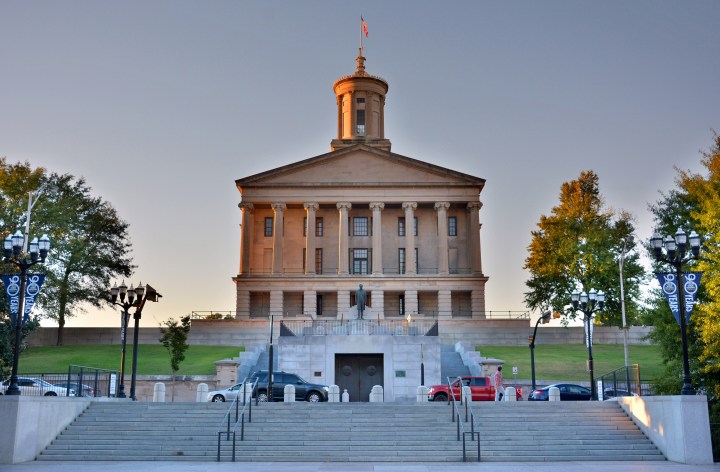
Photo: Tennessee StatehouseDeclarations of fascism rang throughout the chamber of the Tennessee House of Representatives on April 3 as House Speaker Cameron Sexton (R-Crossville) called for a vote on three resolutions to expel three Democrats for “disorderly behavior” (Brown and Jones 2023). Democratic Representatives Justin Jones, Justin Pearson, and Gloria Johnson, who collectively represent more than 200,000 constituents, faced the expulsion vote on April 6 that resulted in Jones and Pearson losing their seats.
The events leading to the unprecedented expulsion of two House members started with the mass shooting in Nashville on March 27 where six people were killed, including three children (Brown and Jones 2023). This reignited the long-running debate over gun control laws (or lack thereof). The Republican Governor of Tenessee responded to the shooting with a proposal of “$155m to place an armed security guard at every public school in Tennessee and to boost security presence at both public and private schools” (Yousif, Drenon and Goh 2023). Unsatisfied, more than 1,000 peaceful protesters, including hundreds of young people and their parents, gathered at the Tennessee Capitol on March 30 in support of gun control laws. There were no injuries, property damages, or arrests (Jones and Brown 2023). The controversy began when Representatives Jones, Pearson, and Johnson disrupted proceedings by leading protestors into the gallery with bullhorns.
“Any time we brought it up, our microphones were cut off,” Jones told NPR. “We were ruled out of order. And so we did not have even a venue to voice the grievances of our community. And so we had no other choice but to do something out of the ordinary and to try and stand in solidarity with disrupting business as normal because business as normal was sticking our head in the sand when our children are dying” (Ryan, Jarenwattananon and Kelly 2023).
Republicans quickly condemned the three representatives. Representative Sexton denounced the actions of the “Tennessee Three,” comparing their actions to those that participated in the January 6 insurrection (Jones and Brown 2023). Republican Representative Jody Barrett supported this assessment, telling NPR that “if you boil it down to what actually happened, both incidents were an attempt to interrupt a governmental activity or proceeding” (Ryan, Jarenwattananon and Kelly 2023).
Republicans swiftly stripped Jones and Johnson of their committee positions (Pearson did not serve on any committees) and restricted the three’s access to the Cordell Hull Legislative Office Building and parking garage (Brown and Jones 2023). Three resolutions to expel the representatives passed on April 3 and the votes on each were held on April 6. Each representative was given an opportunity to defend themselves.
Jones was the first to take the floor. In a speech before the vote, he said, “This is not about expelling us as individuals. This is your attempt to expel the voices of the people from the people’s house. It will not be successful,” Jones said. “Your overreaction, your flexing of false power has awakened a generation of people who will let you know that your time is up.” He was expelled from the House by a vote of 72-25 (Breen 2023).
Next was Pearson, who remarked, “We have heard from thousands of people asking us to do something about gun violence,” Pearson said. “What it is in the best interest of our people is ending gun violence.” He was expelled by a vote of 69-26.
Before her vote, Johnson referenced past scandals that did not result in expulsion. “We had a child molester on the floor for years, they helped him get reelected and did nothing to expel him,” Johnson said. “We’ve had members pee in each other’s chairs. We’ve had members illegally prescribe drugs to their cousin-mistress, and nothing happened. But talk on the floor without permission, and you’ll get expelled.” Johnson kept her seat by one vote; she is also the only one of the three who is white. “I think it’s pretty clear: I’m a 60-year-old White woman. And they are two young Black men,” Johnson told CNN.
In his interview with NPR, Barrett denied that race played a factor in his decisions. “In my view as an attorney, then it was incumbent upon the debate to present evidence to correct that and to establish clearly what it was that Ms. Johnson did to rise to the level of expulsion,” Barrett said. “I just don’t think that we established that during the debate.”
In the aftermath of the expulsions, prominent Democrats across the United States voiced their reactions. President Joe Biden issued a statement after the votes: “Today’s expulsion of lawmakers who engaged in peaceful protest is shocking, undemocratic, and without precedent. Rather than debating the merits of the issue, these Republican lawmakers have chosen to punish, silence, and expel duly-elected representatives of the people of Tennessee.” He also held a private conference call with Jones, Pearson and Johnson (Loller, Hall and Miller 2023).
Former President Barack Obama tweeted, “What happened in Tennessee is the latest example of a broader erosion of civility and democratic norms. Silencing those who disagree with us is a sign of weakness, not strength, and it won’t lead to progress.”
Vice President Kamala Harris traveled to Nashville on April 7. Along with privately meeting with the three representatives, Harris spoke at Fisk University, Nashville’s historically Black university that Jones attended.
“Let’s understand the underlying issue is about fighting for the safety of our children,” Harris said. “It’s been years now where they are taught to read and write and hide in a closet and be quiet if there’s a mass shooter at their school, where our children, who have God’s capacity to learn and lead, who go to school in fear.”
Jones and Pearson will not be out of politics for long. The procedure after the expulsion of a House member directs the representative’s district to choose an interim replacement until an election is held; there are no rules that prohibit the council of the district from choosing the expelled member to be appointed back to the House (Yousif, Drenon and Goh 2023). The representatives are also able to run again when the special elections are held.
On April 10, Nashville’s Metro Council “unanimously voted to reinstate freshman Democrat Justin Jones to his seat in the Tennessee House” (Abrams 2023). Two days later on April 12, the Shelby County Commission unanimously voted to reappoint Justin Pearson (Gutierrez and Breslin 2023). Both Jones and Pearson have been sworn in, reuniting the “Tennessee Three” in the state House.
Ashley Pickus is a junior from Plainview, New York. She is double-majoring in political science and English rhetoric and minoring in writing studies. Ashley spends most of her free time following the current pop culture trends, watching television shows, or listening to music. If asked, she can explain the meaning of any Taylor Swift song and its significance. After graduation, Ashley hopes to find a job in the media industry.
References
Abrams, Cynthia. 2023. “Tennessee rep. Justin Jones returns to Capitol after Nashville Council reinstates him.” NPR, April 10. https://www.npr.org/2023/04/10/1169154500/tennessee-rep-justin-jones-unanimously-reappointed-to-house-by-nashville-council.
Biden, Joe. 2023. “Statement from president Joe Biden on expulsion of Tennessee lawmakers for acting on Gun Safety.” The White House, April 7. https://www.whitehouse.gov/briefing-room/statements-releases/2023/04/06/statement-from-president-joe-biden-on-expulsion-of-tennessee-lawmakers-for-acting-on-gun-safety/.
Breen, Kerry. 2023. “What to know about the ‘Tennessee Three’: Why were two of the Democratic lawmakers expelled, and what happens now?” CBS News, April 10. https://www.cbsnews.com/news/tennessee-expulsion-house-democrats-expelled-what-happens-now/.
Breslin, Ryan and Carmyn Gutierrez. 2023. “Justin Pearson sworn back into Tennessee House.” WSMV, April 13. https://www.wsmv.com/2023/04/13/rally-reappointed-lawmaker-justin-pearson-ahead-swearing-in-ceremony/.
Brown, Melissa and Vivian Jones. 2023. “Tennessee GOP begins expulsion process for 3 Democrats, House session devolves into Chaos.” The Tennessean, April 5. https://www.tennessean.com/story/news/politics/2023/04/03/tennessee-republicans-file-resolutions-to-expel-three-democrats-who-led-gun-reform-chants-on-house-f/70078002007/.
Jones, Vivian and Melissa Brown. 2023. “Tennessee capitol protest explainer: Here’s what did and did not happen.” The Tennessean, April 4. https://www.tennessean.com/story/news/politics/2023/04/04/tennessee-capitol-protest-heres-what-did-and-did-not-happen/70075823007/.
Loller, Travis, Zeke Miller and Kristin Hall. 2023. “Kamala Harris leads Tennessee rally, backs ousted lawmakers.” AP NEWS, April 8. https://apnews.com/article/kamala-harris-tennessee-gun-violence-lawmakers-expelled-0a5011694aa5cbf5917bac7f9e09551b.
Obama, Barack. 2023. “What happened in Tennessee is the latest example of a broader erosion of civility and democratic norms. silencing those who disagree with us is a sign of weakness, not strength, and it won’t lead to progress.” Twitter, April 7. https://twitter.com/BarackObama/status/1644163255189774337.
Ryan, Erika, Patrick Jarenwattananon and Mary Louise Kelly. 2023. “Tennessee gop rep. Barrett on why he voted to expel two colleagues but not the third.” NPR, April 7. https://www.npr.org/2023/04/07/1168728769/tennessee-gop-rep-barrett-on-why-he-voted-to-expel-two-colleagues-but-not-the-th.
Yousif, Nadine, Brandon Drenon and Melisa Goh. 2023. “Lawmakers expelled: What to know about the ‘Tennessee three’.” BBC News, April 7. https://www.bbc.com/news/world-us-canada-65182502.
-
How France Regained its International Status After the Second World War
How did France, with a crippled economy and weakened military, gain the status of a superpower?
When World War II ended in Europe in the spring of 1945, France was a shadow of its former self. The army was defeated by Nazi Germany, and the country had suffered under occupation for years. With their financial and economic situation being so terrible, France lacked all the material fundamentals to regain a dominant role on the world stage. Nevertheless, the country gained superpower status in the new world order that followed World War II.
Initially, France was not involved in the plans for the creation of the postwar order. But in the last year of the war, France acquired many privileges that secured its international status. In 1945, France was given a permanent seat on the UN Security Council, along with the United States, Britain, the Soviet Union (later Russia), and China. These “Big Five” to this day have a great influence on the organization thanks to their veto powers. But how did France, with a crippled economy and weakened military, gain the status of a superpower?
French Foreign Relations During The War
On the eve of World War I, The French Empire was undeniably a world power, being global in scope with colonial possessions on every continent. The First World War was devastating, but despite the damage suffered, France remained a relevant force in the world during the Interbellum (Meunier 2017). Its colonial empire was largely intact, and the French army was among the largest and strongest in the world. France also gained control of the economically important Rhineland, a heavily-industrialized, formerly-German region. This beneficial position, however, was not long-lasting—World War II was fatal to France’s economy and industry; the French Gross Domestic Product in 1945 was almost half of that in 1938, and the country was plagued by famines. However, the damage to France’s dignity was even greater, as on May 10, 1940, the Nazi invasion began. One month later, German soldiers marched on the Champs Élysées in the heart of Paris. France had been defeated, dealing a heavy blow to the nation’s international status.
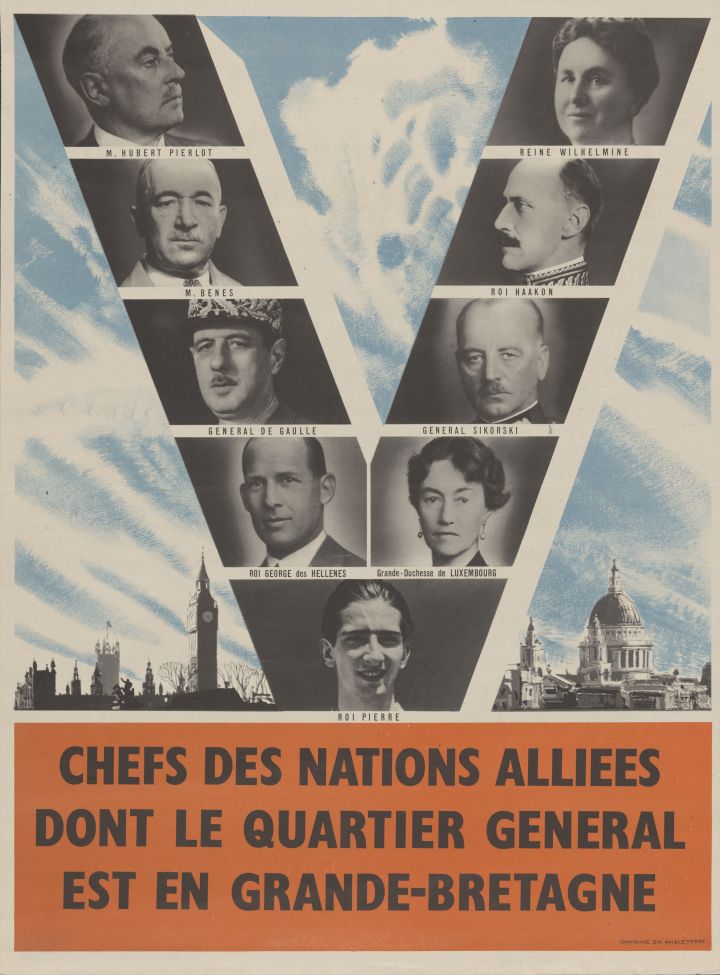
When the French leadership began negotiating its surrender, General Charles de Gaulle was on a diplomatic mission in London. There he remained when the cabinet fell and Marshal Philippe Pétain, a puppet of Hitler, became the president of occupied “Vichy France.” De Gaulle quickly tried to form an alternative government-in-exile in London called Françaises Libres: the Free French. In the meantime, the Vichy regime wanted to sentence him to death for high treason.
Meanwhile, De Gaulle struggled to gain recognition for his government in exile. Even in the French colonies, where many governors ignored him (Manning 1977). On the world stage, there were now two governments trying to present themselves as the legitimate representation of France. According to De Gaulle, the Vichy regime was not legitimate because it had deprived the French people of their right to self-determination, “a right considered traditional and sacred in France” (Cassin 1941). The Vichy regime abandoned the idea of a French Republic, something De Gaulle refused to do. He did his best to uphold the illusion that France was not lost and still fighting the war (Trotiño 2008).
But De Gaulle’s personality got in the way of his ambitions. The Allies did not favor him as the temporary representative of France (Williams 2017). The United States, in particular, was reluctant because of President Roosevelt’s dislike for De Gaulle; he was suspicious of the motivations of the self-proclaimed French leader. De Gaulle was said to have “Napoleonic” traits and was accused of wanting to start his own dictatorship in France. The United States for a long time maintained diplomatic relations with the Vichy regime to keep the door open for this regime to be the rulers of postwar France. Since the French contribution to the war so far was minor, Roosevelt did not recognize France as a superpower (Trotiño 2008). In Roosevelt’s vision, only “Four Policemen” were needed to maintain world peace after the war, not five. Consequently, the Free French were not invited to the Dumbarton Oaks Conference in July and August 1944, where the groundwork was laid for the postwar world.
The relationship of the Free French with Britain was much better than with the United States, although the British had their doubts about De Gaulle’s legitimacy. Initially, they saw De Gaulle as representing a group of Frenchmen and not the Frenchmen. When De Gaulle reproached Churchill for doing Roosevelt’s bidding, Churchill delicately answered him that if he had to choose between Europe and “the rest of the world,” he would always choose “the rest of the world” (Gildea 2002). It was clear that the future world order was an Anglo-American project, not a European one. Yet, with the growing threat of the Cold War, helping France restore its global position became a policy objective for Britain. (Hilderbrand 1990). France was the only candidate on the European continent to be able to counter both Germany and the Soviet Union. But there was also a second reason why involving France in world governance was in Britain’s interest. Both countries had large colonial empires, and France could help the British constrain the decolonization desires of other superpowers.
In February 1945, the “Big Three” met in Crimea for the Yalta Conference. France was not invited, much to the annoyance of the Free French, who had already renamed themselves the “Provisional Government of the French Republic.” France was given an occupation zone in West Germany, but this was seen more as a favor than as a right. The agreement, in De Gaulle’s eyes, violated France’s international status (Heimann 2015). French administrators were outraged that the future of Europe was being determined by three “non-European powers.” They dug their heels in and refused to join the San Francisco Conference, where the United Nations Charter was drafted, as long as they were denied a say in the original agreements. This tactic paid off because the Allies changed their position, and France was accepted as a full partner in the new world government. Along with the “Big Three” and China, it was given a permanent seat on the Security Council. From then on, France’s international status was on the rise again. The French had successfully secured their place in future world affairs.
The Foundations Of International Status
It was not just British self-interests and French stubbornness that allowed France to resume the role of a superpower. Other countries were equally or even better suited to become the fifth world power. Brazil, for example, was highlighted as a candidate by the United States. In terms of natural resources and population, Brazil was comparable to France. With Brazil, the South American continent would also be represented on the Security Council. However, there was no desire for a sixth permanent seat. In the end, France was chosen because it enjoyed greater prestige. But what was that reputation based on? The defeat of 1940 made it painfully clear that the balance of power had shifted away from Europe and France. But material assets are not the only source of international status. A potential superpower can also gain recognition based on three other factors: symbolic value, moral claims, and contextual factors (Heimann 2015).
Historical heritage is the most important foundation for symbolic power. Privileges are rarely taken away from countries that are traditional superpowers, and France has a rich past. Giving a newcomer, such as Brazil, important privileges would make other countries jealous. The choice of France was accepted by the international community due to its historical legacy. In addition, France derived much symbolic value from its colonial empire. De Gaulle saw the French empire as a crucial element in France’s resurgence as a world power (Williams 2017). He managed to recapture French territories in North Africa between 1942 and 1943 with what was left of the French armed forces, supported by the British and the Americans. De Gaulle immediately installed part of his government in Algeria so that they would no longer be a “government in exile,” but one that represented French interests from French soil. After the war, consideration was given to the idea of transforming the empire into a “French Union,” along the lines of the British Commonwealth. The French attachment to its colonial possessions was welcomed by the British and irked the Americans while giving France some sense of self-worth and relevance.
Moral motives may also bring a nation prestige and privileges. Often these kinds of privileges are rewards for services rendered. For example, countries that contributed or sacrificed greatly to war may have a favorable position in the postwar world order. De Gaulle was aware of this and consistently sought to increase the French contribution to the Allied victory. The remaining French army was small compared to the massive armies of the “Big Three,” while also being poorly equipped. De Gaulle frequently had to ask the Americans for weapons. African soldiers from the French colonies contributed significantly to the war effort. They participated in the invasion of Sicily and Italy, and twenty thousand African infantrymen fought for the liberation of southern France in 1944. However, most of the praise went to the French Resistance and their fight against the German occupiers (Jackson 2004). By, in his own words, using his limited means to “stir up a lot of dust” (Heimann 2015), De Gaulle ensured that France could claim the spoils of war.
Finally, there are contextual conditions that make a state a viable candidate for the role of a superpower. Geography can play a big role, especially in combination with political affinity. While a seat for Brazil would better the global representation in the Security Council, France possessed a more strategic location in the context of the Cold War. Initially, both the United States and the Soviet Union opposed a French seat, but after conversations between Moscow and Paris, the Soviet Union flipped. Stalin likely hoped to bring in France as a political ally (Heimann 2015). This forced the United States to appease France as well. When Roosevelt proposed to Stalin in February 1945 that France be given a zone of occupation in West Germany, the latter asked: “For what reason?” Roosevelt replied: “Out of kindness” (Heimann 2015), a surprising stance for a man who first clearly disapproved of De Gaulle and French imperialism. By playing “hard to get,” France was able to take advantage of tensions between the United States and the Soviet Union to win privileges for itself.
International status is an abstract commodity. A state with poor military or economic weight can still rise to a powerful position if it has symbolic value or if contextual conditions are favorable. France’s status after World War II was one of its own makings. It could not be demanded but had to be obtained through tactical maneuvering. This way, De Gaulle was able to restore France’s grandeur.

Bart van der Wal is an exchange student from The Netherlands. He is majoring in history at Utrecht University with a specialization in globalization and world order. Bart followed a minor in American Studies at the University of Amsterdam and is now on a year-long exchange at Binghamton University, where he takes classes in history and political science. He is especially interested in transatlantic relations and international conflicts. In the near future, Bart will be pursuing a master’s degree in International Relations.
References
Cassin, René. 1941. “Vichy or Free France?” Foreign Affairs, 20(1): 102–112.
Gildea, R. 2002. “Myth, memory and policy in France since 1945.” in: Memory and Power in Post-War Europe: Studies in the Presence of the Past, ed. Jan-Werner Müller, 59–75. Cambridge, UK: Cambridge University Press.
Heimann, Gadi. 2015. “What does it take to be a great power? The story of France joining the Big Five.” Review of International Studies, 41(1): 185–206.
Hilderbrand, Robert. 1990. Dumbarton Oaks: The Origins of the United Nations and the Search for Postwar Security. Chapel Hill, NC: University of North Carolina Press.
Jackson, Julian. 2004. The Fall of France: The Nazi Invasion of 1940. Oxford, UK: Oxford University Press.
Manning, A.F. 1977. “De Nederlandse regering in Londen en de ‘Vrije Fransen.’” Bijdragen en Mededelingen betreffende de Geschiedenis der Nederlanden, 92: 438–450.
Meunier, Sophie. 2017. “Is France Still Relevant?” French Politics, Culture & Society, 35(2): 59–75.
Troitiño, David. 2008. “De Gaulle and the European Communities.” Proceedings of the Institute for European Studies, (4): 139-152. Williams, A. 2017. “France and the Origins of the United Nations, 1944–1945: Si La France ne compte plus, qu’on nous le dise.” Diplomacy & Statecraft, 28(2): 215–234.
-
Conspiracy Theories and the Fall of the USSR
By Matthew Beylinson
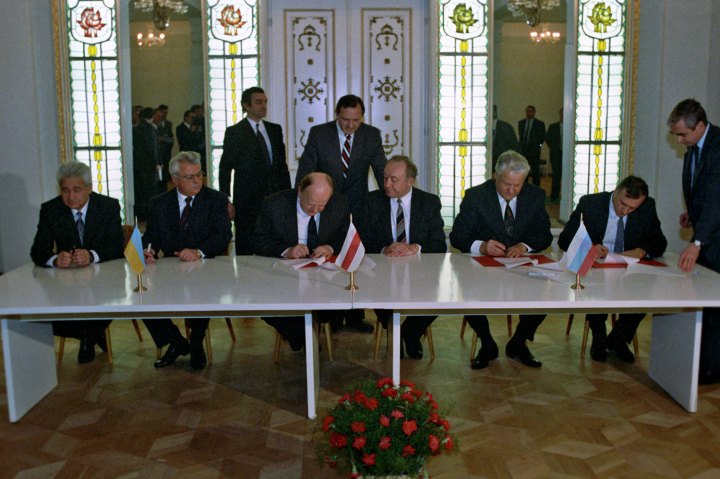
Photo: Leaders sign the agreement to dissolve the USSR (RIA Novosti).How did factors from the Soviet and post-Soviet periods combine to create conspiracies, and how do these conspiracies live on in modern Russia?
It is a quiet night in Moscow as the city starts to settle down. The day is September 9, 1999, and recently, Russia has been rocked by a series of bombings orchestrated by Chechen terrorists. There is an air of confusion and anxiety about the recent bombing and the war in Chechnya. But up till now, the bombings had been happening far from Moscow, and when a bomb exploded in Moscow, there were relatively few deaths. Then, just after midnight, an explosion rings out across the Russian capital; a massive section of an apartment on Guryanova street has just been transformed into a pile of rubble within seconds. Officially, this horrific event (and the bombings before it) was blamed on Chechen terrorists, but even today not all Russians believe this narrative. There is a popular theory that the cause of the attack was the successor to the KGB, the FSB, which organized a bombing campaign under the orders of Vladimir Putin. This attack led to the second Chechen war, which served as a massive boon to Putin’s political career (Ortmann and Heathershaw 2012).
The apartment bombings, which predated the second Chechen war, were just one of many conspiracies floating around Russia in the 1990s. This was a period of extreme social, political, and economic change, surrounded by an atmosphere of nearly complete confusion. Because of these factors, nearly every major event that occurred during this period was thought by some to be part of a conspiracy. But how did this prolific conspiratorial culture emerge, how did factors from the Soviet and post-Soviet periods combine to create conspiracies, and how do these conspiracies live on in modern Russia?
The conspiratorial culture of the ‘90s cannot be discussed without first going into the Soviet period and examining how conspiracies from before the fall helped develop ones after. There is no better place to start than one of the oldest roots of conspiracy theories in Russia, a fear of the West. This fear originated as a feeling of otherness—that the West is different from Russia—and dates back deep into the Tsarist Era (Diligensky and Chugrov 2000). However, Russian fears of Western agents plotting the downfall of the Russian state originated with the Russian revolution. It was a fear that was not irrational, as the Allied powers (which included many powerful Western states) intervened in the revolution on the side of the White Army to put down the Bolsheviks (Baldwin 1969).
But the Bolsheviks won, and they would later establish the Soviet Union. This event was therefore framed as an attack on the Soviet system by a foreign capitalist foe, the West. Khrushchev captures the sentiment in a 1959 speech, where he said, “Remember that in the hard times after the October Revolution, US Troops… landed on Soviet soil to help the White Guards fight our Soviet system. And they were not the only ones to land… Your armed intervention in Russia was the most unpleasant thing that ever occurred in the relations between our two countries…” (Diligensky and Chugrov 2000). The Soviet people, including their leadership, developed a distrust of the West after this event, which expanded into a fear that the next invasion was imminent.
This fear existed among all strata of Soviet society, from the General Secretary to lowly workers in remote republics, and it saw a reemergence after the fall of the USSR. However, what was previously a fear had now become a conspiracy. As the USSR was falling, many were confused as to how this could be possible; it was easy to come up with a simple reason that the West again had intervened, and this time succeeded. The most famous of these conspiracy theories was that of the “Dulles Plan.” The theory maintained that the CIA, under director Allen Dulles, had infiltrated the Soviet Union. The infiltrators would then spread confusion, government infighting, and general social unrest for the sake of ultimately destroying Russian culture and the USSR as a whole (Scheie 2019). This theory was primarily spread by former Soviet officials and by members of the new Russian Federation government. They wanted to explain the collapse of the USSR in such a way that removed all blame from the Russian government; only malicious outside interference could have caused the collapse.
Along with its roots in a fear of the West, the Dulles Plan theory also has roots in another concept important to understanding Russian conspiracy culture, the existence of powerful state security apparatuses. State security apparatuses have existed in Russia since before the Soviet period. Due to their long history, they have established themselves as permanent fixtures in Russian society. This has led to their inclusion in several conspiracy theories. It has also led to these agencies creating conspiracy theories to keep justifying their existence.
Regarding the Dulles Plan, it uses fear of the West to create a necessity for agencies such as the KGB to exist. If there is an impending attack from the West that seeks to destroy Russian culture using hidden operatives, then there is only one response that makes sense: support the KGB. In writing about the role of state security agencies in the spread of the Dulles Plan conspiracy, Scheie writes, “this has created a high dependence on security services in order to preserve the Russian way of life” (2019). This dependency carried on into and past the Yeltsin years when the KGB was revived as the FSK/FSB. They adopted the mindset that only they could defend Russia against its usual hidden enemies.
The West’s plot, in this case, took the form of journalists and media criticizing Russia’s government. This plot is presented in very conspiratorial-sounding language, which can be seen in a quote from Vasilii Stavitskii, an FSB public relations official. He writes, “Someone very ‘wise’ in the West has skillfully used a campaign in order to devastate the power structures… The impression is created that someone very ‘wise’ again wishes through the hands of journalists to suffocate the new democratic state.” The FSB uses the fears of the past to create new conspiracies which help them maintain their position of power and slander members of the opposition. The Western infiltrators have returned, this time as journalists and critics of the regime.
Yet, while the FSB attempts to take a heroic stance as the saviors of Russia, their emergence came at a time of extreme government distrust (Soldatov and Borgan, 2010). This distrust, along with the FSB’s increasingly brutal nature and the massive amount of former KGB/FSB in government, led to conspiracies emerging about the agency. Consider, for instance, the aforementioned conspiracy theory floating around about the apartment bombings. At its basics, this theory combines elements of a general distrust in what the government says is happening, a sense of the FSB becoming increasingly more brutal, and the suspicious amount of former KGB/FSB agents getting key government positions. The production of conspiracies was not and is not just something done by the government and its supporters—the opposition is also involved in this culture of conspiracy theories.
Another key factor from the Soviet period and before that was unfortunately revived in ‘90s conspiracy theories is anti-Semitism. Russia has a long and troubled history of anti-Semitic conspiracy theories. The most infamous case of this is The Protocols of the Elders of Zion, a conspiracy theory alleging that a cabal of Jews was seeking to secretly control the world. The theory originated in Russia and was created by the Okhrana, the secret police of Imperial Russia, in the early 20th century (Anti-Defamation League, A Hoax of Hate: The Protocols of the Learned Elders of Zion). This troubled past remerged with the collapse of the USSR as the near-total social disorder led to old anti-Semitic biases being sown into new conspiracy theories. There was a prevalent theory that the oligarchs who emerged at this time were all Jewish. It was key to this theory that by being Jewish, they had to become oligarchs (Ortmann and Heathershaw 2012).
During the ‘90s, anti-Semitic conspiracy theories also took the form of “alternate” history. Nationalist writers such as Aleksandr Prokhanov, Sergei Kurginian, Vadim Kozhinov, Igor Shafarevich, and Sergei Kara-Murza, who wrote texts claiming that Jews had threatened Russia throughout history, achieved peak popularity in the ‘90s (Laruelle, 2012). One subject often covered was the Medieval Khazar kingdom—a Jewish kingdom on the shores of the Caspian Sea which often conflicted with the Kievan Rus, often considered the predecessor of Russia (Laruelle, 2012). The goal of their incorrect readings of history was to paint Jews as an ancient, eternal enemy of the Russian people.
When these glaringly false histories were combined with theories of an Oligarchic class composed solely of Jews, an impression was created that Jews are not the same as orthodox Russians: they have always been enemies and outsiders, and now they have massive political and social power. The complexities of the post-Soviet period were simplified in terms of evil, wealthy Jews, and good, simple Russians.
One of these more modern elements that contributed to this culture of conspiracies was simply the confusion of the times. It was hard for many Russians to believe that the Soviet Union went from being a global superpower to not even existing in a matter of years. The states left behind after the collapse were shadows of the former geopolitical colossus. The various political events that preceded the sudden downfall of the USSR were thus re-examined with a conspiratorial perspective.
Events such as the August Coup and Gorbachev’s liberalizing policies were explained in terms of a conspiracy. The theory was that a Western plan to destroy the USSR and plunder its wealth had reached its ultimate goal. Gorbachev would use his liberalizing reforms to rouse liberals in Russia into becoming a pro-Western fifth column to topple both communism and the state (Yablokov 2018) This attempt was resisted by hardliners in the communist government and the KGB (Soldatov and Borgan 2010) which, of course, was positioned as the only force that could stop Western infiltrators. It is clear to see the pre-Soviet elements of conspiracy here, such as the nobility of the state security apparatus and an overall fear of Western infiltration.
Lack of information was not the issue; it was an overabundance of information that caused confusion. When the Soviet Union collapsed, there was an influx of information into Russia propelled by new sources of media, like the internet and international news. A broad variety of contradictory information was now offered to the average Russian without the presence of Soviet-style censorship. This created an environment where average people did not know who to believe or which source to trust, thus creating a breeding ground for conspiracy theories to emerge (Ortmann and Heathershaw 2012).
The processes of globalization and Westernization also contributed to the creation of conspiracy theories. Russia very suddenly transitioned from a mostly closed-off, communist state into a quasi-liberal, capitalist state. With the political and economic changes of globalization also came the social changes, which took the form of Westernization. What made these changes a root of conspiratorial thought was their suddenness and their lack of efficacy.
These changes were part of Yeltsin’s program to rapidly transform the new Russia into a modern democracy; it was a plan known as shock therapy. The idea was for a rapid transition into a market economy that followed an equally fast change to democracy. Instead of a free market, though, Russia developed an inefficient economy in which private enterprises were controlled by a very small elite with ties to the government: the oligarchs. This economy was mired in Soviet-style inefficiency as unprofitable industries were propped up by the government due to their ties with the former Soviet system (Huygen 2012) This economic unrest was made worse by the new political freedoms allowed to the public, which allowed them to air their grievances publicly. (Huygen, 2012).
Then to make matters worse, economists from the West were some of the primary advisors of Yeltsin in implementing shock therapy. The Clinton administration and the International Monetary Fund, after some pushing from the US, loaned billions of dollars to Yeltsin’s government with little oversight. The goals of these loans were to continue Russia’s efforts of shock therapy. But the quality of life continued to plummet as both these loans and shock therapy accomplished little for the Russian people, save for the new class of oligarchs (Huygen 2012).
It was all this, along with an influx of Western culture and goods into Russia, that led to the growth of conspiracy theories. The forces of globalization and Westernization, along with the United States as a whole, were clumped under the title of the “New Order,” a term still used by Putin today. (Yablokov 2018) A prime example of a conspiracy based around the New Order is one perpetuated by Gennadii Zyuganov, the leader of the new Communist Party of the Russian Federation. He argued that 1991 was the start of the new world order composed of the Bilderberg Group, the Trilateral Commission, the American Council for International Relations, and the US government. This nefarious new order was working to ultimately destroy the Russian state in any capacity and to end Orthodox Christianity (Yablokov 2018). This theory presents the fears of cultural erosion via economic and political change held by many Russians.
It was not just the opposition like Zyuganov that used conspiracy theories. The Russian government in the ‘90s also did not shy away from spreading conspiracy theories for political gain. One such example is the sinking of the Kursk. The Kursk was a Russian nuclear submarine that sank in 2000 in an accident that claimed the lives of everyone on board. The Kremlin, however, refused to accept the fact that the submarine sank due to poor maintenance and mismanagement. Instead, they promulgated a theory that the Kursk collided with a NATO submarine that was sailing illegally in Russian waters (Ortmann and Heathershaw 2012). This theory was spread by the Russian government to throw the blame on the West for a horrible mistake to which they did not want to own up. Despite their plan, the Kremlin’s theory never really spread among Russians and was even openly mocked.
The conspiracy theories and the elements from which they were made were not just confined to the ‘90s and then lost to history; they are still very much alive in modern Russia. The difference is that, in 21st-century Russia, instead of being spread by opposition politicians or by ordinary citizens in conversation, conspiracies are spread by Russian state media (Yablokov 2018). The use of conspiracies by Russian politicians also has not disappeared after the ‘90s. In the 2007 and 2011-12 Parliamentary and Presidential elections, Russian political elites in United Russia, the ruling party, spread a conspiracy theory that there was again a Western plot to destroy Russia, this time through election interference (Yablokov 2018).
Modern anti-Western conspiracy theories nearly all agree that the only shield against the menace of the West is Putin, his party, and his government. In a 2007 speech, Boris Gryzlov, the chairman of United Russia, spoke of Western aggression against Russia and how Russia is surrounded by the West or Western-aligned states. He also spoke of “well-wishers,” a veiled term for Western agents inside Russia hoping to spread unrest. But in this difficult time, Gryzlov reveals the one shield against Russia’s foes: “Modern Russia is Putin. Russia without Putin is Russia without leadership, Russia without will. Russia, which can be divided and with which you can do whatever you want. Russia as prey.” (Gryzlov 2007). Putin has absorbed the role of the KGB and other state security agencies in Russian conspiratorial thought as shields against the West.
Putin and his political allies are men who have built their careers out of the conspiratorial culture of the ‘90s. As demonstrated, they use elements of conspiracy theories from this time to build support for themselves and their party. Yet it is not just elements of conspiracy theories that they use; they have crafted a zeitgeist of the ‘90s as a time of despair, confusion, chaos, and Western corruption. The so-called “tumultuous ‘90s” is a term modern politicians throw around as a tool against their enemies (Yablokov 2018). The implication is always that if someone other than a United Russia candidate is elected, then we will see a return to the “tumultuous ‘90s.” United Russia would have all Russians believe that the 1990s have never fully ended; they are right around the corner, ready to push the country into mayhem, and the only force that can stop them is Putin and his cronies.

Matthew Beylinson is a political science and classical civilizations double major from Staten Island, NY. He is in his junior year and hopes to attend law school and eventually work in international law or government. Outside of Happy Medium, Matthew is a member of the History Club, Rowing Club, and works as a bus driver for OCCT. He is fluent in Russian and specializes in Post-Soviet politics and the analysis of autocratic and totalitarian regimes.
References
Грызлов, Борис. 2007. “Борис Грызлов: Владимир Путин Останется Национальным Лидером – Независимо От Поста, Который Он Будет Занимать.” Российская газета, October 17. https://rg.ru/2007/10/17/grizlov.html.
Baldwin, Robert Cushman. 1969. “The Allied Military Expedition to North Russia: 1918-1919.” Faculty of the College of Arts and Sciences of the American University.
Diligensky, Guerman and Sergei Chugrov. “‘The West’ in Russian Mentality.” Office for Information and Press, Brussels, Institute of World Economy and International Relations, Moscow.
“A Hoax of Hate: The Protocols of the Learned Elders of Zion.” 2013. Anti-Defamation League, January 5. https://www.adl.org/resources/backgrounders/a-hoax-of-hate-the-protocols-of-the-learned-elders-of-zion.
Huygen, Christopher. 2012. “One Step Forward, Two Steps Back: Boris Yeltsin and the Failure of Shock Therapy.” Constellations 3(1). doi: 10.29173/cons16287.
Laruelle, Marléne. 2012. “Conspiracy and Alternate History in Russia: A Nationalist Equation for Success?” The Russian Review, 71(4): 565–80. doi: 10.1111/j.1467-9434.2012.00669.x.
Ortmann, Stefanie and John Heathershaw. 2012. “Conspiracy Theories in the Post-Soviet Space.” The Russian Review, 71(4): 551–64. doi: 10.1111/j.1467-9434.2012.00668.x.
Scheie, Trina. 2019. “Post-cold War Russian Revisionism and Conspiratorial Thinking: Revealing Centuries of State Security and Intelligence Dependence.” Johns Hopkins University.
Soldatov, Andrei and Irina Borogan. 2010. “Russia’s New Nobility: The Rise of the Security Services in Putin’s Kremlin.” Council on Foreign Relations, 89(5): 80–96.
Yablokov, Ilya. 2018. “Conspiracy Theories in Post-Soviet Russia.” Conspiracy Theories and the People Who Believe Them, 360–71. doi: 10.1093/oso/9780190844073.003.0024.
Yablokov, Ilya. 2018. Fortress Russia: Conspiracy Theories in Post-Soviet Russia. Cambridge, UK: Polity Press.
-
A House Divided: Is Congress Fueling or Reflecting Polarization in the US?
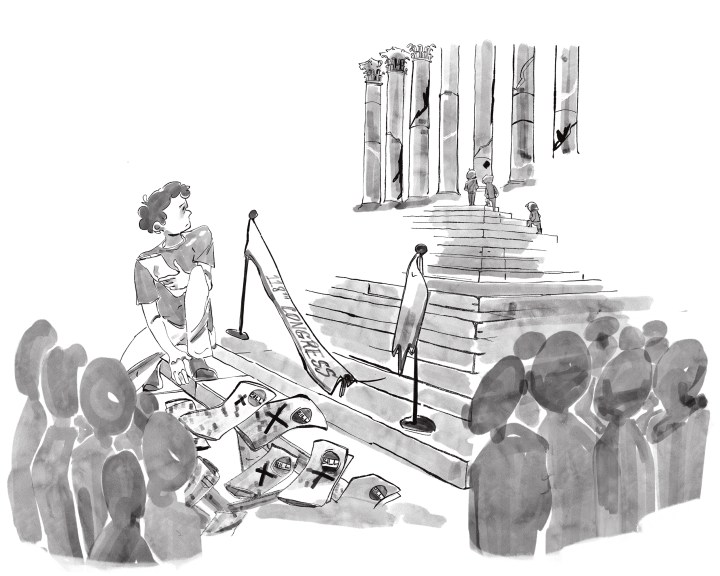
By Benji Hoff
Art by Rhea Da Costa, Resident ArtistRead this article and more in our 2023 winter edition, on campus now!
If you ask any politically aware person about the state of American politics today, they will likely characterize it with one word: polarization. A person’s views on today’s most prominent political issues—such as abortion, gun control, tax brackets, immigration policy, and more—can often be predicted based on their views on any single one of these issues. According to a study by Pew Research in 2016, 66% of Republicans agree with their party’s positions on abortion, and 80% on gun policy (“Partisanship and Political Animosity” 2016). On the other side of the aisle, 81% of Democrats agree with their party’s economic policies and 77% back the party platform on immigration (“Partisanship and Political Animosity” 2016). These numbers demonstrate the general lack of deviation from the party platform. Political scientists are split on the origin of this trend. Does polarization come from the bottom up as people become more ideologically distant from one another and surround themselves with like-minded individuals? Or does the partisan nature of our legislature trickle down to ordinary citizens and push them farther apart?
The trends demonstrated in Congress certainly suggest the latter. Another Pew Research report has tracked polarization in Congress since the 92nd Congress in 1971 (Desilver 2022). The report uses a method that records members’ roll call votes to track the ideological divisions over time. A roll call vote is a simple “yea” or “nay” vote on a particular motion in the House or Senate. A member’s votes will reflect their policy preferences, making this a viable method to compare different Congresses to each other regardless of the relative political climate in each one.
The report places lawmakers on a left-right spectrum from -1 being the most liberal to 1 being the most conservative. Since the 92nd Congress, both parties have strayed further from the ideological center, but Republicans have moved farther. Democrats in the House have moved from an ideological score of -.31 to -.38, representing a moderate increase (Desilver 2022). House Republicans have moved from .25 to .51, doubling their ideological score and representing a starker move toward the extreme (Desilver 2022). Over the past 50 years, both parties have become more ideologically cohesive. There is much less voting across party lines, and like the average citizen, a member’s views on one issue will likely predict their views on any other issue. In the 92nd Congress, there were more than 160 representatives that could be characterized as moderate; now, there are just over 20 (Desilver 2022).
These stats do not confirm the origin of polarization. What they do show is that Congress has grown more divided over time just as American citizens have. Furthermore, Congress exhibits the same partisan animosity found in every-day political discourse. In addition to the rarity of voting across party lines, lawmakers often refuse to collaborate with members of the opposite party. This polarization in Congress results from the structural design of our government in which congressional majorities dominate the agenda, pushing their own policies and blocking those of the opposition. The House Rules Committee is the source of power in this regard. The Rules Committee is controlled by the Speaker of the House, who is a member of the majority party. The Speaker decides who is appointed to the Rules Committee, and if members do not follow the Speaker’s agenda, they will be replaced with new appointees. The Rules Committee is powerful because it unilaterally determines the agenda in Congress, with the exception of some jointly supported bills that are discharged from committee. Which bills are considered on the floor and the terms of floor debate are among two of the major legislative procedures that are controlled by the Rules Committee.
When House majorities change, there tends to be a flurry of legislation passed by the majority party and heavy use of the Rules Committee to snuff out the other party’s agenda. The new majority wants to establish control and dominance over the minority party. This was the case to an extreme degree in the 104th Congress. In 1994, the Republicans swept the elections, gaining control of both the House and the Senate. This marked the end of a 40-year drought in the House, and the Republicans were eager to take control. House Speaker Newt Gingrich adopted a highly confrontational approach to the Republicans’ newfound power (Fenno 1997). He and the rest of the Republican majority tried to push through as much legislation as possible, block any Democratic legislation, and overall asserted their authority over the Democratic minority. A conflict over the Republicans’ proposed budget plan resulted in two government shutdowns, and President Clinton vetoed Republican legislation on spending and tax cuts. Being out of power for so long meant a significant lack of experience in leading as well as an inability to craft bills that would also be supported by the Democratic minority. The uncompromising strategy of the Republicans led to a stronger divide in the House, and the handling of their majority power was viewed by many as ineffective.
Political incentives also drive legislators to high levels of partisanship. In 1974, David Mayhew published his seminal work Congress: The Electoral Connection, in which he characterized Congress members as “single-minded seekers of reelection” (Mayhew 1974). Mayhew applied the rational choice theory of economics to Congress, which states that all humans make rational choices that provide them with the greatest benefit (Ganti 2022). He argued that all electoral activity taken by Congress members is done with the hope of reelection, because without reelection no other political goals can be achieved. While members do try to pass legislation that benefits their constituents and answers their needs, this is often selfishly motivated. If voters see representatives as adequately fulfilling their policy goals and needs, they will vote for them again. Reelection serves to further polarize Congress because breaking from the party line on Capitol Hill will upset the constituency on the ground. Additionally, straying too far from the party platform runs the risk of a challenge within one’s own party. Falling in line with the partisan platform is ultimately best for a Congress member’s hopes for reelection.
The importance of roll call voting is relevant again, as it is an easy instrument for members to signal their ideologies to both their constituents as well as their political opponents. An easy way to gain support from your voting base is to differentiate yourself from the opposite party. Roll call votes provide a clear and understandable record of a Congress member’s ideological platform. This combination of procedural and political factors keeps Congress—and by extension, the country—divided.
Of course, Congress is not the only cause of polarization. Geographical sorting also has some effect, but it is usually overstated in the discourse surrounding polarization. Sorting refers to the phenomenon of people intentionally moving into communities that are comprised of politically like-minded individuals. Political scientist Bill Bishop articulated this theory in his 2008 book The Big Sort, positing that people actively prefer to be surrounded by voices similar to their own (Bishop 2008). More recent research has revealed two major holes in this theory. First is that most people are financially restricted from living wherever they want. No matter how liberal a person identifies, most can not afford to live in the most liberal parts of the country, which are large, dense cities with exorbitant rent. Secondly, Americans tend to move frequenty, so data is not always accurate as population distributions shuffle around (Martin and Webster 2018). It is also counterproductive to blame citizens’ living preferences for polarization when oftentimes economic and social policy affects where someone chooses to live.
Many may point to gerrymandering as a cause of polarization. Safe districts—districts that are reliably either Democratic or Republican—certainly disincentivize working across the aisle, but the reason for this goes back to reelection goals. Why would a representative from a safe district risk their reelection prospects by collaborating with a despised political rival? The main problem with the gerrymandering explanation is that the US Senate can not be gerrymandered because each state elects two Senators at large, regardless of population. The Senate demonstrates the same patterns of ideological division that the House does, so gerrymandering can not be the primary cause.
Media is also often blamed for polarization, but news outlets are best viewed as amplifiers of extreme politics, not creators. Most politically engaged people recognize the political leanings of different news sources and try to balance their media intake accordingly. Those who exclusively watch CNN or FOX likely already have solidified views and are seeking confirmation. Media companies are businesses, so they may value ratings over truth or sincerity. It makes sense for them to appeal strongly to one demographic as opposed to appealing to both sides of the political spectrum. Hence, the polarization of the media is an effect—not the source—of nationwide polarization as networks attempt to please specific political groups.
Overall, Congress’s effect on polarization is largely understated and often excluded from the discourse on the subject. Perhaps this is because the processes and procedures of Congress are an elusive, complex subject that many people do not have the time or interest to delve into. It is much easier to consume mass media, browse news headlines, and then share partially-formed views on social media. However, easier does not mean better. This surface-level engagement with politics is certainly a factor in the intensely polarized political climate of today. Maybe a more nuanced understanding and broader discussion of our governmental structure could contribute to a decline in polarization. Voters would be more informed, putting more pressure on lawmakers to work together towards productive goals rather than seeking to widen the political aisle. An informed, educated public can help uproot polarization on the ground, but it is also crucial to understand our government and how it works to divide us from the top down.

Benji Hoff is a sophomore from Stamford, Connecticut. He is majoring in philosophy, politics, and law and plans to attend law school after graduating. Benji was a part of the Source Project at BU, a year-long research program for first-year students. In the Source Project’s History and Capitalism stream, he studied many contemporary political theorists and philosophers, culminating in a research paper on Jewish and capitalist ideology. In his free time, Benji loves to play and watch sports; he is a diehard Mets fan! He also plays guitar and is an avid listener of classic rock and roll music.
References
Bishop, Bill. 2008. The Big Sort. Boston, MA: Houghton Mifflin.
Desilver, Drew. 2022. “The Polarization in Today’s Congress Has Roots That Go Back Decades.” Pew Research Center, March 10. www.pewresearch.org/fact-tank/2022/03/10/the-polarization-in-todays-congress-has-roots-that-go-back-decades/.
Fenno, Richard. 1997. Learning to Govern: An Institutional View of the 104th Congress. Washington, DC: Brookings Institution Press.
Ganti, Akhilesh. 2022. “Rational Choice Theory: What it is in Economics, With Examples.” Investopedia, May 24. www.investopedia.com/terms/r/rational-choice-theory.asp.
Huder, Josh. “It’s Congress’s Fault: How Congress Polarizes America.” The Government Affairs Institute, Georgetown University. gai.georgetown.edu/its-congresss-fault-how-congress-polarizes-america/.
“Majority Changes in the House of Representatives, 1856 to Present.” History, Art, and Archives: United States House of Representatives. history.house.gov/Institution/Majority-Changes/Majority-Changes/.
Martin, Greg, and Steven Webster. 2018. “The Real Culprit Behind Geographic Polarization.” The Atlantic, November 26. www.theatlantic.com/ideas/archive/2018/11/why-are-americans-so-geographically-polarized/575881/.
Mayhew, David. 2004. Congress: The Electoral Connection. New Haven, CT: Yale University Press, original 1974.
“Partisanship and Political Animosity in 2016.” 2016. Pew Research Center, June 22. www.pewresearch.org/politics/2016/06/22/5-views-of-parties-positions-on-issues-ideologies/.
-
SCOTUS Hears Arguments in Moore v. Harper: Independent State Legislature Doctrine May Have Implications for Federal Election Processes
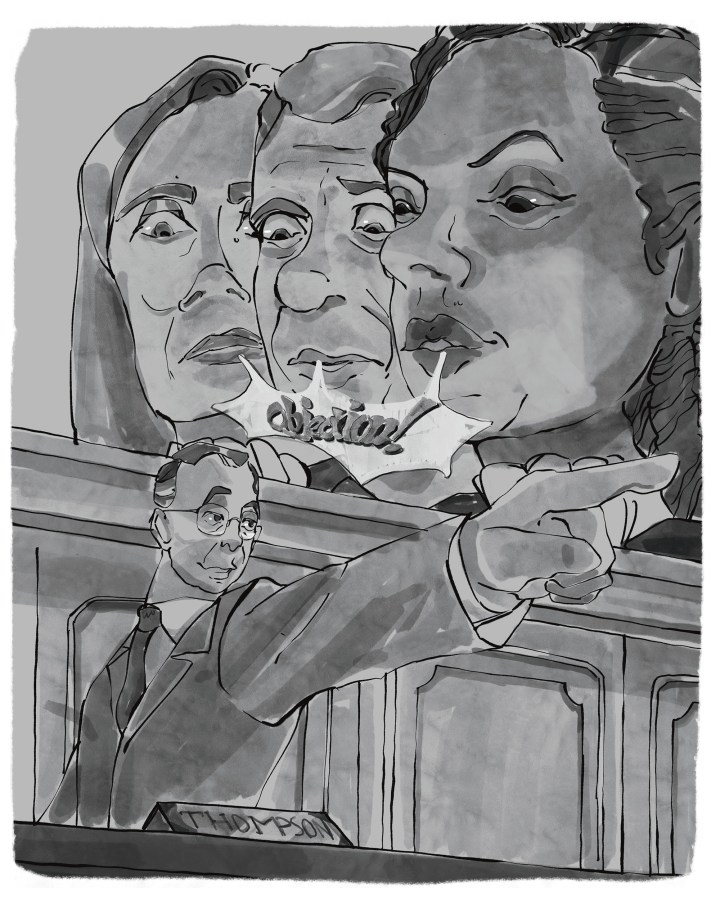
By Joseph Brugellis
Art by Rhea Da Costa, Resident ArtistRead this article and more in our 2023 winter edition, on campus now!
When Americans go to the polls to elect their next congressperson, they are often unaware of the critical role that state legislatures play in administering federal elections. The Elections Clause of the United States Constitution gives state legislatures the power to govern how federal elections are conducted (US Const. art. I, §4). It has long been understood that this lawmaking authority is not unlimited; state courts reserve the right to ensure that the federal election laws and procedures approved by the legislature “comply with [the] state constitution” (Herenstein and Wolf 2022). As an example, the Pennsylvania Supreme Court in recent years has held that partisan gerrymandering by the state legislature in the congressional redistricting process violates the state constitution (Chung 2018).
This widely held legal precedent is now under threat. In November 2021, the Republican-led North Carolina General Assembly passed a new congressional redistricting map. Several voting rights activists filed a lawsuit contending that this new map was a partisan gerrymander that violated several provisions of the state constitution. Three judges on the North Carolina Superior Court (a trial court) initially ruled against the activists and declined to block the redistricting map. The state Supreme Court, however, agreed with the voting rights activists, and, on February 4, 2022, directed the Assembly to craft a remedial map to be submitted to the trial court. Simultaneously, the trial court appointed three special masters on February 16 to draw their own proposed redistricting map. One week later, the trial court rejected the congressional map proposed by the Assembly, instead adopting the map drafted by the special masters. The Assembly appealed this decision to the US Supreme Court (“Brief for Petitioners” 2022).
On June 30, 2022, the US Supreme Court agreed to hear arguments in Moore v. Harper (“Order List” 2022), a case which could restrict the ability of state constitutions and courts to place limits on the power of legislatures to alter the federal elections process. The heart of this case concerns whether the Supreme Court should adopt a version of the so-called “independent state legislature” (ISL) doctrine, which asserts that state legislatures retain “broad power to regulate federal elections” (Howe 2022) without being subject to limits imposed by the state constitution and courts.
At stake? Democracy itself—a broad adoption of the ISL doctrine could result in rogue legislatures stripping previously-guaranteed voting rights protections from the state constitution with no ability for state courts to protect these rights
(“Transcript” 2022).The ISL doctrine is of relatively recent vintage, first appearing more than 20 years ago in Chief Justice William Rehnquist’s concurrence in Bush v. Gore (2000) (Herenstein and Wolf 2022). After Al Gore formally contested the certification of Florida’s election results in the 2000 presidential election, the Florida Supreme Court created a novel system for a statewide voter recount. George Bush appealed to the US Supreme Court, which ruled 7-2 that the Florida Supreme Court’s recount scheme violated the 14th Amendment (“Bush v. Gore”). Chief Justice Rehnquist wrote a concurring opinion where he also expressed the view that the Florida Supreme Court’s scheme violated the Presidential Elector Clause because only the “state legislature” can make the rules governing how presidential electors are to be chosen (V. Amar and A. Amar 2022). While advocating for the general supremacy of the legislature to govern how the electoral process operates, Chief Justice Rehnquist crucially “acknowledge[d] that state courts” play a key role in ensuring that state legislative action comports with the state constitution (“Transcript” 2022).
Proponents of the ISL doctrine claim that their position is supported by the Constitution (Brief for Petitioners 2022). The text of the Elections Clause states that “The Times, Places and Manner of holding Elections for Senators and Representatives, shall be prescribed in each State by the Legislature thereof…” (US Const. art. I, §4). The Constitution also contains the Presidential Elector Clause, which provides that the state legislature be given the power to appoint electors during a presidential election (US Const. art. II, §1). The ISL doctrine asserts that the Constitution’s usage of the term ‘legislature’—the state organ tasked with making and amending laws—rather than “the State as a whole” implies that other state entities (e.g. state courts) cannot interfere substantively in the legislature’s election law endeavors (“Brief for Petitioners” 2022). Unlike the version of the ISL doctrine embraced in the Rehnquist concurrence, the petitioners in Moore v. Harper go further and argue that state courts have no power to place substantive limits upon what the legislature may do (“Transcript” 2022).
Those opposed to the adoption of the ISL doctrine note how centuries of historical practice demonstrate that state legislatures could not ignore the state constitution when passing laws governing federal elections. Immediately after the Constitution was ratified in 1787, many states amended their respective constitutions to enact rules regarding federal election procedures. Delaware’s 1792 constitution, for example, contained a provision requiring that federal elections be conducted “‘by ballot’ rather than voice vote” (“Brief of Amici Curiae” 2022). By 1802, states like Vermont, Tennessee, and Ohio all had constitutional provisions mandating that federal elections be free and open to all (“Brief of Amici Curiae” 2022). As the 19th century progressed, state constitutions began to be more explicit in regulating the administration of federal elections. The constitutions of Indiana, Missouri, Mississippi, and Michigan, for example, set out a specific time for federal elections to be conducted (“Brief of Amici Curiae” 2022). According to those opposed to the adoption of the ISL doctrine, if such a theory was one grounded in historical practice, then all of these state constitutional provisions would have been ruled as violations of the Elections Clause. They were not.
Prior Supreme Court precedent also casts doubt on the notion that state legislatures retain unqualified control over the federal elections process. In Davis v. Hildebrant (1916), decided more than a century ago, the Supreme Court ruled that the Elections Clause did not prevent voters from rejecting a congressional redistricting map in a referendum “authorized by the state constitution” (“Brief by State Respondents” 2022). Sixteen years later, in Smiley v. Holm (1932), the Supreme Court ruled that the Elections Clause did not prevent a state governor from vetoing a legislature’s preferred course of action concerning federal elections (“Brief for Respondents” 2022). And in 2019, the majority opinion in Rucho v. Common Cause explicitly stated that “[p]rovisions in… state constitutions can provide standards” that limit how a legislature can act in the redistricting process (“Rucho v. Common Cause”). All three precedents call into question the validity of the claim that state legislatures retain absolute control over the administration of the federal
elections process.This simmering dispute came to a head when advocates forcefully argued their positions for nearly three hours in front of the Supreme Court on December 7, 2022. Attorney David H. Thompson represented North Carolina’s Republican state legislators (Howe 2022). Thompson argued that states lack the ability to place substantive limitations on their legislature’s ability to regulate the time, place, and manner of federal elections and therefore the North Carolina Supreme Court should not have struck down the newly crafted congressional map as being a partisan gerrymander violative of the state constitution (Liptak 2022).
Several justices from across the ideological spectrum appeared deeply skeptical of adopting this far-reaching argument. Chief Justice John Roberts questioned whether Thompson’s argument can be squared with prior precedents like Smiley v. Holm (1932) (“Transcript” 2022). Justice Ketanji Brown Jackson pointed out that while the US Constitution identifies the legislature as the appropriate body to regulate federal elections, it is the state constitution that confers lawmaking authority to the legislature and thus makes it subject to constitutional restrictions and state judicial review:
“What I don’t understand [Mr. Thompson] is how you can cut the state constitution out of the equation when it is giving the state legislature the authority to exercise legislative power… why suddenly in this context [of the Elections Clause] do you say all those other constitutional provisions that bind or constrict legislative authority… evaporate in this world?”
(“Transcript” 2022)Justice Amy Coney Barrett remained skeptical of Thompson’s distinction between impermissible restrictions that limit the ability of the state legislature to actually enact its desired election laws and permissible limits that merely set out a process for the legislature to obtain its desired election regulations. According to Mr. Thompson’s proposed legal test, a hypothetical provision in a state constitution that empowers the governor to veto an election law passed by the legislature would be permissible because such a provision merely sets up a proverbial “hoop that [the state legislature] has to… jump[] through” in order to enact the desired election law (“Transcript” 2022). Suppose that the state constitution, however, contained a provision that patently barred the state legislature from engaging in partisan gerrymandering. This would not be permissible because the provision imposes constraints on the actual elections-related substance that the state legislature wishes to enact into law. Drawing on her prior experience “[a]s a former civil procedure teacher,” Justice Barrett told Mr. Thompson that “it [would be] a hard line to draw” between what restrictions are permissible or impermissible under his theory
(“Transcript” 2022).While remaining skeptical of Thompson’s more far-reaching arguments, Justice Brett Kavanaugh floated a compromise position that would give great deference to interpretation by state courts while allowing federal courts to intervene only when state courts egregiously misinterpret the law (Howe 2022).
Neal Katyal and Donald Verrilli, former solicitor generals under the Obama administration, joined the current Solicitor General of the United States, Elizabeth Prelogar, in representing the private respondents, North Carolina state officials, and the United States federal government in front of the Supreme Court. They forcefully asserted that adopting Thompson’s argument would buck more than two centuries of history and that “the blast radius” created from the adoption of the ISL doctrine would “sow elections chaos” (Liptak 2022). Solicitor General Prelogar noted that Thompson’s theory would give the legislature “free rein” to pass any election law desired without any check on this power by the state constitution or courts (“Transcript” 2022). Justices Clarence Thomas, Samuel Alito, and Neil Gorsuch seemed more receptive to adoption of the ISL doctrine. After Mr. Katyal warned about the potential damage to democracy that could occur if the Court were to adopt a broad version of the ISL doctrine, Justice Alito responded by rhetorically asking whether democracy would be furthered by “transfer[ing]” the power of federal redistricting to “elected [state] supreme court” judges where these judges can publicly “campaign on the issue of districting” (Liptak 2022).
We will likely not know the Supreme Court’s ruling in Moore v. Harper until June 2023. Based on oral argument, it seems likely that the Court will decline to adopt the broad formulation of the ISL doctrine advocated by the Republican state legislators from North Carolina. As Justice Elena Kagan noted, a ruling that embraces much of the ISL doctrine would unleash dramatic consequences (“Transcript” 2022). State courts would be powerless to stop legislatures from engaging in aggressive partisan gerrymandering while voting rights protections in state constitutions would be vulnerable to evisceration (“Transcript” 2022). A narrow ruling that reaffirms the vital role that state courts and state constitutions play in safeguarding our federal election processes would be consistent with both historical practice and prior precedent. Such a ruling would reaffirm the role that checks and balances plays in ensuring that no branch of elected government wields more power than the rest.
Joseph Brugellis is a freshman from New Hyde Park, NY, on Long Island who intends to double-major in history and philosophy, politics, and law. After graduation, Joseph plans to go onto law school and hopes to one day be appointed as a federal judge. Joseph is passionate about the American judicial branch and is deeply interested in how different interpretative philosophies held by judges shape constitutional law. During summer 2022, Joseph worked as an intern in the office of state Senator Anna M. Kaplan. In his free time, Joseph enjoys reading, listening to music, and exploring nature.
References
Amar, Vikram and Akhil Amar. 2021. “Eradicating Bush-League Arguments Root and Branch: The Article II Independent-State-Legislature Notation and Related Rubbish.” The Supreme Court Review, 1–51. www.journals.uchicago.edu/doi/10.1086/720128.
“Brief by State Respondents”. 2022. Supreme Court of the United States. www.supremecourt.gov/DocketPDF/21/21-1271/243478/20221019152815715_21-1271%20Moore%20v.%20Harper%20-%20State%20Respondents%20Brief.pdf.
“Brief for Petitioners.” 2022. Supreme Court of the United States. www.supremecourt.gov/DocketPDF/21/21-1271/236562/20220829124545799_21-1271%20Brief%20for%20Petitioners.pdf.
“Brief of Amici Curiae Scholars of State Constitutional Law.” 2022. Supreme Court of the United States. www.supremecourt.gov/DocketPDF/21/21-1271/244053/20221026154758809_Moore%20Harper%20Amicus%20Brief.pdf.
“Bush v. Gore.” Oyez. www.oyez.org/cases/2000/00-949.
Chung, Andrew. 2018. “Supreme Court turns away Pennsylvania electoral map dispute.” Reuters, October 29. www.reuters.com/article/us-usa-court-gerrymandering/supreme-court-turns-away-pennsylvania-electoral-map-dispute-idUSKCN1N31PC.
Herenstein, Ethan and Thomas Wolf. 2022. “The ‘independent state legislature theory,’ explained.” Brennan Center for Justice, June 6. www.brennancenter.org/our-work/research-reports/independent-state-legislature-theory-explained.
Howe, Amy. 2022. “Court seems unwilling to embrace broad version of ‘independent state legislature’ theory.” SCOTUSblog, December 7. www.scotusblog.com/2022/12/court-seems-unwilling-to-embrace-broad-version-of-independent-state-legislature-theory/.
Liptak, Adam. 2022. “Supreme Court Seems Split Over Case That Could Transform Federal Elections.” The New York Times, December 7. www.nytimes.com/2022/12/07/us/supreme-court-federal-elections.html.
“Order List: 6/30/22.” 2022. Supreme Court of the United States. www.supremecourt.gov/orders/courtorders/063022zor_5he6.pdf.
“Rucho v. Common Cause.” FindLaw Cases and Codes. caselaw.findlaw.com/us-supreme-court/18-422.html.
“Transcript of Oral Argument in ‘Moore v. Harper,’” 2022. Supreme Court of the United States. www.supremecourt.gov/oral_arguments/argument_transcripts/2022/21-1271_5i26.pdf.
-
How Chinese President Xi’s Reelection May Impact Taiwan and the US

Xi Jinping holds the three highest positions in the Chinese Communist Party, wielding more power than any of his predecessors, and he might be here to say.
By Geonha Lim
Art by Rhea Da Costa, Resident ArtistRead this article and more in our 2023 winter edition, on campus now!
Chinese President Xi Jinping’s reelection last October, which gave him another five years to his already ten-year long presidency and ultimate control over the government, is raising concerns for the ongoing China-Taiwan and China-US relations. Though certain experts worry that China will adopt more transgressive diplomatic policies, others argue that Xi’s reelection is not as concerning as people think.
China has a unique political power structure with which some American readers may be unfamiliar. It traditionally does not operate on one-leader totalitarianism (as many people assume) but rather operates as a one-party autocracy. The Chinese Communist Party (CCP) is the supreme authority of the People’s Republic of China and controls almost all branches of government. The party and the state are ultimately tied together, and differentiation is nearly impossible. The top branches of the Chinese government consist of the National People’s Congress (the legislative branch), State Council (the executive branch), Supreme People’s Court (the judicial branch), National Supervisory Commission (law enforcement, anti-corruption agency), and the Supreme People’s Procuratorate (the prosecution). Within the Chinese Communist Party are the General Secretary, Politburo Standing Committee, Politburo, Central Committee, and the National Party Congress (Maizland 2022).
Conventionally, the supreme authority of the Chinese government has been shared by three positions: the General Secretary of the Communist Party, the President, and the Chairman of the Central Military Commission. Even during the era of Mao Zedong, China’s national hero and first president, the three top positions were not held by one leader at the same time. From 1982 until Xi changed the constitution in 2018, presidency in China was limited to two five-year terms. However, through his reelection, Xi Jinping has consolidated his power by taking all three leadership roles, removing the two-term presidential limit, filling members of almost all government and party roles with his supporters, and ending traditionally sectarian characteristics of the Chinese Communist Party. Therefore, he has gained practically absolute decision-making powers.
China and Xi have continuously tried to expand their influence in the Asia-Pacific region through One-China Policy and the Belt and Road Initiative, which has caused inevitable clashes with Taiwan and the US. Xi’s goal is to progress China into a fully developed country by 2049 with the great power status it used to have, which includes reunification with Taiwan. Xi’s ambitions have challenged both American and Chinese authorities, as well as military analysts, who are concerned that with Putin’s transgression in Ukraine, China might accelerate its plan to take Taiwan by force. Since October 2021, the Chinese military has operated occasional incursions by sending warplanes to fly near Taiwan and concentrating land forces near the Taiwan Strait. Experts warn that the clock is ticking for Chinese reunification with Taiwan, and military invasion is inevitable and imminent (Lo 2022).
A primary concern of American and Western political and military analysts before Xi’s reelection was that after the election, Xi would no longer have domestic concerns about power consolidation and use his entire force on foreign policy. It is true that in China today, Xi has no political opponent to inhibit his ambitions. However, Xi and the CCP face severe internal and external struggles. In 2020, Avery Goldstein, a political scientist at the University of Pennsylvania, analyzed that China has gained worldwide hostility in its rapid and self-interested approach and has created hurdles to continuing its deep economic engagement with the world’s biggest economies. In response to Chinese transgressions, Western countries now hesitate to depend on or deepen their economic ties with China, which has isolated China. Thus, unless China adjusts to the challenge with reforms, it will struggle to achieve further growth and may face an economic decline (Goldstein 2020). In 2022, Goldstein’s analysis has somewhat come true. Recently, China has faced unprecedented protests against the zero-Covid policy. Also, the Chinese economy has faced severe struggles in exports and investment. The interest rate lift-off of the US Federal Reserve has further hindered the power of the Chinese Yuan and the real estate market (Wong 2022). Regardless of Xi’s ambition to reunite with Taiwan, China may have to deal with its struggles before seeking outward expansion. Conversely, Xi and the CCP may accelerate their invasion plan to divert internal struggles to external war and legitimate state security.
After his reelection, Xi met President Biden last November at the G20 gathering in Bali, Indonesia. Though the meeting did not drive any mutual agreements or consensus, it provided room for conversation and symbolized that leaders of two rival states were not entirely closed to negotiation. During the meeting, the leaders discussed three significant issues: Taiwan, Ukraine, and North Korea. In the matter of Taiwan, the US readout noted that the US was against any aggressive actions toward Taiwan, while the Chinese readout emphasized that Taiwan was China’s core interest and the first red line that should not be crossed (Sacks 2022). In regard to Ukraine, China said that it was concerned about the war and did not want any nuclear conflict to occur, while the US declared it wanted peace in Ukraine. Turning to North Korea, the US hoped China would put leverage and stop North Korea’s nuclear transgressions, but China did not reply on that issue. Though the meeting did not engender fruitful outcomes, it implied that both states left room for future negotiations (Sacks 2022).
Xi Jinping’s reelection has not provoked immediate worrisome consequences. Though political and military analysts believed that domestic stabilization through reelection would motivate Xi to seek more aggressive foreign policies, Xi has faced severe domestic issues such as economic decline and nationwide protests against the zero-Covid policy. While Xi’s moves following his reelection have been relatively peaceful, such as the Biden-Xi meeting at the G20 Summit, Chinese military operations near the China-Taiwan border have continuously intensified. War clouds hanging over the Taiwan Strait, Xi’s next moves are the center of attention.

Geonha Lim is a sophomore from South Korea, majoring in political science and business administration with a minor in genocide and mass atrocity prevention. Interested in global humanitarian issues, he wishes to extend his high school model UN experience and be a real UN diplomat one day. In addition to writing for Happy Medium, Geonha is a participant in Binghamton University’s PwC Scholars Program and the American Parliamentary Debate Association. Geonha is interested in foreign affairs and likes to read and talk with his friends in his free time.
References
Goldstein, Avery. 2020. “China’s Grand Strategy under Xi Jinping: Reassurance, Reform, and Resistance.” International Security, 45 (1): 164–201. doi.org/10.1162/isec_a_00383.
Lo, Catherine. 2020. “‘Taiwan Flashpoint In the Indo-Pacific Region:’ Russian Lessons for Xi Jinping?” Atlantisch Perspectief 2, 32-37.
Maizland, Lindsay. 2022. “The Chinese Communist Party.” Council on Foreign Relations, October 6. www.cfr.org/backgrounder/chinese-communist-party?gclid=Cj0KCQiAtbqdBhDv.
Sacks, David. 2022. “What the Biden-Xi Meeting Means for U.S.-China Relations.” Council on Foreign Relations, November 15. www.cfr.org/blog/what-biden-xi-meeting-means-us-china-relations.
Wong, Kandy. 2022. “US Interest Rates Pledge Spells ‘Bad News’ China.” South China Morning Post, August 29. www.scmp.com/economy/china-economy/article/3190420/us-federal-reserves-interest-rates-pledge-leaves-china-less.
-
Trinidad & Tobago’s Politics are Marked by a Racial and Cultural Divide—Here’s Why

By Rachael Ali, Head Writer for Foreign Affairs
Art by Rhea Da Costa, Resident ArtistRead this article and more in our 2023 winter edition, on campus now!
Trinidad and Tobago is a dual-island Caribbean nation located just seven miles off the coast of Venezuela. The mainland of Trinidad is just 1,850 square miles—roughly the size of Delaware—and the two islands have a combined population of 1,368,000 people who come from a variety of backgrounds. The two main ethnic groups are from African and Indian descent. Afro-Trinidadians and Indo-Trinidadians, as the groups are called, make up 34% and 35% of the population respectively—the latter being my heritage. But how did these two ethnic groups end up in Trinidad & Tobago? What created such a deep divide between them? And how has that influenced Trinidadian politics today?
Christopher Columbus arrived on the shores of Trinidad on his third voyage to the Western hemisphere, and the Spaniards controlled the island from 1498 to 1797, at which point the British took over. Like many other Caribbean islands, Trinidad’s primary agricultural crop is sugarcane. Throughout Spanish and British colonial rule, African slavery was used to cultivate sugarcane until 1838, when England abolished the practice in all of its colonies (Julien 2006). This ruling ended 300 years of cruel and inhumane treatment of enslaved people: familial separation, degradation, torture, and extreme exhaustion from working sixteen to eighteen hours a day (Moore 1995). However, there was still a high global demand for sugar, so the British turned their attention towards India. Thus, the system of Indian indentured servitude began. This influx in immigration from India made Trinidad & Tobago’s racial demographics distinct from other Caribbean islands today.
Indians first arrived in Trinidad & Tobago in 1845 (Khan 2007), and the practice of indentured servitude continued until 1917 (Moore 1995). During this 72-year period, roughly 400,000 Indians voyaged to and set up permanent residence in Caribbean nations (Roopnarine 2011). About a third of these Indians were sent to Trinidad (Khan 2007). However, many Indians claimed that they had agreed to voyage to the islands “under false pretense” (Khan 2007), unaware of the harsh conditions that they would endure while working on plantations.
African slaves and Indian indentured servants faced similar challenges. For example, strict laws enacted by the white planter class dictated that indentured laborers were unable to travel over two miles past the plantation where they lived and worked (Roopnarine 2011). In fact, the population of Indian indentured laborers had a higher death rate compared to all other ethnic groups in the country (Roopnarine 2011).
To reiterate, Africans and Indians arrived in Trinidad & Tobago under colonial rule at the beck and call of the white planter class. Why, then, is there so much racial division in Trinidadian politics today? The answer to this question has religious, societal, and colonial implications.
Firstly, Africans and Indians differed in their religious and spiritual beliefs. The majority of Indians brought their Hindu and Muslim faiths to Trinidad, while many Africans maintained the spiritual traditions stemming from their motherland, such as voodoo and obeah (Wright Muir 2020). When Indians arrived to Trinidad, the majority of Afro-Trinidadians had converted to Christianity, while a minority continues to practice voodoo and obeah to this day. However, Indians largely resisted Christianity until the arrival of Reverend John Morton and his Presbyterian missionaries in 1868; and, even then, they remained apprehensive of Westernization (Moore 1995). This is one of the reasons why Indians were faced with xenophobia upon their arrival, as they were foreign and considered to be “exotic” in this pre-formed, Afro-European society (Khan 2007).
Indian societal and cultural norms were another factor that created a rift between Afro and Indo-Trinidadians. Indians came to Trinidad with the caste system mentality, which forbade them from mingling outside of their class and race. Additionally, as Indians were reluctant to conform, they tended to stay in the rural areas and keep to themselves (Roopnarine 2011). Many Indo-Trinidadians opposed race-mixing because it was viewed as “a drain from the size of the Indian community” (Stoddard and Cornwell 1999), rather than a contribution to a larger culture.
One last source of racial tension was the colonial government which inhibited racial intermingling, thus preventing cultural integration. For example, from 1845 to 1917, government officials hired many indigenous peoples and Afro-Trinidadians in order to recapture Indian indentured servants who had fled their plantations. White people in positions of power also divided people of color through the perpetuation of harmful stereotypes. One infamous perpetrator of these stereotypes was the previously mentioned Reverand John Morton, the leader of Presbyterian missionaries dedicated to converting Indo-Trinidadians. Morton made it common knowledge in Trinidadian society that Indians were lazy drunkards (Khan 2007), brainwashed by “‘dark idolatry’” and a “‘Mohammedan delusion’” (Moore 1995). Similarly, Morton stated that Afro-Trinidadians were poor, ignorant heathens who beg and steal to survive (Moore 1995). Ultimately, these constant lies and degradation took a psychological toll on the lower classes of African and Indian descent, as these two majority groups began to tear each other down in a desperate attempt to join whites at the top.
So how does all of this history come into play today?
Trinidad & Tobago was emancipated from England in 1962, and the 1960s saw the rise of the People’s National Movement (PNM) which was supported mainly by the Afro-Trinidadian community (Nakhid, Barrow, and Broomes 2016). With the election of Eric Williams (PNM) as Prime Minister in 1966, white officials were ousted from their highly powerful positions in the legislature and the school system. However, a worthy adversary arose to oppose the PNM; the Democratic Labour Party, supported primarily by Indo-Trinidadians, known today as the United National Congress (UNC).
Trinidad & Tobago has been under PNM leadership since 2015 with the election of Dr. Keith Rowley as Prime Minister. Prior to his election, the UNC was in power with Prime Minister Kamla Persaud-Bissessar serving from 2010 to 2015. Bissessar was the first woman to hold this position, and made global history as the first person of Indian origin to be elected prime minister of a country outside of India and South Asia. She was also named Time Magazine’s 13th most influential female leader in 2019. One highlight from her administration is the completion of Couva Hospital in 2015, which is currently being used to treat Covid-19 patients as well as conduct research regarding post-Covid treatments by students at the University of West Indies in Trinidad.
Despite this success, many Trinidadians are upset with the state of Couva Hospital, which was originally intended to be a children’s hospital with facilities for adults. It was supposed to be a fully functioning hospital with a burns care unit and a pharmacy, but it is not being used to its full potential or capacity. This is largely due to the subsequent Rowley administration, which has stated that the government was unable to provide sufficient funding and staff for the institution. However, many Trinidadian citizens and politicians are in disbelief, as “there have been calls to have the hospital functioning and to forget the politics” (Wayow 2016). This hospital could serve Trinidadians of all races and political affiliations and has strong grassroots support, but the Rowley administration’s course of action has caused even further division and animosity.
Despite negative public response over the hospital, Rowley’s administration has coped well with the Covid-19 pandemic, with 51.3% of the total Trinidadian population fully vaccinated.
Despite this success, a large reason behind the delayed opening of the Couva Hospital and why Trinidad’s political parties are racially divided is because the country is ethnically segregated. In other words, there are “black” areas and “Indian” areas, much like how regions in the US are predominantly white and others are mostly populated by people of color or immigrants due to historical practices like redlining. Indo-Trinidadians are typically found in the South of Trinidad while Afro-Trinidadians reside in the North of the island. This has led to certain issues in particular areas being ignored by whichever administration is elected. In December 2022, I stayed with my family in the South of Trinidad for over two weeks, and it was not hard to notice that their roads are littered with dangerous potholes and far too narrow to qualify as two-way streets (but are functioning as such). Indo-Trinidadians, like the cousins who I stayed with, have been imploring the government to fix this faulty infrastructure, but because this issue is in the South, these inquiries have gone ignored by the PNM for eight years.
All in all, present racial tensions in the Trinidadian government can be traced to British colonialism, as the white upper class took advantage of differences between Africans and Indians and used these differences to turn these two groups against each other. These harmful, colonial-era stereotypes have unfortunately persisted to this day and made their way to the top of the Trinidadian government, resulting in the suffering of the entire Trinidadian population, regardless of race.

Rachael Ali is a third-year undergraduate student at BU, currently serving as Happy Medium’s Head Writer for Foreign Affairs. She is originally from the Bronx and is majoring in political science with a double-minor in Spanish and French. Rachael’s goal is to attend law school and become an international lawyer. This past summer, Rachael was an intern political journalist at Happy Medium. Topics that Rachael is passionate about include immigration, reproductive rights, indigenous communities, gun laws, and environmental justice.
References
Chan Tack, Clint. 2022. “Rowley: Don’t let guard down on covid19.” Trinidad and Tobago Newsday, December 31. newsday.co.tt/2022/12/31/rowley-dont-let-guard-down-on-covid19/.
“COUVA Children’s Hospital.” 2013. United National Congress, June 1. unctt.org/couva-childrens-hospital/.
“COVID-19 Weekly Update – Tuesday January 03, 2023.” 2023. Ministry of Public Health, Goverment of the Republic of Trinidad and Tobago, January 3. health.gov.tt/covid-19-weekly-update-tuesday-january-03-2023.
Description of “Institute of Commonwealth Studies, Trinidad and Tobago: Political Parties Material.” Institute of Commonwealth Studies Library, University of London. archiveshub.jisc.ac.uk/search/archives/0ce6807a-817d-324c-b976-fd0226b437b2.
“The Honourable Dr. Keith Rowley.” Ministry of Foreign and CARICOM Affairs. foreign.gov.tt/about/honourable-dr-keith-rowley/.
Julien, Lisa-Anne. 2006. “The Life and Times of King Sugar.” New African, May: 62–63.
“Kamla Persad-Bissessar.” Archives of Women’s Political Communication, Iowa State University. awpc.cattcenter.iastate.edu/directory/kamla-persad-bissessar/.
“Kamla Persad-Bissessar: Prime Minister of Trinidad and Tobago (2010-2015).” Council of Women World Leaders. www.councilwomenworldleaders.org/kamla-persad-bissessar.html.
Khan, Aisha. 2007. “Mixing Matters: Callaloo Nation Revisited.” Callaloo, 30(1): 51–67. doi:10.1353/cal.2007.0145.
Khan, Rishard. 2022a. “Doctors—Plans to remove Couva hospital as main COVID facility.” Trinidad and Tobago Guardian, October 17. www.guardian.co.tt/news/doctors-plans-to-remove-couva-hospital-as-main-covid-facility-6.2.1559009.37f18370d0.
Khan, Rishard. 2022b. “Couva hospital to be used for UWI research post-COVID treatment.” Trinidad and Tobago Guardian, October 27. guardian.co.tt/news/couva-hospital-to-be-used-for-uwi-research-postcovid-treatment-6.2.1563121.482b9677f7.
Moore, Dennison. 1995. Origins & Development of Racial Ideology in Trinidad: the Black View of the East Indian. Orleans, Ontario: NYCAN International Inc.
Nakhid, Camille, Dorian Barrow and Orlena Broomes. 2016. “Situating the Education of African Trinidadians within the Social and Historical Context of Trinidad and Tobago: Implications for Social Justice.” Education, Citizenship and Social Justice, 9(2): 171–187. doi.org/10.1177/1746197914534817.
“People of Trinidad and Tobago.” Encyclopaedia Britannica. www.britannica.com/place/Trinidad-and-Tobago/People.
Robinson, A., Napoleon Raymond, David Watts, and Bridget M. Brereton. 2023. “Trinidad and Tobago.” Encyclopaedia Britannica, January 1. www.britannica.com/place/Trinidad-and-Tobago.
Roopnarine, Lomarsh. 2011. “Indian Migration during Indentured Servitude in British Guiana and Trinidad, 1850–1920.” Labor History, 52(2): 173–191, doi:10.1080/0023656x.2011.571473.
“Size of States.” State Symbols USA. statesymbolsusa.org/symbol-official-item/national-us/uncategorized/states-size.
Stoddard, Eve, and Grant H. Cornwell. 1999. “Cosmopolitan or Mongrel? Créolité, Hybridity and ‘Douglarisation’ in Trinidad.” European Journal of Cultural Studies, 2(3): 331–353. doi:10.1177/136754949900200303.
Wayow, Sue-Ann. 2016. “Will the Couva Childrens Hospital ever open.” Daily Express, One Caribbean Media, April 11. trinidadexpress.com/news/local/will-the-couva-childrens-hospital-ever-open/article_e079281e-830e-5da3-89a3-c57258d612ef.html.
Wright Muir, Ghenete. 2020. “Reclaiming the Caribbean’s Old Religions: Vodou, Santeria and Obeah.” Island Origins: The Caribbean American Lifestyle Magazine, July 26. islandoriginsmag.com/reclaiming-the-caribbeans-old-religions-vodou-santeria-and-obeah/.
-
Subscribe
Subscribed
Already have a WordPress.com account? Log in now.
 Happy Medium
You must be logged in to post a comment.